 Vista
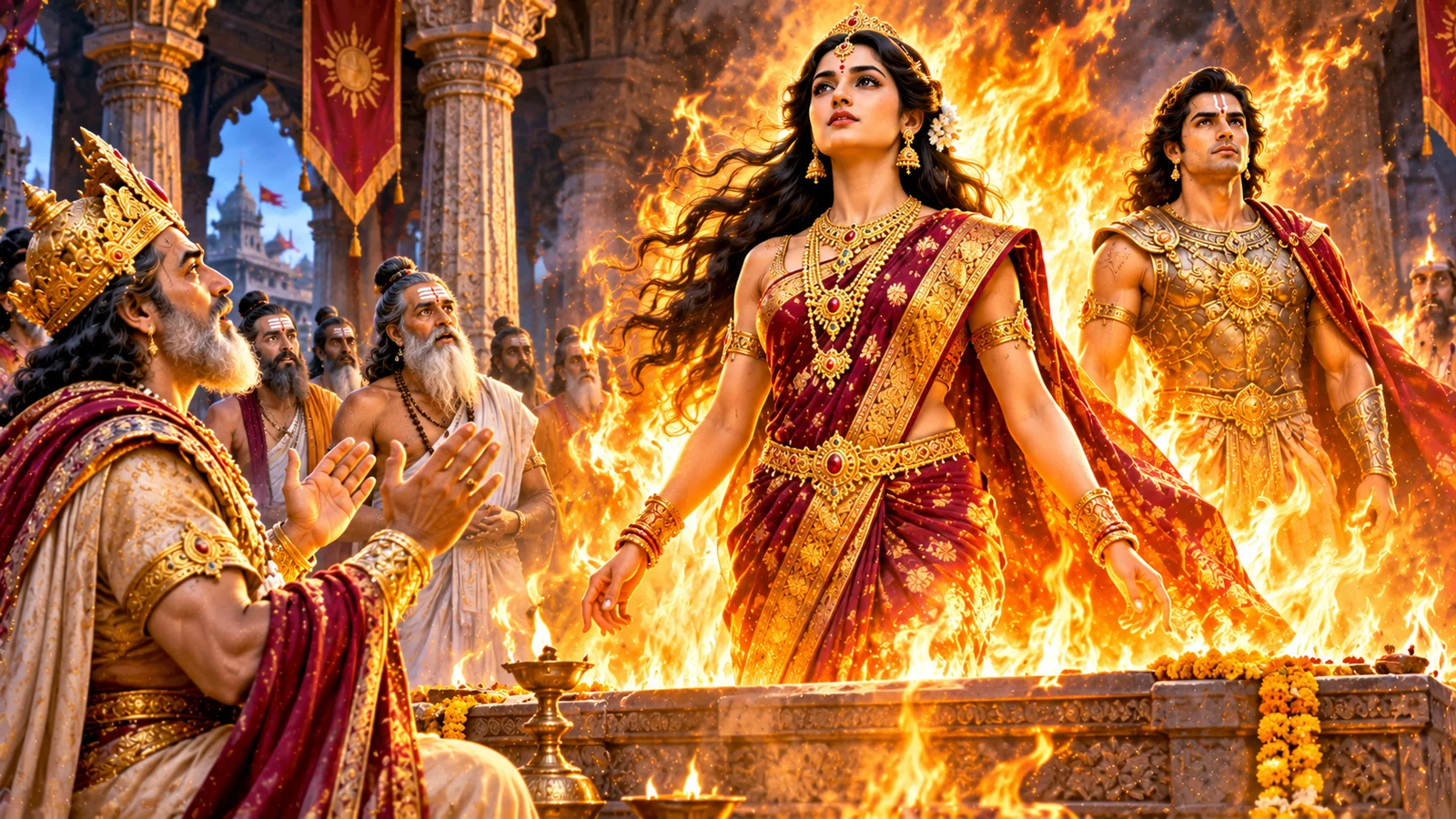
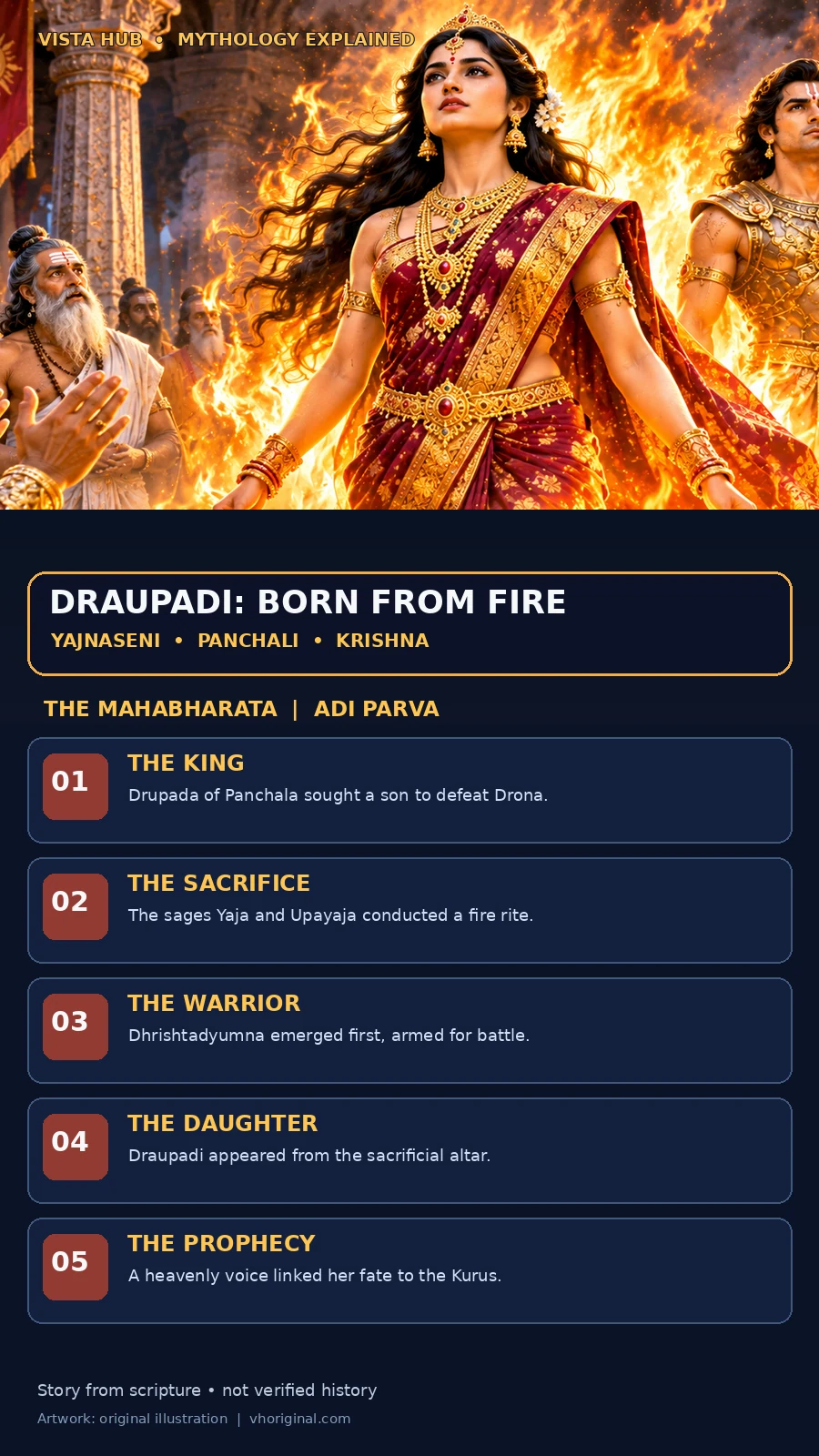
Quick answer: According to the Mahabharata’s Adi Parva, Draupadi appears from the sacrificial altar during a fire ritual arranged by King Drupada of Panchala. The king had sought a son capable of defeating Drona, his former friend and powerful rival. The rite produces Dhrishtadyumna, the warrior destined to confront Drona, and then Draupadi, the princess also known as Krishna, Panchali and Yajnaseni. The text presents this as an extraordinary epic birth, not as a scientifically documented event. More importantly, Draupadi does not remain a magical child in the background. Her later choices, questions and suffering become central to the Mahabharata’s debate about power, dignity, duty and justice. To understand why Draupadi was born from fire, we have to begin with the painful conflict between her father and Drona rather than jump directly to her marriage with the Pandavas.
What Is the Story of Draupadi’s Birth from Fire?
The famous image is unforgettable: a sacred fire burns on the altar, priests complete a ritual, and a remarkable princess emerges in the presence of the Panchala court. In the Adi Parva, the fire-born prince Dhrishtadyumna appears first; Draupadi is then described as arising from the centre of the sacrificial platform. The narrative is reported to the Pandavas by a Brahmana, making it part of the epic’s layered storytelling. The tradition calls Draupadi Yajnaseni, a name associated with her father Yajnasena or Drupada, and her birth story reinforces the connection with the yajna.
The scene should not be confused with the later public assembly in which Draupadi chooses a husband, or with the dice-hall humiliation that transforms the direction of the epic. Those are different episodes. The birth establishes a dramatic set of expectations, but the later woman is far more complex than a prediction announced at her arrival. The epic does not suggest that any contemporary visitor can identify a surviving fire altar or reproduce the event scientifically. It is a sacred and literary narrative with a clear place in Hindu tradition.
Why Did King Drupada Arrange the Sacrifice?
Drupada ruled Panchala and had once known Drona closely. Their relationship deteriorated after a dispute over an earlier promise of friendship and the privileges of kingship. Drona later became a teacher of the Kuru princes. At his request, Arjuna and the other pupils confronted Drupada, who suffered defeat and humiliation. It is easy to see why the king resented this reversal: a childhood bond had become a public conflict involving status, land and military power.
The Adi Parva describes Drupada searching for a way to overcome Drona, whose military learning and weapons he regarded as formidable. Rather than imagine that another ordinary battle would necessarily succeed, he looked for accomplished priests who could perform a specific rite to obtain a child capable of defeating his opponent. The story does not begin with Draupadi as a tool for an existing marriage alliance. Its immediate stated purpose is Drupada’s desire for a son who could kill Drona. That distinction is important because many quick summaries claim that the king performed the sacrifice simply “to get Draupadi.”
Drupada’s wish also supplies a warning about revenge. The epic places future children inside a feud they did not initiate. Even if a reader interprets the birth symbolically, the moral tension remains: what happens when a parent’s political resentment becomes the imagined destiny of the next generation? The Mahabharata rarely gives comfortable answers about the costs of such decisions.
Who Were Yaja and Upayaja, the Two Sages?
The king’s search brought him to two brothers, named Yaja and Upayaja in many English translations. He first approached the younger, Upayaja, offering gifts for a rite that might produce the desired son. Upayaja initially refused. He later directed Drupada toward his elder brother Yaja, whom he considered more willing to accept a worldly bargain. The account pays attention to the personalities and ethical choices of the priests, rather than presenting the entire ceremony as a mechanical miracle.
Yaja agreed to conduct the sacrifice, with Upayaja contributing his knowledge and invocations. The name spellings differ across Sanskrit transliterations and English editions, but the two-priest story is recognizable. During the rite the queen was summoned, yet she was not ready to participate at that precise moment. The priest proceeded once the offering had been prepared. Popular retellings sometimes exaggerate the queen’s absence into claims about her lack of any relationship to the children. The narrative is subtler: she later asks that the children recognize her as their mother, and that request is granted.
This detail reminds us that an extraordinary birth story still belongs to a royal family and to a network of responsibilities. It is more accurate to mention the queen as part of the narrative than to erase her completely. It also prevents simplistic assumptions that “fire-born” is a claim about an identifiable biological process.
Dhrishtadyumna and Draupadi: What Emerged from the Yajna?
The first figure to emerge in the account is Dhrishtadyumna. He appears as an extraordinary warrior, already associated with armour and weapons. The voice from the sky announces his role in Drona’s downfall. The Panchalas celebrate because the king’s primary demand seems to have been answered. Yet the account immediately develops in a surprising way: a daughter appears from the sacrificial altar. She is described with dark colouring, distinctive beauty and a fragrance likened to the blue lotus. The text calls her Krishna, the feminine form of a name connected in that setting with dark complexion.
A second heavenly announcement associates Draupadi with events that will gravely affect the Kuru princes and numerous warriors. The reader therefore encounters two connected but distinct destinies: the brother’s connection to Drona, and the sister’s connection to the wider crisis of the Kuru world. Neither character is simply a decorative addition to a supernatural scene. Dhrishtadyumna later becomes a significant military leader in the Kurukshetra War, while Draupadi’s own presence tests the conduct of kings, husbands and elders.
The term “twins” appears in some English translations for the pair produced by the sacrifice, but it does not mean the epic tells an ordinary medical twin-birth story. They emerge in a mythological ritual narrative. Nor should a dramatic modern illustration be labelled a photograph or an archaeological reconstruction of what happened on a verifiable date.
Why Is Draupadi Called Yajnaseni, Panchali and Krishna?
One woman carries several names in the Mahabharata, and each name focuses attention on a different relationship or feature. Draupadi identifies her as the daughter of Drupada. Panchali or Panchālī connects her with Panchala, the kingdom of her father. Krishna or Krishnā, when used for Draupadi, is associated in the epic’s account with her dark complexion. It should not automatically be confused with Krishna, the male deity who is her friend and ally in other episodes.
Yajnaseni is commonly explained as the daughter of Yajnasena, another name used for Drupada. Its sound naturally evokes the yajna to modern readers, and popular accounts sometimes present it simply as “she who was born from a sacrifice.” That is a memorable association, but an article should not erase the patronymic explanation. Calling Draupadi an agnikanya or fire-born woman describes the birth motif. It does not turn her into Agni, the Vedic fire deity, or establish that she was a literal goddess of fire in every version of the epic.
Names also matter for reading translations. A passage mentioning Krishna with feminine grammar may be about Draupadi; a passage about the charioteer or divine counsellor may refer to Krishna of Dwaraka. Look at the immediate context rather than relying on a search snippet.
What Did the Prophecy About Draupadi Mean?
The declaration following Draupadi’s emergence foreshadows severe danger to the Kauravas and the death of many warriors. Readers familiar with the Kurukshetra War will naturally connect this with the humiliation of Draupadi in the dice hall, the failures of powerful men to protect her dignity, and the conflict that followed. But the prophecy does not mean she alone “started” the Mahabharata War. Such a claim removes the responsibility of Duryodhana, Shakuni and other participants while blaming a woman who was subjected to serious injustice.
Long before the battle, the epic shows a network of conflicting decisions: rival claims to the throne, political deceit, exile, disrespect for agreements and escalating hostility. Draupadi’s questions expose failures within that network. Her demand to know whether a husband who had lost himself could still stake her in a game is not a minor emotional detail; it is an argument about lawful power and a person’s status. Whether readers approach the episode through theology, ethics or literary criticism, the question remains challenging.
Prophecy in epic literature is a narrative device as well as a feature of religious belief. It creates anticipation, but it should not be used to erase individual choice or treat every later character as a puppet without accountability. That difference gives Draupadi a moral presence beyond the moment of her extraordinary arrival.
How Does the Fire-Birth Connect to Draupadi’s Swayamvara?
The next great turning point is the assembly at Panchala, often called Draupadi’s swayamvara. Princes and warriors gather for an archery challenge; the disguised Arjuna succeeds in the famous contest in influential versions of the story. Events afterward lead to Draupadi becoming the wife of the five Pandava brothers. The details are discussed differently in translations and later retellings, so it is wise to name a source rather than repeat television dialogue as if it were universal scripture.
It would be misleading to present the swayamvara as a modern system in which every participant had equal freedom and consent under contemporary law. It belonged to the social world imagined by the epic, shaped by royal power and political alliances. At the same time, Draupadi is not silent throughout the Mahabharata. Her speech, resolve and response to humiliation often reveal precisely where the social order fails to live up to its own ideals.
The relation between fire-birth and marriage is therefore not a single straight line from a prophecy to an unavoidable war. A series of human decisions fills the gap. The epic becomes richer when a reader follows those decisions instead of reading only the headline events.
Is Draupadi’s Birth a Myth, Symbol or Historical Fact?
A respectful answer separates three questions. First, what does the text narrate? The Adi Parva describes an extraordinary birth associated with a sacrifice. Second, what can it mean? Readers may interpret the flames as a sign of powerful destiny, a figure for transformation or the unsettling consequences of revenge. Those interpretations can be thoughtful, but they are interpretations and need not be identical across religious communities. Third, what independent historical evidence exists? The epic narrative by itself does not establish that a woman physically emerged from a fire altar at a location and date that can be confirmed by scientific methods.
The word myth in literary study is not a casual insult. It refers to a significant narrative through which people communicate values, identity and ideas about the cosmos. Believing readers may accept the birth as a sacred event; other readers may understand it primarily as religious literature. Clear journalism can acknowledge both perspectives without manufacturing “proof” or mocking devotion.
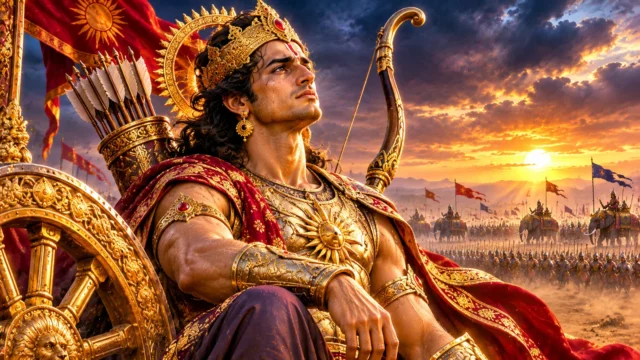
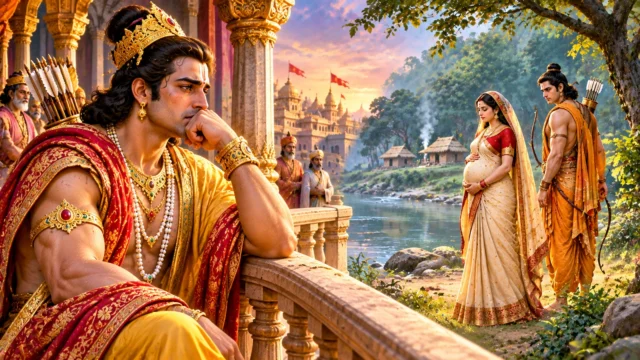
Photorealistic AI artwork should always be identified as an interpretation. It is particularly easy for dramatic images of flames, palaces and ancient clothing to look like documentary reconstructions. Images help readers imagine the story but cannot settle debates about historical chronology or textual variants.
What Makes Draupadi More Than a Tragic Heroine?
Draupadi is frequently remembered through episodes of suffering, especially the dice hall. That focus can hide the confidence, reasoning and political awareness she displays elsewhere. She challenges people who are supposed to know dharma, holds others to their promises and remains a distinctive voice even when circumstances are stacked against her. Her story asks what dignity means when powerful institutions become unwilling to defend it.
Her relationship with her brothers, her husbands, Krishna and the rulers around her cannot be summarized as either constant triumph or constant victimhood. There are emotions of loyalty, grief, anger, affection and complexity. She is neither simply the revenge that Drupada wanted nor a magical device placed into the narrative to trigger war. Different modern authors and performers have also retold the epic from her perspective, but a retelling is a new artistic interpretation and should not be quoted as an original line from Vyasa.
The fire-born title provides a strong opening symbol. The fuller character comes from what she says and does after that opening. Anyone reading the Mahabharata seriously benefits from paying attention to her arguments, not just to the spectacular circumstances of her birth.
Common Misconceptions: Myth vs Text
- “Drupada performed the yajna specifically to create Draupadi.” His stated immediate aim in the Adi Parva is a son able to defeat Drona. Draupadi also appears during the rite.
- “Draupadi alone caused the Kurukshetra War.” The epic includes many political and moral causes. Assigning sole blame to her is an unfair oversimplification.
- “Yajnaseni literally means fire goddess.” It is commonly connected to Yajnasena, another name for Drupada; fire-birth is a related story motif.
- “There is only one version of every detail.” Translations, recensions and local retellings differ, including over sequence and emphasis.
- “AI-generated paintings prove what happened.” Images are contemporary illustrations, not historical evidence.
Frequently Asked Questions
Who was born from the fire in the Mahabharata?
King Drupada’s rite produces Dhrishtadyumna and Draupadi in the Adi Parva account. Dhrishtadyumna emerges as a warrior, while Draupadi appears from the sacrificial platform.
Why was Draupadi born from fire?
Her extraordinary appearance occurs during a sacrifice Drupada commissioned while seeking a son who could confront Drona. The epic presents her birth as part of a larger divine and political destiny.
Is Yajnaseni another name for Draupadi?
Yes. The name is linked with her father Yajnasena, also called Drupada, and is often associated by readers with her sacrificial birth.
What is the name of Draupadi’s brother?
Dhrishtadyumna is the fire-born brother central to this episode. Draupadi also has family connections beyond this single story, including Shikhandi in the epic’s larger narrative.
Who was Draupadi’s father and mother?
Drupada, king of Panchala, is her father in the epic. His queen is present in the account and asks that the children know her as their mother; translations describe her in relation to Prishata, Drupada’s father.
Was Draupadi the main cause of the Mahabharata War?
No single character explains the whole conflict. The epic portrays rivalries, political choices, deception and serious breaches of justice across generations.
Where is Draupadi’s fire-birth story mentioned?
Look in the Adi Parva, especially the passages on Drupada’s sacrifice in Ganguli’s English translation, often numbered Section 169. Chapter numbering differs across editions.
Conclusion: The Meaning of the Fire-Born Princess
Draupadi’s birth from fire is a powerful beginning, but it is not the complete story of Yajnaseni. The ritual answers one king’s desire for revenge, introduces a warrior brother and brings a princess whose life will expose deep contradictions in royal society. Knowing the names, the sequence and the source helps avoid common misinformation. Above all, the Mahabharata gives Draupadi a voice. Her importance comes not only from the flames at her arrival but from the difficult questions she continues to ask long afterward.
Related Reading on Vista Hub
- Karna and the tragic choices in the Mahabharata
- Kurukshetra War: the 18-day timeline and rules
- Ramayana vs Mahabharata: key differences
Sources and Textual Notes
- Mahabharata, Adi Parva, Section 169 (Ganguli English translation)
- Mahabharata, Adi Parva, Section 167 (story framing)
- Cleveland Museum of Art: Razmnama illustration of fire sacrifice for Dhrishtadyumna
Editorial note: Epic narratives are presented as religious literature. AI artwork is illustrative, not a historical photograph. Updated 13 November 2026.


Share Your Opinion
Comments are closed on this post.