A morning mark can become a frightening night-time story
Imagine noticing a blue mark on your arm while changing clothes in the morning. You do not remember hitting anything. Someone suggests a spirit pressed on you during the night, and suddenly every small scratch seems connected. This is an illustrative scene, not a report of an actual incident.
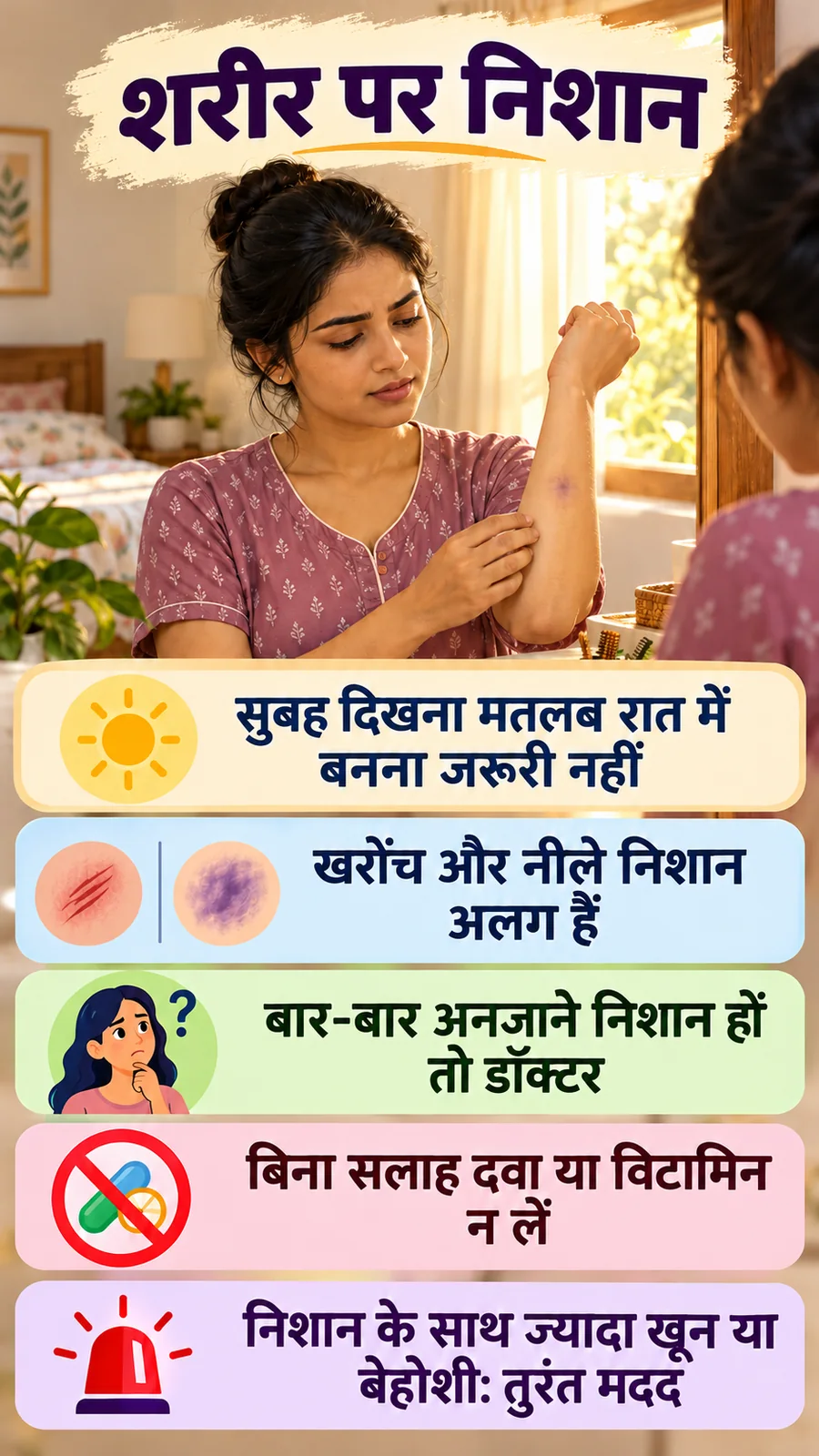
Finding a mark after sleep does not establish that it developed during that night. You may have noticed it for the first time in the morning. The useful questions concern its appearance, recurrence and accompanying symptoms, rather than a rushed supernatural or medical label.
Significant bleeding, black stools, vomiting blood, collapse, confusion or a rapidly spreading purple rash needs urgent assessment. In a serious emergency in India, contact 112 or the nearest emergency department. Do not wait for a ritual explanation.
A bruise is different from a scratch
A bruise can develop when blood from small vessels leaks into surrounding tissue beneath the skin. The surface does not necessarily break. A scratch is a surface injury that may follow rubbing or a fingernail, among other causes. A photograph alone does not establish how either happened.
Colours can change, but they are not a dependable home method for dating an injury precisely. Neither every blue mark nor every red line should be classified from its appearance alone. Other skin changes may look similar and need their own assessment.
A minor knock that you do not remember is one possibility. It should not become a reason to dismiss recurring unexplained marks. Describe what you know and what you do not remember, rather than inventing an accident to make the explanation feel complete.
Itching and skin reactions deserve separate questions
Scratching or rubbing without noticing is possible when itching is present. Clothing, bedding and skin conditions may be relevant. A mark discovered in the morning does not prove that you scratched yourself while asleep.
In dermatographia, light rubbing or scratching can produce raised lines or wheals. That response is different from an ordinary blue bruise. Do not deliberately scratch your skin to perform a home test; a clinician can assess the pattern when needed.
Mention persistent itching, swelling, repeated raised lines or a spreading rash as separate symptoms. The explanation for a surface scratch and the explanation for easy bruising may not be the same. One convenient label should not cover every mark on the body.
FACT: a bruise does not diagnose a vitamin deficiency
Medicines, fragile skin, injuries and some platelet or clotting problems can be relevant to bruising assessment. A mark alone does not establish vitamin C or K deficiency, and taking supplements is not a substitute for finding the cause.
A clinician may ask about when it started, medication, other bleeding and family history; blood tests are sometimes appropriate. Not everyone needs the same test panel. Prepare the history instead of choosing a diagnosis from a search result.
What to do today
Take a well-lit photograph and record the date. A ruler placed nearby may provide scale, without pressing on the skin. Note the number, location and any pain, itching or remembered injury. A photograph documents change; it does not diagnose the cause.
Check ordinary factors such as rough bedding, friction from clothing and itching. Avoid repeatedly rubbing the mark, pressing it to experiment or applying unknown substances that may irritate the skin. An actual cut or injury needs care suited to that problem.
Tell the clinician if you take a prescribed blood thinner, but do not stop it yourself because of a frightening mark. Such medicines may prevent serious illness. Seek advice before adding painkillers, supplements or steroids as your own treatment.
When to arrange an appointment
Seek assessment for recurring marks without a clear injury, increasing number or size, substantial pain, nose or gum bleeding, unusual bleeding elsewhere or a change after starting medicine. Mention fever, tiredness or other symptoms too.
Primary care or a government hospital can be a starting point. Bring your medicines list, relevant health history and photographs. Ask which possibilities need investigation, what a recommended test will answer and when follow-up should happen.
An unexplained mark does not automatically mean a serious disease. Equally, a repeated pattern deserves attention rather than certainty from a family theory. Describe whether it is new, whether it has changed and whether normal activities are affected. Those details help the clinician decide the next step.
Safety matters when another person may have caused an injury
If someone has hurt you or you feel unsafe at home, do not hide that information inside a story about spirits. Ask a trusted person or professional for a private conversation. A child or someone unable to explain an injury needs their concern taken seriously.
An unexplained bruise in a baby who is not independently mobile needs prompt medical assessment. It should not be dismissed as ordinary play or a supernatural mark. Assessment can consider both health and safeguarding without treating either possibility as already proven.
If you bring a family member, ask them to help describe observations rather than answer every question for you. You may also request time to speak alone. The purpose is an accurate account and a safe next step, not forcing a particular explanation.
Advice: investigate the mark without inventing a culprit
A useful family statement is: “There is a mark, and we do not yet know why. Let us give the doctor a clear history.” Accusing a relative of black magic or hurting someone during a ritual does not identify the cause.
Harmless prayer can be a personal source of comfort, but should not postpone medical assessment. Record the actual findings, avoid damaging home experiments and seek help according to the pattern and severity.
At follow-up, explain whether new marks appeared and whether other symptoms changed. Ask what to do if the problem recurs and what would require urgent help. A simple plan is more useful than spending each morning searching for a frightening explanation.
Frequently asked questions
Do scratches after sleep prove a spirit was present?
No. Rubbing, itching and skin problems are among possibilities that may need assessment.
Does a bruise prove vitamin deficiency?
No. A clinician may consider nutrition alongside other causes, but a mark alone cannot establish a deficiency.
Should I stop a blood thinner?
Do not stop prescribed medicine without medical advice. Report new or increasing bruising.
Can colour date an injury?
Colour alone is not a reliable way to determine the exact date at home.
What about an unexplained bruise on a baby?
A baby who is not independently mobile needs prompt assessment for unexplained bruising.
Related reading
A Dark Shadow in Your Room: Sleep, Vision and What to Check
Footsteps or Jingling Sounds on the Roof at Night: What to Check
Why Do Dogs Howl at Night? Sounds, Distress and Ghost Claims
Rotten Egg Smell in the House: Safety First, Then the Cause
Why Do I Wake Up at 3 AM? Sleep Patterns, Fear and Next Steps
Sources and review
Information reviewed: 14 October 2026. The opening scene is illustrative, not a reported case.
NHS practice: Unexplained bruising
NHS Highland: Bruising assessment
NHS: Bruising in non-mobile children
This is general information, not an individual diagnosis or treatment. Seek professional help for severe or persistent symptoms.