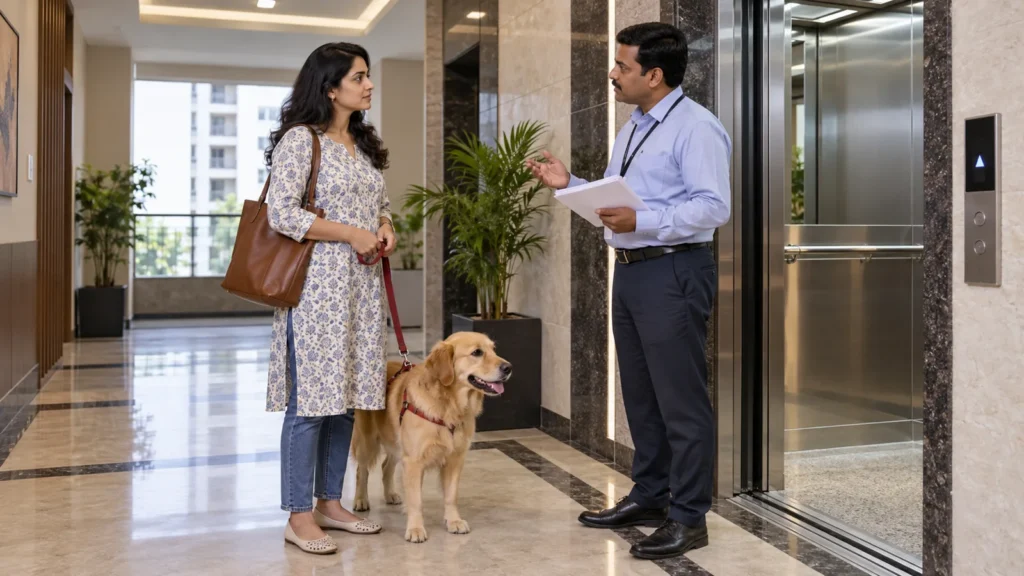
RWA banning your pet dog or imposing a fine: what to do
Your association says you cannot keep a dog, use the lift or enter common areas without paying a fine. Ask for the written rule and legal basis, respond with relevant AWBI guidance and propose safe shared use. Pet ownership has legal protection, while leash control, cleanliness and the safety of neighbours remain your responsibility.
The direct answer: a majority or AGM resolution does not by itself make an arbitrary blanket pet ban lawful. AWBI’s 26 February 2015 guidelines oppose bans on keeping pets, lift exclusion and special lift charges. Applicable municipal law, court orders and the association’s legal status still matter. Every lift disagreement is not automatically a BNS offence, and registration cancellation is not automatic.
- Obtain the notice, fine demand and bye-law/resolution.
- Keep incident dates and evidence of actual exclusion.
- Maintain vaccination and applicable local registration records.
- Send a written objection with a workable safety proposal.
- Choose the registrar, local authority, AWBI or police according to the issue.
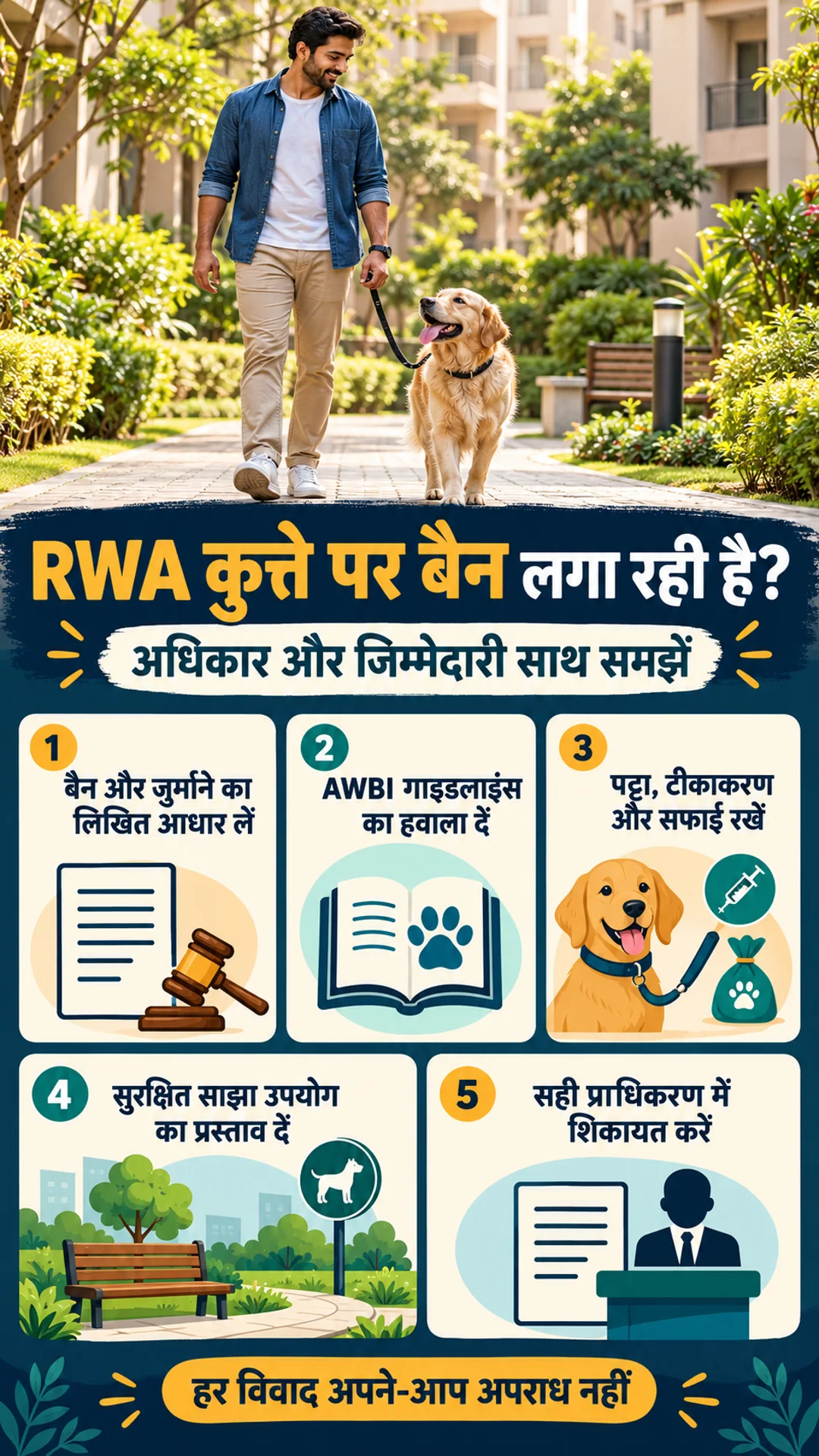
AWBI guidance and court protection: limits on majority decisions
AWBI is a statutory animal-welfare body. Its guidelines reject using consensus or a majority to impose blanket pet-dog bans and arbitrary small-versus-large dog distinctions. General-body voting cannot make a provision contrary to applicable law valid. Refer to the actual document rather than a social-media summary.
A guideline is not the same type of source as an Act of Parliament. Read it with applicable law and judicial directions. In People For Animals (PFA) v. State of Kerala, 2 November 2021, the Kerala High Court held pet-keeping and elevator/common-facility prohibition clauses unlawful and unenforceable, while expressly allowing reasonable conditions to protect other residents’ rights.
Check binding authorities in your jurisdiction and the relevance of a decision from another state. Do not convert it into a claimed Supreme Court permission to enter every park without conditions. Compassion under Article 51A(g) and animal-welfare principles do not automatically erase municipal licensing, safety requirements or a valid court order.
Lifts, stairs, parks and fines need separate examination
AWBI opposes complete lift exclusion for pets and a charge merely for using the lift. It also advises pet owners not to object to a conveniently accessible alternative where more than one working lift exists. Therefore, a workable service-lift proposal and complete exclusion are not necessarily the same situation.
Blocking every route differs from agreeing on an accessible safe route or timing. Explain illness, age or disability-related access needs where relevant. A broken lift or general maintenance is not identical to targeted exclusion of a pet owner. Describe the real incident rather than assuming discriminatory intent without evidence.
For gardens and common areas, examine ownership/control, children’s play areas, safety, timings and local rules. AWBI suggests consensual walking times. Request a practical exercise route; unrestricted off-leash access is not an automatic entitlement. A statement that every park must always be open to pets ignores important distinctions.
For a fine, ask for the amount, alleged violation, authority, registered bye-law, resolution and review/hearing procedure. Pet ownership or lift use alone should not be treated as a punishment ground. Municipal penalties, actual damage claims and an unsupported association pet surcharge differ. Do not stop all maintenance payments as a response; challenge the disputed demand separately.
Owner responsibilities: control, health and cleanup
Keep the pet leashed and under effective control in common areas. Prevent jumping on unfamiliar residents, children and other animals. Consider crowding and movement in lifts. Use a capable handler; seek veterinary/qualified behavioural help and appropriate safeguards for aggression. “It has not bitten anyone yet” is not a complete safety plan.
Maintain vaccination and any required local licence/registration. Do not use old guideline wording as an exemption from a current lawful municipal requirement. Check validity and applicability of any official breed or muzzle condition. An arbitrary association demand and a lawful public-authority direction are different questions.
Clean excreta promptly, carry supplies and agree on disposal. AWBI advises cleanliness and cooperation with reasonable lawful requests. Its objection to special fines is not a reason to leave common areas dirty. Current local law and justified damage remain separate issues.
Barking is natural, but a genuine complaint about continuous night-time noise deserves attention. Address health, anxiety or behaviour through appropriate help. BNS section 291 concerns negligent conduct with an animal that risks human life or grievous hurt. Pet rights are not immunity for unsafe handling.
Records and an adaptable representation to the association
Keep notices, messages, emails, receipts and a chronology. Request preservation of available CCTV promptly without accessing a private system yourself. Submit facts and necessary documents; avoid spreading neighbours’ personal information in public groups.
To: Secretary/President, [RWA/AOA/society]
Subject: Review of pet ban / lift restriction / fine dated [ ]
I reside at [flat]. Notice/resolution [ ] imposes [exact restriction/charge]. The incident was [date and facts].
Please supply the registered bye-law/resolution, legal authority and calculation supporting the demand. AWBI guidelines dated 26 February 2015 oppose blanket pet bans, lift exclusion and special lift charges. Please consider the relevant judicial principles.
I will comply with leash control, vaccination, applicable registration, cleanup and reasonable safety arrangements. Proposed solution: [accessible alternate lift / safe walking time / cleanup process].
Please suspend the unsupported restriction/charge pending written review and arrange a meeting/reply by [reasonable date]. Provide facts of any specific safety complaint so it can be addressed.
Name/safe contact/date
Attachments: notice, relevant guideline extract, health/registration and incident records.
This is a general representation, not an advocate-issued legal notice or prescribed pleading. For formal proceedings, have jurisdiction and relief checked. Your requested seven-day response is not a universal statutory deadline. Unsupported allegations or threats of automatic arrest do not strengthen the request.
Registrar, local authority, AWBI or police: choose the right route
Identify whether this is a co-operative housing society, registered society, apartment association or informal RWA. The co-operative registrar, societies registrar and apartment-law authority have different powers. Use registration details and state law to complain about the rule, demand and access relief rather than assuming every entity has the same regulator.
A pet-ban complaint does not automatically cancel registration. Inquiry, legal powers, process and proportionate relief matter. A civil injunction or appropriate housing/co-operative dispute remedy may be available. Have urgency and maintainability reviewed. Water, electricity or ordinary maintenance disputes need their own legal basis.
The municipal/animal-husbandry authority may address registration and public-safety rules. Send a clear animal-welfare/harassment representation to AWBI through its current official contact where appropriate. AWBI is not a general civil tribunal deciding every fine-refund dispute or an instant refund authority.
Complaint outline:
Association name and registration/category: [ ]
My connection: owner/tenant, flat [ ]
Decision/incident: [notice, date and actual exclusion]
First representation and reply: [ ]
My compliance: leash, vaccination, registration and cleanup [ ]
Relief: review unsupported ban/charge, lawful access and a hearing/written decision.
Add specific threats, cruelty or physical obstruction and evidence separately if they occurred.
Police action may be appropriate for actual threats, assault, wrongful restraint or animal cruelty. BNS section 126 requires examination of obstruction of a person’s lawful movement. A dog-entry board or bye-law disagreement alone does not automatically prove that offence. Describe the events accurately and let the relevant authority assess the provisions. Seek emergency help for immediate danger.
Owned pets and street-dog feeding are different issues
An owned pet, feeding community/stray dogs and safety in institutional/public premises are different subjects. Stray-dog matters involve Animal Birth Control Rules, 2023 and subsequent Supreme Court/AWBI directions. Do not repeat old 2015 street-dog passages as unlimited current permission without checking later orders.
This article addresses apartment access for an owned pet. For a street-dog dispute, separately check local-authority arrangements, designated feeding and current orders. An association should not resort to cruelty, forced abandonment or arbitrary removal. For an actual bite or health emergency, prioritise appropriate medical care and authority response.
Advice, related reading and five FAQs
Advice
Make two connected points: oppose the unsupported restriction and offer a solution to genuine safety concerns. An accessible route, clear walking arrangements and cleanup plan can reduce conflict. Do not abandon the pet under pressure; fulfil your duties and seek written relief from the appropriate authority.
A separate rental issue: steps for an unpaid security deposit
Does unanimous AGM approval validate a pet ban?
Voting alone does not validate a blanket ban contrary to law. Examine applicable rules and facts.
Is every alternate-lift arrangement wrong?
No. Guidance contemplates a conveniently accessible working alternative; complete exclusion is different.
Is every pet-related fine unlawful?
Challenge unsupported special charges. Statutory penalties and lawful damage claims require separate examination.
Can owners ignore leash and cleanup duties?
No. Shared-area safety and hygiene accompany pet ownership.
Will a police complaint immediately shut the RWA?
No. Police assess offence-related facts; registrars and other forums examine institutional disputes within their powers.
- AWBI: pet and street-dog guidelines, 26 February 2015
- Kerala High Court: People For Animals v. State of Kerala, 2 November 2021
- BNS statutory text: sections 126 and 291
- AWBI: current official guidelines and SOP listing
- AWBI: current official contact
Disclaimer: General legal information for India. State housing law, local rules, association type and current court orders affect outcomes. Fact-checked: 13 October 2026.