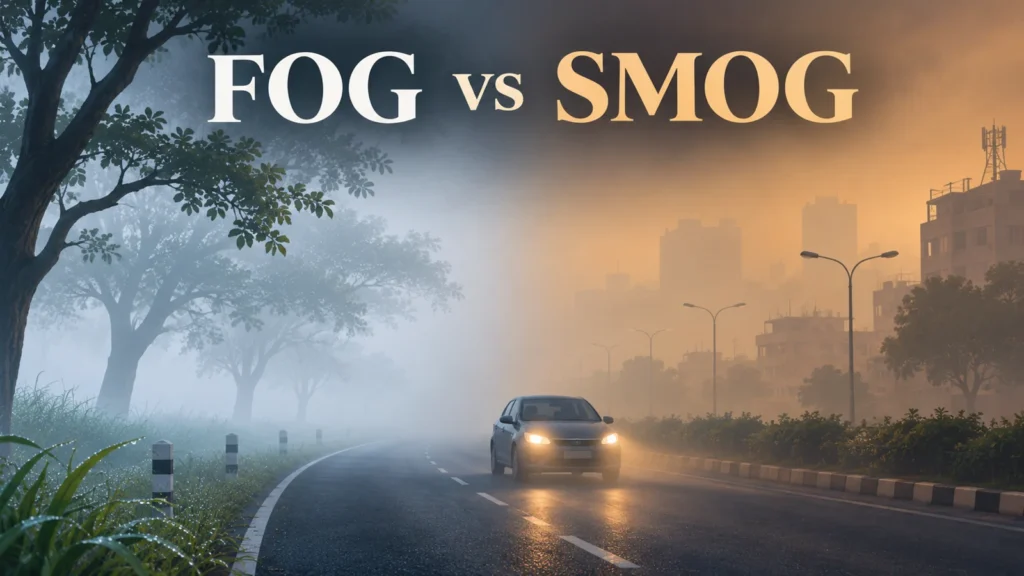
A white or grey layer outside your window cannot, by itself, tell you whether you are looking at fog, pollution haze or a combination. Fog consists mainly of tiny suspended water droplets; smog describes pollution-related conditions. They can occur together. The useful distinction is between two questions: can you see the road well enough to travel safely, and what does monitored air-quality information say about the air you will breathe?
This guide explains those questions separately, with an India-focused AQI reference and practical examples for commuting, driving and planning outdoor activity. It does not report a live AQI reading, announce a new fog warning or claim that a particular city is currently unsafe. Check the latest local information before making a decision. The featured image is an editorial illustration, not a photograph documenting current conditions. Information reviewed on 2 November 2026.
1. What is the difference between fog, haze and smog?
The Met Office describes fog as a cloud near ground level, made of very small water droplets. Haze can involve tiny dry particles affecting visibility. Everyday descriptions are often less precise: people may call several different conditions “mist” or “smog” after looking across a road. A photograph can show reduced visibility, but it cannot reliably identify the complete mixture in the air or replace measurements.
Smog is not simply another word for cold weather. The US EPA explains that ground-level ozone, an important component of photochemical smog, forms when certain pollutants react in sunlight. Polluted winter haze can also involve particles and other pollutants. That is why “sunshine has arrived, so pollution must be gone” is an unreliable rule. Weather, pollutant type and measured conditions all matter.
A practical way to remember the distinction is to give the two risks separate spaces in your plan. Visibility affects what a driver can see and respond to. Air-quality information helps describe pollution conditions. A relatively clear-looking afternoon is not proof of clean air, while an acceptable AQI category does not make a fog-obscured road safe. Avoid treating either indicator as a shortcut for the other.
2. How to read India’s AQI without losing the context
India’s CPCB framework uses six AQI categories: Good, 0–50; Satisfactory, 51–100; Moderate, 101–200; Poor, 201–300; Very Poor, 301–400; and Severe, 401–500. These are air-quality bands, not visibility distances. An index used in another country may have different breakpoints, so do not automatically apply an Indian category label to a number from an overseas system.
Before using a reading, look for the monitoring location, date, reporting time and whether data are available. A station across a large city does not describe every detail immediately outside your doorway. Missing or outdated data do not mean the air is clean. If two services show different numbers, compare their location, time and index method before deciding that one must be wrong.
For example, a family member might forward yesterday evening’s screenshot when you are preparing for this morning’s journey. The number may have been correctly reported at the time, yet still be unsuitable for your current decision. Open the official CPCB AQI page rather than relying on the forwarded image. Use the IMD website separately for relevant weather information.
3. Plan a journey using both weather and air-quality information
Suppose you need to catch an early bus. Start with the forecast or warning relevant to your route, then check air-quality information and your personal circumstances. Confirm the bus or train status with its operator. A weather forecast suggesting disruption is not the same as an announcement that every service has been cancelled. Check your actual service, date and boarding point.
Where local instructions advise postponing a nonessential journey, adjust your plan accordingly. For an essential trip, allow extra time and organise contacts before departure. Passengers can help by avoiding pressure on the driver to make up lost time. The decision is not just whether the destination looks clear on a map; the route and access to a safe stopping place also matter.
A similar approach applies to school travel. A closure notice from another district does not establish that your child’s school is closed. Check the school, district and transport provider. A useful message to a family group identifies the place, time and action required. An undated video labelled “heavy fog everywhere” does none of those things and may distract from the information you actually need.
4. Driving in fog: use the right lights and leave room
The National Weather Service recommends reducing speed, using low-beam headlights and leaving additional distance from the vehicle ahead. High beams can create glare in fog. Understand your vehicle’s lighting modes; daytime running lights do not necessarily provide the same rear visibility as switched-on headlights. Use fog lights in accordance with local traffic rules and the vehicle’s instructions.
If you can no longer continue safely, seek a safe designated place to stop rather than stopping abruptly in a moving lane. Follow local road instructions. There is no single speed or stopping-distance number that this article can responsibly prescribe for every road, vehicle and visibility condition. Another driver moving quickly ahead is not evidence that you can safely copy that speed.
Prepare the windscreen and controls before leaving. Knowing how to use the demister is more helpful than searching for an unfamiliar switch in poor visibility. Do not film the fog while driving. A passenger can handle navigation or messages, leaving the driver to concentrate on the road. These simple divisions of responsibility turn a vague instruction to “be careful” into a workable travel plan.
5. Air pollution precautions and when to seek medical advice
NCDC’s air-pollution advisory highlights additional precautions for people with existing lung or cardiovascular conditions, including avoiding strenuous outdoor activity when pollution is high, following their clinician’s instructions and keeping prescribed medicines available. This does not mean changing treatment yourself. Age, symptoms, underlying illness and the type of work involved can change the advice an individual needs.
A correctly fitted N95 or N99 can help reduce particle exposure, but it does not protect against every gas or make prolonged exposure harmless. A loose covering or cloth is not equivalent particle protection. Do not use a mask as permission to remain in polluted surroundings longer. Seek urgent medical help for severe breathing difficulty, chest pain or rapidly worsening symptoms rather than attributing them automatically to weather.
For a household, a useful planning question is which outdoor tasks are necessary now and which can be reorganised. Reducing an older relative’s unnecessary wait beside a busy road is one example. This is not a claim that one fixed hour is safest in every city. Avoid universal rules such as “morning air is always best”; use local information and the person’s existing medical plan.
6. Indoor air, exercise and misleading shortcuts
Indoor smoke sources also deserve attention. A room with smoking, incense or other combustion is not automatically clean simply because its windows are closed. If considering filtration, look at room suitability, filter maintenance and the manufacturer’s instructions. NCDC advises against ozone-generating air purifiers. One device is not a complete solution for every pollutant or every room.
Hot drinks, steam or a home remedy should not be advertised as a pollution “detox” that cancels exposure. Comfort measures and medical assessment are different things. Decide about exercise using the day’s conditions, symptoms and relevant health advice, rather than following a calendar regardless of circumstances. This guide provides general information and cannot diagnose the cause of an individual’s symptoms.
For background on pollution sources and weather in Delhi, see our Delhi air, sources and weather explainer. Its focus is different from this travel-oriented fog-versus-smog guide. A background article should not be used as proof of today’s AQI, a new restriction or a school closure. Always return to the current official notice for those decisions.
7. Frequently asked questions about fog vs smog
Can I identify fog or smog by looking outside? Appearance alone is insufficient. Check weather and visibility information separately from monitored air quality. Water-droplet fog and pollution can coexist, so forcing every scene into one simple visual label can be misleading.
Does a low AQI mean driving in fog is safe? No. AQI communicates pollution conditions, not the distance a driver can see. Assess actual visibility and follow road warnings and traffic rules. You need both kinds of information for a complete travel decision.
Does sunshine remove smog? There is no universal rule. Different pollutants respond differently, and sunlight also participates in ground-level ozone formation. Check updated local measurements instead of assuming that brighter skies establish clean air.
Will any face covering provide complete protection? No. Fit and respirator type matter, and particle-filtering equipment does not remove every gaseous pollutant. Exposure reduction and individual medical advice remain important. Do not delay care for serious symptoms because you were wearing a mask.
Where should I check today’s fog alert and AQI? Use IMD for relevant weather information, CPCB for Indian air-quality information and the appropriate local authority or operator for travel and school decisions. Read the location, date and time before sharing or acting.
Sources and limits: Reviewed 2 November 2026. General education, not a live weather warning or individual medical advice. Follow local traffic instructions and your clinician’s care plan. Met Office: fog and haze · US EPA: ozone and smog · CPCB: Indian AQI · NWS: driving in fog · NCDC: air pollution health advisory (2022) · NIOSH: particle respirators and gases