Slug: `delhi-hawa-sardi-nahi-sources-weather-policy`
Focus: Delhi air pollution causes analysis
Category: 85 News & Trending
Discussions about Delhi’s air quality usually peak between October and January. The sky turns hazy, AQI bulletins dominate headlines, talks of bans on schools and construction emerge, and the debate eventually centers around vehicles, stubble burning, or a single “culprit.” This framing is convenient, but incomplete. Delhi’s air pollution is not just a winter event. It is a year-round story of emissions, land-use, traffic, energy use, and regional transport, which weather conditions make highly visible and dangerous for a few days.
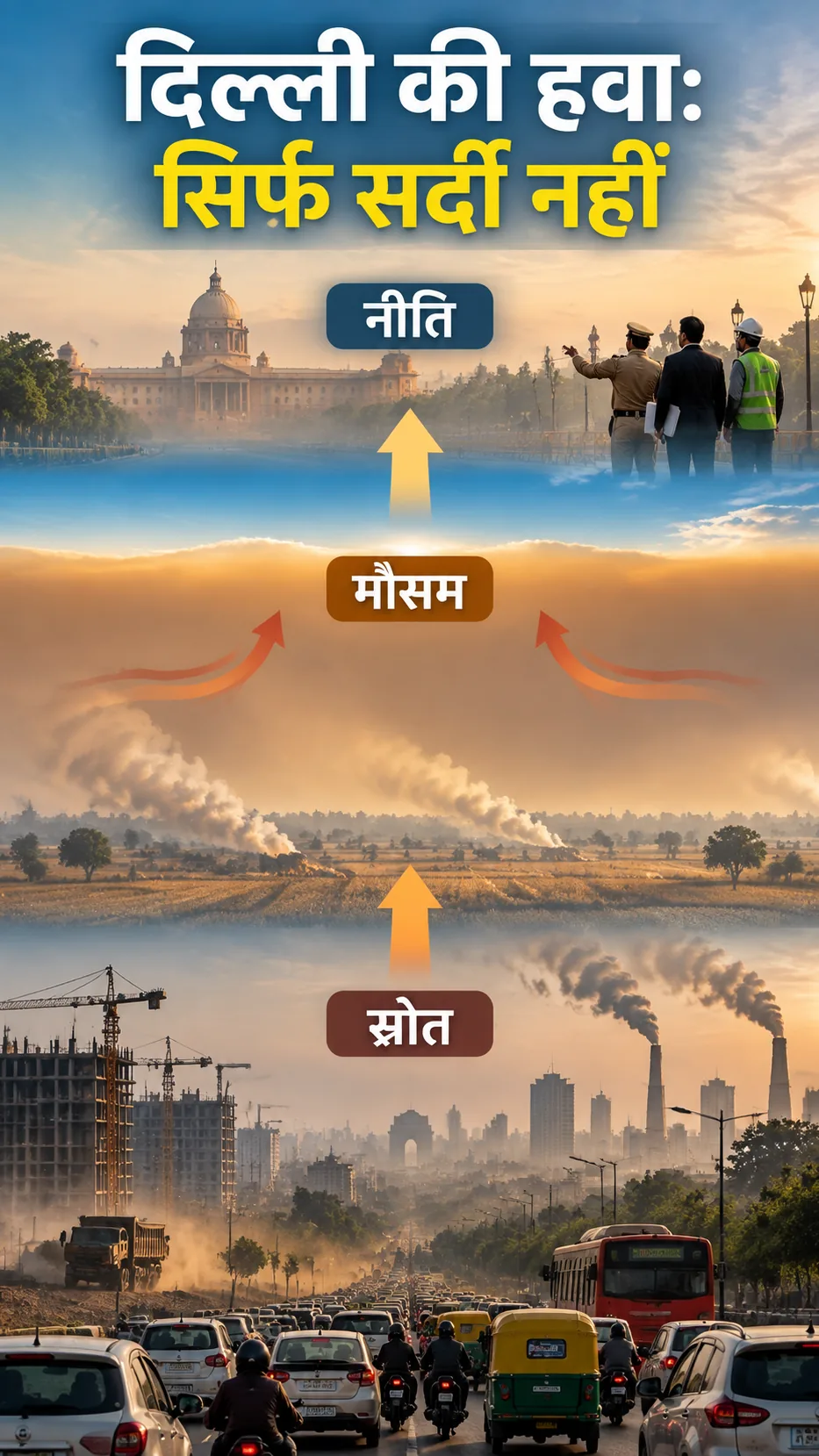
To understand this, it is essential to look at three layers together: sources, weather & atmospheric chemistry, and policy & implementation. Sources tell us where pollutants enter the air from. Weather determines whether they dilute or get trapped near the ground. Policy determines how prevention, monitoring, enforcement, and public health responses work. If only one of these three layers is taken as the complete explanation, a measure might make headlines, but it will not offer a permanent solution to the problem.
First Point: AQI Measures Air Conditions, Not the Offender
AQI is a communication tool. It translates measured levels of different pollutants into understandable health categories. It does not name a specific source. On one day, PM2.5 levels might be formed by a mixture of traffic, industry, domestic fuel, dust, secondary particles, and regional smoke. On another day, due to wind direction, humidity, and sunlight, the picture in the same city might be completely different. Therefore, when AQI rises, questions like “who contributed what percentage of pollution” cannot be asked without specifying season, location, pollutant, and methodology.
Source-apportionment studies are useful, but their results change with season and model assumptions. Whether a monitoring station is near a road or in a residential area, the duration of the sample, and how local emissions and outside-air contributions are distinguished—these factors influence interpretation. This does not mean these studies shouldn’t be trusted. It means applying a single chart to the entire year and all of Delhi-NCR would be incorrect.
Vehicles: Not Just Exhaust Pipes, But the Entire Mobility System
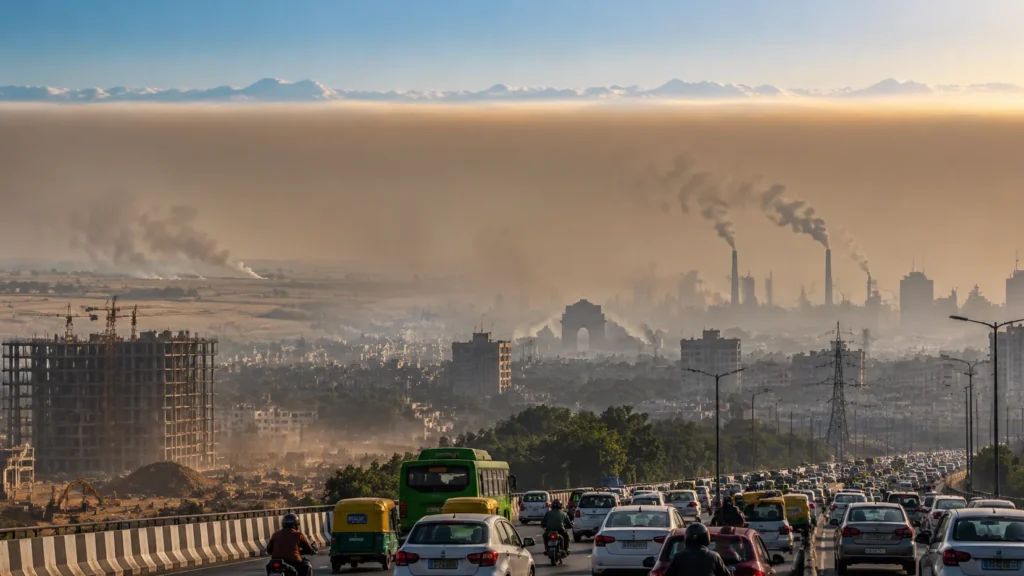
Vehicles in Delhi are a significant and continuously present source of pollution. This includes private cars, buses, trucks, delivery vehicles, two-wheelers, taxis, and inter-state traffic. Traffic emissions include exhaust gases and particles, but the story doesn’t end there. Brake and tyre wear, resuspension of road dust, idling, congestion, and poor maintenance of old vehicles can also increase exposure. The route and timing of heavy-duty diesel traffic can have distinct impacts on local air quality.
Therefore, simply saying “buy a new car” or “implement odd-even” is not an adequate answer. City road design, reliability of public transport, last-mile connectivity, parking pricing, freight windows, and walking-cycling safety also dictate emission levels. If commuters lack safe, timely bus or metro connections, appeals to give up cars will have limited impact. If delivery and freight logistics lack better scheduling, congestion may simply shift to another time or route.
Vehicle emission standards and PUC certificates are necessary, but real-world enforcement is equally essential. Passing a vehicle test and operating cleanly in real-world traffic can be two different things. Work is needed on old and poorly maintained vehicles, tampered pollution-control systems, fuel quality, inspection capacity, and enforcement consistency. Electric vehicles can reduce tailpipe emissions, but they bring their own policy requirements for clean electricity generation, battery lifecycle management, public charging infrastructure, and affordable access. EVs do not eliminate tyre and brake wear, nor are they a substitute for reducing congestion.
Industry, Power, and Small Combustion Sources
Delhi-NCR is an interlinked airshed. Pollutants do not stop at administrative boundaries. Emissions from industrial boilers, brick kilns, power generation, metal processing, stone cutting, hot-mix plants, diesel generator sets, waste burning, and small commercial units come from various locations. The pollutant profile of every unit is not identical. One unit might contribute particulate matter, while another releases nitrogen oxides, sulphur compounds, or volatile organic compounds that later play a role in secondary particulate matter or ozone chemistry.
When it comes to industry, binary debates—”shut down industries” versus “leave industries alone”—do not work. Cleaner fuel, stack controls, process changes, energy efficiency, continuous monitoring, reliable power supply, and transparent compliance are needed simultaneously. Written regulations do not automatically stop emissions. The quality of inspections, public availability of data, predictable penalties for violations, and access to technology and finance for smaller units are vital.
A temporary ban on diesel generators can falter if reliable power alternatives are not provided. Covering construction sites, wetting materials, and organizing transport look simple on paper; verifying compliance across thousands of sites, subcontractors, and municipal roads is an administrative challenge. This is why policies must speak not only the language of bans, but also of measurable compliance and practical alternatives.
Dust: Construction, Roads, and Topsoil
Dust in Delhi’s air is both a visible and invisible problem. Large construction projects, road widening, demolition, open plots, unpaved shoulders, broken pavements, uncovered trucks, and loose materials release coarse dust. Heavy traffic continuously resuspends road dust. Coarse particles irritate the eyes and throat, while fine particles can travel deeper into the respiratory system.
Linking dust control solely to construction bans is also incomplete. Steps like wheel-washing at site entry points, covering trucks, shielding debris, securing material storage, regular mechanical sweeping, paving road shoulders, and managing excavations are required. These need daily coordination among municipal bodies, contractors, traffic police, and pollution-control agencies. If one agency issues an order and another lacks the staff, equipment, or data, compliance remains weak.
Stubble and Regional Smoke: Significant, But Not the Only Factor
Crop-residue burning cannot be ignored in Delhi-NCR’s winter pollution narrative. Burning field residue after harvest cycles creates smoke plumes that, under favorable wind directions, reach the NCR. This is an issue of regional transport, not just Delhi’s municipal administration. For farmers, residue management involves costs, time constraints, equipment access, cropping schedules, labor availability, and local alternatives. Therefore, punitive measures or moral blame alone do not form a sustainable policy.
However, stubble burning cannot be called the single explanation for every winter peak. Delhi’s local vehicles, industry, dust, waste burning, household and commercial fuel use, and secondary aerosol formation exist year-round. The contribution of regional smoke varies with weather and wind patterns. On some days it can be a major factor; on others, minor. An effective response requires satellite observations, ground monitoring, farm-level support, residue collection systems, viable end-use markets, enforcement, and interstate coordination.
Crop-residue management has multiple pathways—mulching, in-situ treatment, baling, biomass utilization, and crop diversification—but no single option fits every region. Machine availability, field size, timing, and local procurement mechanisms are critical. Imposing emergency restrictions in Delhi alone does not alter farm economics.
View Weather Inversion as an Amplifier, Not the Villain
In winter, Delhi’s air often appears severely degraded not because emissions suddenly surge, but because atmospheric ventilation weakens. Normally, warm air near the ground rises, diluting pollutants through vertical and horizontal atmospheric mixing. During temperature inversion, warmer air sits above a cooler layer near the ground. This stable boundary layer prevents mixing. Pollutants accumulate near the surface, where fog, humidity, and fine particles combine to deteriorate visibility and air quality.
Low wind speeds and shallow mixing heights aggravate this phenomenon. Fog and high humidity increase water uptake and light scattering by particles. Sunlight interacting with ambient gases can also produce secondary particles. Consequently, the same emission load can lead to vastly different AQI levels under varying meteorological conditions. Weather forecasts are just as critical as emission inventories for predicting air quality.
It is crucial to recognize that inversion is not the root source of pollution. If there are fewer emissions in the air, inversion has less material to trap. But when traffic, industrial output, dust, and smoke are present, inversion compresses them into concentrated human exposures. While winter crackdowns might offer temporary relief, pollution episodes will recur during the next stable weather window unless baseline local emissions are reduced.
How Delhi’s Air Changes Throughout the Year
Winter is the most visible season, but the rest of the calendar is far from pristine. During the monsoon, rain and strong atmospheric mixing temporarily reduce several pollutants, yet traffic and industrial emissions continue uninterrupted. When sunshine returns post-rain, atmospheric chemistry shifts. In summer, intense sunlight triggers reactions between nitrogen oxides and volatile organic compounds to raise ground-level ozone—a pollutant that cannot be understood merely through the lens of dust. Pre-monsoon dry soil and construction dust can also be prominent factors.
In autumn, harvest cycles, changing wind trajectories, and cooler nights cause regional smoke to overlap with local emissions. In winter, light winds, inversion layers, humidity, and low mixing heights combine to trigger severe pollution episodes. While a “winter action plan” is necessary, it must be backed by a year-round baseline policy. Clean air must be treated as a permanent public infrastructure objective, not an emergency seasonal fight.
Three Layers of Policy: Prevention, Emergency Response, and Public Health
A robust policy architecture must function across at least three levels. First, structural prevention: public transport and clean mobility, industrial fuel and process controls, reliable power supply, dust management, waste collection, crop-residue alternatives, and regional land-use planning. These deliver gradual results, but they address the root causes of emissions.
Second, episode management: when forecasts indicate severe drops in ventilation, graded measures like GRAP can phase in restrictions on construction, traffic, diesel generators, and other activities. Forecast-based action is far superior to reactive bans because agencies can prepare in advance. However, emergency plans are only effective if baseline emissions are already suppressed and enforcement capacity is operational.
Third, public health protection: citizens require clear advisories, school and workplace protocols, healthcare system readiness, and indoor air guidance. Vulnerable demographics—children, the elderly, pregnant women, and individuals with asthma, COPD, or cardiovascular diseases—must take heightened precautions during severe pollution days. Wearing properly fitted masks helps reduce exposure, but masks are not a substitute for city-wide source control. Indoor air can also degrade; ventilation decisions should account for outdoor conditions and building usage.
CAQM, CPCB, state pollution control boards, municipal bodies, transport departments, police, agriculture departments, and neighboring state authorities hold distinct responsibilities. For citizens, agency roles should be transparent: where to log complaints, who publishes air data, who takes regulatory action, and how outcomes are tracked. Framing the issue as “Delhi government versus neighboring states” masks the critical need for inter-agency coordination. Airshed governance requires shared targets, compatible datasets, and clear accountability.
Why Bans and Odd-Even Often Remain Short-Term Measures
Bans are not entirely ineffective. Halting a highly polluting activity for a few days can shave off the peak of an episode. The issue arises when temporary bans are mistaken for permanent source reduction. Halting construction pauses one source, but road traffic, industrial operations, domestic fuel use, and regional smoke continue. Once bans are lifted, deferred activity rebounds simultaneously. Without proper inspections and practical alternatives, bans can also displace activities into the informal sector, night hours, or adjacent jurisdictions.
Odd-even is likewise a targeted demand-management tool rather than a comprehensive clean-air policy. Its efficacy hinges on rule design, exemptions, public transit capacity, compliance, carpooling adoption, freight handling, and overall traffic behavior. If commuters switch to secondary vehicles, taxis, or two-wheelers, alter trip times, or bypass restricted zones via peripheral roads, actual emission reductions may fall short of public claims. Short-term comparisons during fluctuating weather conditions also fail to provide causal proof of success.
Such measures belong within a structured plan: predictable triggers based on forecasts, transparent evaluations, public transit reinforcement, logistics planning, and sector-specific enforcement. Every restriction should be followed by published data detailing pollutant changes, localized impacts, meteorological factors, and compliance rates. Without empirical evaluation, policy devolves into routine ritual.
A Better Framework: Emissions, Exposure, and Accountability
Delhi must be planned as an entire airshed rather than within isolated municipal boundaries. First, it requires reliable, comparable monitoring—integrating fixed stations, mobile monitoring units, meteorological data, traffic counters, and industrial emissions tracking. Source inventories must be updated seasonally. Satellite maps of smoke are helpful, but they cannot replace ground-level datasets. Public dashboards should reflect margins of uncertainty to prevent false precision.
Second, policy impact must be evaluated across both total emissions and human exposure levels. Reducing total emissions from an industrial stack is beneficial, but policy must also track exposure changes around schools, hospitals, roadside workers, and residential areas. Green buffers do not solve all issues, but when combined with improved road design, dust mitigation, and active mobility infrastructure, they play a crucial role in exposure management.
Third, incentives must align with enforcement. Financial and technical support for cleaner technologies, viable residue alternatives for farmers, transition assistance for small businesses, and clean cooking access for households should be paired with reliable penalties for repeated non-compliance. Subsidies alone cannot drive full compliance, and fines alone cannot finance an economic transition.
Finally, clear accountability must be established. Annual pollution reduction targets should be broken down by pollutant, sector, and responsible agency. Independent audits must cover public procurement, transit fleet electrification, road dust management contracts, construction compliance, and crop-residue schemes. Genuine policy is defined by measured improvements, not press conferences.
What Can Individual Citizens Do?
Individual action cannot substitute institutional source control, yet it plays a valuable role in reducing exposure and demand. On high-pollution days, limit strenuous outdoor exercise, avoid lingering in heavy traffic zones, and ensure sensitive family members have necessary medical supplies and doctor consultations. Properly fitted particulate respirators can reduce inhaled pollutants; ensuring a tight seal and timely filter replacement is key. Indoors, minimize smoke, incense, active smoking, and unvented combustion. Buying an air purifier is not an essential solution for every home; evaluate room size, filter maintenance requirements, power consumption, and ventilation needs before investing.
Opt for safe walking, cycling, public transit, or ridesharing for short trips where feasible, though this should not be treated as a personal moral test. Protecting outdoor workers and delivery staff remains a collective responsibility of employers and urban planners. Refrain from burning waste, keep construction materials covered, and report violations with geotagged photos through official complaint channels. Avoid drawing broad conclusions on pollution sources from simple AQI screenshots; consult official updates, forecasts, and health advisories.
Conclusion: Winter Amplifies Symptoms, It Does Not Create the Problem
An honest assessment of Delhi’s air quality cannot be reduced to a single culprit. Vehicles and traffic congestion, industrial emissions, construction and road dust, waste and household fuel burning, crop-residue smoke, regional transport, and atmospheric chemistry are interconnected gears. Winter atmospheric inversions and poor ventilation compress these pollutants near ground level. Consequently, the crisis appears most acute in winter, even though emissions persist across the entire calendar year.
Achieving lasting improvements requires addressing all three operational layers simultaneously: steadily reducing source emissions, utilizing predictive weather and chemistry forecasting, and structuring policies around prevention, emergency response, and public health protection. Temporary bans and odd-even schemes can briefly mitigate extreme spikes, but they do not constitute a standalone clean-air strategy. Delhi requires policies that provide farmers with workable tools, commuters with reliable public transit, industries with clear transition pathways, agencies with defined mandates, and citizens with transparent data. Only then will clean air evolve from a seasonal headline into a year-round governance priority.
FAQ: Five Key Questions About Delhi’s Air Quality
1. Is Delhi’s air pollution caused entirely by stubble burning?
No. Crop-residue smoke contributes significantly during specific seasonal and wind conditions, but vehicular exhaust, industrial operations, construction dust, waste burning, household fuels, and secondary chemical processes are persistent local factors year-round. Contributions vary by season and location; single-cause explanations are misleading.
2. What is atmospheric inversion and why does it degrade the AQI?
Inversion occurs when a stable layer of warm air traps cooler air near the ground. This limits vertical air mixing and prevents pollutants from dispersing. Inversion acts as an amplifier rather than a source—if baseline emissions are lowered, less pollution gets trapped near the surface.
3. Will the odd-even scheme permanently clean Delhi’s air?
The odd-even scheme targets private car usage, but overall air quality is also heavily influenced by heavy transport, industrial emissions, dust, backup generators, regional smoke, and weather conditions. Exemptions, transit capacity, enforcement, and route shifts mean actual outcomes vary. It should be viewed as a temporary measure within a broader, multi-layered policy.
4. Does rain permanently resolve the pollution crisis?
Rainfall and improved atmospheric ventilation temporarily clear airborne pollutants, but primary emission sources remain active. Once rain stops, ongoing traffic, industrial, and dust emissions resume. Achieving clean air requires sustained, year-round emission reduction measures.
5. What steps should individuals take on high-AQI days?
Check official forecasts and health advisories, reduce heavy outdoor exertion, avoid spending prolonged time in traffic hotspots, minimize indoor smoke, and consult medical professionals if managing respiratory or cardiovascular conditions. A well-fitted particulate respirator can reduce personal exposure, though it is not a replacement for systemic source control and medical care.
Editorial note: AQI metrics, source allocations, emergency restrictions, and health advisories evolve over time and across locations. Verify current updates against CPCB/CAQM advisories, real-time local monitoring stations, and updated scientific evaluations prior to publication.
Disclaimer: This pollution analysis is for educational purposes. Consult medical professionals for health advice; verify official statistics directly with designated authorities.