
Landlord not returning your security deposit: what should you do next?
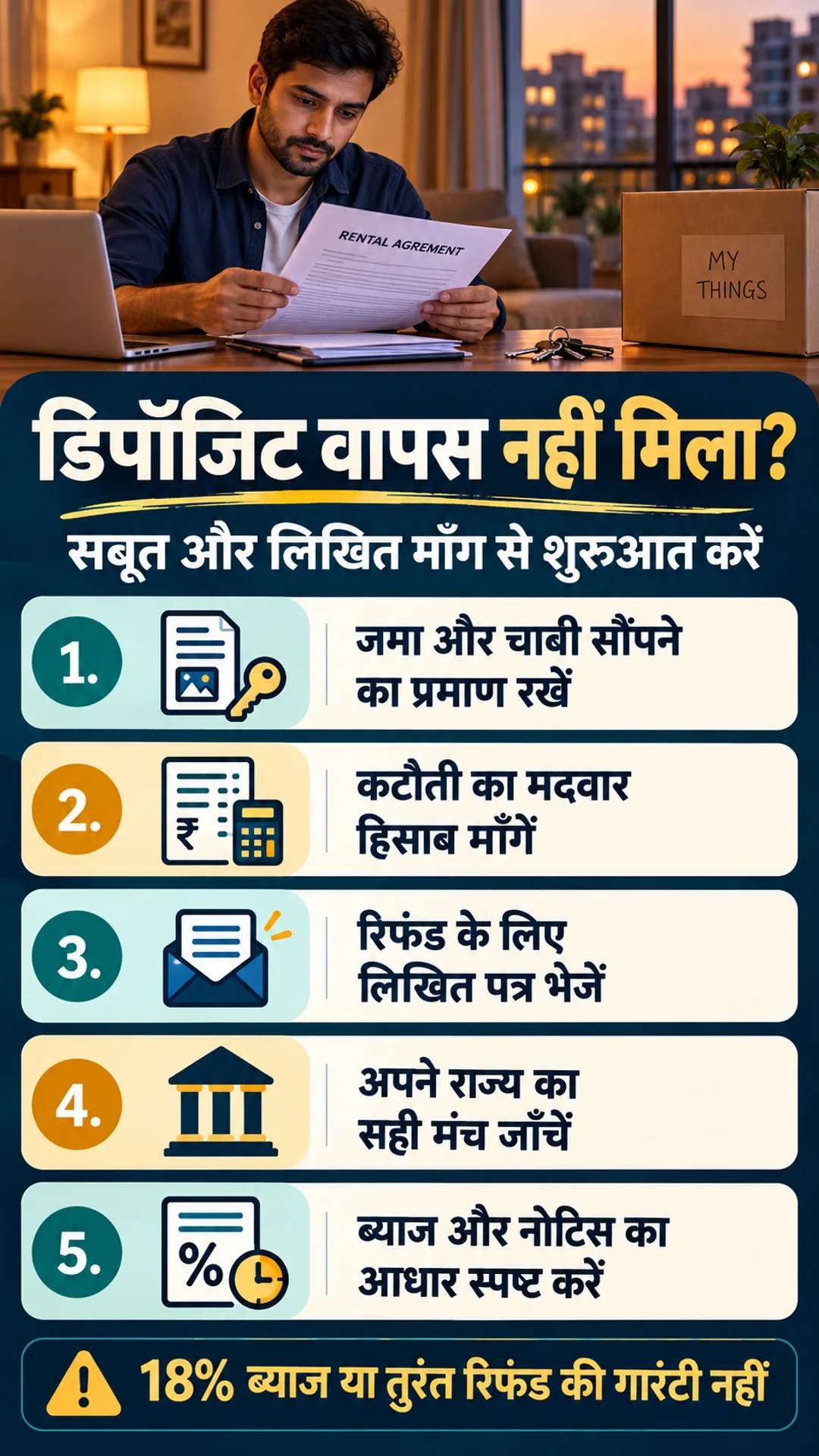
You have moved out, returned the keys and started paying rent elsewhere, but the old landlord keeps postponing the refund. Start by organising the amount and handover records. Ask in writing for the refund and an itemised deduction statement. Then choose a notice, settlement or appropriate recovery route based on the state law, agreement and actual dispute.
This guide focuses on action when money remains unpaid. Our linked deduction guide covers painting, notice and damage in detail. A nationwide deposit cap, automatic eighteen-percent interest, universal consumer-court jurisdiction or seven-day recovery guarantee should not be assumed. Ordinary tenancy and a paid accommodation/rental-management service can involve different legal questions.
Immediate checklist
- Collect deposit payment/receipt, agreement and rent records.
- Record the termination notice, final readings and handover date.
- Preserve acknowledgment of keys and vacant possession.
- Separate admitted dues, disputed deductions and unexplained retained amounts.
- Send a written request with a reasonable response date and secure refund method.
Separate security deposit, advance rent and booking fees
Check whether the amount is refundable security, advance rent or a separately agreed booking/brokerage charge. Examine the receipt and terms. Keep separate records of money paid to the landlord, broker or rental company; payment to a broker does not automatically establish that the landlord received it.
For example, ₹50,000 security and ₹5,000 brokerage are separate payments. If an evidenced ₹2,000 electricity adjustment is agreed, the working security balance is ₹48,000. Brokerage refund depends on its separate terms. This is an illustration, not an outcome in your dispute. Identify each component clearly in a settlement.
For cash payments, a receipt and the owner’s acknowledgment can help. A cash withdrawal alone does not fully prove payment to the landlord. Collect genuine supporting records rather than creating backdated receipts or forged signatures. An unwritten arrangement does not automatically destroy every claim, but proving payment and terms becomes especially important.
Proving handover and requesting a deduction calculation
Leaving the property and the landlord accepting vacant possession can be distinct facts. Document joint inspection, keys, meter readings and outstanding bills. If no receipt is supplied, send a factual same-day confirmation and preserve relevant witnesses/communications. Do not manufacture an acknowledgment or assume a disputed handover date is settled.
For each deduction ask for the amount, period, contractual clause and invoice/calculation. “The house was damaged” is not an itemised statement, but every repair charge is not automatically unlawful either. Read the linked guide for deduction principles; this article concerns recovering the balance once those items are identified.
If ₹40,000 is held and ₹15,000 deductions are alleged, request return of the ₹25,000 undisputed balance while objecting separately to contested charges. Do not sign an unread full-and-final discharge when taking a partial refund. If preserving the balance claim, clarify that in writing; the final settlement’s actual terms matter.
The Model Tenancy Act is not automatically nationwide law
The central Model Tenancy Act, 2021 is a template circulated for adoption by states and union territories. It contains residential-deposit and refund provisions, but these do not automatically apply to every property. Check enacted state law, amendments, tenancy category and coverage first.
Use the property state’s official housing/revenue/rent department or India Code for the current framework. Registration, urban-area coverage, exemptions and agreement dates can affect the forum. Rent Authorities and Rent Courts do not necessarily have identical powers. A screenshot describing another state is not a filing basis for your tenancy.
FACT: eighteen-percent interest is not a guaranteed right
Delayed-refund interest may be claimed where the contract or applicable law supports it. The Interest Act, 1978, relevant litigation provisions and judicial discretion may matter. There is no universal statutory eighteen-percent entitlement on every residential security deposit. Identify an actual interest clause and due date, or request legally permissible interest without presenting an invented rate as mandatory.
Putting a percentage in a notice does not make it payable. Prepare the basis, period and calculation separately. Before adding eighteen percent to a ₹30,000 claim, check whether that rate is supported for the particular arrangement. Legal fees, damages and interest are not automatically awarded merely because they are demanded.
Refund request and formal demand templates
A calm written request for reconciliation is often a practical starting point. Set a reply period based on the contractual due date and circumstances. Fifteen days may be a chosen response period, not a universal statutory deadline. Sending a demand is not filing a suit or obtaining a recovery order.
1. Request for itemised deductions and refund
Subject: Security deposit for [address] – reconciliation and balance refund
Hello [name],
I paid ₹[deposit] on [date/mode]. The tenancy ended on [date] and vacant possession/keys were handed over on [date/details]. Relevant records are enclosed.
Please provide an itemised account of proposed deductions of ₹[amount], with contractual clauses and bills/calculations. My calculation records admitted dues of ₹[amount] and a refundable balance of ₹[amount]. I dispute [specific deduction] for [reason].
Please return the undisputed balance by [reasonable date] and respond to the disputed items in writing. Secure payment details can be provided directly.
Name, contact, date; relevant attachments
2. Formal demand adapted to your facts and law
To: [landlord/liable party and service address]
Subject: Unpaid refundable deposit for tenancy [address/agreement date]
Sir/Madam,
I paid ₹[amount] under [payment details]. Possession was handed over on [date]. Refund is due on the basis of agreement clause [number]/applicable provision [details]. Despite requests dated [dates], ₹[amount] remains unpaid.
Admitted adjustments: [itemised list]. Disputed charges: [objections and records].
Please return ₹[net claim] and respond to the calculation within [reasonable period]. I reserve the right to seek permissible interest and other available relief under the applicable contract/law. [Only add a contractual rate, dates and calculation where genuinely supported.]
If unresolved, I will assess appropriate recovery/settlement remedies. This demand does not assert automatic police arrest or a guaranteed court award.
Name, contact, date
Attachments: agreement, payment, handover and previous correspondence
This is a general demand format, not a notice issued by your advocate. Do not add a lawyer’s name, stamp or signature without authority. Have the parties, wording and forum reviewed for a formal notice or complex dispute. Preserve suitable delivery/tracking records and avoid posting sensitive banking or identity material in public groups.
Rent forum, civil recovery or consumer commission?
Where the enacted state tenancy framework provides a competent rent forum, check its jurisdiction and claim process. A Rent Court may be appropriate in some situations, while ordinary civil recovery applies in others. Amount, location, defendant, contract and limitation affect filing. A tenancy tribunal does not automatically hear every private money claim.
Consumer status and deficiency of service are not automatic in an ordinary residential landlord-tenant dispute. A separate rental-platform, accommodation-management or paid-service arrangement may need a different assessment. Do not treat consumer commissions as a universal deposit shortcut. Creating a portal account does not establish jurisdiction.
Where a consumer complaint is maintainable, use current official e-Jagriti filing/help guidance. e-Daakhil and other legacy systems were subsumed into that platform from 1 January 2025. Check the current complaint, party, relief, evidence/affidavit and fee requirements. Time spent in an unsuitable forum is not inexpensive recovery.
For a civil route, examine the suitable procedure, court fee and limitation promptly. Repeated reminders do not automatically reset limitation. The effect of an acknowledgment, promise or part payment depends on the facts. For an old deposit, get deadline advice before sending another notice and waiting further.
Smaller claims, settlement and the limits of police intervention
Ask DLSA about pre-litigation Lok Adalat or available mediation. Regular Lok Adalat works through mutual settlement; it is not a shortcut for compelling payment in every contested claim. Permanent Lok Adalat’s public-utility jurisdiction is different and should not be assumed to cover an ordinary tenancy-deposit dispute.
Record the amount, date, method, adjustments, receipt and full/final scope of any settlement. If accepting instalments, clarify the consequences of non-payment. Do not inadvertently surrender a remaining ₹20,000 claim while receiving ₹10,000. Distinguish a written promise from funds actually credited, and read the signed document.
Ordinary non-refund is generally a contract/recovery issue. Violence, threats, unlawful confinement or independently supported criminal conduct can justify a separate factual complaint. Do not label every delay cheating merely to force payment. Taking the owner’s belongings, changing locks or damaging the property is not a recovery remedy.
Advice
Establish the agreement and actual balance first. Do not create new rent arrears by unilaterally treating security as the last month’s rent; check the agreement or a written arrangement. Compare the amount and costs when choosing notice, settlement and filing. No template guarantees success, but a clear record helps explain and prove the claim.
FAQ: landlord not returning security deposit
Can a landlord keep the entire deposit?
Not automatically in every case. Review the applicable terms/law and documented deductions; see the linked deduction guide.
Will demanding eighteen percent make it payable?
No. The contractual/statutory basis and judicial assessment matter.
Should I go directly to consumer court?
Check maintainability in an ordinary tenancy dispute first. Service arrangements and state rent forums may change the assessment.
Must a lawyer send the first demand?
You can send your own request. Professional review is useful for an advocate notice or complex dispute; do not impersonate a lawyer.
Can I adjust the last rent from security myself?
Confirm the agreement or written settlement. Unilateral adjustment may create a fresh arrears dispute.
- MoHUA: Model Tenancy Act 2021 (model text)
- PIB: state adoption of Model Tenancy Act
- Interest Act 1978
- Official e-Jagriti consumer portal
- NALSA: regular Lok Adalat
- NCH example: rental-company service complaint
Disclaimer: General legal information for India. State law, contract, property category and facts affect forum and relief. Fact-checked: 13 October 2026. No guarantee of refund, interest or recovery within a fixed period.