Wrong entry in your CIBIL report? Start with the record, not just the score
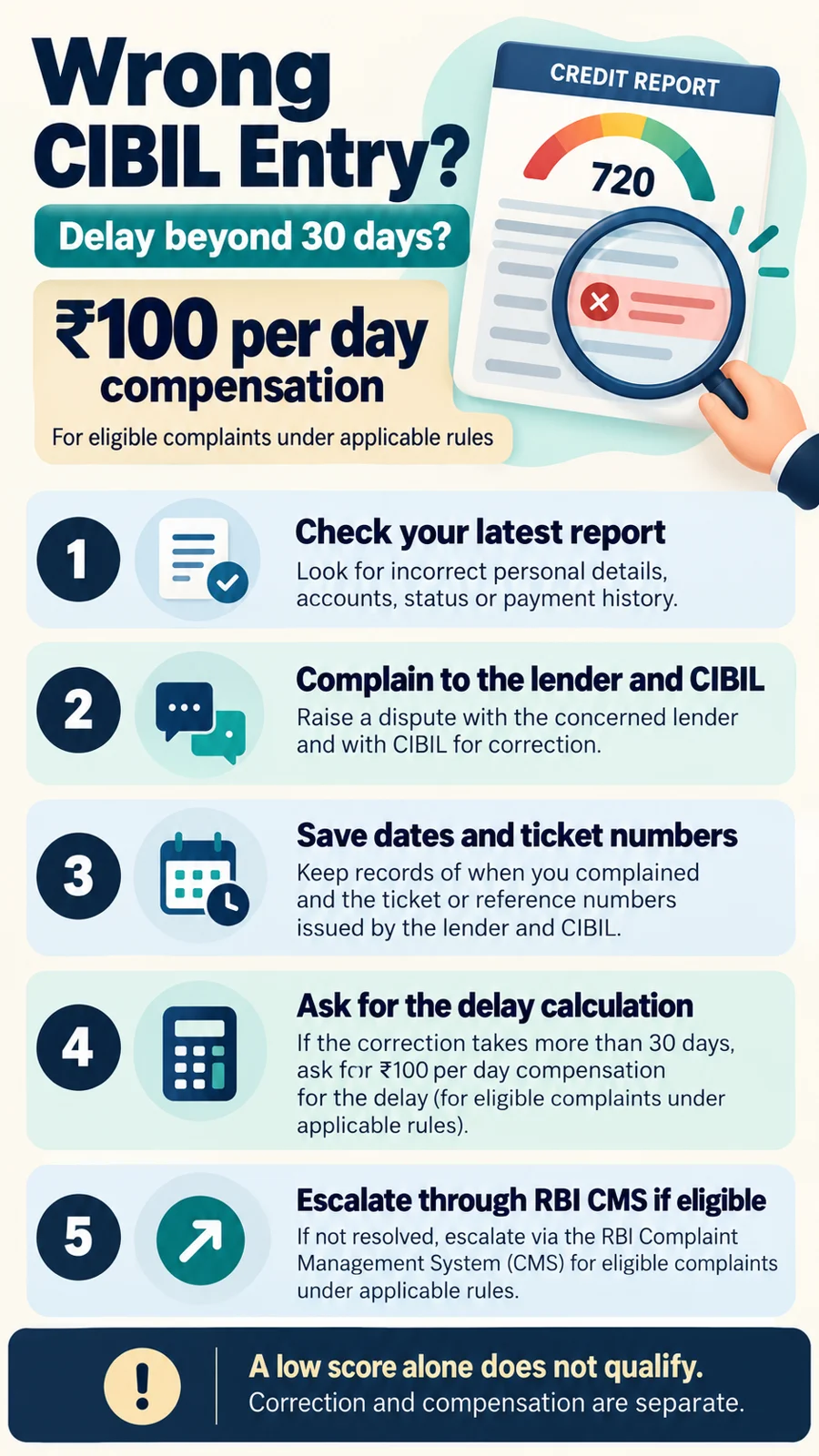
You repaid a loan, yet your credit report still shows an overdue balance. Or an account appears that you never opened. The useful response is to identify the disputed field, collect evidence and submit a written complaint. Eligible credit-information complaints delayed beyond 30 calendar days can attract compensation of ₹100 per calendar day.
Correction, compensation for delay and approval of a new loan are separate outcomes. A low score alone does not establish entitlement to this payment. This guide explains how to build a clear complaint without promises of instant results.
Identify what is actually wrong
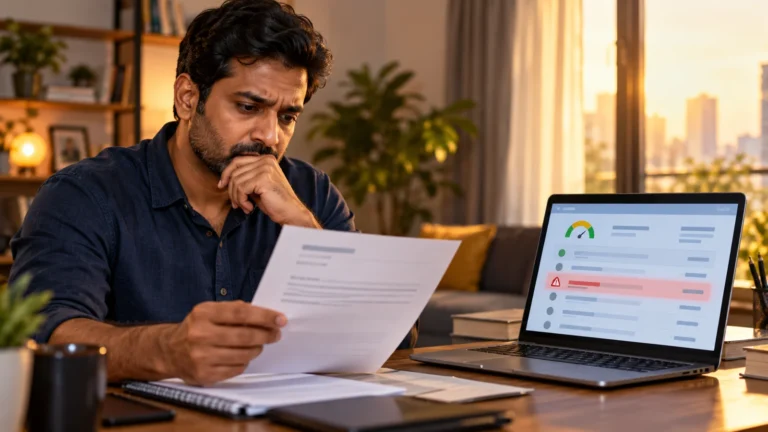
Read the latest report and note the lender, account reference, current balance, overdue amount, account status and reporting date. Describe the mismatch in one sentence: “My fully paid account still shows ₹8,000 overdue.” A precise issue is easier to investigate than a request to “fix my score.”
An unfamiliar account, incorrect payment information or identity mismatch warrants checking. However, a digital lending app may use a partner bank or NBFC whose legal name appears in the report. Compare the entry with your loan agreement before calling it fraudulent.
A correctly closed account remaining visible is not automatically an error. Check the reported status and balance. CIBIL explains these distinctions on its consumer dispute page.
Do not pay a stranger simply because an unfamiliar entry appears. Ask the lender for details through its official channel. Keep full reports and identity documents out of public social-media posts.
Closed and settled mean different things
Full repayment generally leads to a “closed” status. A lender accepting less than the total payable amount may report the account as “settled.” Paying an agreed settlement does not automatically make that reporting inaccurate.
If you paid in full but see “settled,” attach your payment evidence and closure letter. If you genuinely settled for less, ask the lender for a written explanation of any remaining payment and the reporting treatment before making further payments. CIBIL’s settled-status explanation helps distinguish the two situations.
How the ₹100-per-day compensation framework works
FACT: Eligible complaints about credit-information correction have an overall 30-calendar-day resolution period from the initial complaint to a credit institution or bureau. The compensation rate for delay beyond that period is ₹100 per calendar day. The framework took effect on 26 April 2024.
The institution has a 21-day correction/transmission timeline, with the bureau working within the overall 30-day limit. This is not permission to make a consumer wait separate 30-day periods at each organisation. Liability can be apportioned according to their respective contribution to delay.
Sending the corrected credit-information report matters when determining resolution. Eligible compensation should be credited within five working days of resolution. See the RBI framework and illustrations.
For example, 12 additional calendar days beyond the permitted period would produce ₹1,200 at the stated rate in an eligible case. Do not double this merely because both the lender and bureau were involved. Request their written calculation and allocation.
The clock does not automatically start when you closed the loan or first noticed a low score. Preserve the initial complaint date and acknowledgement. A telephone conversation without a reference or written record makes the chronology harder to demonstrate.
Build a complaint that someone can act on
Create one folder containing the report, payment receipts, relevant account statements, closure/NOC letter and correspondence. Give documents recognisable names. Keep the material focused on the disputed account rather than attaching unrelated financial history.
- Use CIBIL’s official account to identify the field and raise a dispute. Its current page specifies recent reports within the past 60 days for its dispute facility.
- Complain in writing to the reporting lender as well. State both the incorrect value and the correction requested.
- Record the complaint dates, service-request numbers and acknowledgements.
- Follow the lender’s published escalation process to its grievance or principal nodal officer when needed. Refer to the existing complaint.
CIBIL’s dispute service is free. The bureau needs confirmation from the reporting institution before changing lender-supplied information. This makes a focused lender complaint useful alongside the bureau dispute.
Keep one copy of your submission exactly as sent. If a reply refers to a different account or ignores the document establishing repayment, point out that specific mismatch. Ask for acknowledgement of any new evidence rather than assuming it has reached the right team.
Provide accurate payment-account details only through official channels. Never disclose an OTP or UPI PIN to someone offering compensation. Avoid paid agents promising to erase accurate repayment history or guarantee a particular score.
What if the dispute is rejected or unanswered?
Read the rejection reason. If the response says the lender confirmed the entry, ask the lender to explain its underlying records against your evidence. Request a reasoned response rather than simply opening another identical ticket.
Where there is no response within 30 days, or the response is unsatisfactory, check eligibility for escalation through RBI CMS. A prior complaint to the institution is required. Explain wrongful denial of compensation separately from the underlying reporting error. Consult RBI’s current Ombudsman FAQ and portal requirements. Filing is free.
Present a short chronology: initial complaint, acknowledgement, follow-up, response and outstanding relief. Ask for correction, a reasoned written decision and eligible delay compensation as separate requests. Attach only documents that support those requests.
The compensation framework has exclusions, including disputes about the score computation/model and matters pending or decided in other forums. Read the applicable conditions before pursuing the same dispute through multiple routes. Disclose relevant proceedings honestly.
A timely rejection that you disagree with is different from late disposal. An eligible credit-information complaint disposed of after 30 days can still attract delay compensation even where no correction was ultimately required, as CIBIL’s framework FAQ explains. An unsatisfactory response alone does not establish delayed resolution.
Complaint template and Advice
Subject: Credit-information correction and eligible delay compensation — complaint [reference]
I complained on [date] about [account/report reference]. The report shows [incorrect information], whereas the attached [evidence] supports [correct information]. Please investigate, make the necessary reporting correction and provide a reasoned written response. If the applicable 30-calendar-day period has been exceeded, please provide the delay calculation, responsible institution(s) and compensation payable under RBI’s framework. Contact: [details]. Attachments: report, payment evidence, closure letter and acknowledgement.
Advice
Maintain a simple timeline and add each response to it. Continue paying other valid loan obligations while pursuing the dispute. Once corrected, compare the actual field in the new report rather than only watching the score. A correction does not guarantee a specified score increase or approval of a new loan.
If a lender needs clarification urgently, share a concise dispute summary and documentary proof through its official channel. Ask it to explain its application decision; do not treat a complaint reference as an automatic substitute for its credit assessment.
Related reading: Builder delays, bank EMI and legal options.
FAQ
Does compensation start on the first complaint day?
No. It concerns eligible delay beyond the permitted 30-calendar-day period.
Does rejection rule out compensation?
Not necessarily. Late disposal and the merits of a correction are separate issues. Ask for the recorded disposal date and delay calculation.
Must every closed loan disappear?
No. A correctly reported closed account may remain part of the credit history.
Can I collect ₹100 daily from both organisations?
Do not assume double payment. Responsibility for the overall eligible amount may be divided between them.
Will my report be fixed within 48 hours?
There is no general guarantee of a 48-hour correction, particular score increase or loan approval.
General consumer information, not individual legal or lending advice. Sources checked: 13 October 2026. Read current official requirements before filing.