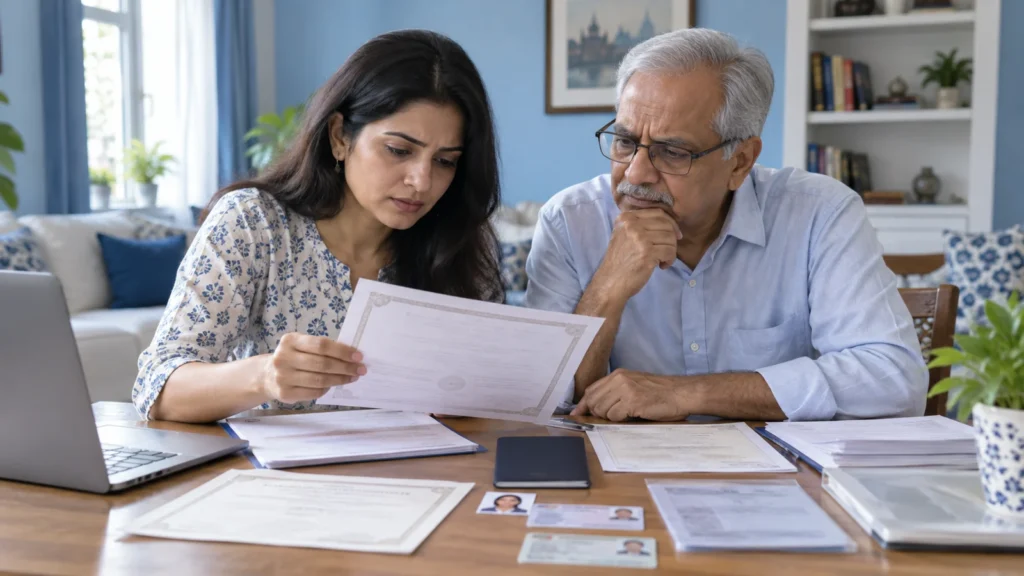
Seller refusing to return token money? Start with the loan rejection reason
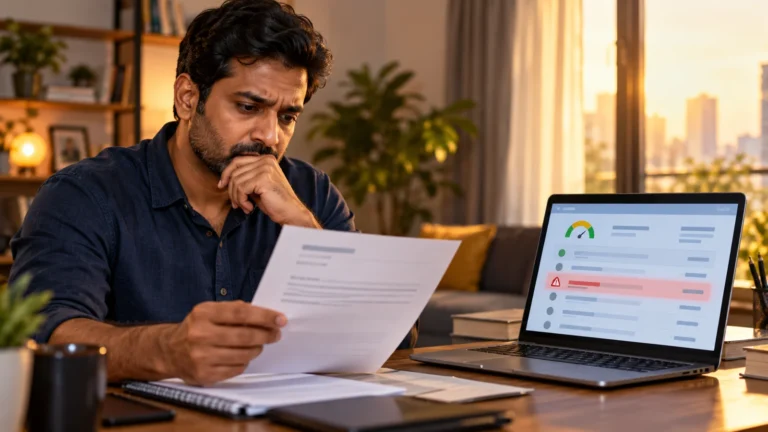
You paid a booking amount for a home, but the bank refused your loan. The seller now says the token is non-refundable. Before abandoning the money or threatening a police complaint, establish why financing failed and what the transaction documents actually promised. Those facts shape the refund claim and the appropriate next step.
Home loan rejection does not automatically entitle every buyer to a full refund. Equally, calling money “non-refundable” does not settle every dispute about deductions. This guide separates borrower eligibility, property-document issues and cancellation terms without promising instant recovery.
Borrower rejection and property rejection are different
Borrower eligibility: Income, existing repayments, credit history or incomplete personal documents may lead to rejection. Without an agreed financing condition, inability to arrange funds alone may not excuse the buyer’s payment obligations. Review deadlines, cancellation provisions and the responsibilities each party accepted.
Property checks: The lender may raise legal or technical concerns about title documents, approvals or the actual construction. Ask for a written rejection reason and clarification of the specific problem. Do not translate a vague “not approved” message into a finding of fraudulent ownership.
Valuation shortfall: A lower bank valuation can reduce the available loan even where the property is otherwise acceptable. This does not, by itself, establish defective title. Identify whether the difficulty is affordability, valuation, missing documents or a substantive legal issue.
If the bank cannot share an internal report, request whatever written explanation it can provide. Preserve the exact wording. A complaint saying “the loan failed because of missing approval X” is easier to assess than “the bank said the whole property is illegal.”
Read the receipt and contract together
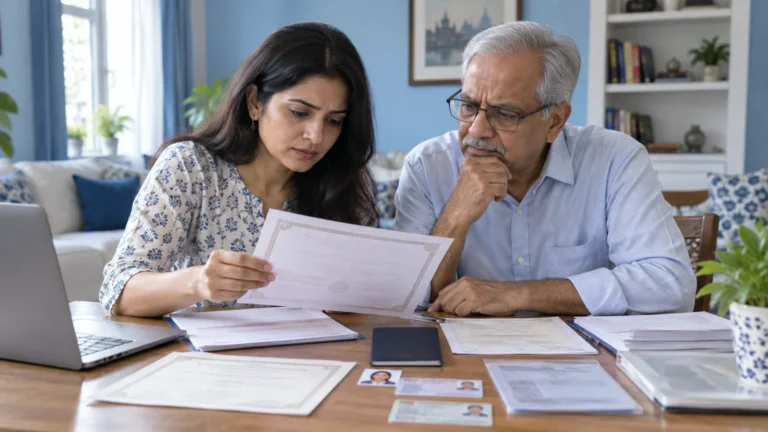
Identify the payee: private seller, developer or broker. Match the receipt with the property description and transaction reference. Check the total sale price, balance payment deadline and the purpose of the initial amount. Its label alone does not determine whether it is an advance or earnest money securing contractual performance.
- Was purchase expressly conditional on loan sanction or satisfactory legal verification?
- Which documents did the seller agree to supply, and by when?
- What happens if financing fails: refund, cancellation or an extension?
- Does the agreement clearly describe forfeiture and the circumstances triggering it?
- Did either party later agree to different terms in messages or email?
Brokerage and money paid towards the property may be separate claims. Record them separately. A transfer proves that money moved; also preserve evidence connecting it with this property and the agreed purpose. If no formal receipt exists, save acknowledgements and transaction-related messages.
Stamping and registration requirements vary with the state and document. Do not assume that notarisation makes every clause enforceable, or that lack of registration necessarily eliminates a money claim. Have the actual documents reviewed before conceding your position.
Make property-document concerns specific
Under the applicable framework of section 55 of the Transfer of Property Act, seller duties include disclosure of certain material property/title defects known to the seller, unknown to the buyer and not discoverable through ordinary care. That is not an automatic refund rule for every missing paper.
Create a short record with four columns: document requested, request date, seller’s response and the bank’s concern. Keep accusations out of it unless supported. Ask for the identified document and a written explanation of how the concern can be resolved.
Mutation or a revenue entry is not, alone, a complete title investigation. Occupancy/completion documents and other approvals must be assessed against the property’s type, stage and local requirements. An independent property lawyer’s review is useful alongside the bank’s lending decision.
If the problem is curable and you still want the home, seek a written extension with a clear deadline. If there are serious doubts about the seller’s authority or the property, obtain advice about cancellation and refund rights. Avoid an unreviewed letter admitting buyer default merely because the seller requests it.
Can all earnest money be forfeited?
FACT: Neither full refund nor full forfeiture follows automatically in every transaction. The nature of the deposit, contract, breach, amount and applicable legal rules matter. A reasonable earnest-money forfeiture and a penal deduction are not always treated identically.
In Godrej Projects Development Ltd. v. Anil Karlekar, 3 February 2025, the Supreme Court retained the direction to refund amounts exceeding a 10% Basic Sale Price deduction, rather than the disputed 20%, but removed the interest direction. This is not a blanket rule permitting every seller to deduct 10% or guaranteeing interest to every buyer.
Kailash Nath Associates v. DDA discusses breach, forfeiture and compensation. Its reasoning needs to be applied with the facts and subsequent decisions, rather than copied as a promise of full recovery.
Ask the seller to identify the clause, alleged default and deduction calculation. If ₹50,000 is proposed as a deduction from a ₹2 lakh payment, ask what each charge represents. Do not accept an unexplained deduction, but do not invent an entitlement to double repayment either.
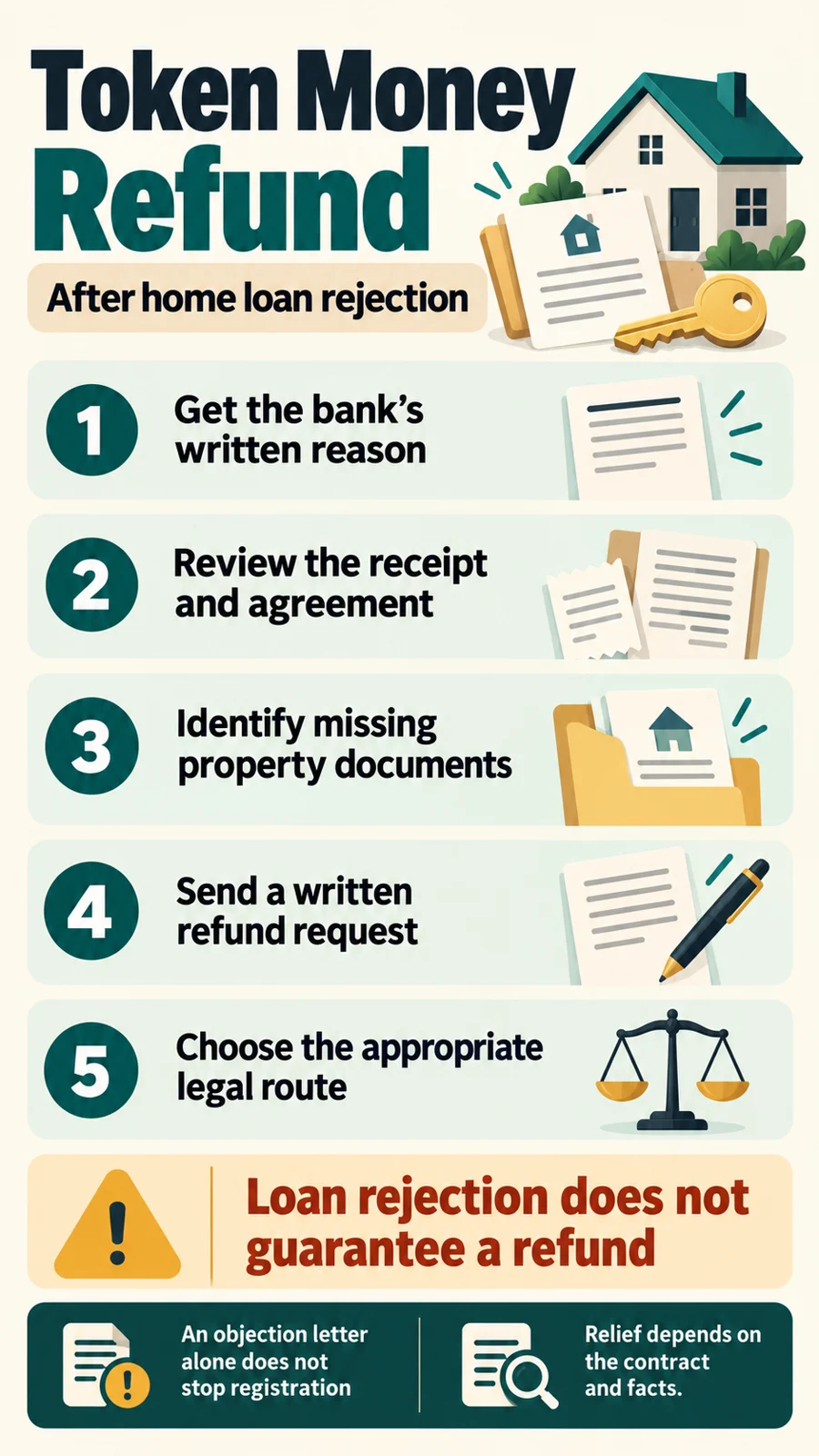
Practical recovery steps and the appropriate forum
- Collect evidence: Receipt, agreement, payment proof, bank clarification, advertisements and correspondence.
- Send a written request: Explain the facts, refund basis and amount, with a reasonable response date. A requested 7–15 day response window is not a universal statutory deadline.
- Document a settlement: Specify the refund, any agreed deduction, payment date and method. Read a full-and-final release before signing.
- Assess the correct route: A private resale dispute may call for civil remedies. An eligible developer/project dispute may raise RERA or consumer remedies, depending on jurisdiction and facts.
RERA section 13 addresses a promoter taking more than 10% advance/application money before a written, registered agreement for sale. Section 18 refund rights relate to specified promoter defaults; they do not create an automatic refund for every failed home-loan application. Do not assume every private resale is a RERA case.
If both sides are willing to settle, ask the District Legal Services Authority about a pre-litigation Lok Adalat. NALSA explains this settlement route. An ordinary Lok Adalat cannot simply impose a decision on the merits when the parties do not settle.
Forgery or concrete evidence of deception from the outset may justify a distinct legal complaint. An ordinary refund disagreement is not automatically cheating. Preserve truthful records and obtain advice about limitation promptly; continued discussions do not automatically extend every filing deadline.
Before selecting a forum, ask what relief it can grant, the evidence required, likely costs and whether an arbitration clause affects the route. Filing the same grievance everywhere can create procedural difficulties. A focused claim is more useful than multiple inconsistent narratives.
An objection letter or caveat is not an automatic registration stop
Sending the sub-registrar a letter saying your token remains unpaid does not universally stop another sale deed. State registration rules, statutory prohibitions and a competent court’s order are separate issues. Do not use an unsupported claim of an automatic registration block as negotiating pressure.
A caveat under CPC section 148A concerns notice/hearing of an application before a court. It is not itself a stay order. If resale threatens an enforceable right, consult a lawyer promptly about appropriate interim relief.
Refund request template
Subject: Token-money refund/clarification — [property reference]
I paid ₹[amount] on [date] under [receipt/UTR]. The relevant transaction condition was [clause/promise]. The bank’s response dated [date] states [exact reason]. Please provide [identified documents/clarification] and refund the amount on the basis of [refund ground]. If any deduction is proposed, identify its contractual basis and calculation in writing. Please respond by [date]. I reserve my available legal rights. Attachments: agreement, payment evidence and bank clarification.
Advice
For a future purchase, agree financing conditions, document verification, refund terms and deadlines before paying. Do not sign blank cancellation forms. Keep the settlement and proof that the refund actually reached your account. A promise to “send it tomorrow” is not payment.
Related reading: Builder delays, bank EMI and legal options.
FAQ
Does home-loan rejection guarantee a full refund?
No. Examine the rejection reason, financing condition and contractual default issues.
Does a non-refundable clause end the matter?
It matters, but its nature, enforceability and application can be examined.
Can I request a refund without a seller NOC?
Yes. If the seller disputes it, an appropriate forum may need to determine the claim. There is no single universal NOC requirement for every refund.
Does a bank rejection prove defective title?
Not necessarily. Read the actual reason and seek independent legal review.
Will a notice recover my money in seven days?
There is no such guarantee. A demand documents your position and can start negotiations; it is not automatically a refund order.
General legal awareness, not individual advice. Sources checked: 13 October 2026. Review state requirements and your documents with a local property lawyer.