Gomati Chakra identification: a spiral is not enough
Gomati Chakra identification cannot be settled by a round outline or spiral mark alone. Natural material, a finished specimen and a manufactured replica can look similar in a photograph. First establish whether the seller is claiming natural material, an untouched surface, a particular species or collection from a specific place.
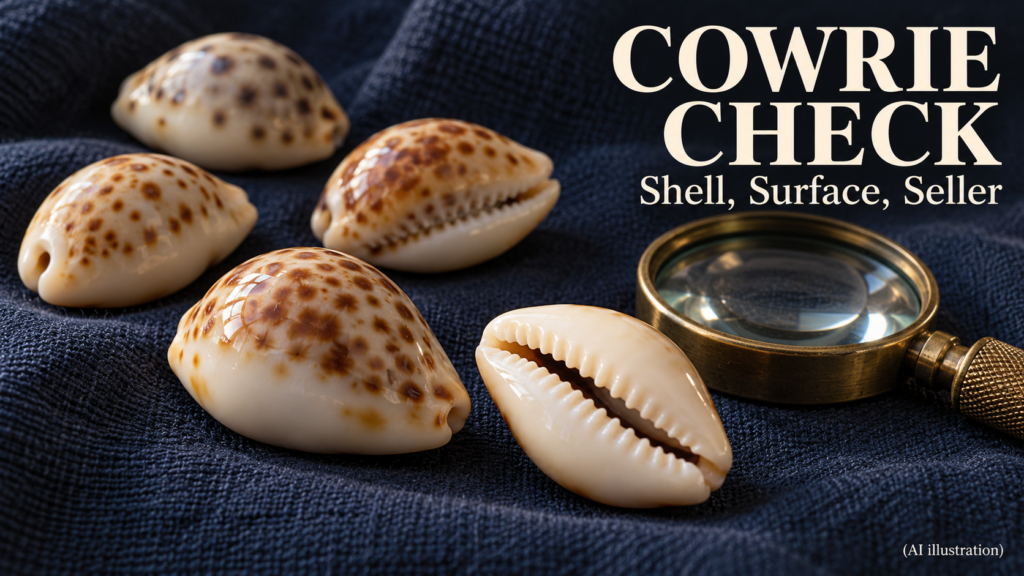
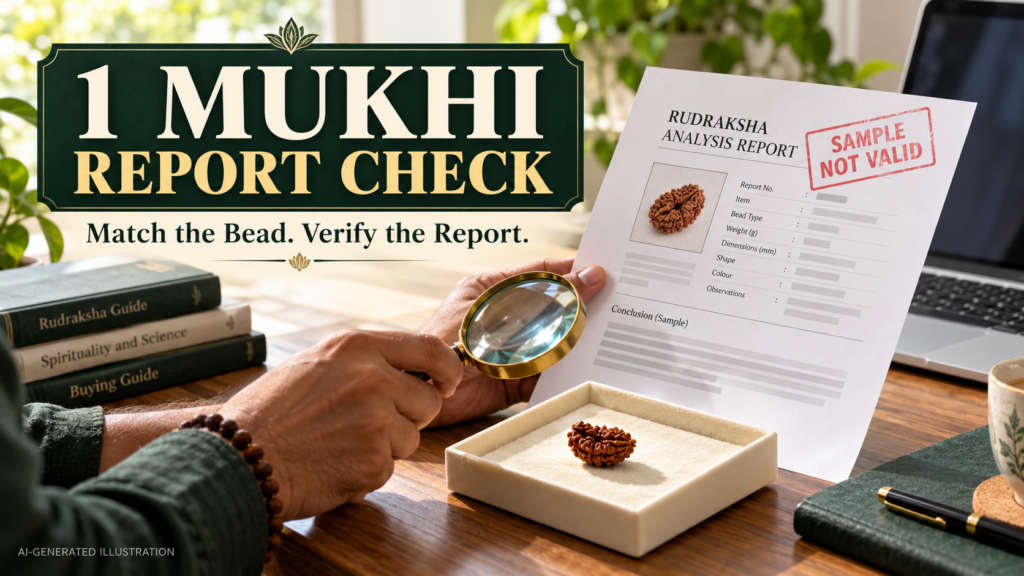
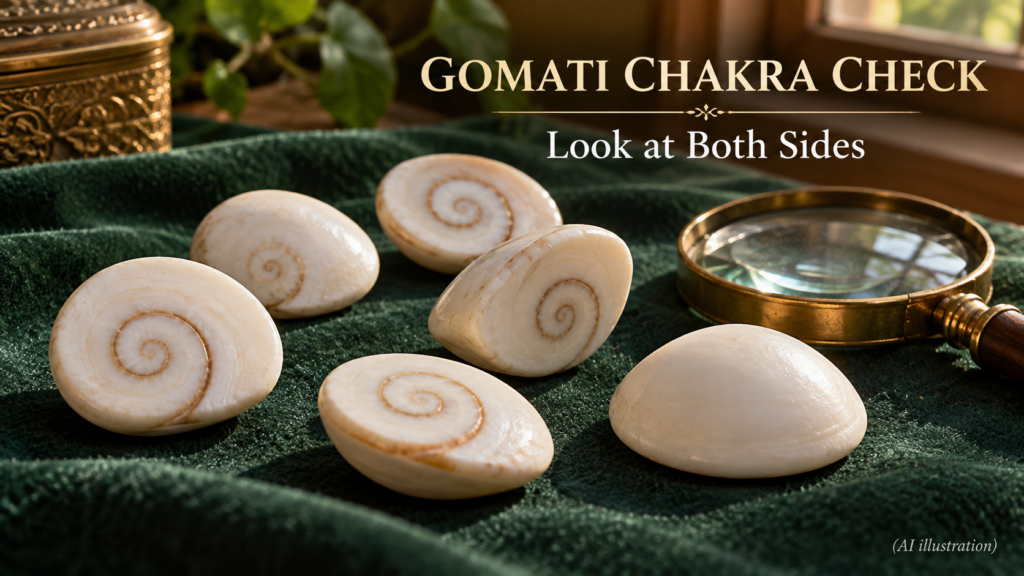
This guide explains useful views and buying questions. It is not an authenticated real-versus-fake specimen gallery. All three images are fictional AI illustrations and must not be used as scientific references to identify another object by resemblance.
What an operculum is and why it is not a whole shell
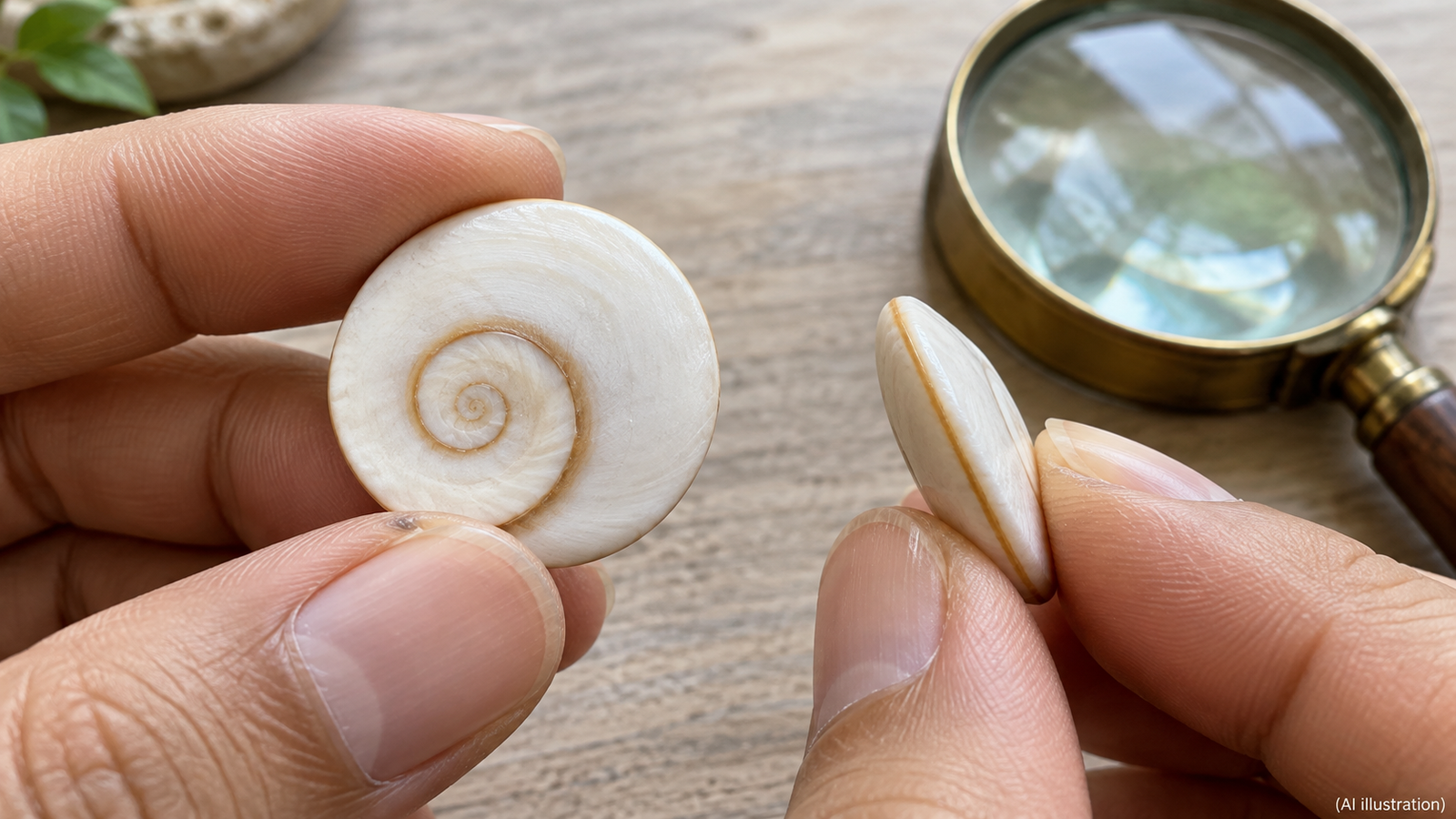
Small disc-like objects sold as Gomati Chakra are commonly described as sea-snail opercula. An operculum is a lidlike structure that closes the opening in some snail shells; it is not the entire shell. A shop calling the item a stone does not establish a geological composition.
The Australian Museum describes the protective operculum of a turban snail. A Museums Victoria example records a white domed side and a spiral pattern on the flatter side of a particular turban-shell operculum. That example explains the structure; it does not identify every commercial Gomati Chakra.
Do not assign every listing one exact scientific species. If a species matters to the purchase, ask for the name and identification basis. Resemblance to an institutional specimen photograph does not automatically establish the offered object’s material, source or species.
Inspect both faces, edges and thickness
Request separate photographs of both faces. Record where the visible spiral lies, whether the other face looks domed or flat and what is visible around the edge. Use ordinary descriptive words rather than imagining layers, minerals or microscopic structures that the picture cannot show.
Record apparent cream or white colour and brown lines as observations. A very round outline, uneven edge or worn-looking spiral alone is not an authenticity verdict. Those features may justify a question about modification or condition, rather than a conclusive label.
If a seamlike line, separate layer, raised colour or join appears, request a clear close-up. One photograph does not conclusively identify resin, paint or adhesive. Shadows and reflections can also mislead. Ask for material disclosure and direct examination when necessary.
FACT: Different-looking faces can be useful observations. They do not independently prove an exact species, an untreated condition or a Gomti/Dwarka origin.
Natural, untreated and Dwarka-sourced are separate claims
Separate three questions: Is it a natural operculum or a replica? Has it been shaped, polished, dyed, coated, drilled or repaired? What record supports the stated collection location? A natural starting material can be worked; natural and untouched are different descriptions.
Purchased in Dwarka and collected naturally at that location are different claims. A shop address, riverside photograph or religious label does not create a provenance chain. If the claimed source affects the price, ask what collection or supply documentation is available.
This article does not claim that every commercial piece comes from one river or that every specimen is rare. A general biological explanation cannot verify a seller’s geographical story. Where information is missing, keep the uncertainty rather than turning an assumption into certification.
For a mounted pendant, ask about the hidden face, setting and adhesive. Packaging, thread or metal quality cannot prove biological identity. The invoice should describe the main object separately from the mount.
Limits of colour, shine and household tests
Whiteness, weight, a cool feel or sinking in water is not sufficient confirmation of a particular natural operculum. Different materials can share some visible and tactile properties. A simple household demonstration should not be presented as a validated identification test.
A wet or oiled surface is not equivalent to a dry one. Request a dry specimen in ordinary light and disclosure of any applied finish. Darker colour, increased gloss or a claimed energy effect cannot replace a material finding.
Avoid flames, hot needles, acids, bleach, boiling, scraping or breaking experiments. They can damage the surface without resolving the original question. Begin with non-destructive observation and ask an appropriate specialist what further examination is useful.
Advice: request photographs and a written description
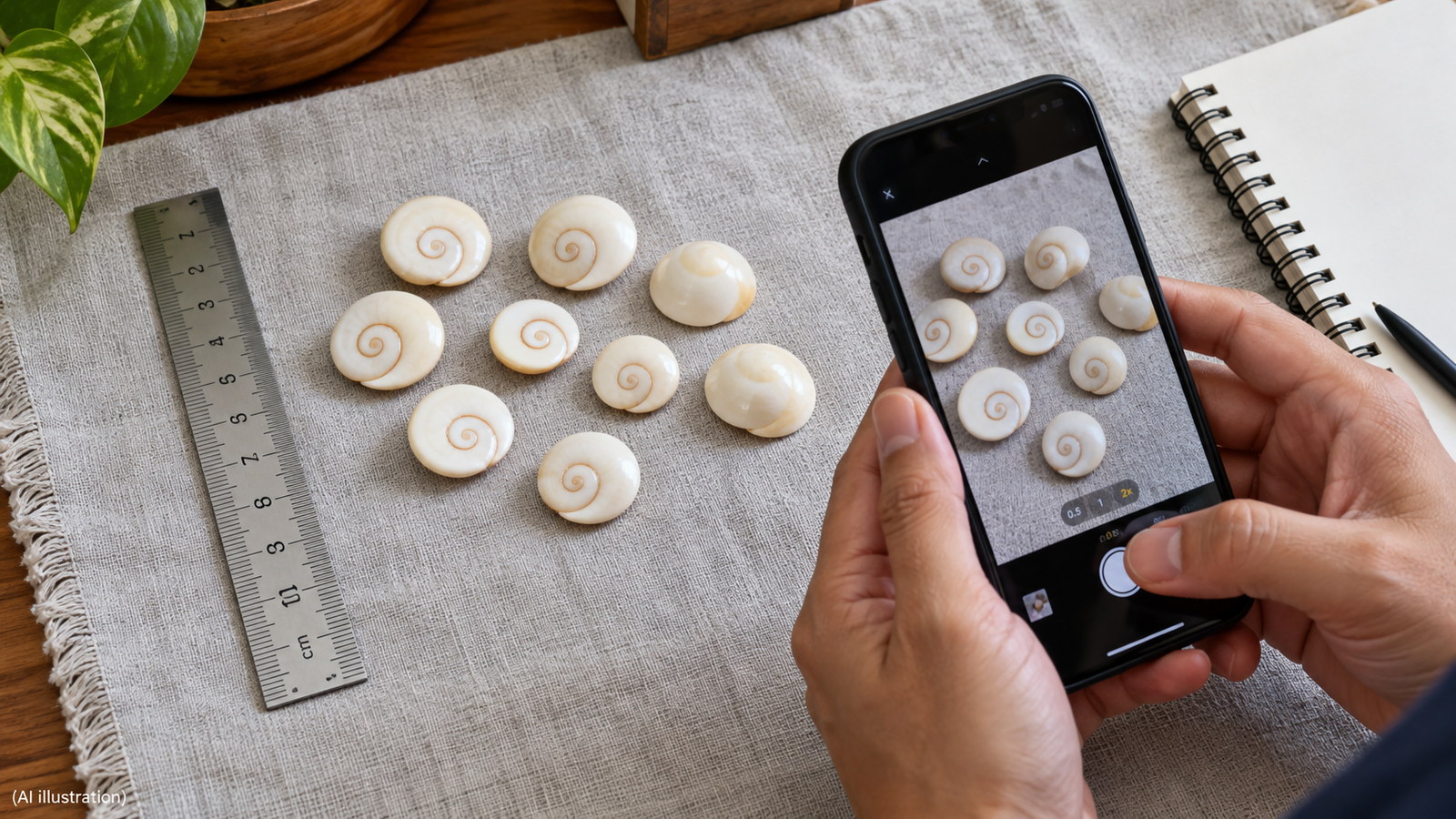
Request the spiral face, opposite face and edge profile of the actual available piece or lot. Put a ruler beside it to document length and thickness. A plain background, clear focus and diffuse daylight without heavy filters aid comparison. For bulk lots, ask about quantity, size range and chipped or drilled pieces.
Send this question: “Is this a natural operculum or a replica? Has it been polished, coloured, coated, cut or drilled? Please show both faces and edges of the actual item, dimensions and any record supporting its claimed source. What return terms apply if it does not match the description?” Save the response and invoice.
A slow continuous video helps connect the views to one object but is not certification. On delivery, compare visible marks, measurements, quantity and damage. One attractive stock photograph cannot identify an entire packet.
For an expensive or supposedly rare piece, ask a malacology specialist or natural history museum whether they offer identification. Not every institution provides commercial certification or valuation. For a report, check the issuer, specimen photograph, reference and findings; do not extend a material conclusion to origin or religious effects.
Ask someone familiar with your tradition about ritual practice. This guide does not promise wealth, medical treatment or supernatural outcomes. Resolve physical identification questions through the actual item and its written description.
Frequently asked questions
Does a spiral prove authenticity? No. It is a visible clue, not a standalone material test.
Is a Gomati Chakra an entire conch shell? An operculum is a lidlike part, not a whole shell.
Does polishing always mean a replica? No. Natural material can be finished.
Does the name prove Dwarka origin? No. The specific object needs separate source evidence.
Are the illustrations real specimen references? No. They are fictional AI images, not authenticated specimens.
Sources and fictional AI image disclosure
General educational and buying information, not certification, valuation or a religious ruling. Sources explain general operculum biology and limited museum examples; no seller is endorsed. All three images are fictional AI illustrations. Checked on 24 October 2026.
- Australian Museum: protective operculum of a turban snail
- Museums Victoria: a turban-shell example and its operculum faces
- NSW Department: turban shells and their protective operculum
Real cowrie shell identification and buying checks