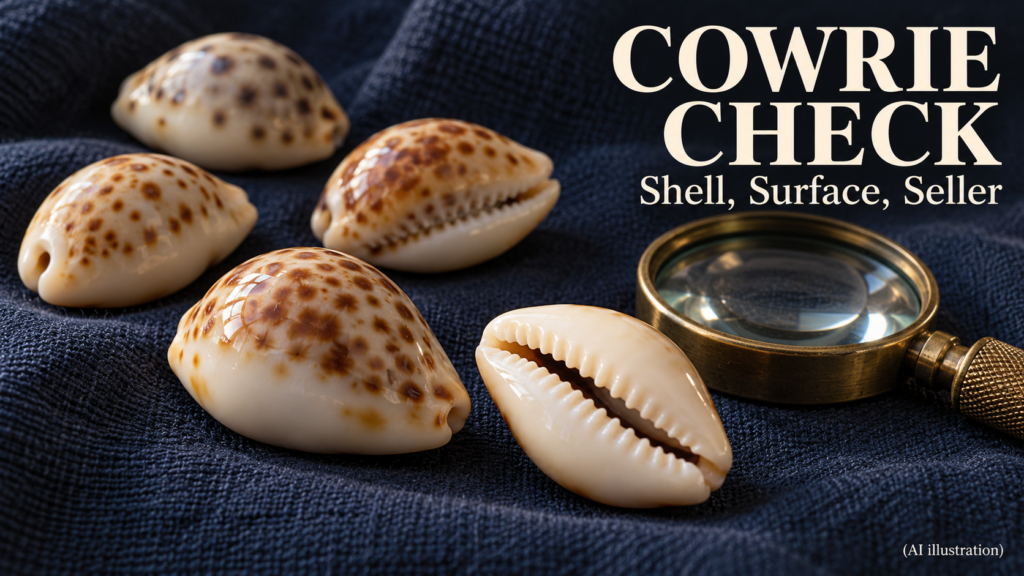
Real cowrie shell identification starts with the sales claim
Real cowrie shell identification is not settled by a white colour, glossy finish or narrow underside opening alone. A replica can imitate visible features, while a natural shell may be cut, drilled or coloured for decoration. First ask whether genuine refers to natural material, a particular species, an intact condition or a religious description.
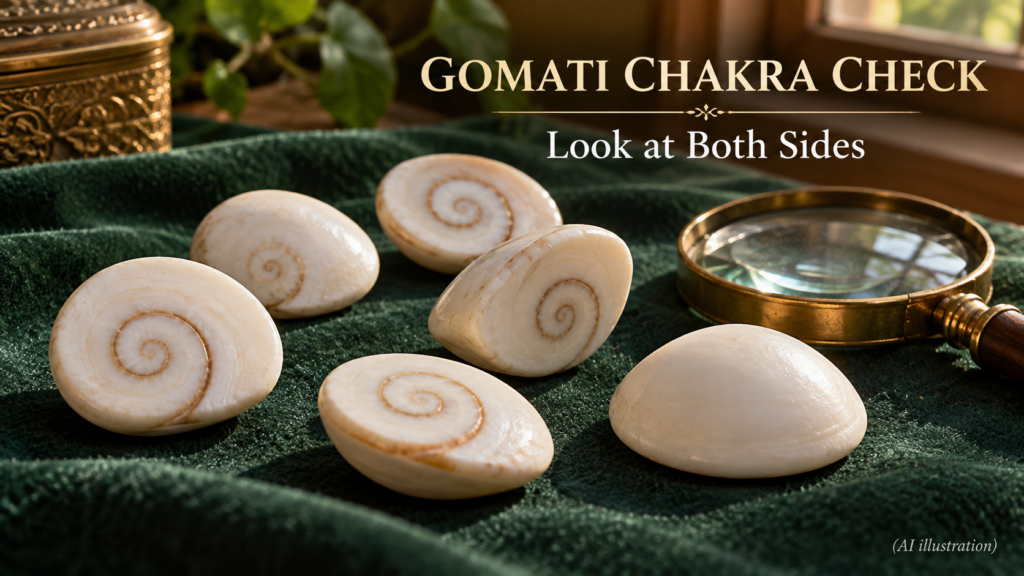
This guide helps you document visible features and ask better buying questions. A photograph is a starting point, not a universal test of material or species. All three images are fictional AI illustrations. They are not photographs of authenticated shells or identified counterfeit examples.
Look at the upper surface, aperture and ends
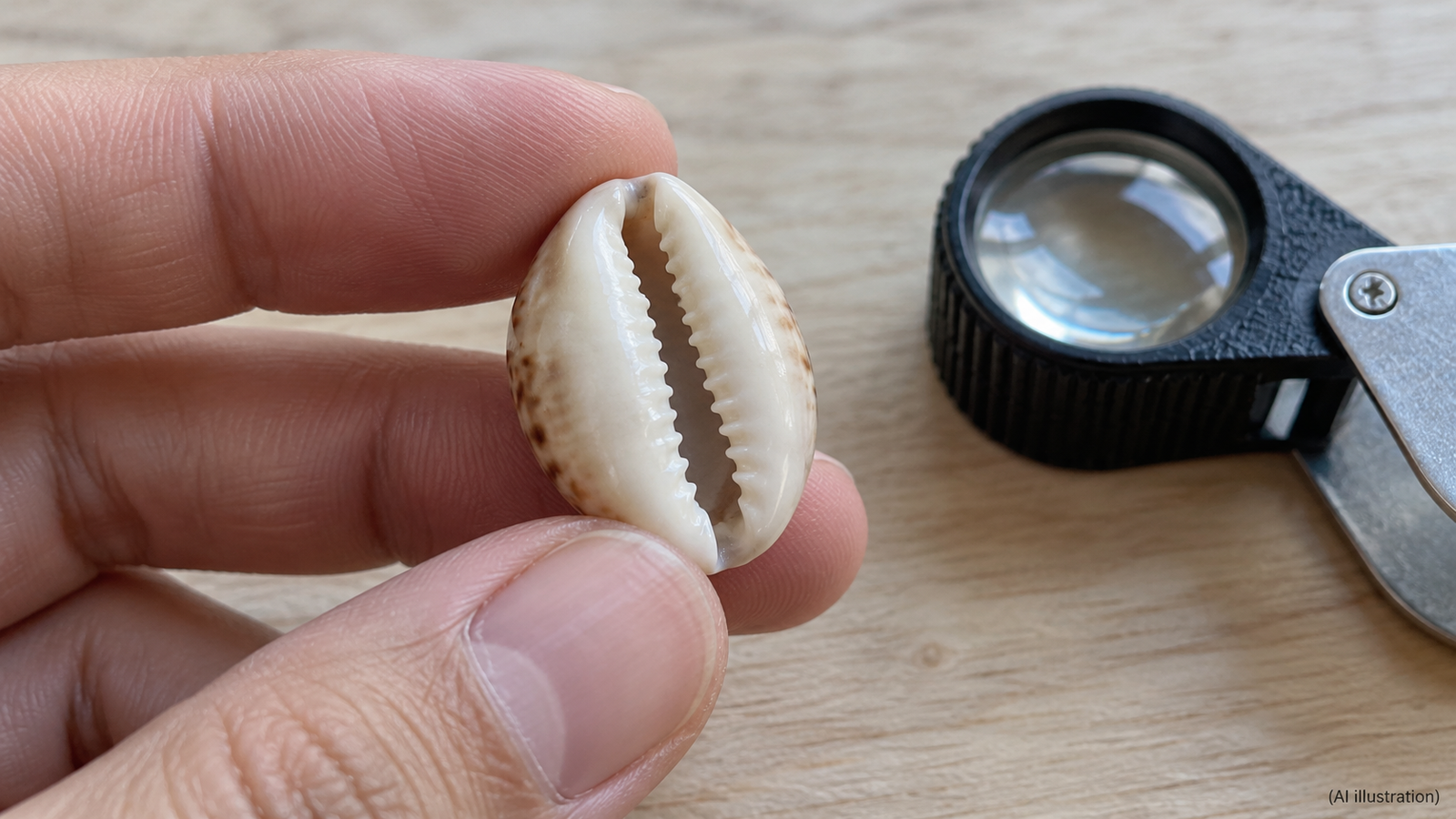
Cowrie is a common name used for marine snail shells. In many adult cowries the upper surface is rounded and the underside has a long, narrow aperture. Toothlike ridges around the opening and the shape of both ends can help with an inspection. Do not expect every specimen to meet one size or tooth-count rule.
Nova Southeastern University’s regional shell key uses the slitlike underside opening as an initial grouping feature, but that step does not separate cowries from every similar-looking shell. A visible slit therefore cannot independently prove a species or the material used to make an object.
Monetaria moneta is the accepted scientific name of the money cowrie in WoRMS. Not every white, yellow or ritual-labelled shell in a shop is necessarily that species. If a seller makes a specific species claim, request the scientific name and the basis for the identification.
Why shine, colour and size cannot decide everything
The Bailey-Matthews National Shell Museum describes cowrie shells as usually smooth and glossy. High shine therefore does not automatically mean plastic. Equally, a glossy appearance cannot prove natural shell material. Reflections, exposure and image processing can change what a surface looks like.
The museum’s Atlantic Gray Cowrie example shows markedly different growth stages within one species. This limited biological example is not a diagnosis of every shopping specimen. A small, worn or differently shaped shell should not immediately be labelled a replica.
Ask what labels such as yellow cowrie, white cowrie or Lakshmi cowrie mean in that listing. Distinguish the claimed natural colour from an applied colour and the appearance under the seller’s lighting. No colour guarantees a ritual outcome, rarity or market value.
FACT: Natural shell, unmodified shell and a particular species are separate claims. Confirming one does not automatically establish the others. Clear descriptions are more useful than a universal real-versus-fake checklist based on colour.
Modified natural shells are different from replicas
Natural shells can be cut or drilled for craft and jewellery use. A Horniman Museum shell-money record documents cowries with their backs removed. A cut upper surface therefore does not itself establish artificial material. Ask why the shell was modified and whether that was disclosed.
If you ordered intact uncut shells and received cut ones, compare them with the listing. A product openly described as craft-cut natural shells makes a different claim. Put natural, intact and untreated descriptions in writing so delivery can be checked against what was promised.
A mouldlike line, closed opening, uneven colour layer or apparent join can justify a close-up and a material question. One photograph does not conclusively diagnose resin, plastic or adhesive. Damage, coatings and natural surface features may also complicate an image.
Avoid hot needles, flames, acids, bleach, boiling or breaking experiments. They can damage the item without resolving its identity. Start with non-destructive observation, seller disclosures and, where the claim justifies it, an appropriate specialist.
Request photographs of the actual offered lot
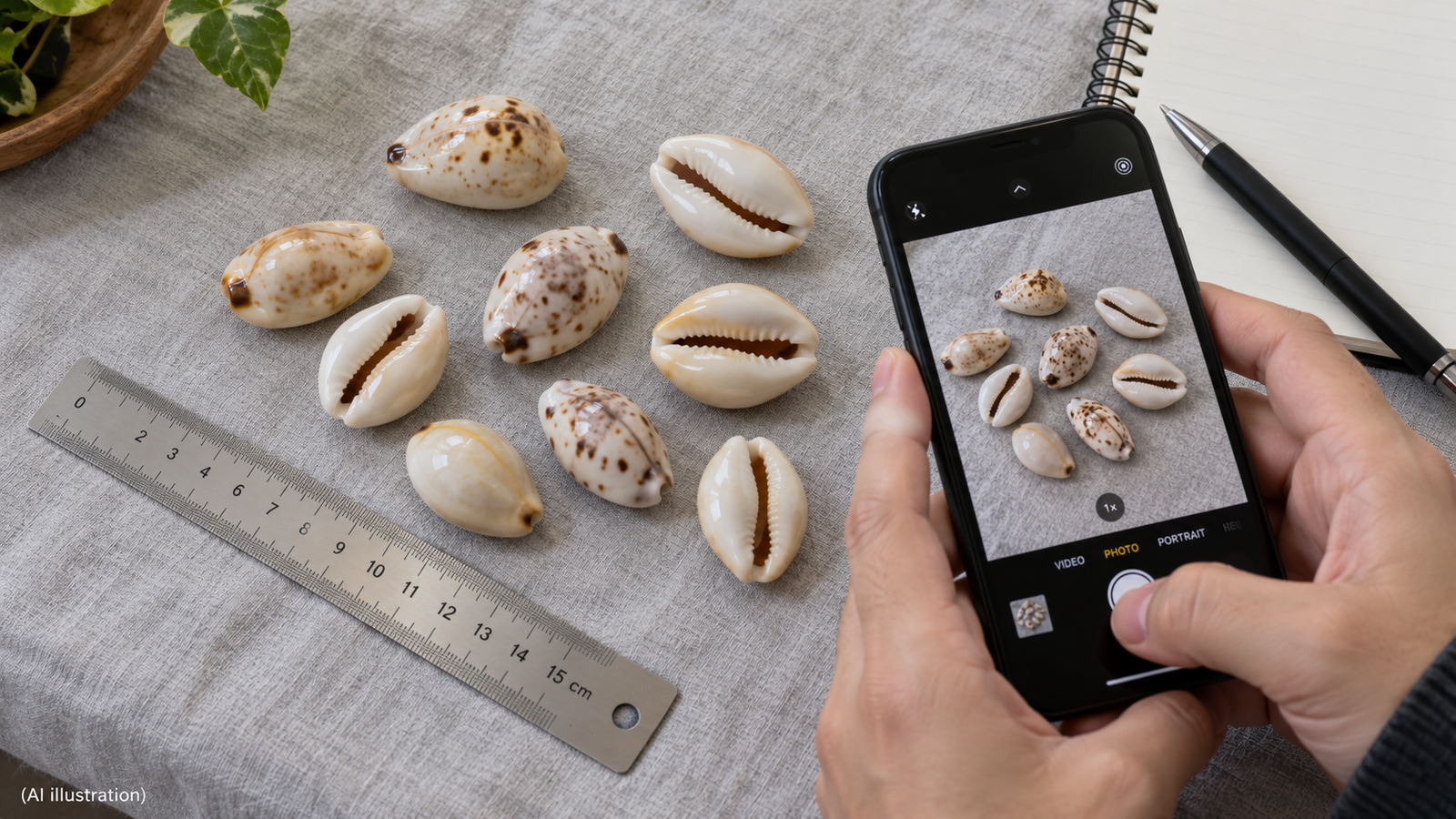
Request an overall dorsal view, a clear underside aperture view and side and end views. Use sharp close-ups without heavy filters. Establish whether the pictures show your available piece or representative shells from the actual lot, and label that distinction clearly.
Ask for a ruler beside the shells in approximately the same plane. Diffuse daylight, a plain background and a dry surface make comparisons easier. If the shells were oiled, wetted, polished or coated, request that information separately rather than assuming every image shows the same condition.
A slow continuous video helps connect the top and underside of a piece, but it is not certification. For a bulk pack, one attractive sample does not show the condition of every shell. Ask about quantity, size range, broken pieces, cutting, drilling and any mixed species.
On delivery, compare the quantity, size range, damage and disclosed treatments with the written description. Keep the original listing and images. A manufactured replica may be suitable for crafts; describing it as natural shell is a separate claim that must match what you ordered.
Advice: questions to send before buying
Send this question: “Are these natural sea shells or replicas? Please show clear top and underside photographs of the actual available lot, quantity and size range. Are any cut, drilled, dyed, polished or coated? What return terms apply if the natural/uncut description is not met?” Keep the reply and invoice.
For a costly rare or collectible claim, ask a relevant malacology specialist or natural history museum whether they provide identification. Not every museum offers commercial certification or valuation. Confirm service scope, fees and specimen requirements before sending an object or paying for an opinion.
If a report is supplied, compare its reference, specimen photograph, quantity and findings. A natural shell conclusion need not establish species, age, origin, ritual suitability or price. Contact the issuer independently and ask how the offered lot is connected to that report.
Keep physical identification separate from religious belief. Ask someone familiar with your tradition about ritual use. This article does not guarantee wealth, a cure or supernatural effects from owning cowries. Make the purchase decision after the material and seller description are clear.
Frequently asked questions
Are glossy cowries always fake? No. Natural cowries can have glossy surfaces.
Can a cut-back cowrie be natural? Yes. A natural shell can be modified for crafts.
Do underside teeth prove the material? No. They are a visible feature, not a standalone material test.
Is every yellow cowrie Monetaria moneta? Do not decide from colour or a trading label alone.
Is this a real-versus-fake specimen gallery? No. The images are AI illustrations and cannot authenticate other objects by resemblance.
Sources and AI illustration disclosure
General educational and buying information, not certification or valuation of a specific shell. Sources support limited biological, taxonomic and documented-modification facts. No seller is endorsed. All three images are fictional AI illustrations. Checked on 24 October 2026.
- Bailey-Matthews National Shell Museum: natural cowrie shell appearance
- Nova Southeastern University: regional shell identification key
- WoRMS: accepted name Monetaria moneta
- National Shell Museum: growth-stage differences in Atlantic Gray Cowrie
- Horniman Museum: documented cowries with backs removed
Dakshinavarti shankh identification and photograph limits