 Vista
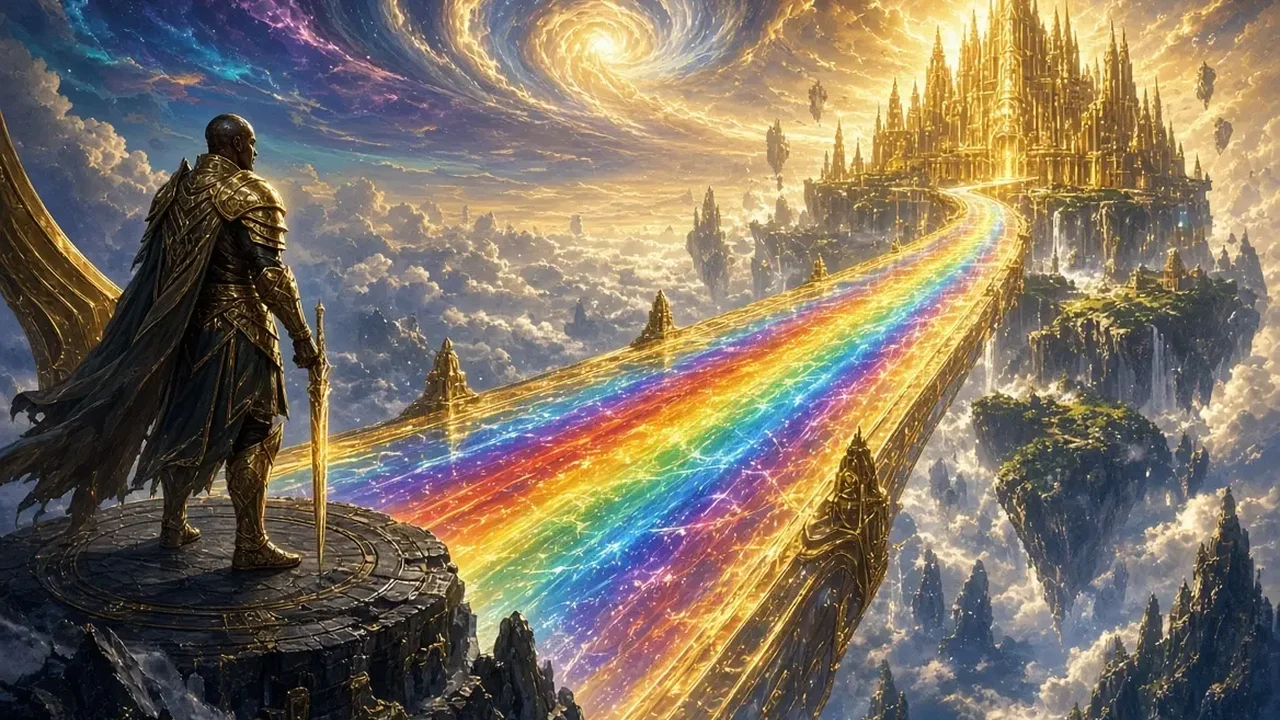
Bifröst (often written Bifrost) is the remarkable rainbow-like bridge in Norse mythology associated with the path from earth to the gods’ dwelling. Snorri’s Prose Edda describes it as a finely made bridge of three colors. Heimdall guards its heavenly end from Himinbjörg. The bridge is extraordinarily strong, but its destruction is foretold when the forces of Múspell arrive at Ragnarök. It is not a surviving stone structure or a sci-fi teleportation machine, even though modern entertainment makes it look like one.
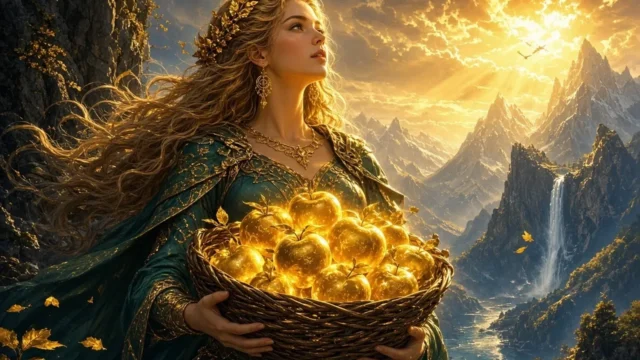
This guide explains Bifrost bridge Norse mythology, how it connects with Asgard and Midgard, who guards it, why it is linked with fire, why Thor uses an alternative route in certain accounts, and what breaks the bridge at the final battle. The featured artwork and infographic are modern interpretations of these stories.
What Is Bifröst? The Rainbow Bridge of the Gods
Bifröst is one of the most recognizable locations in modern Norse-themed art. In the Prose Edda, it is the bridge the gods made from earth toward heaven, which the storyteller compares with the rainbow people see in the sky. It has three colors and is said to be constructed with extraordinary skill. That gives modern illustrators a striking opportunity: a luminous multicolored path stretching between mountains and a distant divine hall. But the text does not offer a photograph-like blueprint or describe a fixed bridge made of modern glass and steel. Its value is symbolic and narrative. It provides a means of connection while reminding readers that even a marvelous divine construction can be vulnerable to cosmic destruction. The spellings Bifröst, Bifrost and Bifrǫst are commonly encountered in English or transliteration. They do not represent three different bridges. A beginner’s guide should identify the object first rather than flood the page with fantasy specifications.
Where Does Bifrost Lead: Asgard and Midgard?
Modern summaries often say Bifrost links Midgard, the human world, to Asgard, the realm associated with the Æsir gods. This is a useful shorthand for the more detailed prose picture of a bridge from earth to heaven and an approach to divine territory. In that account Heimdall keeps watch near the point where the bridge reaches heaven. The story does not provide exact GPS endpoints, modern country names or a transportation network map. Sometimes artists depict a straight staircase climbing through clouds, while others draw an arch in the sky or a giant beam of color. Those are interpretations. A source-based infographic should label Midgard as the human world and Asgard as a divine realm, but should not tell visitors that archaeologists have found the entrance to the supernatural bridge. The distinct roles of world, bridge and guardian are more educationally valuable than a fabricated address.
Why Is the Bridge Three-Colored and Associated with Fire?
Snorri describes the bridge as three-colored and very strong. In a connected passage, the red part of the bridge is explained in relation to burning fire, which helps keep hostile frost giants from an easy route upward. This detail is interesting because the bridge is not a harmless decoration placed in the sky. It is associated with a protected boundary. Modern digital art often uses every color of the spectrum and adds blazing lightning, but the medieval prose specifically emphasizes three colors rather than a standardized RGB rainbow diagram. Nor does the source specify that the bridge generates a measured amount of solar power or serves as an engineered energy beam. A good educational poster might mark ‘rainbow-like bridge’, ‘fiery protection’ and ‘guards the approach to the gods’. It should avoid giving a false physical explanation for a mythical structure. The appeal of Bifröst is precisely the combination of beauty and danger.
Who Guards Bifrost? Heimdall and Himinbjörg
Heimdall is the named watchman of the gods. Snorri says he lives at Himinbjörg, near the heavenly end of Bifröst, and watches for dangerous visitors, including hostile giants. He needs very little sleep, sees great distances in darkness or daylight and hears the most delicate sounds. His horn Gjallarhorn is heard widely and is sounded at the approach of Ragnarök. A figure standing with a horn above a rainbow bridge is therefore a strong visual clue. However, the old sources do not say he permanently operates a mechanical gate by plunging a special sword into a futuristic console. That image belongs to modern adaptations. The horn, watchfulness and position by the bridge are the core source-supported details. In an infographic showing Odin, Thor and Heimdall, the roles should remain distinct: Heimdall guards the route, Thor fights with Mjölnir, and Odin bears Gungnir.
Why Does Thor Not Always Cross the Bridge?
One of the intriguing complications in the Prose Edda is that Thor wades rivers while the other gods ride to their meeting places. Snorri quotes lines listing rivers including Körmt, Örmt and the two Kerlaugar, and explains Thor’s different route in relation to the bridge and the heat or force associated with him. Readers sometimes turn this into a simple universal rule that Thor is forbidden from Bifrost forever. The literary passage is more specific, and the exact interpretation depends on the poetic and prose context. This is a good example of why a modern chart cannot capture every nuance with one arrow. A faithful illustration may depict Thor crossing water while the other gods travel toward the world tree. It should not claim that a verified historic law bans all thunder gods from rainbow bridges. Mythic geography is described through episodes, not a complete set of traffic regulations.
Does Bifrost Break During Ragnarok?
Yes. Snorri describes Bifröst breaking when the destructive forces associated with Múspell ride out for the final conflict. The bridge’s collapse is not treated as evidence that the gods’ craftsmanship was poor; the narrator explains that almost nothing can withstand the force of such an attack. This ending gives the structure a tragic place in the larger mythology. The very bridge that links regions and protects divine territory cannot remain intact when the cosmic order falls. Some modern images show Surtr personally slicing it apart with his sword, or depict a massive explosion controlled by a particular fictional device. Those scenes may be dramatic, but they should not be asserted as the one precise original description. The underlying text associates the bridge’s destruction with the forces of Múspell during Ragnarök. A source-aware caption can say ‘the collapse of Bifrost at Ragnarok, artistic interpretation’ without inventing unnecessary details.
Is Bifrost a Real Rainbow, the Milky Way or a Portal?
The Prose Edda explicitly invites the reader to recognize the bridge as the rainbow. That makes the rainbow identification the most familiar reading. Scholars sometimes discuss alternative imagery and etymological questions, including how the bridge appears in different poems. But those debates should be labeled as interpretations, not presented as newly discovered proof that ancient Vikings built a physical structure in the sky. The Milky Way is a real astronomical feature, and the rainbow is a real optical phenomenon; neither observation turns the supernatural bridge in myth into a measurable transportation system. Likewise, the word ‘portal’ can be an accessible description for modern fans, but the medieval texts do not describe a computerized wormhole network. The safest answer to ‘Is Bifrost real?’ is that rainbows are real, while Bifröst as a route used by gods belongs to mythological literature.
Bifrost in Marvel and Video Games Versus Old Norse Stories
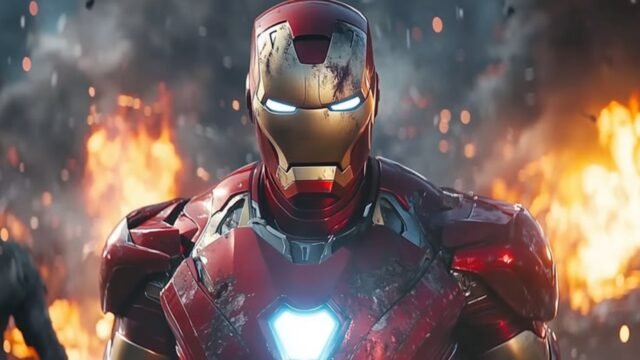
Modern films make the Bifrost resemble a tunnel of colored energy transporting heroes between planets. Some games offer fixed travel gates, maps and rules for opening the route. Those settings create engaging fiction, but they are not transcripts of Gylfaginning. In the traditional prose Heimdall’s watchfulness and Gjallarhorn are key elements; there is no requirement for a modern machine room or a named actor’s costume. The distinction is not a criticism of fantasy storytelling. It simply prevents a reader who searches for the ‘real Norse Bifrost’ from mistaking entertainment design for historical religious evidence. A good comparison article can show the old narrative motifs, then explain how modern works reinterpret them. Original artwork also avoids relying on a branded screen image when the underlying myth has enough distinct visual features of its own: the rainbow-like bridge, the fiery edge and a vigilant guardian.
Bifrost Pictures, Tattoos, Wallpapers and Visual Accuracy
Bifrost is popular in fantasy wallpapers, tattoo sketches and educational maps because its colorful arc offers a striking contrast with snowy mountains or a dark sky. Some modern designs add Yggdrasil, Odin’s ravens, Asgard’s halls or the final fires of Ragnarök. Those can be beautiful personal combinations, but they do not establish one standard Viking Age tattoo symbol. An informative poster should identify the bridge, Heimdall, the two sides of the crossing and the fate of the bridge during Ragnarök. ALT text must describe the actual image rather than merely stack keywords: ‘rainbow Bifrost bridge leading toward Asgard in Norse mythology artwork’ is helpful when the image shows that scene. Captions can explain that the picture is a modern fantasy rendering. As with other mythological images, a strong story and accurate labels matter more than claims that a particular illustration is the bridge’s authentic ancient appearance.
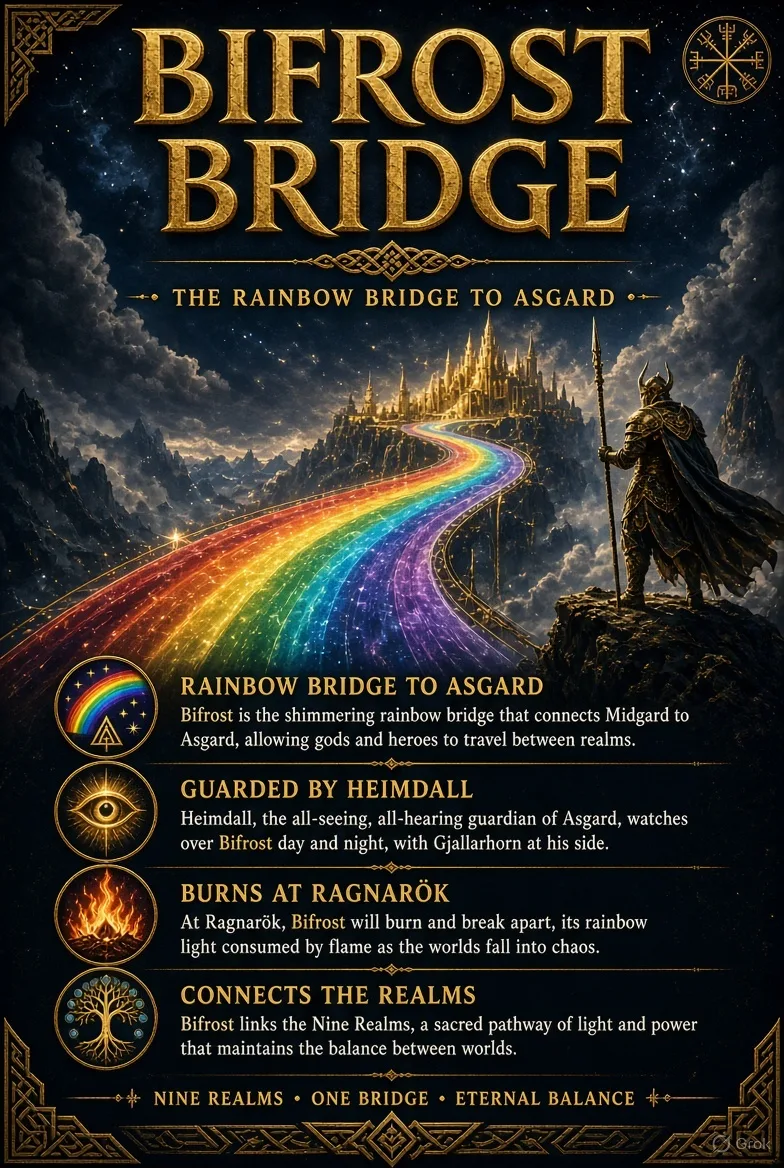
Artwork and source Gylfaginning describes Bifrost as the bridge from earth to heaven and says it breaks under the sons of Muspell. A route through all nine realms is a modern interpretation.
Frequently Asked Questions
What is Bifrost in Norse mythology?
A rainbow-like bridge created by the gods from earth toward heaven, in the familiar Prose Edda account.
Who guards Bifrost?
Heimdall keeps watch by the bridge near Himinbjörg.
How many colors does Bifrost have?
Snorri describes the bridge as three-colored.
Why is Bifrost associated with fire?
The red part is connected with burning fire and with protection against hostile giants.
What happens to Bifrost at Ragnarok?
It breaks when the forces of Múspell arrive during the final conflict.
Is Bifrost a scientific wormhole?
No. It is a mythological bridge; modern portal technology belongs to adaptations.
Conclusion
Bifröst is memorable because it connects worlds but cannot survive the final crisis. The bridge’s rainbow, fiery protection, Heimdall’s vigilance and collapse at Ragnarök are the elements that make a strong, accurate visual article. Its extraordinary appearance can be imagined in art without treating a film’s portal design as a medieval fact.
Sources and artwork disclosure
Prose Edda Gylfaginning: Bifrost and Heimdall; Bifröst with primary source context; Viking Society Gylfaginning critical edition.
Last checked 15 November 2026. Illustrations depict myths, not archaeological structures.








Share Your Opinion
Comments are closed on this post.