 Vista

Titanomachy is the war between the older Titans and the younger divine alliance led by Zeus. In Hesiod’s Theogony, the struggle lasts ten years before Zeus’s side prevails with crucial help from the Cyclopes and the Hundred-Handers. Thunderbolts, hurled rocks and a universe-shaking clash establish the epic scale of the conflict. The defeated opposing Titans are confined to Tartarus, and the rise of the Olympian order follows. This was not simply a battle of small gods against giant humans, nor is it identical to the later Gigantomachy, a different mythic war involving Giants. Here is the complete sequence of the Titan war with characters, causes, alliances, outcome and original source.
What was the Titanomachy in Greek mythology?
The name Titanomachy refers to a great divine conflict usually summarized as “Titans versus Olympians.” That shorthand is helpful, but the ancient story is more nuanced. The Titans are the older generation of gods born from Gaia and Ouranos, while Zeus and his siblings belong to the next generation. Their struggle is not a verified prehistoric battle but a myth of cosmic succession: who has the authority to rule the ordered world after the previous ruler has suppressed his own family?
Our primary continuous source is Hesiod’s Theogony, especially the episodes about Cronus, Zeus’s liberation of divine relatives, and the great war beginning around line 617. There are other ancient and later accounts, including references to lost epic material, but not every modern detail can be attributed to Hesiod. Mythological names are also often reused by films and video games whose stories do not follow the ancient texts. Keeping the literary source clear prevents an invented movie battle from being treated as official Greek history.
Why did the Titans and Olympians go to war?
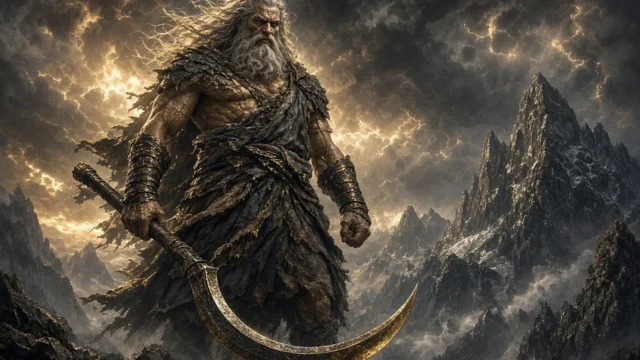
The war begins with a pattern of family conflict. Ouranos tries to suppress children born from Gaia. Their son Cronus attacks and replaces his father as the leading ruler. Later Cronus receives a prophecy that he will himself be displaced by a child. To avoid losing power he swallows the children born to his wife Rhea. She rescues the youngest son, Zeus, by presenting Cronus with a wrapped stone instead of a baby.
Zeus grows up and brings about the release of Hestia, Demeter, Hera, Hades and Poseidon, the siblings who had been swallowed. Their return creates the possibility of a younger divine alliance challenging the old power. The issue is not that every Titan is automatically an evil monster or that the younger gods were created simply to fight. The conflict comes from inherited claims to rule, fear of succession, and the violence of the earlier generation.
Who were the Titans? Cronus, Rhea and their relatives
Hesiod names important Titans including Oceanus, Coeus, Crius, Hyperion, Iapetus and Cronus, as well as Titan goddesses Theia, Rhea, Themis, Mnemosyne, Phoebe and Tethys. Their children and descendants include many figures who matter to later Greek mythology. The word “Titan” marks a generation and lineage in this tradition; it does not guarantee that every member had the same body, personality or political allegiance.
That point is crucial for understanding the war. Prometheus, a son of Iapetus, is a Titan-associated figure but is not simply one of Cronus’s identical soldiers in every telling. Oceanus has his own traditions, and Rhea herself actively protects Zeus. Other Titan-descended powers continue to exist within the world of the Olympians. Saying “Zeus killed all the Titans” is therefore wrong both because Hesiod emphasizes imprisonment of opponents and because the family survives in multiple forms.
How did Zeus build the Olympian alliance?
Zeus’s famous victory depends on more than raw muscle. His siblings belong to the younger divine order, and he also releases powerful beings who had been kept apart or confined. The Cyclopes of the divine genealogy give him thunder, lightning and the thunderbolt. These are not necessarily the same figures as the one-eyed shepherd Polyphemus in Homer’s Odyssey, whose role belongs to a separate heroic story.
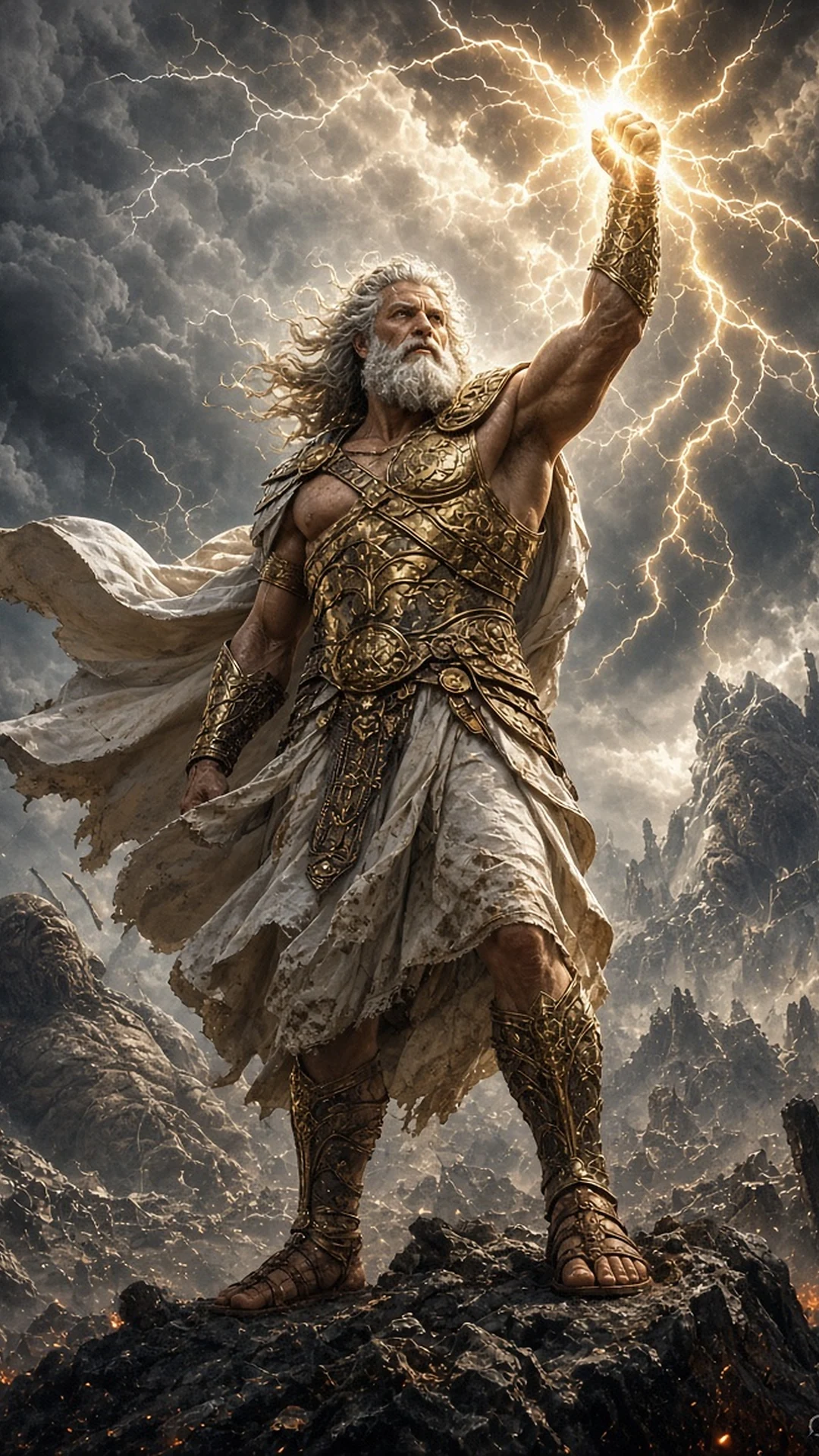
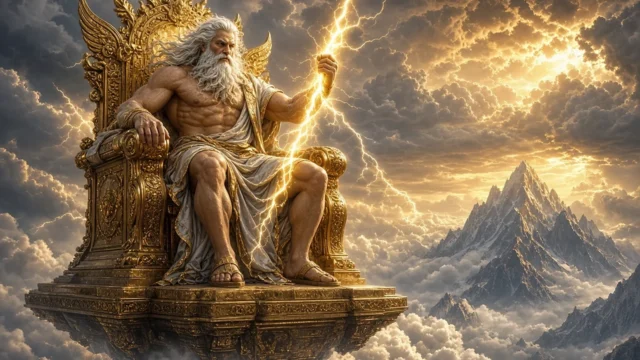
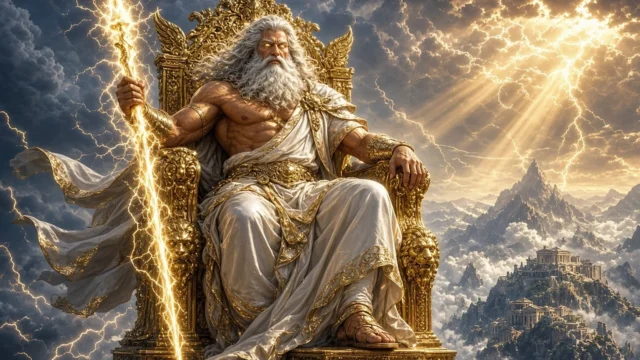
The Hundred-Handers, also called Hecatoncheires, include Cottus, Briareos and Gyes. Their extraordinary many-handed strength becomes decisive when the Olympian side needs to overwhelm the Titans. Hesiod presents Zeus as someone who recognizes the importance of securing allies and giving them reason to fight. An image of Zeus throwing a lightning bolt captures part of the story, but it misses the alliances that make the final outcome possible.
Where did the Titans and Olympians fight?
In the familiar Hesiodic narrative, the older Titans occupy Mount Othrys while the gods led by Zeus fight from Olympus. The conflict is cosmic in scope, so it is not presented as a normal military engagement with surveyed borders or a dated battlefield. Hesiod describes reverberations felt throughout earth, sea, sky and even the depths below. The mountains express rival seats of divine authority rather than two modern geographic nations.
Mount Olympus is a real mountain in Greece, but the divine action associated with it belongs to epic imagination. Othrys too is a geographical name, yet archaeological evidence of a particular battle of immortal beings does not follow from that fact. Readers should enjoy the story as a cultural narrative while understanding the difference between an existing mountain and a supernatural struggle recounted by ancient poets.

How did the ten-year Titan war unfold?
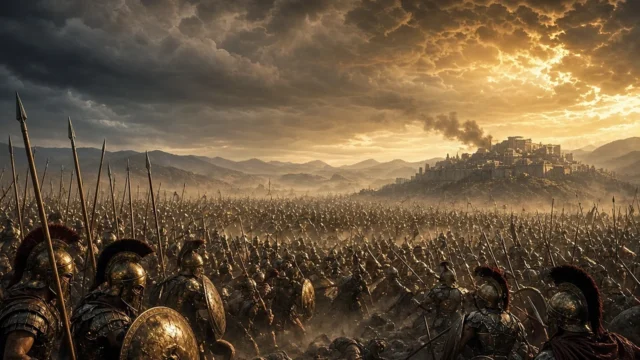
Hesiod explicitly describes a conflict that continues for ten years, with the two sides locked in fierce struggle. The poem does not give a simple day-by-day campaign log. Instead it moves toward a climactic confrontation filled with roaring thunder, heat, lightning, shaking earth and overwhelming force. Zeus hurls his thunderbolts as the confrontation becomes increasingly violent. The imagery gives the listener a sense that the conflict threatens the structure of the world itself.
The Hundred-Handers contribute by launching a terrifying mass of rocks at the opposing Titans. Hesiod describes them throwing hundreds of rocks with their many hands, pushing the enemies toward defeat. The combination of Zeus’s weapons and allied strength changes the balance. This should not be confused with a modern game’s staged boss fight in which Zeus wins solely by discovering a special secret level. The poetic logic emphasizes a ruler’s power, support and eventual establishment of order.
Who won the Titanomachy and what happened afterward?
Zeus and the Olympian alliance win the decisive conflict. The defeated Titans are bound and shut away in the deep region of Tartarus, described in Hesiod as far beneath the earth. Poseidon helps establish the imprisoning gates in the poetic account, while the Hundred-Handers are associated with guarding the confinement. The point is that the former opposing rulers are restrained, not that each Titan is killed and removed from every later Greek myth.
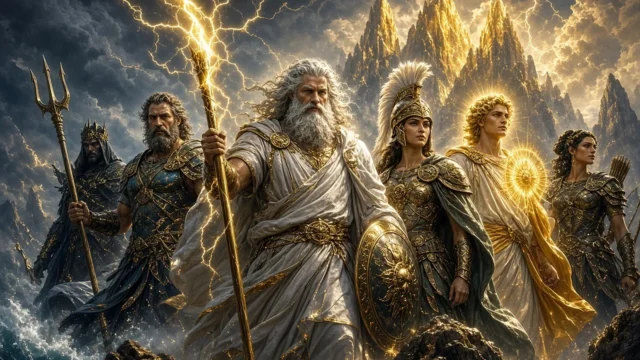
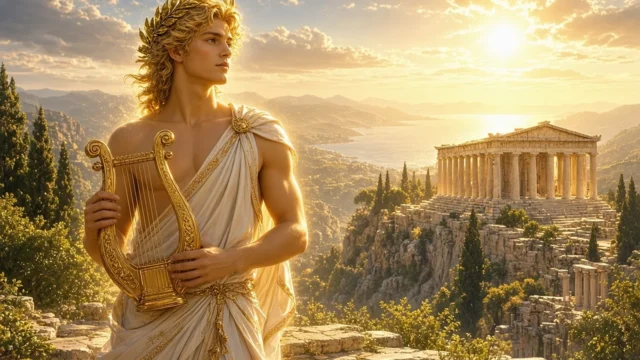
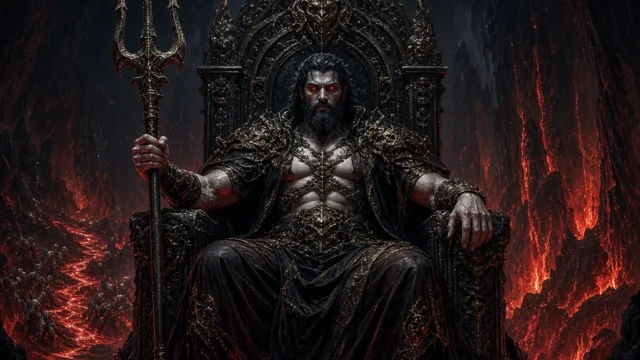
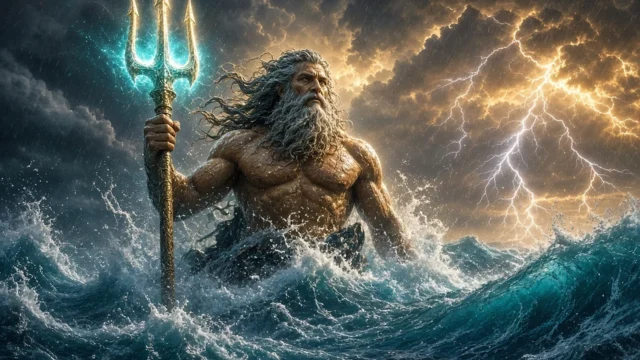
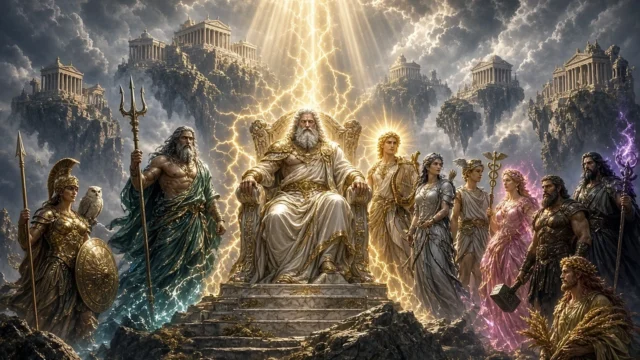
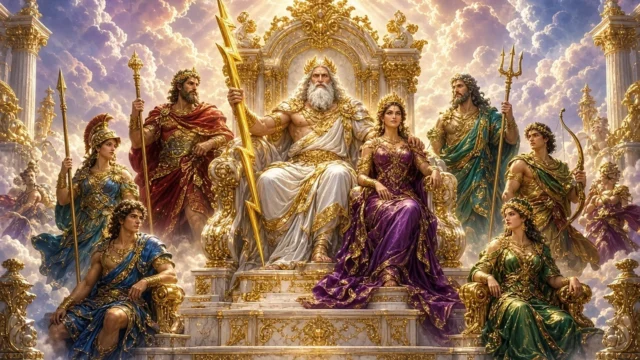
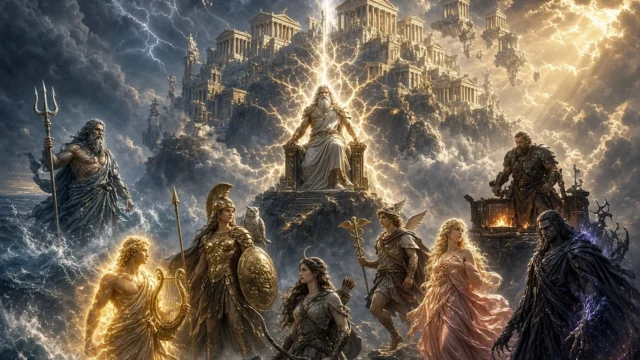
Zeus’s victory establishes the young divine dynasty that readers recognize from stories of Athena, Apollo, Artemis, Hermes, Ares and other Olympians. The division of great domains among Zeus, Poseidon and Hades is emphasized in Homer’s Iliad Book 15. Their authority over sky, sea and the underworld reflects the emerging divine structure. Yet the earth and Olympus are described there as shared, so a simplified picture in which Zeus owns every region without qualification does not match the full passage.
Tartarus: did the Titans die or become prisoners?
In Hesiod, Tartarus is an extremely deep and dark region, already introduced among the earliest cosmic realities in the poem. After the Titanomachy, it becomes a place where defeated Titans are held behind barriers. The poet expresses its depth through the image of a heavy anvil falling for days between the sky, earth and Tartarus. That is a mythic comparison rather than an astronomical distance measurement or an actual geological depth.
It is important to distinguish defeat, imprisonment and death. The tradition centers on the first two, and the earlier beings are divine figures rather than ordinary mortal soldiers. Different poets may give Cronus other later destinies, including associations with a golden age or blessed realm, but those alternatives should be labeled rather than simply added to the Hesiodic version. The most reliable answer to “What happened to the Titans?” is that the opposing group lost cosmic power and was confined.
Titanomachy vs Gigantomachy: what is the difference?
These two names refer to different myths. The Titanomachy is a succession war between the Titans’ generation and the alliance led by Zeus. The Gigantomachy is a later mythic conflict between the Olympians and Giants (Gigantes), widely depicted in Greek art. Ancient sources differ in the genealogies and circumstances of the Giants, and another colossal adversary, Typhon, has his own distinctive combat narrative with Zeus.
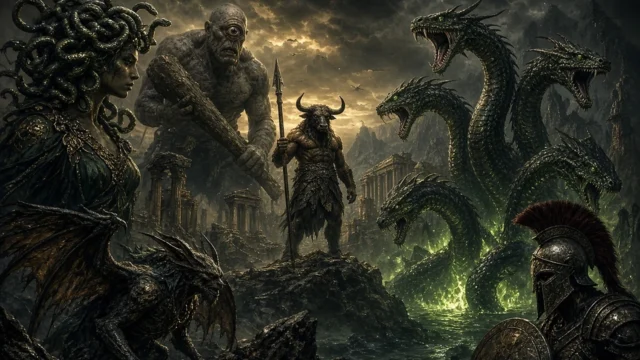
Many online images merge Titans, Giants, Cyclopes and Typhon into a single unnamed army of monsters. That can produce a dramatic poster, but it risks confusing the stories. Cyclopes and Hundred-Handers are allies of Zeus in the Hesiodic Titanomachy rather than enemies he must destroy. Typhon’s confrontation belongs to another section of the Theogony. The word “giant” in a general description is not sufficient to identify a character as a Titan or a Gigante.
What does the Titanomachy mean in the Greek creation story?
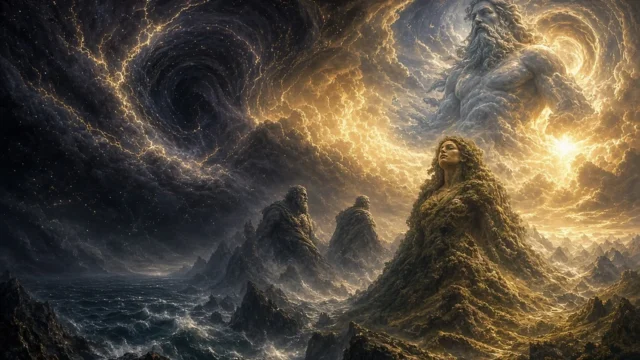
Hesiod’s broader narrative begins with Chaos, Gaia, Tartarus and Eros, then tells of Ouranos and the Titans before reaching Zeus. The Titanomachy completes a major stage in that succession. The younger generation must overcome the older ruler whose attempts to suppress children mirror the previous conflict. The resulting order gives the Olympians authority. Readers can therefore understand the war as a narrative about the emergence of a more stable divine regime, not just a spectacle of physical destruction.
Modern authors may interpret the myth in terms of generational change, political power or the danger of hoarding authority. Those are useful readings if identified as interpretations rather than passages directly quoted from Hesiod. No amount of spectacular art turns the conflict into a scientific account of how the solar system was made. It also should not be mapped one-to-one onto divine battles in another religion merely because both traditions contain conflict between great powers.
Titanomachy timeline and key participants
| Stage | Actors | Outcome |
|---|---|---|
| Older rule | Ouranos, Cronus | Divine succession begins |
| Prophecy | Cronus and Rhea | Children swallowed; Zeus saved |
| New alliance | Zeus, siblings | Imprisoned relatives released |
| Reinforcements | Cyclopes, Hundred-Handers | Thunderbolts and overwhelming support |
| War | Olympian alliance, opposing Titans | Ten years of conflict in Hesiod |
| Victory | Zeus and allies | Titans confined in Tartarus |
| New divine order | Olympian gods | Zeus holds supreme kingship |
Five FAQs about Titanomachy
What does Titanomachy mean?
It is the name for the mythic war involving the older Titans and the younger gods led by Zeus.
How long did the Titanomachy last?
Hesiod describes ten years of conflict before the decisive Olympian victory.
Who helped Zeus defeat the Titans?
The Cyclopes and the Hundred-Handers were crucial allies alongside Zeus’s siblings.
Did Zeus kill all the Titans?
No. Hesiod emphasizes defeat and confinement of opposing Titans in Tartarus, not the deaths of every Titan.
Is the Gigantomachy the same as Titanomachy?
No. The Gigantomachy concerns Giants, while Titanomachy is about the earlier divine succession war.
Sources and conclusion
Read Hesiod, Theogony 617–735 and the earlier succession passages; compare Homer, Iliad Book 15 for the later division of divine domains. For collected genealogical material consult Theoi’s Titans index. Conclusion: Titanomachy is the ten-year war of divine succession won by Zeus and his allies, resulting in the confinement of opposing Titans and establishment of Olympian rule. Updated 14 November 2026. Images are artwork, not documentary evidence.

Share Your Opinion
Comments are closed on this post.