 Vista
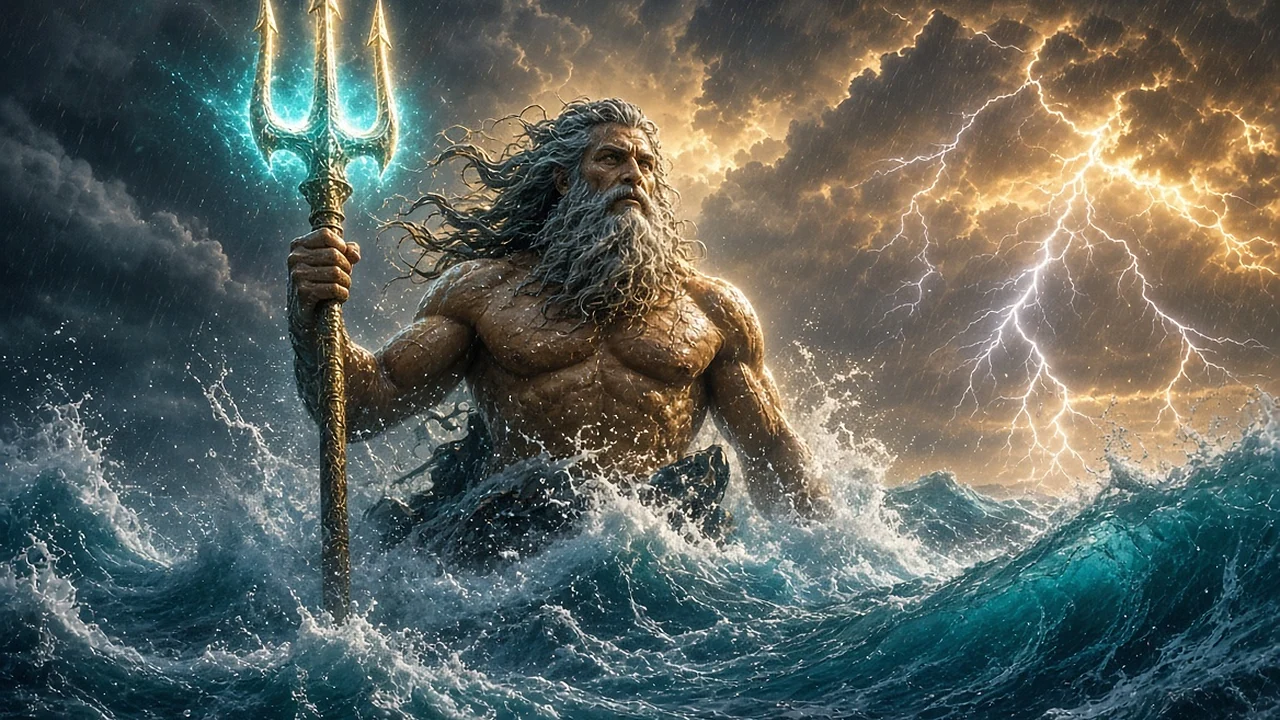
Poseidon in Greek mythology is the god of the sea, earthquakes and horses. He is a son of the Titans Cronus and Rhea and a brother of Zeus and Hades. His most recognizable symbol is a trident, but his identity reaches beyond a spectacular weapon: he can shake the earth, command waves, support cities and challenge other gods. In Homer’s Iliad, Poseidon explains that the three brothers divided important regions of the cosmos by lot; he received the sea. In the Odyssey, his anger helps make Odysseus’s return home painfully difficult. Those primary texts provide a clearer portrait than the simplified modern image of a perpetual ocean villain.
Who was Poseidon, the Greek god of the sea?
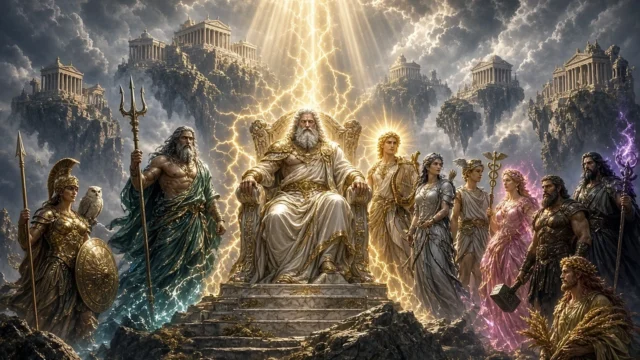
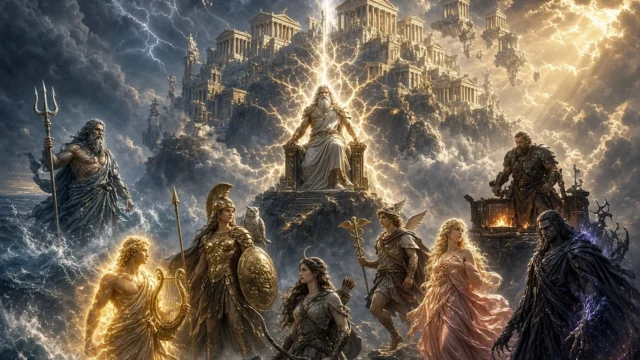
Poseidon belongs to the same divine generation as Zeus, Hera, Demeter, Hestia and Hades. According to the succession story in Hesiod’s Theogony, their father Cronus swallowed his children because he feared a prophecy that a son would overthrow him. Zeus escaped and eventually helped free the siblings. After the victory of the younger divine alliance, the brothers’ respective domains become a major theme in epic literature. Poseidon’s association with the deep ocean is so important that the sea itself can appear as an extension of his force.
Yet the Greeks did not worship him only as a distant monarch beneath the waves. He was involved in maritime life, coastal communities, horses and seismic danger. His Greek epithets often express the idea of the “earth-shaker.” Ancient sailors had compelling reasons to take storms seriously, but a mythical explanation of an earthquake is not a substitute for geology or modern weather science. Greek religion and story are the subjects here, not claims that Poseidon literally caused recorded natural disasters.
How did Poseidon receive the sea? Zeus and Hades compared
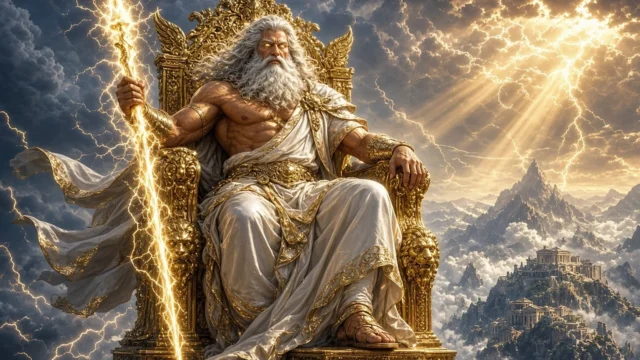
One of the strongest text references appears in Homer’s Iliad, Book 15, around lines 187–193. When Iris carries a command from Zeus, Poseidon protests that he is not merely a powerless servant. He says the three sons of Cronus and Rhea—Zeus, Poseidon and Hades—have their domains: Zeus holds the wide sky, Poseidon received the sea through casting lots, and Hades the dark realm of the dead. Crucially, he adds that the earth and lofty Olympus remain common to them. This is more precise than saying Zeus owns everything and his brothers merely borrow territories.
There is also a political and emotional dimension. Poseidon’s protest reveals tension among divine siblings and competing claims to honor. He ultimately withdraws from the fighting after Iris’s persuasion, not because he was imaginary or weak within the story. The passage is worth reading directly because it challenges the tidy video-game picture in which Zeus has a numerical “power score” and every other god follows him without objection.
Poseidon’s powers: trident, earthquakes and horses
The trident—a three-pronged spear—is Poseidon’s best-known attribute, recognizable on ancient and modern images. As ruler of the sea he can be associated with violent waves, storm-tossed ships and the danger of a coastal journey. He is also the earth-shaker, a title reflecting earthquakes as terrifying natural events understood through divine stories. A wave rising dramatically in an image can represent this mythic force, although it is not historical evidence of a particular tsunami.
His connection to horses surprises many beginners. Poseidon receives horse-related epithets and appears in myths about extraordinary horses and transformations. A powerful horse can be as meaningful to his iconography as a ship or a dolphin. The common Roman counterpart is Neptune, whose own cult and history developed within Roman society; matching names does not erase the differences between Greek and Roman practice. Poseidon can be pictured as a mature bearded deity like Zeus, so the trident and surrounding marine setting are more reliable clues than his face alone.
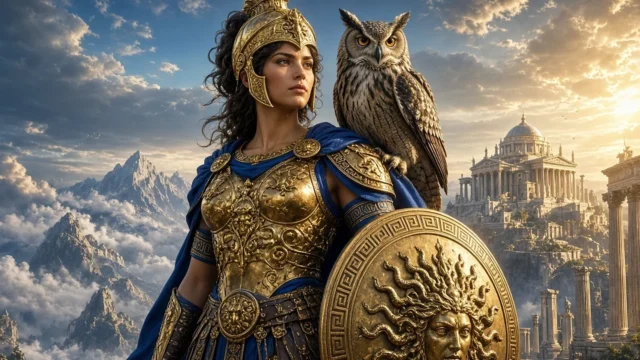
Athena vs Poseidon: who became patron of Athens?
In a famous civic legend, Poseidon and Athena compete for the honor of protecting Athens. In one widespread telling, Poseidon produces a saltwater spring on the Acropolis, while Athena offers the olive tree. Citizens or a judge prefer Athena’s gift, and the city becomes closely associated with her. Different ancient accounts, however, describe Poseidon’s gift differently—sometimes a horse—and vary the details of the judgment. It is therefore misleading to announce one version as the only ancient account.
The story offers an interesting way to think about the qualities a city values: maritime power, speed and horses on one side, cultivation and a sustainable resource on the other. These interpretations are useful if labeled as interpretations, not claimed as an ancient vote count. Despite Athena’s victory in the legend, Poseidon remained important to the religious landscape of Athens and other Greek communities. Two gods in rivalry are not proof that worship of the loser instantly disappeared.
Why was Poseidon angry with Odysseus?
The best-known conflict between Poseidon and a human hero occurs in Homer’s Odyssey. After the Trojan War, Odysseus and his crew encounter the Cyclops Polyphemus. In Book 9, the Cyclops devours members of the crew. Odysseus outwits and blinds him, allowing the survivors to escape hidden beneath sheep. However, Odysseus then reveals his true name. Polyphemus calls upon his father Poseidon to punish the hero by delaying his return and bringing ruin to his companions.
The story is more complicated than Poseidon simply “hating all sailors.” The god is answering his son’s prayer, while Odysseus’s clever escape is spoiled by pride and the need to announce his identity. Subsequent challenges delay the voyage, although other gods and human decisions also contribute. The Odyssey does not describe the sea as inherently malicious: it is a place of hospitality, discovery and life-threatening risk. Poseidon becomes a particular obstacle within a layered epic journey.
Poseidon in the Trojan War and other Greek stories
Poseidon is involved in the mythic history of Troy before and during the famous war. Later traditions describe his work on the city’s walls and a dispute with King Laomedon over promised payment, which leads to the sending of a sea monster. In Homer’s Iliad, divine loyalties and interventions complicate the conflict between Trojans and Achaeans. Poseidon’s relationship with Zeus during that war is not simply obedient: the Book 15 dispute offers a memorable example.
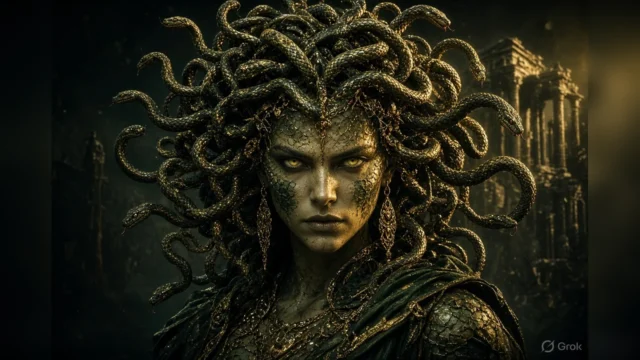
He also appears in genealogies of many other figures, including Triton, associated with the sea, and in some versions the Athenian hero Theseus. Such parentage may vary among sources, so listing every sea creature or horse as Poseidon’s child would be inaccurate. His consort Amphitrite is prominent in marine tradition. He is also linked to Medusa in Hesiod, but the later Ovidian temple-and-transformation account is a different literary layer. Readers need to keep the earliest genealogy and later Roman narrative apart.
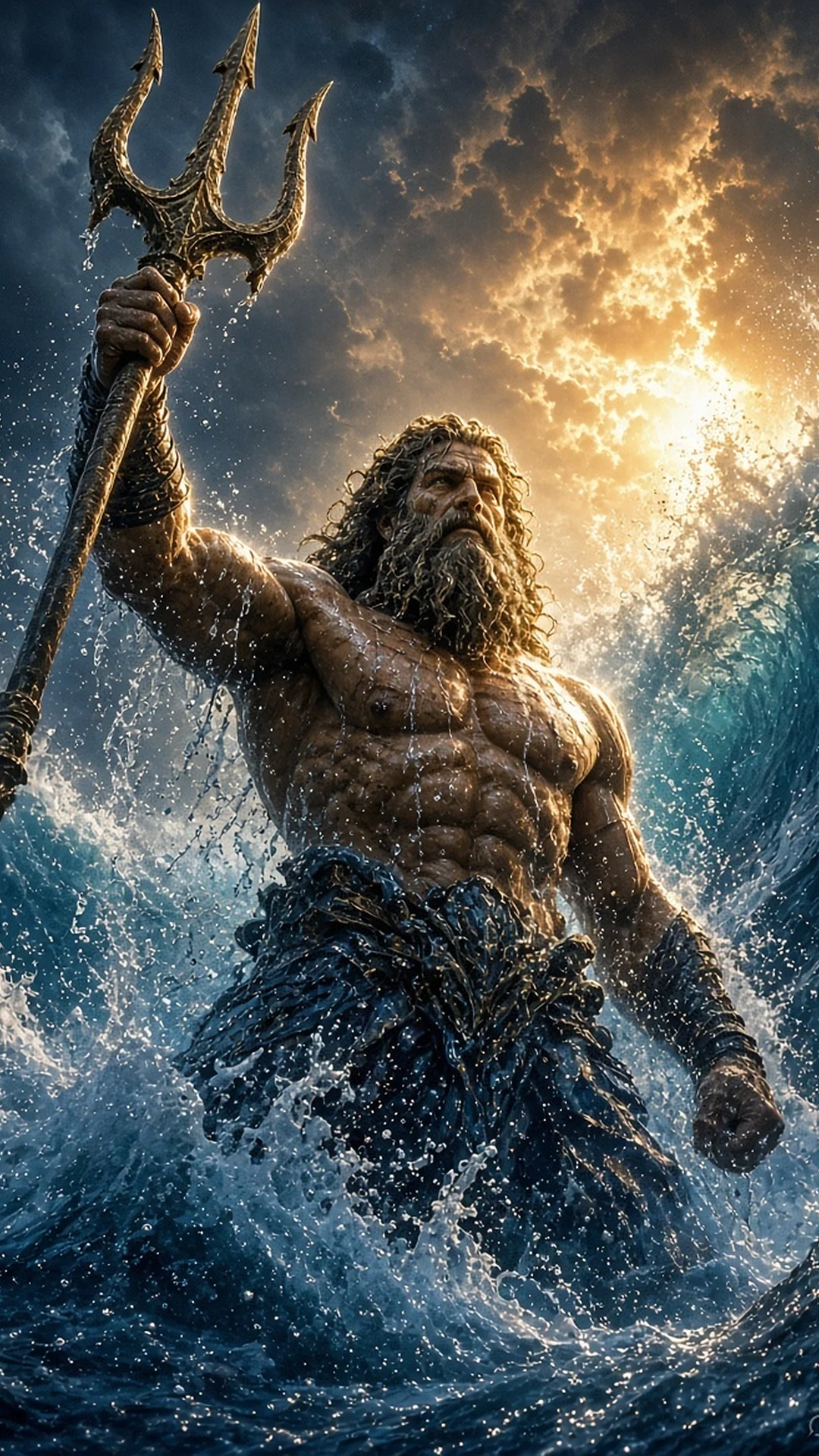
Poseidon vs Neptune and comparison with Varuna
Greek Poseidon and Roman Neptune share the familiar sea-god pairing, but that is a conventional cross-cultural identification, not evidence that every ritual or story was identical. Similarly, Indian readers may notice a broad water-related theme in depictions of Varuna. Their theological roles, literary backgrounds and histories are distinctive. Neither the trident nor control of water proves that Poseidon is the same deity as Varuna or another figure in Indian mythology.
For careful context see our existing Greek vs Hindu mythology comparison. This article instead focuses on Poseidon’s character, sea-related authority and appearances in Greek texts. Readers can then explore Athena’s contest with him, Odysseus’s return and the underworld of his brother Hades as separate search topics rather than turning all mythology into one oversized post.
Poseidon Greek mythology: five FAQs
Who were Poseidon’s parents?
Cronus and Rhea are his parents in Hesiod’s main divine genealogy; Zeus and Hades are among his brothers.
What is Poseidon’s main weapon?
The trident, a three-pronged spear, is his most distinctive artistic symbol.
Why is Poseidon called the earth-shaker?
Earthquakes are one of his traditional domains; the epithet appears in ancient epic literature.
Was Poseidon more powerful than Zeus?
The gods rule different domains. Zeus holds kingship, but Poseidon asserts his own share and honor in Iliad 15; ancient texts do not provide a simple numerical ranking.
Why did Poseidon punish Odysseus?
Polyphemus, Poseidon’s Cyclops son, asked for revenge after Odysseus blinded him and boasted of his identity.
Sources and conclusion
For the division of domains read Homer, Iliad 15.187–193. For the Cyclops episode consult Homer, Odyssey 9, and for mythological references see Theoi’s Poseidon source collection. Conclusion: Poseidon is the sea god, earth-shaker and a force in heroic stories; he is neither a mere copy of Zeus nor a modern villain with a trident. Updated 14 November 2026. Visual scenes are illustrative.










Share Your Opinion
Comments are closed on this post.