 Vista
The Four Vedas: Quick Answer and Why They Matter
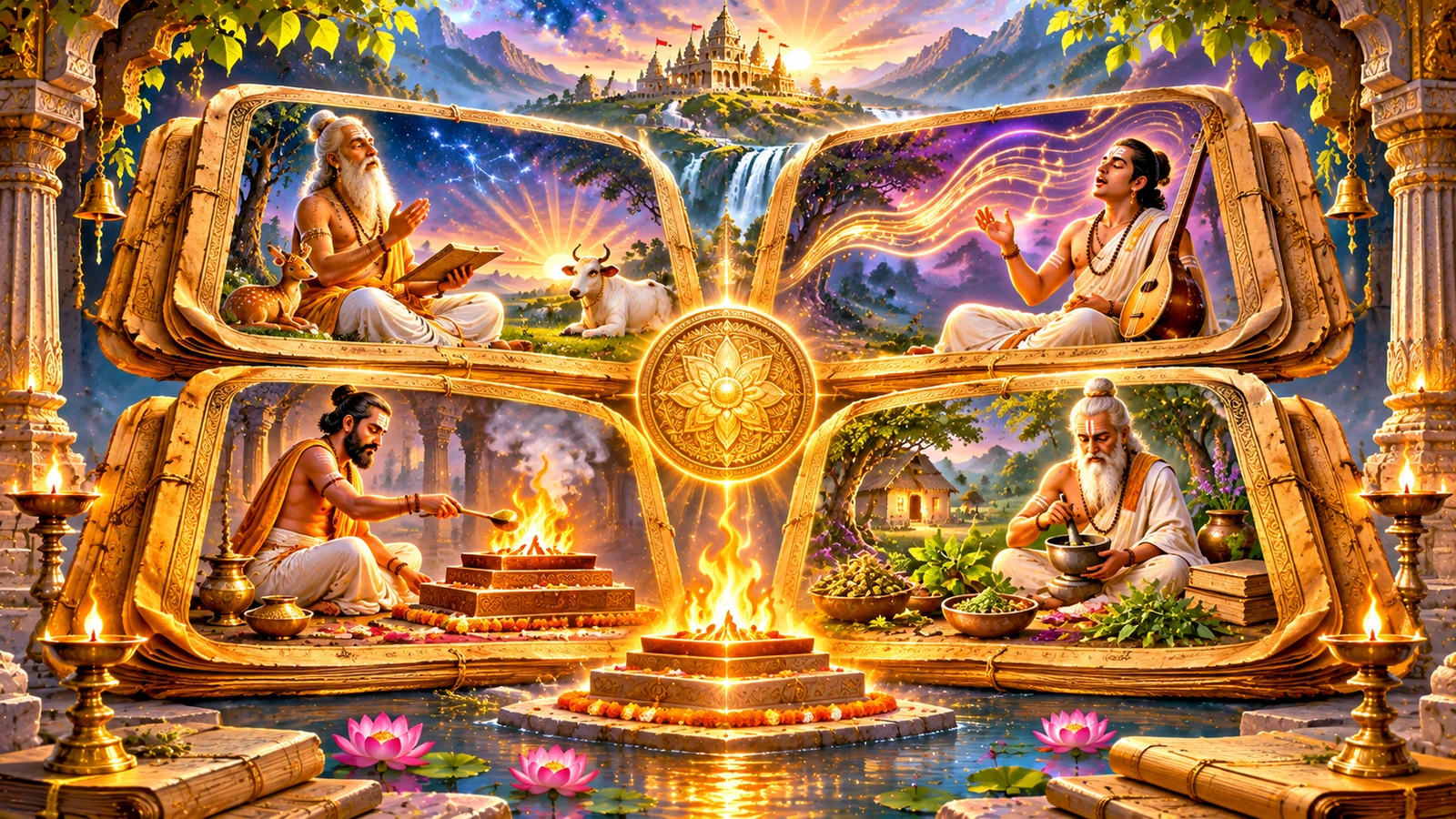
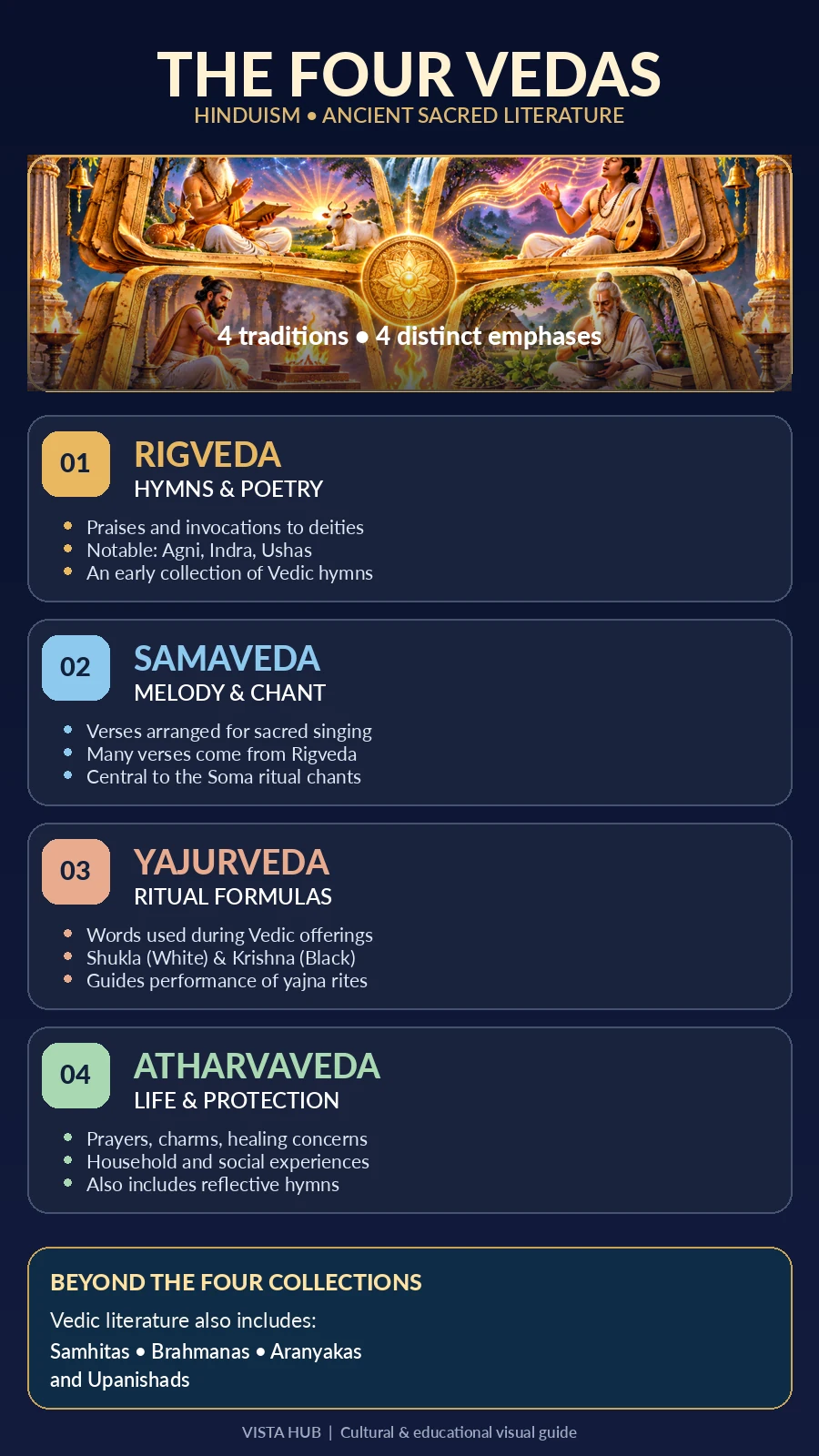
The four Vedas in Hinduism are the Rigveda, Samaveda, Yajurveda and Atharvaveda. In a useful beginner’s summary, the Rigveda is a collection of hymns, the Samaveda organizes verses for melodic chanting, the Yajurveda supplies formulas used in ritual performance, and the Atharvaveda includes prayers, charms and reflections connected with a wide range of human concerns. These labels describe their principal emphases, not everything they contain. The Vedas are a foundational body of ancient Sanskrit sacred literature, preserved for centuries through disciplined oral transmission. They are not four modern books written on one date by one author. Each name refers to a textual and recitational tradition, with several historical layers and, in some cases, different surviving schools. Many Hindus regard the Vedas as shruti, or sacred knowledge heard or revealed to ancient seers. Historians study them as a complex group of orally composed and transmitted texts from the ancient Indian subcontinent. These devotional and academic understandings address different questions and should not be confused. This guide answers which four Vedas exist, what makes each distinctive and how their later literature relates to the Upanishads and Hindu philosophy.
What Does the Word Veda Mean?
The Sanskrit word veda is associated with knowledge. That meaning is more helpful than the casual claim that the Vedas are simply “four books about religion.” Their contents include praise-poetry, liturgical speech, chant, explanatory prose and philosophical discussion. A Vedic verse could be memorized, performed in ritual, explained by a teacher or considered as part of a later philosophical question. The traditions are inseparable from sound: accent, pronunciation, meter and sequence mattered to those who preserved them. UNESCO recognizes the tradition of Vedic chanting as intangible cultural heritage and describes the elaborate recitation methods through which verses were transmitted. This is why a printed page is only one window into the heritage. Another important term is shruti, meaning “what is heard.” In many Hindu schools it marks the Vedas as a special category of scriptural authority. This does not mean every community interprets their meaning in the same way; ritual specialists, Vedanta scholars and contemporary readers frequently approach the same material differently. For an English beginner, the best first step is to learn the four names without flattening their meanings into four unrelated subjects.
1. Rigveda: Sacred Hymns and Early Vedic Poetry
The Rigveda is widely regarded as the oldest of the four Vedic collections. Its core is the Rigveda Samhita, a carefully organized anthology of hymns, commonly described as 1,028 hymns arranged in ten mandalas, although count and editorial conventions deserve care. Its poems praise and address deities such as Agni, associated with sacrificial fire; Indra, prominent in Vedic hymns; Ushas, the dawn; and many others. They are not just a list of divine names. A hymn may celebrate a natural phenomenon, request protection, reflect on social bonds or ask a difficult question about the origin of existence. The famous Nasadiya Sukta, commonly located in the tenth mandala, is noteworthy for its questioning tone about creation. It should not be recast as a confirmed description of the Big Bang. The Rigveda also preserves different poetic voices and forms, often tied to remembered priestly lineages. It can be read as religious poetry and as an important source for studying early language and society, while remembering that a hymn is not an impartial historical record. If you wonder what “Rig” contributes to Vedic knowledge, think first of verse and invocation: words shaped for sacred recitation rather than a modern textbook with chapters on a single theme.
2. Samaveda: Melodies, Chanting and the Sound of Ritual
The Samaveda is especially associated with singing and melodic performance in Vedic ritual. Many of its verses are also found in the Rigveda, but that does not make it a useless copy. Their arrangement and performance are different. The Sama tradition asks what happens when words are sung according to inherited melodic patterns and adapted for a particular ritual setting. It is strongly linked with the udgatri priest and the Soma sacrifice in classical accounts of Vedic ritual. A passage on a printed page does not fully show the performance: special chant manuals and teaching lineages preserve how the syllables and notes are rendered. It is tempting to describe the Samaveda as the literal “origin of all Indian music,” but that is a bigger historical claim than the evidence supports. It is undeniably important for the study of Vedic musical recitation; later Indian musical traditions have their own diverse histories. The central difference between Rigveda and Samaveda is therefore not that one contains religion and the other contains entertainment. Both are sacred; the Samaveda highlights an exacting culture of vocal, melodic ritual expression. Hearing a responsibly documented chant can teach a newcomer something that silent reading alone cannot convey.
3. Yajurveda: Ritual Formulas and the Performance of Yajna
The Yajurveda is associated with the utterances and formulas used when a ritual is actually being performed. Its texts place words alongside the actions of a sacrifice, or yajna. Think of a distinction between a hymn praising a divine figure and a formula spoken as an offering is placed on a sacred fire: both are religious language, but they play different roles. The Yajurveda is especially important to the adhvaryu priest in descriptions of the Vedic sacrificial system. Its historical textual traditions include two major groupings commonly called Shukla (White) Yajurveda and Krishna (Black) Yajurveda. These names refer to textual recensions and organization, not moral judgements or the color of a ritual flame. The collections differ in how mantras and explanatory prose are arranged. Different schools within these groups preserve further variations. Readers should avoid pretending the Yajurveda is a universal do-it-yourself manual for any modern religious ceremony. It belongs to specific ancient ritual traditions and has to be understood in their context. Still, the broad takeaway is easy: the Yajurveda helps explain how sacred speech was coordinated with ceremonial action.
4. Atharvaveda: Protection, Everyday Concerns and Reflection
The Atharvaveda often surprises people who expect every Veda to look like a formal sacrificial hymnbook. Its material includes prayers for protection, texts addressing illness or well-being, domestic and social concerns, charms and speculative reflections. Some passages are connected with healing rituals and anxieties of everyday life. This does not make the Atharvaveda a verified medical manual. An ancient prayer concerning sickness is evidence of a ritual and cultural response to illness, not proof that it safely treats a modern disease. Nor is it fair to reduce the Atharvaveda to “black magic”: the label flattens a diverse collection and can stigmatize a religious tradition without helping readers understand it. The text is relevant to studying household practices, belief, language and ideas of protection. Its surviving recensional traditions, including the Shaunaka and Paippalada branches, also show that “the Atharvaveda” is not simply one unchanging printed edition. The heritage is broader than superstition versus science. A thoughtful reader can explore how communities articulated fear and hope while recognizing the modern evidence standards required for medical claims. Of the four Vedas, this one makes especially clear why reducing ancient sacred literature to a single modern category is misleading.
Four Vedas Comparison: Names, Main Focus and Ritual Use
The following comparison is a quick reading guide. It deliberately identifies a dominant emphasis rather than claiming any Veda contains only one type of writing. Vedic practice involved priests with different roles, and the texts often interact. Their relationships are easier to remember through four questions: What is recited? What is sung? What words accompany an action? What concerns appear beyond the main sacrificial setting? This overview is useful for school assignments, introductory reading and readers seeking a reliable alternative to sensational “secret powers of the Vedas” lists. It should not be treated as a claim that every regional tradition follows one identical ritual system.
| Veda | Main emphasis | Remember it for |
|---|---|---|
| Rigveda | Hymns and poetry | Invocations to Agni, Indra and other deities |
| Samaveda | Melodic chanting | Verses sung for Vedic ritual |
| Yajurveda | Ritual formulas | Words coordinated with yajna offerings |
| Atharvaveda | Prayer and life concerns | Protection, healing-related and reflective texts |
Samhitas, Brahmanas, Aranyakas and Upanishads: The Four Text Layers
A common beginner mistake is to imagine that the word Veda means only the collection of early mantras. In traditional classification, Vedic literature is often discussed through four related layers: Samhitas (collections of hymns and formulas), Brahmanas (explanations of ritual), Aranyakas (texts associated with further reflection on rites and symbolic interpretation), and Upanishads (important philosophical inquiries into the self, ultimate reality and liberation). This is a teaching framework rather than a statement that every Veda preserves four equal-sized books in an identical order. Some Upanishads are embedded within other layers, and particular schools preserve different bodies of literature. The Vedic Heritage Portal maintained under India’s cultural institutions explains this classification and notes the overlap. For new readers, the point is that the Vedas contain both elaborate ritual thinking and openings into profound philosophical questions. Learning these terms also prevents the false distinction that the Upanishads are unrelated to the Vedas. Their historical composition and later reception are complicated, but the relationship is fundamental. The broader Vedic world connects poetic utterance, performance, explanation and reflection.
Are the Vedas, Upanishads and Bhagavad Gita the Same?
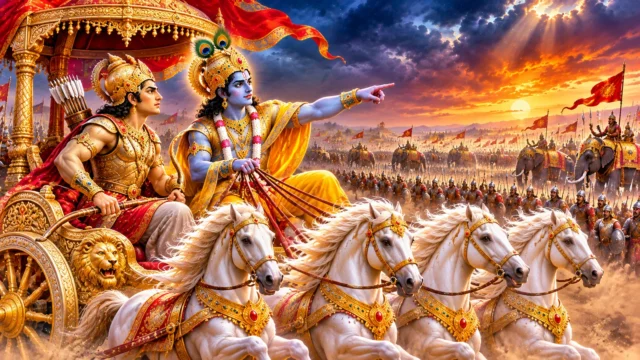
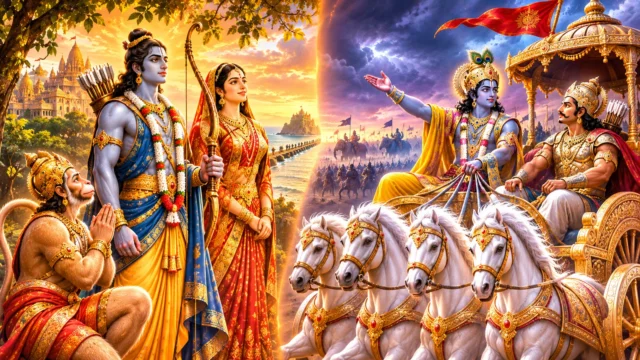
No. The four Vedas are ancient bodies of sacred literature. Major early Upanishads are associated with the Vedic traditions and are frequently discussed as part of the later Vedic corpus. The Bhagavad Gita is a dialogue between Krishna and Arjuna within the Mahabharata, a distinct epic setting that later thinkers interpret in relation to the Upanishads and other traditions. The Gita is enormously influential but is not itself a fifth Veda. The same distinction applies to the Ramayana, Puranas and law or ritual texts: their importance does not automatically make them one of the four Vedas. Hindus differ in how they prioritize these sources, and modern family worship often relies more on accessible devotional songs and stories than on specialized Vedic recitation. For anyone trying to read an English translation, identify the exact work and its category first. A quotation marketed as “from the Vedas” should include a verifiable hymn, section or source; otherwise it may be a later interpretation, a mistranslation or an invented motivational line. Accurate labeling respects the texts and helps readers find the right material.
Who Wrote the Four Vedas? Tradition and Historical Research
In many Hindu understandings, the Vedas are apaurusheya, not products of an ordinary human author, and were heard by rishis. A traditional narrative credits Veda Vyasa with arranging Vedic knowledge into four collections and handing it on through disciples. This is a religious account of their authority and transmission. It differs from the historical study of languages, textual layers and priestly schools. Scholars generally describe the Vedic texts as developing over an extended period through oral composition and careful preservation rather than arriving as four volumes on a single publication date. Dating is complex: major textual layers belong broadly to the late Bronze Age and early Iron Age, with scholarly estimates differing by section and method. Claims that archaeology has proved one exact author or a precise year for every Veda should be treated skeptically. Likewise, saying “all four Vedas were written by Vyasa in one afternoon” confuses traditional attribution with a modern production story. A careful article can explain both frameworks without mocking devotion or presenting religious belief as independently established historical documentation.
How Were the Vedas Preserved Without Printed Books?
Vedic oral transmission is one of the most remarkable aspects of this literature. Students learned recitation from teachers through intensive repetition and specialized patterns designed to preserve sound, accent and the order of words. The language of the oldest passages differs from later classical Sanskrit in important ways. In a tradition where precise chanting mattered, preserving pronunciation was part of preserving a text. UNESCO’s listing of Vedic chanting highlights these pedagogical methods and the cultural significance of surviving recitation schools. The existence of elaborate oral methods does not imply every Vedic branch survives unchanged in the same form. Some lineages and manuscripts are lost, some differ, and scholars compare surviving evidence. Modern recordings, printed editions and digital archives make access easier, but none substitutes for understanding a text’s school and context. If you hear two performances of a Vedic verse, variations may reflect recensional practice rather than a singer making a mistake. This heritage offers a valuable lesson in the history of knowledge transmission: human memory, training and social institutions can preserve complex verbal traditions across many generations.
Four Common Myths About the Vedas
Myth 1: The four Vedas are four chapters of one modern book. They are distinct textual and recitation traditions with different layers. Myth 2: The Samaveda is nothing but a copied Rigveda. Although many verses overlap, melodic organization and liturgical purpose are central to its identity. Myth 3: The Atharvaveda proves ancient cures work today. It documents ritual approaches to health and protection; modern safety and efficacy require modern evidence. Myth 4: Every quotation labeled “Vedic” is authentic. The internet routinely circulates unattributed sayings. A responsible writer looks for an edition, verse reference and translation. Another recurring claim is that the Vedas explicitly describe every present-day scientific discovery. These texts have considerable intellectual and cultural importance, but forced one-to-one readings of modern science into religious poetry are usually poor scholarship. The stronger claim is also unnecessary: the Vedas are meaningful sources of religious thought and historical study without needing to be rebranded as physics manuals. Respect for tradition and precision about evidence can coexist.
How to Begin Reading the Four Vedas in English
Start with a reputable overview of Vedic literature before trying to read an entire Samhita. Learn what “hymn,” “mandala,” “shakha” and “recension” mean, then choose one small unit to examine carefully. A translated Rigvedic hymn is often an accessible first encounter because it reads as poetry. For the Samaveda, complement the words with a well-documented audio performance that names its recitation tradition. For the Yajurveda, use an introduction that explains the ritual gestures alongside the formulas; otherwise the text can feel opaque. For the Atharvaveda, approach healing and protective charms as cultural and religious documents, not practical medical prescriptions. The Vedic Heritage Portal and UNESCO’s Vedic chanting record are useful starting resources; academic reference articles can add historical context. Compare translations when possible. Do not assume that a free PDF labelled “complete Vedas” represents all surviving schools or four textual layers. Ask what edition, translator and manuscript or oral tradition it follows. Careful reading offers more genuine discovery than a list of unverifiable spectacular claims.
Frequently Asked Questions
What are the names of the four Vedas in order?
The standard four are Rigveda, Samaveda, Yajurveda and Atharvaveda. Some lists place Yajurveda before Samaveda; that order does not create an extra Veda.
Which Veda is the oldest?
The Rigveda is generally treated by scholars as the oldest of the four core collections, though its individual layers and precise dates require care.
What is the difference between Rigveda and Samaveda?
The Rigveda collects sacred hymns; the Samaveda organizes many related verses for melodic chanting in ritual settings.
Is the Yajurveda mainly about yajna?
Yes. Ritual formulas and their coordinated performance are its central emphasis, especially in Vedic sacrificial practice.
Is Atharvaveda about black magic?
That is an inaccurate oversimplification. It includes charms and protective prayers as well as domestic, healing-related and reflective material.
Are the Upanishads a fifth Veda?
No. The Upanishads are important later Vedic philosophical texts linked to different Vedic schools.
Who authored the four Vedas?
Traditional Hindu accounts regard the Vedas as shruti and connect their arrangement with Vyasa. Academic research studies their long, layered oral formation.
Conclusion: Four Vedas, One Diverse Literary Heritage
Remember four anchors: Rigveda—hymns; Samaveda—melody; Yajurveda—ritual formulas; Atharvaveda—prayers and the concerns of life. Those descriptions are doors into a much larger tradition, not boxes that contain every possible interpretation. The Vedas link poetry, oral performance, rites and philosophy across centuries. Read with attention to the source, community and historical context, and leave room for differences between devotional claims and academic descriptions. That combination makes the Four Vedas easier to understand—and far more interesting than misleading claims about a single secret book of supernatural powers.
Related Reading
Sources and Further Reading
- Vedic Heritage Portal — Introduction
- Vedic Heritage Portal — Samhitas
- UNESCO — Tradition of Vedic Chanting
- Oxford Bibliographies — The Vedas (Michael Witzel)
Editorial note: Vedic religious claims and cultural history are described in their contexts; ancient ritual or healing texts are not presented as modern scientific or medical proof. Reviewed 13 November 2026.



Share Your Opinion
Comments are closed on this post.