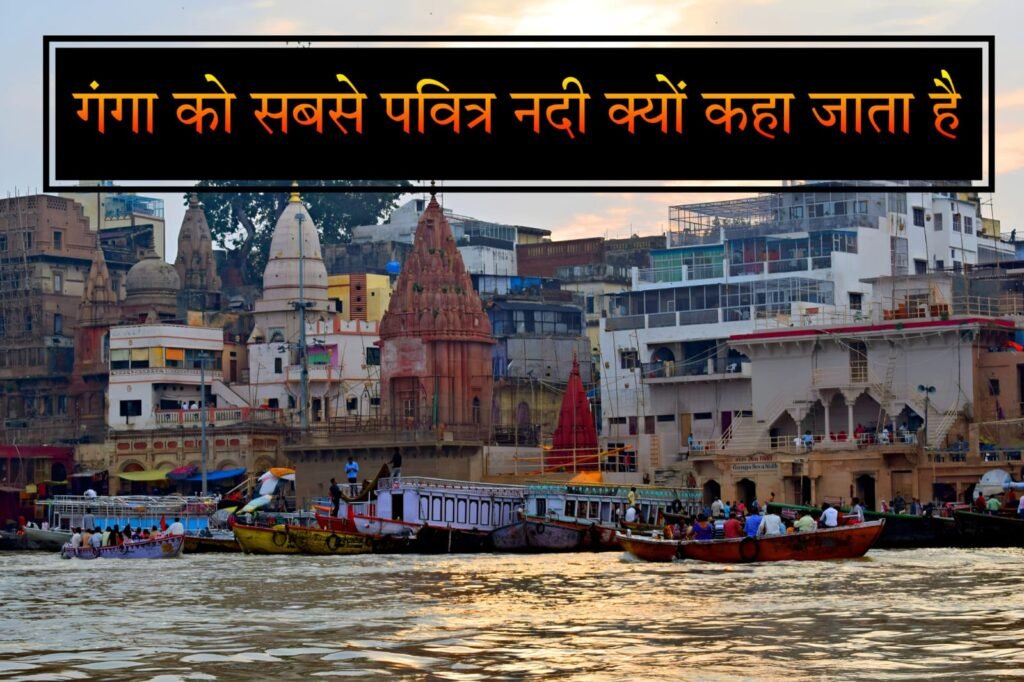
The Sacred Ganges: More Than Just a River
In India, rivers are not merely sources of water; they are revered as life-giving goddesses. Among these, the name that resonates most profoundly is ‘Mother Ganga.’ For centuries, the Ganges has been considered the holiest river in India. But have you ever wondered why the Ganges holds this unparalleled status? Why is it called ‘Mother Ganga,’ and why is it the focal point of faith for millions?
This exploration delves into the diverse reasons that make the Ganges not just a geographical entity but a vibrant symbol of faith, science, and culture. It’s not solely a matter of religious belief; scientific facts and deep cultural connections underpin its sanctity.
The Religious Significance of the Ganges: A Confluence of Faith and Tradition
The most significant reason for considering the Ganges the holiest river lies in its profound religious and mythological importance. Ancient Indian scriptures describe the Ganges as a goddess who descended from heaven to Earth.
Mythological Tales and the Descent of the Ganges
The most famous tale of the Ganges’ arrival on Earth is linked to King Bhagiratha. After the 60,000 sons of the Suryavanshi King Sagara were incinerated by the curse of Sage Kapila, King Bhagiratha undertook severe penance for their liberation. His aim was to bring the Ganges, flowing in heaven, to Earth so that the ashes of his ancestors could attain salvation through Ganga water. Pleased by Bhagiratha’s penance, Ganga promised to descend to Earth, but her mighty current was too powerful to be contained. Bhagiratha then worshipped Lord Shiva, who caught the force of Ganga’s stream in his matted locks and then released it gently onto Earth. This is why Ganga is also called ‘Bhagirathi.’ This event establishes Ganga as a goddess and a bestower of salvation, signifying her descent not just for water, but for liberation and redemption.
Sins Erased and Salvation Granted
Hinduism holds a strong belief that a mere dip in the Ganges washes away all sins and grants salvation (moksha). People often wish to breathe their last or have their ashes immersed in the Ganges, as it is believed to free the soul from the cycle of birth and death. Grand religious gatherings like the Kumbh Mela are held on the banks of the Ganges, where millions of devotees bathe to earn merit. This belief transforms the Ganges from a mere river into a gateway for spiritual purification and ultimate liberation.
Pilgrimage Sites and Festivals
Several major pilgrimage sites, including Haridwar, Rishikesh, Prayagraj (Allahabad), and Varanasi (Kashi), are situated on the banks of the Ganges. These places have been centers of attraction for devotees for centuries. Ganga Aarti, sacred baths, and various religious rituals performed here reflect unwavering devotion to the river. Bathing in the Ganges during festivals like Ganga Dussehra, Makar Sankranti, and Kartik Purnima is considered especially significant. All these traditions firmly establish the Ganges as the holiest river in the hearts of the Indian populace.
The Scientific Significance of the Ganges: Nature’s Precious Gift
Alongside religious faith, the Ganges possesses a significant scientific aspect that distinguishes it from other rivers.
Medicinal Properties and Water Purity
A unique characteristic of Ganga water is its ability to remain fresh for extended periods compared to ordinary water. Scientific research suggests that the Ganges water contains special bacteriophages – viruses that infect bacteria – which eliminate harmful bacteria present in the water. It also contains sulfur, minerals, and certain radioactive elements that impart medicinal properties. Since ancient times, people have stored Ganga water in their homes for use in rituals and as a remedy for ailments. This self-purifying capability makes the Ganges not only sacred but also scientifically unique.
Biodiversity and Ecosystem
The Ganges River is a home to rich biodiversity. It shelters numerous species, including the Ganges River Dolphin (India’s National Aquatic Animal), gharials, various types of fish, and other aquatic life. Its vast basin supports a complex ecosystem along with millions of people. The fertile soil brought by the Ganges has made the vast plains of North India arable, turning the region into the granary of India. Thus, the Ganges is a vital source of life, not just spiritually, but naturally.
Life-Giving Source
The Ganges is one of India’s largest river systems, serving as the primary source of drinking water, irrigation, and livelihood for over a quarter of the country’s population. The economies of cities and villages situated along its banks depend on the Ganges. It directly impacts the lives of millions, providing them with water, food, and employment. In this way, the Ganges is not just a river but a life-giving artery for the Indian subcontinent.
The Cultural and Social Significance of the Ganges: The Identity of Indian Civilization
The Ganges is deeply woven into the fabric of Indian culture and society. It is more than a river; it is a symbol of civilization.
Ganges in Art, Literature, and Folklore
The Ganges is repeatedly mentioned in the Vedas, Puranas, epics, and other ancient texts. It has been an integral part of Indian literature, art, music, and folklore. Poets have sung praises of its beauty, power, and sanctity. It symbolizes motherhood, purity, tolerance, and continuity. Many folk songs and regional art forms depict the Ganges as a central theme, showcasing its deep penetration into the Indian psyche.
Basis of Lifestyle and Livelihood
Cities and towns that developed along the banks of the Ganges are known for their unique culture and lifestyle. The river has not only provided water but also livelihood through agriculture, fishing, trade, and tourism. The daily activities, religious rituals, and social gatherings on the Ganga ghats are an integral part of Indian life. For centuries, the river has brought people together, fostering a shared cultural heritage.
Symbol of Unity and National Consciousness
Flowing through various states of India, the Ganges connects different regions and cultures of the country. It is a powerful symbol of national unity and integrity. Whether in the plains of North India or the delta regions of the East, the Ganges is revered everywhere and is a significant part of Indian identity. It connects us to our roots and our shared heritage.
Ganga’s Sanctity in Modern Context and Our Responsibility
Today, while the Ganges is considered the holiest river, its sanctity is threatened by pollution. Urbanization, industrialization, and a growing population have polluted its waters. However, the government and various organizations are running many campaigns like ‘Namami Gange’ to make the Ganges clean and pure. Maintaining the sanctity of the Ganges is not just the government’s responsibility but the duty of every Indian. We must understand that the Ganges is not just a religious symbol but our life, our culture, and our future. When we protect the Ganges, we are truly protecting our civilization and our environment.
Conclusion
There isn’t just one reason for calling the Ganges the holiest river, but a complex tapestry of religious faith, scientific significance, and deep cultural connections. It is a bestower of salvation, a life-giver, and a symbol of civilization. It connects us to our roots and is a vital part of our identity. The Ganges is not just a river but a ‘Mother,’ providing us with life, sustenance, and spirituality. Preserving its sanctity is the most important task for our generation, so that future generations can also experience the divine form of ‘Mother Ganga.’
VIVEK BHAI’S ADVICE
Look friends, Mother Ganga is not just a river, but the heartbeat of our culture. Whenever you get a chance, go and sit by the banks of the Ganges. Its peace, its vastness, will give you a different energy. And yes, try your best to contribute to keeping it clean. Don’t throw plastic, don’t spread garbage. This is true devotion, far beyond just worship.