 Vista
What is the Hindi Barakhadi?
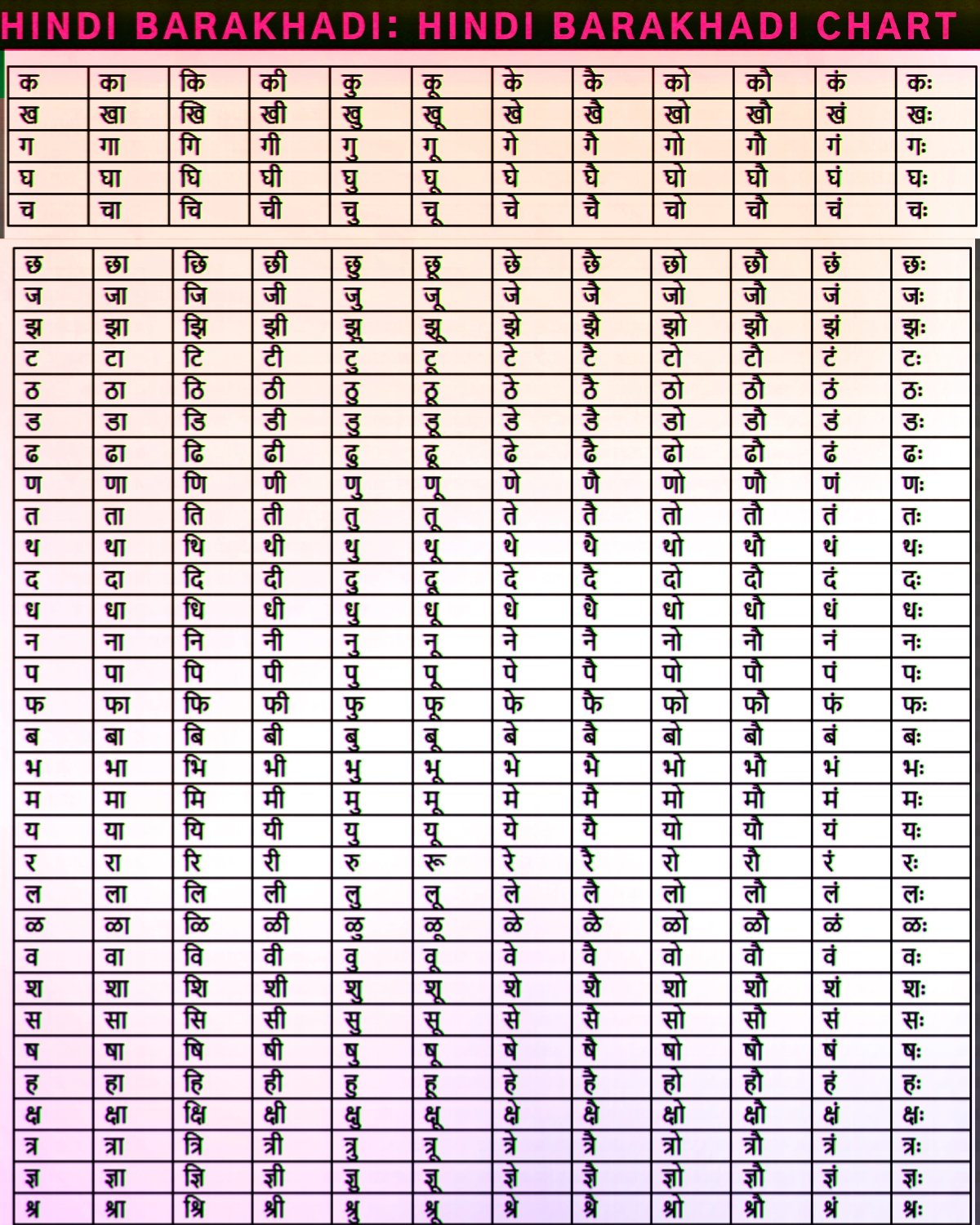
The Hindi Barakhadi is the foundational step for learning to read and write in Hindi. After a child recognizes individual letters, the next stage involves adding vowel signs (matras). The term “Barakhadi” literally means “twelve forms,” referring to the twelve variations of a consonant when combined with different vowel sounds. For example, starting with the consonant “क” (ka), its Barakhadi includes का (kaa), कि (ki), की (kee), कु (ku), कू (koo), के (ke), कै (kai), को (ko), कौ (kau), कं (kan), and कः (kah). This systematic arrangement of consonants with matras forms the basis of the Devanagari script. While vowels (स्वर – swar) like अ, आ, इ, ई are learned separately, it’s the combination of consonants and matras that enables word formation. A Barakhadi chart displayed prominently helps in learning through both sight and sound, reinforcing memory through regular exposure.
Understanding Vowels, Consonants, and Matras
Before diving into the Barakhadi, it’s essential to have a clear understanding of its building blocks:
- Vowels (स्वर – Swar): These are the independent sounds of Hindi, such as अ (a), आ (aa), इ (i), ई (ee), उ (u), ऊ (oo), ए (e), ऐ (ai), ओ (o), औ (au), अं (an), and अः (ah). They can be pronounced on their own.
- Consonants (व्यंजन – Vyanjan): These include letters like क (ka), ख (kha), ग (ga), घ (gha), ङ (nga), and so on. Consonants require a vowel sound to be fully pronounced, and this is where matras come in.
- Matras (मात्रा): These are the vowel signs that modify the sound of a consonant. For instance, when the ‘aa’ matra (ा) is added to ‘क’ (ka), it becomes ‘का’ (kaa). The sequence is क → का → कि → की → कु → कू → के → कै → को → कौ → कं → कः.
When teaching young children, it’s advisable not to overwhelm them with all matras at once. Start with the basic vowel sounds and their corresponding matras, like the ‘a’ sound (inherent in consonants) and the ‘aa’ matra (ा). Gradually introduce इ/ई, then उ/ऊ, followed by ए/ऐ and ओ/औ. Finally, introduce the nasal sound (anuswar – ं) and the voiceless aspirate (visarga – ः). This gradual approach prevents confusion and aids comprehension. Emphasize clear, loud pronunciation and encourage children to repeat after you. Comparing a child’s progress to their own previous performance, rather than to other children, fosters a positive learning environment.
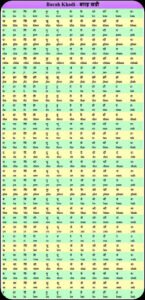
Hindi Barakhadi Chart HD Images
Below are high-definition images of the Hindi Barakhadi chart. You can save these images to your mobile device, download them to your computer, or print them on A4 paper to display in your child’s study area or on a wall. These charts serve as a constant visual aid for learning.
Mobile: Long press on the image → Download / Save image
Computer: Right-click → Save image as…
Displaying the chart prominently ensures it’s not just decorative but a functional learning tool. When a child forgets a matra, pointing to the chart can turn a mistake into a learning opportunity.
How to Use the Barakhadi Chart Effectively
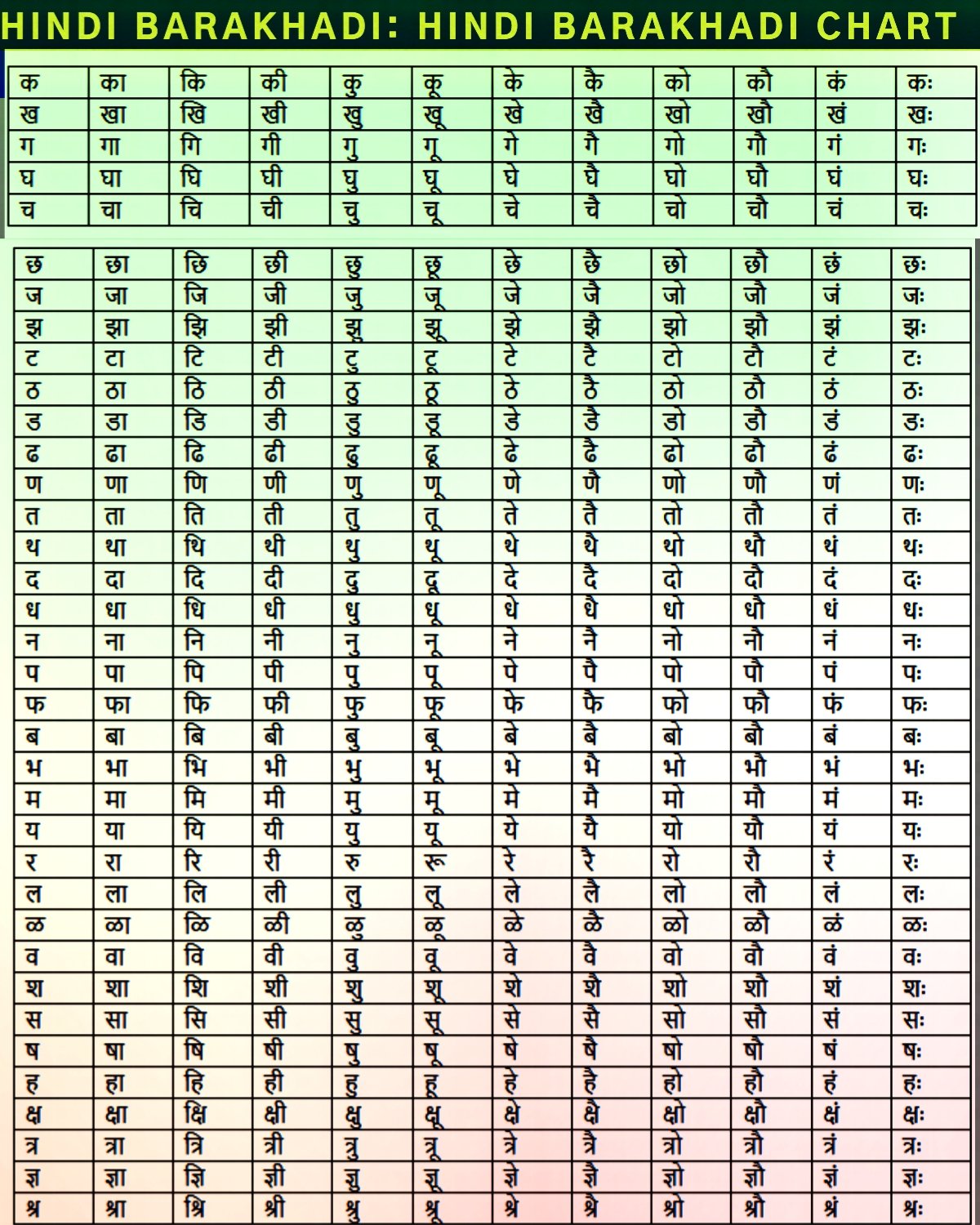
Simply downloading a chart is not enough; regular, small-scale usage is key to reaping its benefits. Here are practical ways to integrate the Barakhadi chart into daily learning:
- Wall Chart: Place it in a visible study corner. Spend 5 minutes each morning reciting a row aloud.
- Finger Tracing: Younger children can trace the letters with their fingers, engaging both sight and touch for better retention.
- Listen-Speak Games: Parents can say a matra, and the child points to it on the chart, or vice versa.
- Copy Practice: Dedicate time daily to writing out the Barakhadi of one consonant in a notebook.
- School Projects: Print the chart and paste it onto chart paper or a file for school assignments, adding a clear title.
- Revision Cards: Create separate flashcards for challenging matras like ऐ, औ, अं, अः.
Consistent practice, even for just 10 minutes a day, can significantly improve reading speed and accuracy. Incorporating short, daily tests can also be beneficial. For example, ask the child to recite a row from memory or identify the matras in a spoken word.
Step-by-Step Guide to Teaching Barakhadi
The best way to teach Barakhadi depends on the child’s age and learning pace. However, a structured approach can be very helpful:
- Master Vowels First: Ensure the child can confidently recognize and pronounce all vowels (अ, आ, इ, ई, etc.) before moving to consonants.
- Introduce Consonants Gradually: Start with a few consonants like क, ख, ग. Begin with only the ‘aa’ (ा) and ‘i’ (ि) matras for these consonants. Once comfortable, introduce the full Barakhadi for each.
- Form Simple Words: Combine syllables to form words, such as ‘काम’ (kaam) from ‘का’ (kaa) + ‘म’ (ma), or ‘किताब’ (kitaab) from ‘कि’ (ki) + ‘ता’ (taa) + ‘ब’ (ba). Explain the meaning to make it relatable.
- Daily Revision: Reinforce learning by reviewing the current day’s row and a row from a previous day. Consistent revision strengthens memory.
- Start Reading: Use simple children’s stories or school readers. It’s okay for the child to refer to the chart when stuck; their dependence will naturally decrease over time. Avoid pushing if the child seems tired, as this can create aversion. Praise even small achievements.
Encourage Hindi conversation at home to improve listening comprehension, which aids reading. If a child struggles with a particular matra, focus on it for a few days. For children with special needs or learning difficulties, consult with school teachers or specialists.
Common Mistakes and Memory Aids
Several common mistakes can hinder Barakhadi learning, but they are easily avoidable:
- Relying solely on visual memory: Emphasize oral recitation and writing practice.
- Confusing similar matras: Clearly demonstrate the subtle differences between इ/ई and उ/ऊ, and between ए/ऐ and ओ/औ.
- Teaching too many matras at once: Master simpler matras before introducing complex ones. Break down learning into manageable chunks.
- Keeping the chart hidden: Display it prominently in the learning area.
Using rhythm and melody can make learning more engaging, similar to how music aids memory. Some families use clapping to keep the rhythm while reciting. Older students can create lists of difficult words to practice specific matras and improve spelling.
Frequently Asked Questions (FAQ)
What is the Hindi Barakhadi?
The Hindi Barakhadi is a systematic arrangement of consonants with their twelve vowel forms (matras), forming the foundation for reading and writing Hindi.
How can I teach Barakhadi to my child?
Start with vowels, then introduce consonants one by one with their matras. Use a chart, practice reciting and writing daily for about 8-10 minutes. Consistent, short sessions are more effective than long, infrequent ones.
Where can I download Hindi Barakhadi charts?
You can save or download the HD chart images provided in this article. Use the instructions for mobile or computer saving.
Can I use a printed chart for a school project?
Yes, a printed A4 chart can be used for school projects, files, or as a wall poster. Ensure you add a clear title.
What is the difference between the alphabet and Barakhadi?
The alphabet (varnamala) is a list of vowels and consonants. Barakhadi is the practice sequence or chart showing how consonants combine with matras to form words.
How long does it take to learn Barakhadi?
Learning speed varies per child. With consistent practice in small steps, most children achieve a good grasp within a few weeks. Avoid rushing the process.
Conclusion: Display, Recite, Read
The Hindi Barakhadi chart is more than just an image; it’s a powerful learning tool. The charts provided here, along with practical explanations on teaching matras and using the chart at home and school, aim to make learning effective and enjoyable. Regular, short practice sessions reduce the fear of rote learning and enhance reading fluency. Our advice for parents and children is simple: save the chart, display it, recite a row daily, and practice writing. Always consider the school textbook as the final authority for curriculum specifics. This guide offers educational tips, not guaranteed outcomes or magical learning methods.












Share Your Opinion
Comments are closed on this post.