Gautam Buddha’s Early Life and Royal Grandeur
Born around 563 BCE in Lumbini, Nepal, Siddhartha Gautama was the son of King Suddhodana and Queen Mahamaya. His mother passed away seven days after his birth, and he was raised by his aunt, Prajapati Gautami. From childhood, Siddhartha was known for his calm, contemplative nature, often finding solace in observing nature and pondering life’s deeper mysteries. Astrologers predicted he would either become a great emperor or a renounced ascetic. King Suddhodana, wishing for his son to be a ruler, shielded him from the harsh realities of the outside world, ensuring he lived a life of luxury within the palace walls. At 16, he married Princess Yashodhara, and they later had a son named Rahula.
The Four Sights: The First Step Towards Truth
Despite his privileged life, Siddhartha yearned to understand the true meaning of existence. During a chariot ride outside the palace, he encountered four profound sights that altered his perspective: an old man, a sick person, a corpse, and a serene ascetic. These encounters revealed the inescapable truths of aging, illness, suffering, and death. Witnessing the ascetic sparked a realization that renunciation might offer a path to liberation from these universal sufferings.
Mahaparinirvana: The Great Renunciation and the Quest for Truth
Deeply affected by these experiences, Siddhartha felt detached from his royal life. At the age of 29, he made the momentous decision to leave his palace, wife, and son behind in pursuit of truth. This event is known as the ‘Mahabhinishkramana’ or the ‘Great Renunciation’. Following his departure, Siddhartha spent years in rigorous ascetic practices, seeking knowledge from various teachers. However, he found that extreme self-mortification brought only physical weakness, not mental peace. He concluded that both excessive indulgence and extreme asceticism were detrimental, and he embraced the ‘Middle Path’—a way of moderation and balance.
Enlightenment Under the Bodhi Tree: From Siddhartha to Buddha
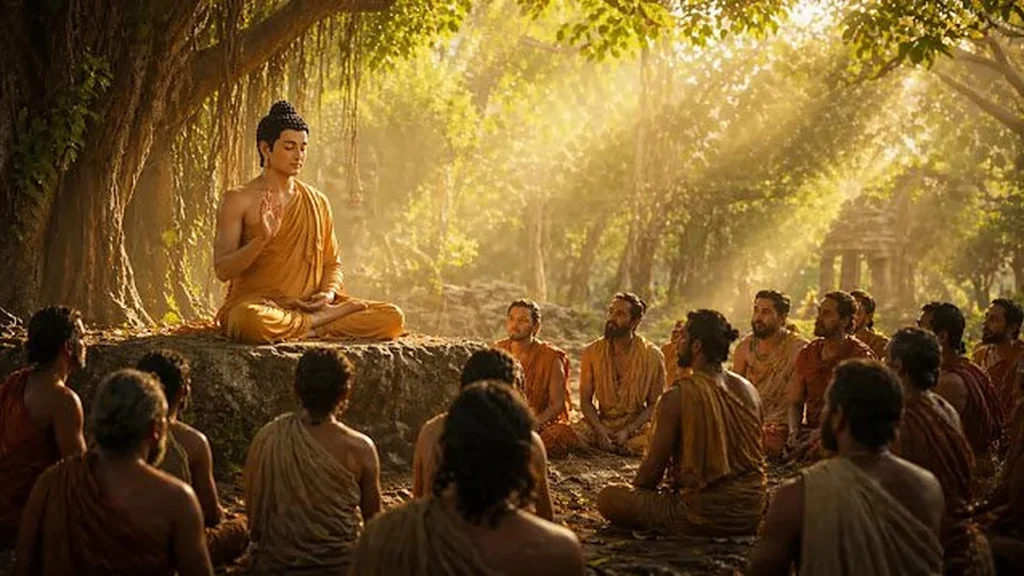
In his final quest for truth, Siddhartha meditated under a Bodhi tree in Bodh Gaya, Bihar, vowing not to move until enlightenment was achieved. After days and nights of intense meditation and inner struggle, he attained ‘Bodhi’ (enlightenment), becoming ‘Buddha’—the ‘Awakened One’. Post-enlightenment, Buddha understood the ‘Four Noble Truths’: Life is suffering (Dukkha). The origin of suffering is craving (Trishna). The cessation of suffering is possible by eliminating craving. The path to the cessation of suffering is the Noble Eightfold Path.
First Sermon and Dharmachakra Pravartana
After attaining enlightenment, Buddha delivered his first sermon to his five former companions in Sarnath, near Varanasi. This event, known as ‘Dharmachakra Pravartana’ or ‘Setting the Wheel of Dharma in Motion’, marked the establishment of Buddhism and the formation of the Sangha (community of monks and nuns). For the next 45 years, Buddha travelled across India, spreading his teachings and guiding thousands towards self-realization and peace.
Mahaparinirvana: The Final Journey and Eternal Peace
Around the age of 80, in 483 BCE, Gautam Buddha attained ‘Mahaparinirvana’ (final liberation) in Kushinagar, Uttar Pradesh. His last words were, “All conditioned things are impermanent. Strive on with diligence.” He advised his disciples to follow the ‘Dhamma’ (teachings) rather than any individual.
Key Teachings of Gautam Buddha
1. The Four Noble Truths
The foundational principles of Buddhism, outlining the nature of suffering, its cause, its cessation, and the path to achieve it.
2. The Noble Eightfold Path
The practical guide to ending suffering, comprising Right Understanding, Right Thought, Right Speech, Right Action, Right Livelihood, Right Effort, Right Mindfulness, and Right Concentration.
3. The Middle Path
Advocates for balance and moderation, avoiding extremes of self-indulgence and severe asceticism.
4. Non-violence and Compassion (Ahimsa and Karuna)
Emphasizes love, kindness, and non-violence towards all sentient beings, teaching that hatred can be overcome by love.
5. No-self (Anatta)
The doctrine that there is no permanent, unchanging self or soul, encouraging detachment from ego and worldly attachments.
6. The Law of Karma
The principle that our actions have consequences, motivating individuals to act ethically and consciously.
Gautam Buddha’s Relevance in the Modern World
In today’s fast-paced and stressful world, Buddha’s teachings offer profound guidance. Meditation techniques enhance mental peace, stress reduction, and self-awareness. His principles of non-violence, compassion, and tolerance serve as a beacon for global harmony. Buddhist philosophy encourages us to understand life’s impermanence, transcend material desires, and seek inner happiness.
Conclusion
Gautam Buddha’s life and teachings are an invaluable legacy to humanity. His journey from a prince to an enlightened being teaches us that through the pursuit of truth, self-discipline, and compassion, we can overcome life’s sufferings and attain true peace. His message continues to inspire us to live more mindful, tranquil, and compassionate lives.