Understanding Direct and Indirect Speech: The Basics
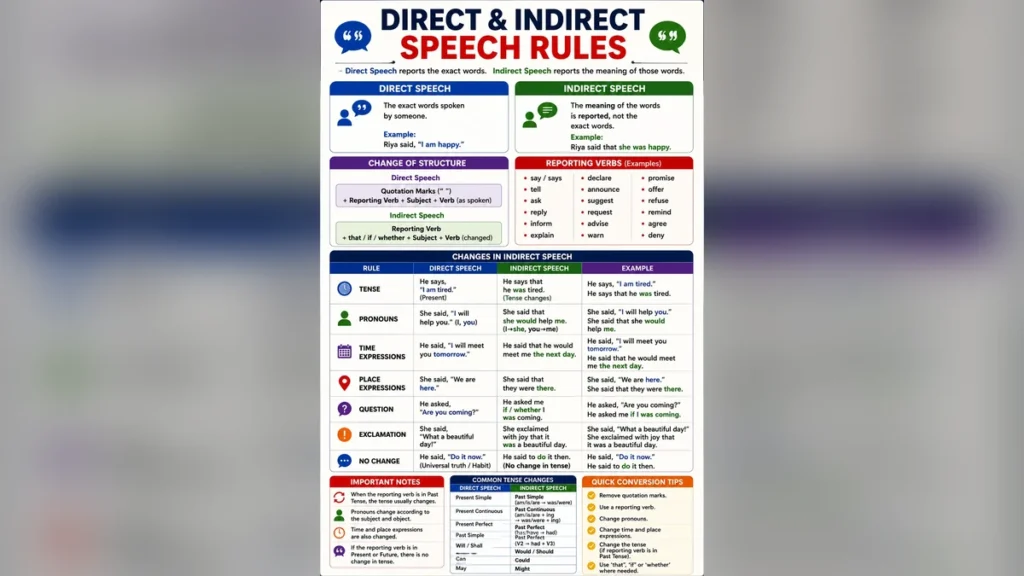
When learning English grammar, direct and indirect speech (also known as narration) can often feel confusing, especially when it comes to changing tenses and pronouns. Many students find themselves losing marks on exams due to these complexities. A clear chart summarizing all the rules at a glance can be incredibly helpful. Let’s break down the fundamental difference between Direct Speech and Indirect Speech.
Direct Speech is when you quote someone’s exact words, enclosed in quotation marks (e.g., “I will come tomorrow”). There is no alteration to the speaker’s original words.
Indirect Speech, on the other hand, is when you report what someone said, but in your own words, without changing the meaning. Quotation marks are removed, and conjunctions like ‘that’ are often used. This is not just a grammatical rule but a natural way of conversing in everyday life.
Before diving into complex rules, grasping these basic structures is essential. Once you understand this core difference, the subsequent rules will become much easier to follow.
Tense Conversion Rules: A Simple Table
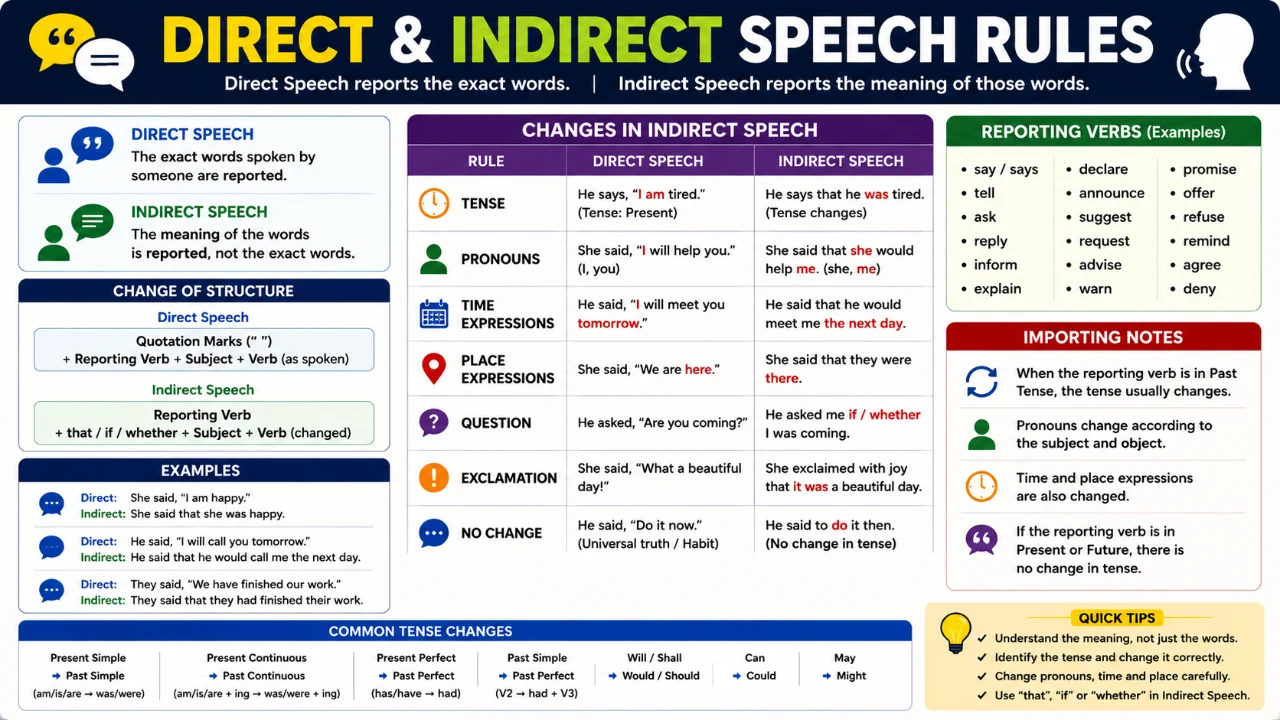
The most common challenge in narration is changing tenses. The basic principle is: if the reporting verb is in the past tense, the tense of the reported speech also shifts back to a corresponding past tense. Present tenses typically change to their past equivalents.
Here’s a simple comparison to help you remember these changes:
| Direct Speech (Original Tense) | Indirect Speech (Changed Form) |
|---|---|
| Simple Present (do/does, V1) | Simple Past (did, V2) |
| Present Continuous (is/am/are) | Past Continuous (was/were) |
| Present Perfect (has/have + V3) | Past Perfect (had + V3) |
| Simple Past (did/V2) | Past Perfect (had + V3) |
Important Note: Past Perfect and Past Perfect Continuous tenses do not change when converted to indirect speech; they remain the same.
The SON Formula for Pronoun Changes
Pronoun changes can be particularly confusing for many students. However, a time-tested and accurate formula in grammar, known as the SON formula, simplifies all pronoun changes.
- S (Subject): First Person pronouns (I, We, My, Our) change according to the subject of the reporting verb.
- O (Object): Second Person pronouns (You, Your) change according to the object of the reporting verb.
- N (No Change): Third Person pronouns (He, She, It, They, Names) remain unchanged.
For example, if the sentence is ‘He said to me, “You are my friend”‘:
- ‘You’ (Second Person) changes based on ‘me’ (becomes ‘I’).
- ‘my’ (First Person) changes based on ‘He’ (becomes ‘his’).
The resulting indirect speech is: He told me that I was his friend.
Changes in Words of Time and Place
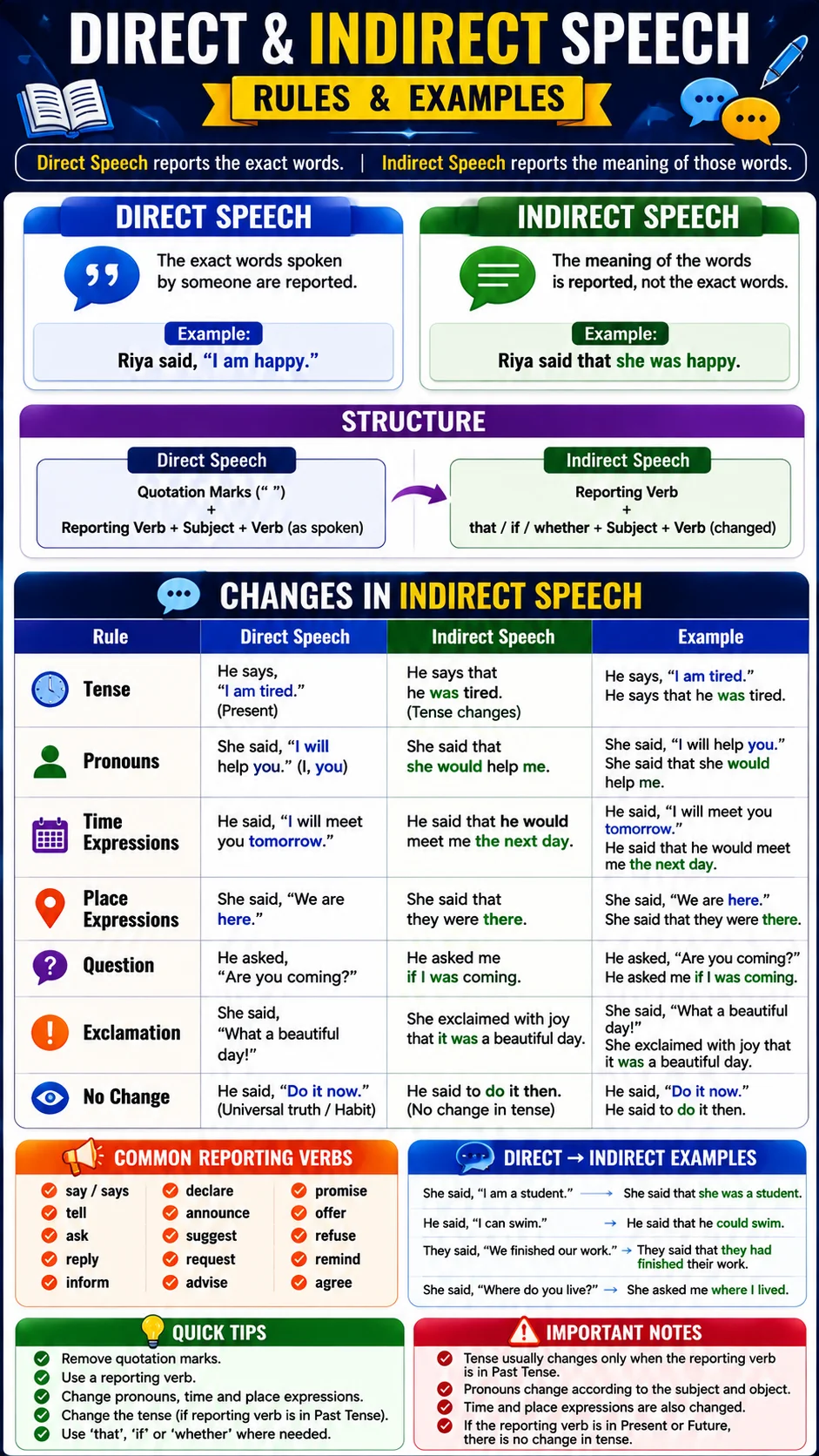
When reporting past events, words indicating proximity in time and place often shift to show ‘distance’. Students sometimes correctly change tenses but forget to alter these time and place words, leading to lost marks. Here are some common changes:
- Now becomes Then
- Today becomes That day
- Tomorrow becomes The next day or The following day
- Yesterday becomes The previous day or The day before
- Here becomes There
- This becomes That
Keep a small list of these words handy. With a few practice sessions, these changes will become automatic.
FACT: If the reporting verb is in the Present or Future tense, the tense of the reported speech does not change. This is a crucial point often overlooked by students.
Converting Interrogative and Imperative Sentences
Questions and commands follow slightly different rules than simple statements.
- Interrogative Sentences: For ‘Yes/No’ questions (starting with Is, Are, Do, Have, etc.), ‘If’ or ‘Whether’ is used instead of ‘that’ to connect the clauses. The sentence structure also changes to an assertive form. For ‘Wh- Family’ questions (What, Why, Where, How), the Wh- word itself acts as the conjunction, and no additional conjunction is needed. The reporting verb ‘said’ changes to ‘asked’ or ‘inquired’.
- Imperative Sentences: For commands, advice, or requests, the quotation marks are removed, and ‘to’ is placed before the verb. For example, ‘He said to me, “Please help me”‘ becomes ‘He requested me to help him’. The reporting verb ‘said to’ changes to ‘ordered’, ‘advised’, or ‘requested’ based on the context.
Exceptions: Universal Truth and Exclamatory Sentences
Every rule has exceptions, and in narration, these are frequently tested.
- Universal Truth: If the reported speech contains a universal truth, historical fact, scientific law, or habitual action, the tense of the reported speech does not change, even if the reporting verb is in the past tense. For instance, ‘The teacher said, “The Earth revolves around the sun.”‘ becomes ‘The teacher said that the Earth revolves around the sun.’ Changing ‘revolves’ to ‘revolved’ would be incorrect as it’s an eternal truth.
- Exclamatory Sentences: In exclamatory sentences, ‘said’ is replaced by phrases like ‘exclaimed with joy’, ‘exclaimed with sorrow’, or ‘exclaimed with surprise’, depending on the emotion. The exclamation mark (!) at the end is replaced by a full stop (.).
Create Your Own Shortcut Chart for Revision
While downloading charts is easy, writing them yourself helps your brain retain information much faster. A single-page handmade cheat sheet is far more effective for last-minute revision than flipping through a thick book.
Take a blank A4 sheet and divide it into four sections:
- Section 1: Tense conversion arrows (5 main ones).
- Section 2: The SON formula.
- Section 3: Key time/place words (around 7).
- Section 4: The universal truth exception.
As you draw this table, about 50% of the rules will register in your subconscious. Stick it on the first page of your notebook for constant visibility.
Vivek Bhai’s Advice: Think Context, Not Just Rules
Many people try to memorize grammar rules like mathematical formulas, which is a common mistake. Language is meant to be understood in context, not just memorized. When converting from direct to indirect speech, imagine you are relaying a conversation to someone else. Thinking from this perspective helps tenses and time references naturally fall into place.
Neurologically, our brains grasp patterns and context much faster than long definitions. Practicing by speaking about ten well-constructed sentences, rather than memorizing twenty separate rules, helps your tongue naturally stumble on incorrect constructions.
💡 Tip: Stop rote memorization. For 15 days, convert just 5 sentences to indirect speech daily. Your brain will naturally pick up the correct patterns.
In today’s digital age, we often take screenshots but retain little. Downloading PDFs doesn’t guarantee marks; understanding comes from manually writing the chart and practicing.
Frequently Asked Questions
If the Reporting Verb is in the Present Tense, does the Tense inside change?
No, if the reporting verb is in the Present (e.g., says, say) or Future (will say) tense, the tense of the reported speech does not change. Only pronouns and context-specific words change.
What does ‘Said to’ change into when converting from Direct to Indirect speech?
‘Said to’ changes to ‘Told’ in assertive sentences, ‘Asked’ in interrogative sentences, and ‘Ordered’ or ‘Requested’ in imperative sentences, depending on the context.
What is the full meaning of the SON formula in narration?
In the SON formula, ‘S’ stands for Subject (for 1st person pronouns), ‘O’ stands for Object (for 2nd person pronouns), and ‘N’ stands for No Change (for 3rd person pronouns like he, she, they).
Is the Past Perfect Tense also changed in Indirect speech?
No, Past Perfect and Past Perfect Continuous tenses do not change in indirect speech. Their auxiliary verbs (Had + V3) and main verb forms remain the same.
Disclaimer: The information provided in this article is for general awareness only.