What does keeda jadi look like? Start with the name
What does keeda jadi look like? Searching can produce a dried caterpillar-shaped object and a cluster of orange clubs, both labelled Cordyceps. A shared marketing word does not make them identical. Start with the scientific name and the material shown, then ask what the image actually documents.
The natural Himalayan caterpillar fungus is discussed as Ophiocordyceps sinensis, formerly Cordyceps sinensis. It is a fungus–insect-host complex, rather than an ordinary leafy herb. The common phrase can conceal important differences between organisms and products.
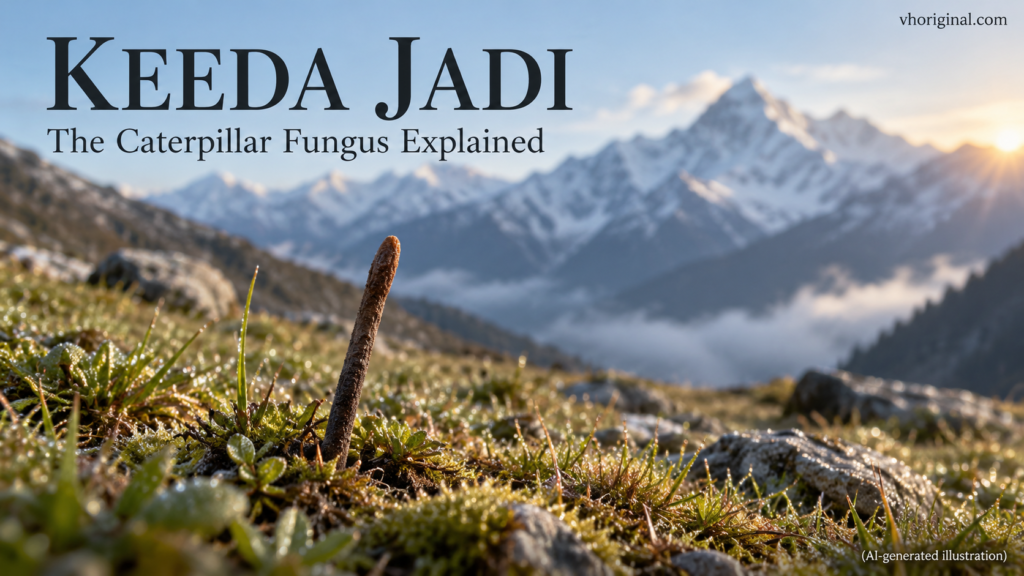
This guide explains appearance and source checking. Its three images are conceptual AI scenes, not authentic fresh photographs, scientific specimens or a seller’s actual stock. Links below provide real photographic references.
What is visible above the soil?
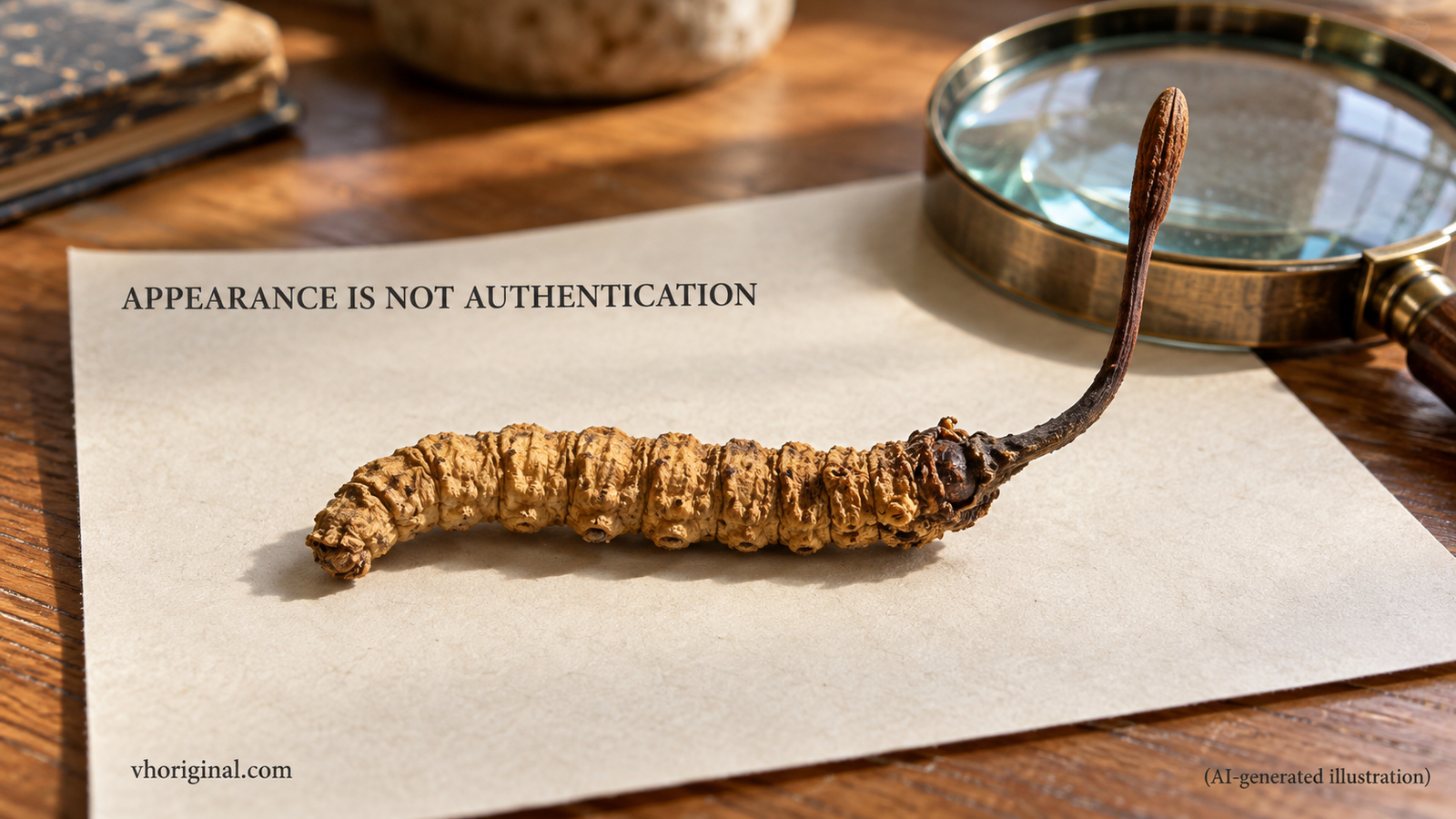
The G.B. Pant National Institute of Himalayan Environment’s 2020 monograph describes a high-altitude fungus–caterpillar association. The fungus is associated with a soil-dwelling moth larva; the emerging fruiting structure is called a stroma.
A field image may show only a slender fungal part while the caterpillar-associated portion remains underground. It need not resemble a complete dried object on a seller’s tray. An isolated stalk also does not prove identification.
A Scientific Reports study describes emergence through the head region of the larva. Calling this a living caterpillar turning into a plant would be misleading: the complex can include a dead, fungus-filled host form.
Our hero image illustrates that general ground-level idea. Its mountain background, proportions and texture do not verify a locality or species. This guide does not recommend digging up a habitat for a photograph.
Field view, dried complex and powder differ
An in-situ view records habitat and an emerging structure. A specimen on a card shows a different stage or presentation. Drying, storage, lighting and camera settings can alter appearance; do not turn two unexplained stages into a simplistic real-versus-fake comparison.
A dried complex may show a caterpillar-shaped portion attached to a fungal stalk. Soil, damage and low resolution can conceal details. One stock photograph cannot authenticate a seller’s actual batch.
Powders, capsules and extracts no longer show the original external form. Brown powder or a capsule photograph cannot establish species. Determine the declared material and what appropriate testing has actually examined.
FACT: Species identity, wild or cultivated origin, product composition and a health claim are separate questions. One attractive image or a single laboratory number cannot establish them all.
Ophiocordyceps sinensis versus Cordyceps militaris
Cordyceps militaris is a different species. An Indian cultivation study in ICAR’s Mushroom Research describes orange club-shaped fruiting bodies. Do not equate a photograph of orange cultivated material with a wild O. sinensis caterpillar complex.
Conversely, correctly declared cultivated C. militaris is not automatically fake because it looks different. Compare what the seller claims with what the material actually is.
Mycelium is the fungal network; a fruiting body is another structure. Whole caterpillar complex, cultured mycelium, fruiting-body powder and extract are distinct descriptions. Ask for the complete scientific name and material if a label says only Cordyceps.
Similar names do not establish equal potency, purity or clinical effects. This article does not declare species or finished products medically interchangeable.
Advice: check records beyond the photograph
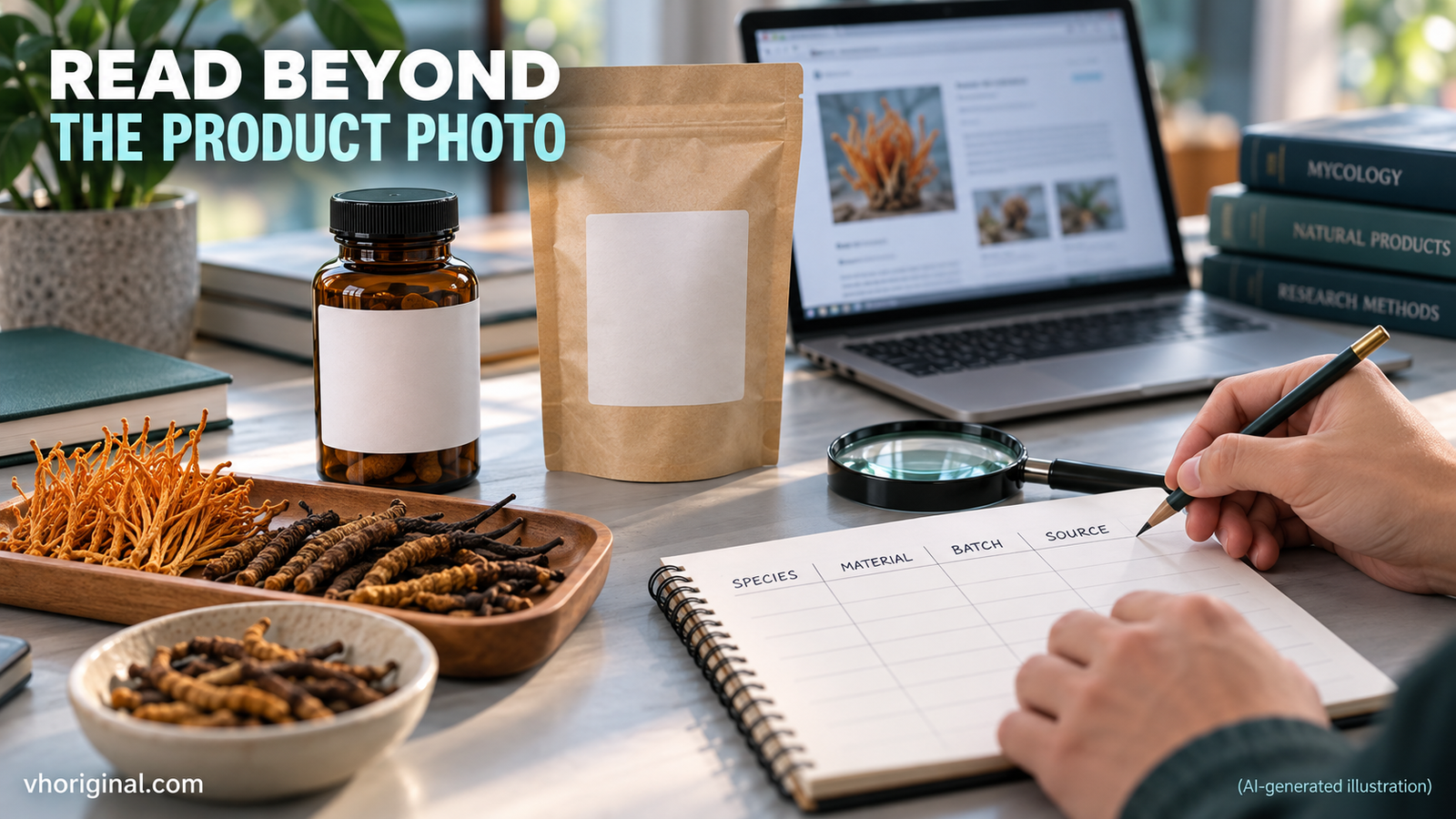
Ask for image source, date, specimen or batch identifier, stage and editing history. A generic field or laboratory promotional photograph is not documentation of your packet. Preserve the connection between a crop and the original.
Five useful questions are: complete scientific name; whole material, mycelium, fruiting body or extract; wild or cultivated claim; batch number; and the exact identity or quality tests performed. Record uncertainty when answers are missing.
Read laboratory name, report date, sample or batch and method. Check whether the report concerns this batch or an unrelated earlier sample. Identity, chemical-content and contamination tests answer different questions. Accept only what a report actually supports.
A PLOS ONE culture study used morphological and molecular approaches to confirm fungal identity. Research confirmation therefore goes beyond colour. This does not establish one universal test for every commercial product.
Boiling, tasting, burning or breaking a sample is not a validated home authentication method supplied by this guide. Ask a qualified mycology or analytical laboratory what is appropriate for your specific question. Do not use our AI scenes as reference specimens.
Habitat and health-claim precautions
In a natural habitat, observation should not become a pretext for collection. Respect fragile alpine ground, vegetation and local access or collection arrangements. This guide does not supply a route to harvesting or trading based on an online photograph.
An attractive sample does not establish edibility, freedom from contamination or treatment efficacy. Do not taste unidentified fungal material. No price, dose or treatment recommendation is made here.
Memorial Sloan Kettering advises discussing cordyceps supplements with healthcare providers and reporting supplement use. Do not start one solely from an online photograph or testimonial, especially alongside existing medication.
An honest caption might say: “Dried caterpillar-fungus-like material; seller’s species claim recorded; no independent authentication.” Revise it when evidence improves. Do not describe AI imagery as an authentic fresh specimen photograph.
Five frequently asked questions
Is keeda jadi an ordinary plant? This context concerns a fungus–insect-host complex.
Will a field photo show the complete caterpillar body? The fungal part can emerge while the host portion remains below ground.
Is orange Cordyceps always fake? No; it may be a different declared species or material.
Can a powder photo prove authenticity? External appearance is insufficient.
Are these genuine fresh macro photos? No; they are AI illustrations with real source references below.
Sources and AI illustration disclosure
General biology and product literacy, not specimen authentication, purity certification, valuation or medical advice. Generated proportions and texture are not reliable scientific identification measurements. Sources checked: 25 October 2026.
- G.B. Pant National Institute of Himalayan Environment, 2020: Caterpillar fungus in the Himalaya (monograph)
- Scientific Reports, 2017: fungus-larva relation in the formation of Cordyceps sinensis
- ICAR Mushroom Research, 2023: cultivated Cordyceps militaris — morphology and molecular characterization
- PLOS ONE, 2017: culture and identity confirmation of Hirsutella sinensis mycelium
- Memorial Sloan Kettering: cordyceps supplement information and precautions
Photo identification limits: millipede versus centipede