In the rich tapestry of Hindu devotion, the worship of the Divine Mother, or Adishakti, holds a supreme place. Among the countless hymns, stotrams, and prayers dedicated to her various manifestations, the ambe tu hai jagdambe kali aarti stands out as one of the most powerful, melodious, and widely recited prayers. Sung with immense devotion and love, this beautiful Aarti invokes the blessings of Goddess Durga and Goddess Kali, the ultimate destroyers of evil and protectors of the righteous.
Whether it is the vibrant festival of Navratri, the auspicious occasion of Durga Puja, or regular Friday evening prayers in Hindu households, this Aarti resonates in temples and homes alike. It is not merely a ritualistic song but a heartfelt cry of a child seeking refuge in the loving arms of the Divine Mother. In this comprehensive guide, we present the complete lyrics of this sacred Aarti in Hindi, explore its deep spiritual meaning, and understand the immense benefits of reciting it with pure devotion (Shraddha).
The Spiritual Significance of Goddess Durga and Kali
To truly appreciate the essence of the ambe tu hai jagdambe kali aarti, one must understand the dual nature of the goddess addressed in these verses. The Divine Mother is both gentle and fierce, nurturing and destructive.
- Ambe (Goddess Durga): She represents the gentle, protective, and nurturing aspect of the divine feminine. She is the mother of the universe who maintains cosmic order, protects her children from harm, and bestows peace, prosperity, and wisdom.
- Kali: She represents the fierce, transformative, and destructive aspect of the divine. Goddess Kali destroys ego, ignorance, and negative forces. Her fierce form is not meant to terrify the devotee but to assure them that no evil force can stand against the power of divine justice.
By singing this Aarti, devotees acknowledge both these aspects. They seek the gentle maternal love of Mother Ambe while simultaneously praying for the fierce protection of Mother Kali to ward off internal and external negativity.
How and When to Recite the Aarti
While the Divine Mother welcomes prayers offered at any time, performing the Aarti with proper rituals enhances the spiritual vibrations of your home. Here is how you can perform the ritual:
- Timing: The ideal time to sing this Aarti is during the Sandhya Kaal (evening twilight) or during morning prayers. It is highly auspicious to recite it on Fridays, Tuesdays, and during the nine holy nights of Navratri.
- Preparation: Cleanse yourself and sit in a quiet, clean place in front of the deity’s idol or picture. Prepare a puja thali (worship plate) containing a ghee lamp (diya) or camphor (kapur), fresh flowers, incense sticks, and sweet offerings (prasad).
- The Ritual: Light the lamp and wave it in a gentle circular motion in front of the deity while singing the Aarti. Ringing a small brass bell during the Aarti helps focus the mind and purifies the surrounding environment.
- Devotion (Bhakti Bhava): The most important ingredient in Hindu worship is absolute surrender and love. Sing the verses clearly, reflecting on their deep meaning.
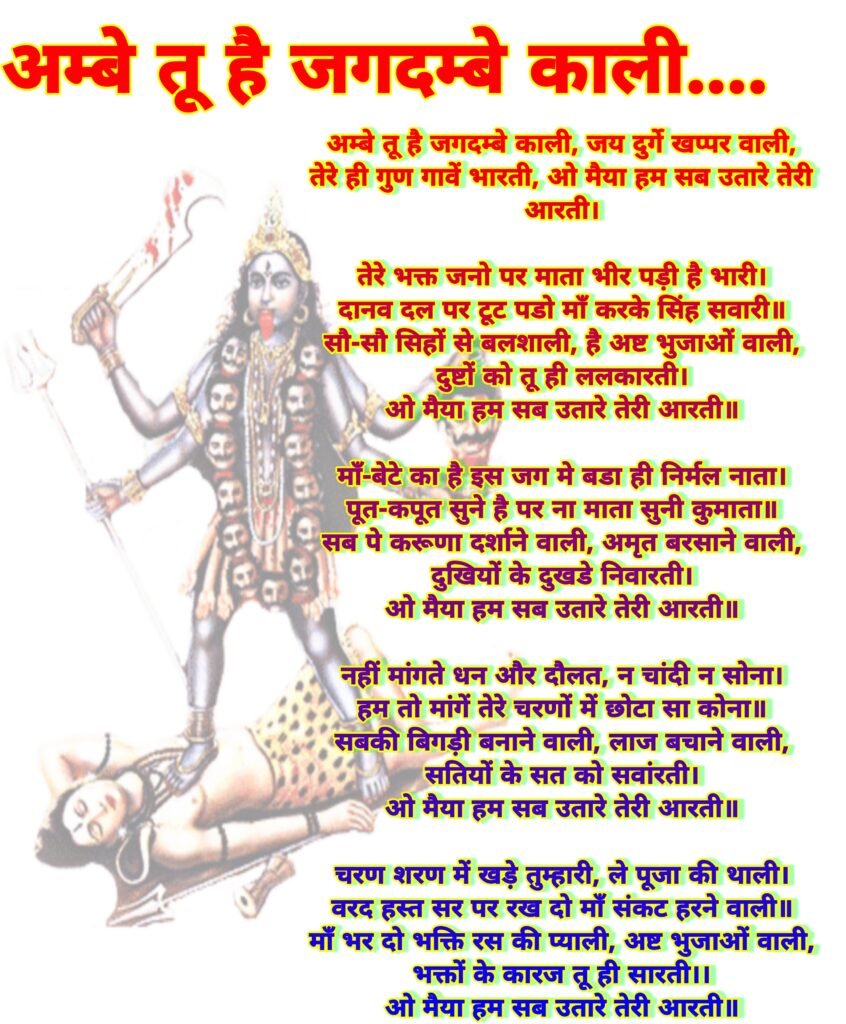
संपूर्ण आरती: अंबे तू है जगदंबे काली के बोल (Ambe Tu Hai Jagdambe Kali Lyrics in Hindi)
यहाँ प्रस्तुत हैं “अंबे तू है जगdंबे काली” आरती के संपूर्ण बोल, जिन्हें आप अपनी पूजा में शामिल कर सकते हैं और माँ का आशीर्वाद प्राप्त कर सकते हैं:
स्थाई
अंबे तू है जगदंबे काली,
जय दुर्गे खप्पर वाली,
तेरे ही गुण गावें भारती,
ओ मैया हम सब उतारे तेरी आरती।
छंद 1
तेरे भक्त जनो पर माता,
भीर पड़ी है भारी।
दानव दल पर टूट पड़ो माँ,
करके सिंह सवारी।
सौ-सौ सिहों से बलशाली,
है अष्ट भुजाओं वाली,
दुष्टों को तू ही ललकारती।
ओ मैया हम सब उतारे तेरी आरती।
छंद 2
माँ-बेटे का है इस जग में,
बड़ा ही निर्मल नाता।
पूत-कपूत सुने हैं पर ना,
माता सुनी कुमाता।
सब पे करुणा दर्शाने वाली,
अमृत बरसाने वाली,
दुखियों के दुखड़े निवारती।
ओ मैया हम सब उतारे तेरी आरती।
छंद 3
नहीं मांगते धन और दौलत,
न चांदी न सोना।
हम तो मांगें तेरे चरणों में,
छोटा सा कोना।
सबकी बिगड़ी बनाने वाली,
लाज बचाने वाली,
सतियों के सत को सवांरती।
ओ मैया हम सब उतारे तेरी आरती।
छंद 4
चरण शरण में खड़े तुम्हारी,
ले पूजा की थाली।
वरद हस्त सर पर रख दो माँ,
संकट हरने वाली।
माँ भर दो भक्ति रस प्याली,
अष्ट भुजाओं वाली,
भक्तों के कारज तू ही सारती।
ओ मैया हम सब उतारे तेरी आरती।
English Translation and Verse-by-Verse Meaning
To help you connect deeply with the emotions of this prayer, here is the detailed English translation and spiritual meaning of each verse of the ambe tu hai jagdambe kali aarti:
The Refrain (Sthayi)
“Ambe Tu Hai Jagdambe Kali, Jai Durge Khappar Waali…”
Meaning: O Mother, You are Ambe, the mother of the entire universe, and You are also the fierce Kali. Glory to You, O Durga, who carries the skull-cup (representing the destruction of ego). All of Mother India (and all creation) sings Your glorious praises. O Mother, we all perform Your Aarti to express our deep love and gratitude.
Verse 1: The Protector of Devotees
“Tere Bhakt Jano Par Mata, Bheer Padi Hai Bhaari…”
Meaning: O Mother, Your devotees are currently facing immense troubles and difficulties. We pray to You to ride Your majestic lion and descend to destroy the demonic forces of negativity and evil. You possess the strength of a hundred lions, and with Your eight powerful arms, You challenge and destroy the wicked forces that threaten peace.
Verse 2: The Unconditional Love of a Mother
“Maa-Bete Ka Hai Is Jag Mein, Bada Hi Nirmal Naata…”
Meaning: The relationship between a mother and her child is the purest bond in this entire world. There are stories of children who turn out to be bad or ungrateful (poot-kapoot), but there has never been a mother who is bad or unloving (kumata). You are the one who showers compassion and nectar upon all, relieving the deep sorrows of the distressed.
Verse 3: The Prayer of Selfless Devotion
“Nahi Maangte Dhan Aur Daulat, Na Chaandi Na Sona…”
Meaning: O Mother, we do not ask for material wealth, gold, or silver. Our only desire is to find a tiny, humble corner at Your sacred lotus feet. You are the savior of those whose lives are ruined, the protector of our dignity, and the one who preserves the virtue and truth of the righteous.
Verse 4: Seeking Refuge and Blessings
“Charan Sharan Mein Khade Tumhari, Le Pooja Ki Thaali…”
Meaning: We stand at Your feet, seeking Your divine refuge, holding the plate of worship. O destroyer of all obstacles, please place Your hand of blessing (Varada Mudra) upon our heads. Fill our hearts with the sweet nectar of pure devotion. O eight-armed Mother, You are the one who successfully completes all the tasks of Your beloved devotees.
Spiritual Benefits of Chanting This Aarti
Singing the praises of Goddess Durga through this Aarti brings profound changes to a devotee’s life. Here are some of the spiritual and mental benefits observed by those who practice this devotion regularly:
- Removal of Fear and Anxiety: The fierce form of Goddess Kali reminds us that no worldly fear is greater than the divine protection of the Mother. Chanting this Aarti instills immense courage and mental strength.
- Destruction of Negative Energies: The vibrations generated by singing these verses help clear negative energies, evil eyes, and obstacles from your home and workplace.
- Cultivation of Humility: The third verse beautifully teaches us to value spiritual connection over material greed. It helps cultivate a sense of contentment and humility.
- Strengthening Family Bonds: The Aarti highlights the pure, unconditional love of a mother. Singing this together as a family fosters peace, mutual respect, and harmony among family members.
- Inner Peace and Joy: The rhythmic chanting and focus on the divine form of Mother Durga soothe the nervous system, leading to deep meditative peace and spiritual joy.
Frequently Asked Questions (FAQs)
1. What is the best day to sing the Ambe Tu Hai Jagdambe Kali Aarti?
While you can sing this Aarti daily during your morning or evening prayers, Fridays and Tuesdays are considered highly auspicious. Fridays are traditionally dedicated to the Divine Mother (Shakti worship).
2. Why is Goddess Kali mentioned alongside Goddess Durga in this Aarti?
Goddess Kali and Goddess Durga are different manifestations of the same supreme cosmic energy (Adishakti). The Aarti beautifully integrates both the nurturing, protective nature of Durga (Ambe) and the fierce, transformative power of Kali, showing that they are ultimately one.
3. What does “Poot-kapoot sune hain par na mata suni kumata” mean?
This is one of the most famous lines in Hindu devotional literature. It translates to: “A child may turn out to be bad or fail in their duties, but a mother’s love is so pure and unconditional that she can never become a bad mother.” It highlights the absolute, forgiving nature of the Divine Mother.
4. Can women recite this Aarti during their menstrual cycle?
In traditional Hindu practices, physical worship (touching idols or performing rituals with a puja thali) is often avoided during menstruation to allow the body rest. However, mental chanting, listening to the Aarti, and silent devotion are always welcomed, as the Divine Mother’s love transcends physical rules.
5. Why does the Aarti mention “eight arms” (Ashtabhuja)?
Goddess Durga is traditionally depicted with eight arms (Ashtabhuja), each holding a different weapon or symbolic object gifted by the gods. These represent her multi-dimensional power, readiness to protect her devotees from all directions, and her ability to perform multiple cosmic tasks simultaneously.
Disclaimer
The information and rituals provided in this article are based on traditional Hindu scriptures, beliefs, and spiritual practices. Devotional practices are highly personal, and the most important aspect of any prayer is the purity of intent and devotion (bhakti) rather than rigid adherence to rituals.