 Vista
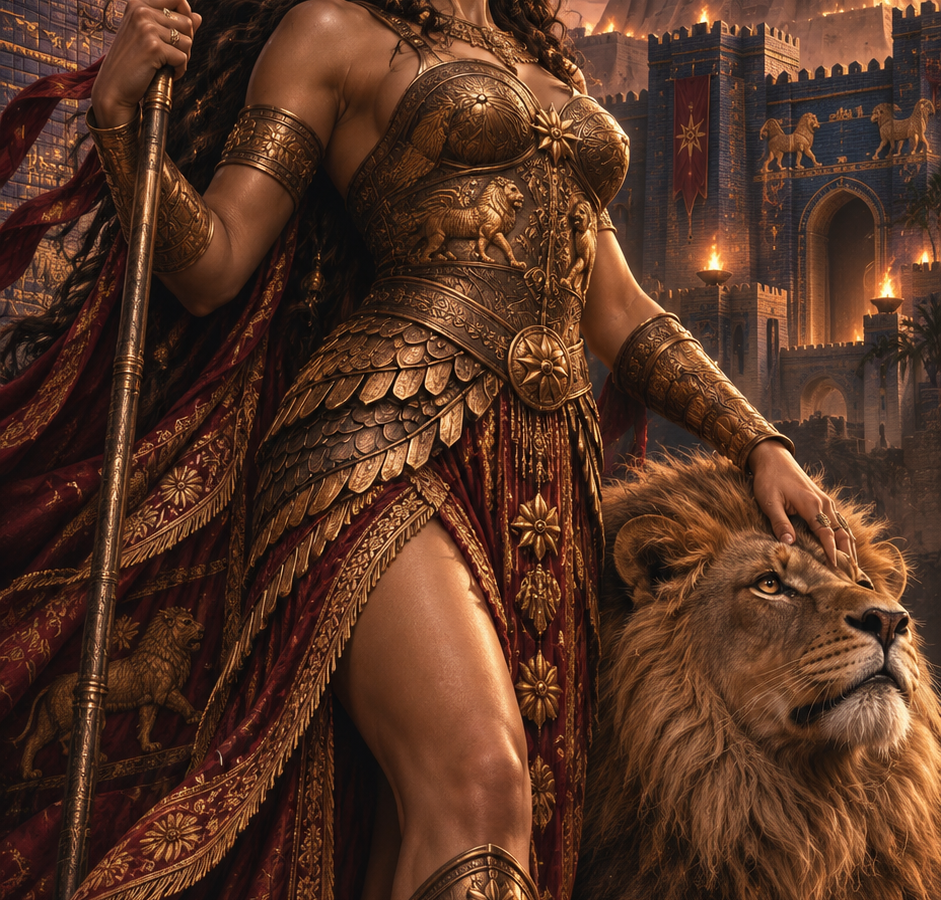
Mesopotamian mythology is the collection of myths, hymns, epics and religious beliefs of the ancient peoples who lived between the Tigris and Euphrates rivers, in what is now mostly Iraq, with parts of Syria, Turkey and Iran. It includes Sumerian gods such as Enki, Enlil, Anu and Inanna, the Babylonian hero-god Marduk, the Assyrian national god Ashur, the Anunnaki, the Epic of Gilgamesh, the oldest known flood stories, protective winged bulls (lamassu), demons like Pazuzu and a gloomy underworld ruled by Ereshkigal. This guide is one master reference for Mesopotamian gods and goddesses, stories, creatures, symbols, tattoos and art. It also separates what the clay tablets actually say from what modern “ancient aliens” claims added later.
What Is Mesopotamian Mythology?
“Mesopotamia” is a Greek word meaning “between the rivers”. It names the fertile land of the Tigris and Euphrates, where the world’s earliest cities such as Uruk, Ur, Nippur, Babylon and Nineveh grew. The mythology of this region is not one tidy system. It is a long tradition written by Sumerians, Akkadians, Babylonians and Assyrians over roughly three thousand years, and the gods, names and stories changed as empires rose and fell.
Quick overview:
- Where: ancient Mesopotamia, the land of the Tigris and Euphrates.
- When: from the third millennium BCE (Sumerian) to the late first millennium BCE (late Babylonian).
- How we know: cuneiform writing pressed into clay tablets, plus seals, statues and temple reliefs.
- Key texts: Epic of Gilgamesh, Enuma Elish, Atrahasis, Inanna’s Descent.
- Important caution: surviving texts are incomplete, and different cities told different versions.
History and Origins of Mesopotamian Mythology
Sumerian civilization and Sumerian mythology
The Sumerians, in southern Mesopotamia, developed cuneiform writing around the late fourth to early third millennium BCE and left the oldest recorded myths. Their gods were tied to city-states: An at Uruk, Enlil at Nippur, Enki at Eridu, Nanna at Ur, Inanna at Uruk. Many Sumerian literary texts that survive were copied in scribal schools in the early second millennium BCE.
Akkadian, Babylonian and Assyrian traditions
The Akkadians spoke a Semitic language and absorbed Sumerian religion, giving gods Akkadian names (Enki became Ea, Inanna became Ishtar, Utu became Shamash). Babylonian mythology elevated Marduk, the patron of Babylon. Assyrian mythology raised Ashur, the god of the city of Ashur, to the top and even adapted Babylonian epics to make him the hero. These are related traditions, not identical ones.
Cuneiform tablets and ancient Mesopotamian religion
Ancient Mesopotamian religion was polytheistic. Gods lived in temples, were fed and clothed through ritual, and were thought to run natural forces and cities. People believed humans existed to serve the gods. Libraries such as that of Ashurbanipal at Nineveh (7th century BCE) preserved thousands of tablets, including the best-known Gilgamesh version.
| Tradition | Region and period | Language | Chief god (approx.) |
|---|---|---|---|
| Sumerian | South Mesopotamia, 3rd millennium BCE onward | Sumerian | Enlil, An, Enki (varies by city) |
| Akkadian | Central Mesopotamia, from c. 2300 BCE | Akkadian | Ishtar, Shamash, Ea |
| Babylonian | Babylon, esp. 2nd to 1st millennium BCE | Akkadian (Babylonian dialect) | Marduk |
| Assyrian | North Mesopotamia, esp. 1st millennium BCE | Akkadian (Assyrian dialect) | Ashur |
Mesopotamian Creation Myth
There is no single Mesopotamian creation myth. Different texts give different accounts, and it is a mistake to merge them into one story.
Nammu and the primordial waters (Sumerian)
In Sumerian tradition the goddess Nammu is the primeval sea who gave birth to heaven (An) and earth (Ki). Some texts say An and Ki produced Enlil, and the gods were created before humans. The Sumerian creation myth is known mainly from fragments rather than one complete poem.
Enki and Ninmah
In Enki and Ninmah, the junior gods are tired of digging canals, so Nammu asks her son Enki to make servants for them. Enki shapes humans from clay. At a feast, Ninmah and Enki compete in creating people with different disabilities and fates, a story about the place of every human in society.
Atrahasis
The Old Babylonian Atrahasis (around the 18th century BCE) tells that the lesser gods, the Igigi, rebel against hard labour. The gods slay a god named We-ilu and mix clay with his flesh and blood to create humans to do the work. This version then continues into the flood story below.
Enuma Elish: Apsu, Tiamat and Marduk
The Enuma Elish, the Babylonian creation epic, is probably from the later second millennium BCE and was recited at Babylon’s New Year festival. It begins with fresh water Apsu and salt water Tiamat mixing. Their noisy children disturb Apsu, who plans to destroy them, but Ea (Enki) kills him first. Tiamat, grieving, raises an army of monsters under Kingu. The young god Marduk volunteers to fight her on condition that he be made king of the gods. He defeats Tiamat, splits her body to make heaven and earth, and creates humans from the blood of Kingu to serve the gods. The poem explains and justifies Marduk’s supremacy, so it is political as well as religious. In Assyria, the god Ashur replaces Marduk in some copies.
Who Were the Anunnaki?
Who are the Anunnaki? In ancient texts, the Anunnaki are a group of major gods, whose name is often translated roughly as “of royal blood” or “offspring of An”, though the etymology is debated. They are usually described as the children or court of An, the sky god, who make decisions in the divine assembly. They are not described as visitors from another planet.
What the texts actually say
Early Sumerian sources use “Anunna” for the senior gods who decree fates. The group’s roles vary: in some texts the Anunnaki are the great gods of heaven and earth; in later Akkadian traditions they are often associated with the underworld, where they sit as judges with Ereshkigal. Different literary traditions do not give a fixed list of members or a fixed number.
Anunnaki vs Igigi
In Atrahasis, the great gods (Anunnaki) rule while the lesser Igigi do the heavy labour until they rebel. Humanity is created to relieve the Igigi. Later texts sometimes use the two names more loosely, for example Igigi as heaven’s gods and Anunnaki as earth’s or underworld’s gods.
Did the Anunnaki create humans?
In myths, yes in a literary sense: gods create humans from clay and divine blood to serve them (Enki and Ninmah, Atrahasis, Enuma Elish). These are religious stories about the human role in the cosmos, not records of genetic engineering.
Anunnaki ancient aliens, Nibiru and conspiracy theories
The idea that the Anunnaki were extraterrestrials who engineered humanity became popular mainly through the writings of Zecharia Sitchin from the 1970s, and was spread further by television and internet culture. Assyriologists, scholars who read cuneiform, have rejected Sitchin’s translations and conclusions. “Nibiru” appears in Babylonian astronomy as a name for a celestial point or planet (often linked to Marduk or Jupiter); the idea of a hidden planet on a 3,600-year orbit is a modern invention, and astronomers have found no such planet.
| Popular claim | What ancient texts and evidence show |
|---|---|
| Anunnaki were aliens | Texts call them gods of heaven, earth and the underworld; no tablet describes spaceships or visitors from another planet |
| They genetically engineered humans | Myths say gods shaped humans from clay and divine blood, a religious explanation of work and mortality |
| Sumerian tablets prove Nibiru | Nibiru is an astronomical term in Babylonian texts; the hidden-planet story is modern and unsupported |
| Sumerians knew impossible science | Mesopotamian astronomy and mathematics were advanced, and are well explained by long observation and records |
Ancient myth is not scientific evidence, and a real archaeological record exists for Mesopotamia: cities, temples, tablets and tombs show ordinary human builders. Treat modern “Anunnaki secrets” content as entertainment, not history.
Mesopotamian Gods and Goddesses List
This Mesopotamian mythology gods list uses both Sumerian and Akkadian names. Matching names (Enki/Ea, Inanna/Ishtar) are related but not always identical, because each city and period gave its gods slightly different roles.
| Deity | Tradition / equivalent | Domain | Symbols |
|---|---|---|---|
| An / Anu | Sumerian / Akkadian | Sky, king of the gods | Horned crown, tiara |
| Enlil | Sumerian (Nippur) | Wind, air, authority | Horned crown, Ekur temple |
| Enki / Ea | Sumerian / Akkadian | Fresh water, wisdom, magic, craft | Goat-fish, flowing waters |
| Utu / Shamash | Sumerian / Akkadian | Sun, justice | Sun disk, saw, rays |
| Nanna / Sin | Sumerian / Akkadian | Moon | Crescent |
| Marduk | Babylonian | Babylon’s patron, king of gods | Spade, mushussu dragon |
| Ashur | Assyrian | National god of Assyria | Winged disk |
| Ninurta | Sumerian / Akkadian | War, farming, hero | Plough, bow, mace |
| Nergal | Akkadian / Sumerian | Plague, war, underworld | Lion, mace |
| Adad / Ishkur | Akkadian / Sumerian | Storm, rain | Lightning, bull |
| Dumuzi / Tammuz | Sumerian / later forms | Shepherd, fertility | Sheep, shepherd’s crook |
Anu: Sumerian sky god
Anu (An) is the distant sky father, head of the gods in theory, whose chief cult was at Uruk. In practice, other gods such as Enlil often do the ruling, so An is more of a remote high authority.
Marduk and Ashur
Marduk began as a minor god of Babylon and rose to supremacy as Babylon became a capital, taking over Enlil’s role in the late second and first millennia BCE. Ashur is the god of the city of Ashur and the symbol of the Assyrian state; kings fought in his name. Both reflect how politics shaped religion.
Utu and Shamash, Nanna and Sin
Utu / Shamash the sun god sees everything and is the god of justice; he appears at the top of the Code of Hammurabi stele handing over the rod and ring. Nanna / Sin is the moon god, important at Ur and Harran, who measured time by the lunar calendar.
Nergal, Ninurta, Adad and Dumuzi
Nergal brings plague and war and becomes king of the underworld as Ereshkigal’s husband. Ninurta is a warrior who defeats the bird-monster Anzu. Adad (Ishkur) is the storm god. Dumuzi is the shepherd-god and Inanna’s husband; his later form Tammuz was mourned in an annual festival, and the name appears in the Hebrew Bible.
Enki and Enlil: Roles and Differences
People often search for Enki vs Enlil expecting a hero and a villain. The sources are more nuanced.
| Enki (Ea) | Enlil | |
|---|---|---|
| Main city | Eridu | Nippur |
| Domain | Fresh water (abzu), wisdom, magic, crafts | Wind, air, kingship, divine authority |
| Typical role | Clever helper, creator, problem-solver | Enforcer of order, decision-maker among the gods |
| In flood stories | Warns the human hero | Sends or approves the flood |
In Atrahasis, Enlil is irritated by human noise and sends plague, famine and finally a flood, while Enki secretly helps humanity. That has encouraged a simple “Enlil bad, Enki good” reading, but Enlil is also the great giver of order and kingship, honoured at Nippur for centuries, and Enki sometimes acts deceptively too. They are better seen as two aspects of cosmic management: order and authority versus cleverness and creativity. In some myths they are brothers, in others father and son; the sources differ. Keep this in mind with any online “Enki and Enlil conflict” story, since the strongest versions are modern retellings.
Mesopotamian Mythology Female Characters and Goddesses
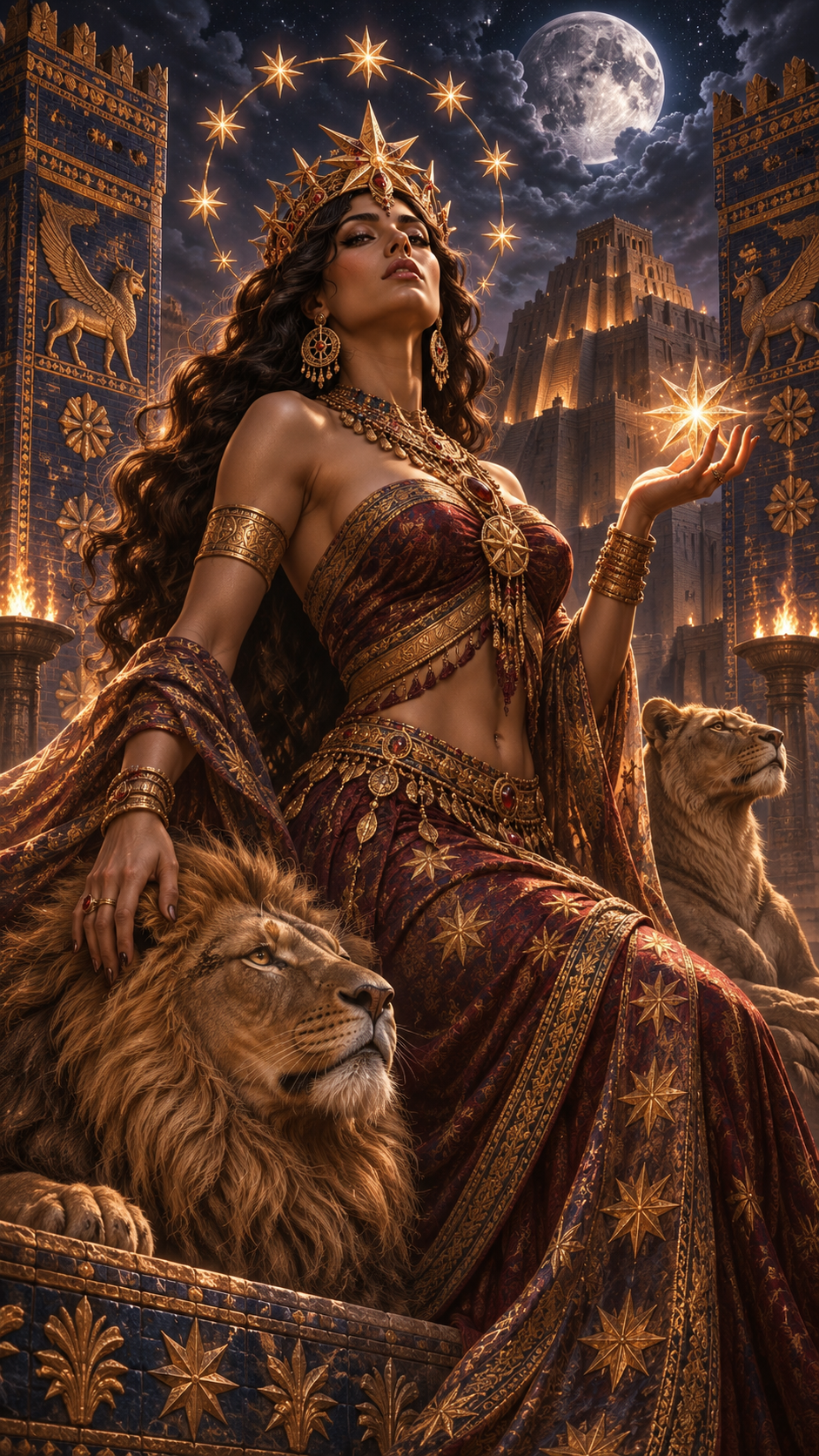
Searches for Mesopotamian goddesses, Sumerian goddess names and Babylonian goddesses are very popular. The ancient evidence shows powerful goddesses in many roles, not only love and beauty.
| Goddess | Tradition | Divine role | Symbols | Famous myth |
|---|---|---|---|---|
| Inanna | Sumerian | Love, war, kingship, Venus | Eight-pointed star, lion, rosette, reed bundle | Descent to the underworld |
| Ishtar | Akkadian / Babylonian / Assyrian | Love, war, Venus | Eight-pointed star, lion | Gilgamesh and the Bull of Heaven |
| Ereshkigal | Sumerian / Akkadian | Queen of the underworld | Underworld throne | Inanna’s descent |
| Tiamat | Babylonian | Primordial salt sea | Sea, monsters | Enuma Elish |
| Ninhursag | Sumerian | Mother goddess, mountains, birth | Omega-like knot, wild animals | Enki and Ninhursag |
| Nammu | Sumerian | Primeval waters | Water | Creation of humans |
| Nisaba | Sumerian | Grain, writing, accounting | Grain stalk, stylus | Scribal hymns |
| Gula | Babylonian / Akkadian | Healing, medicine | Dog | Healing hymns |
Inanna and Ishtar
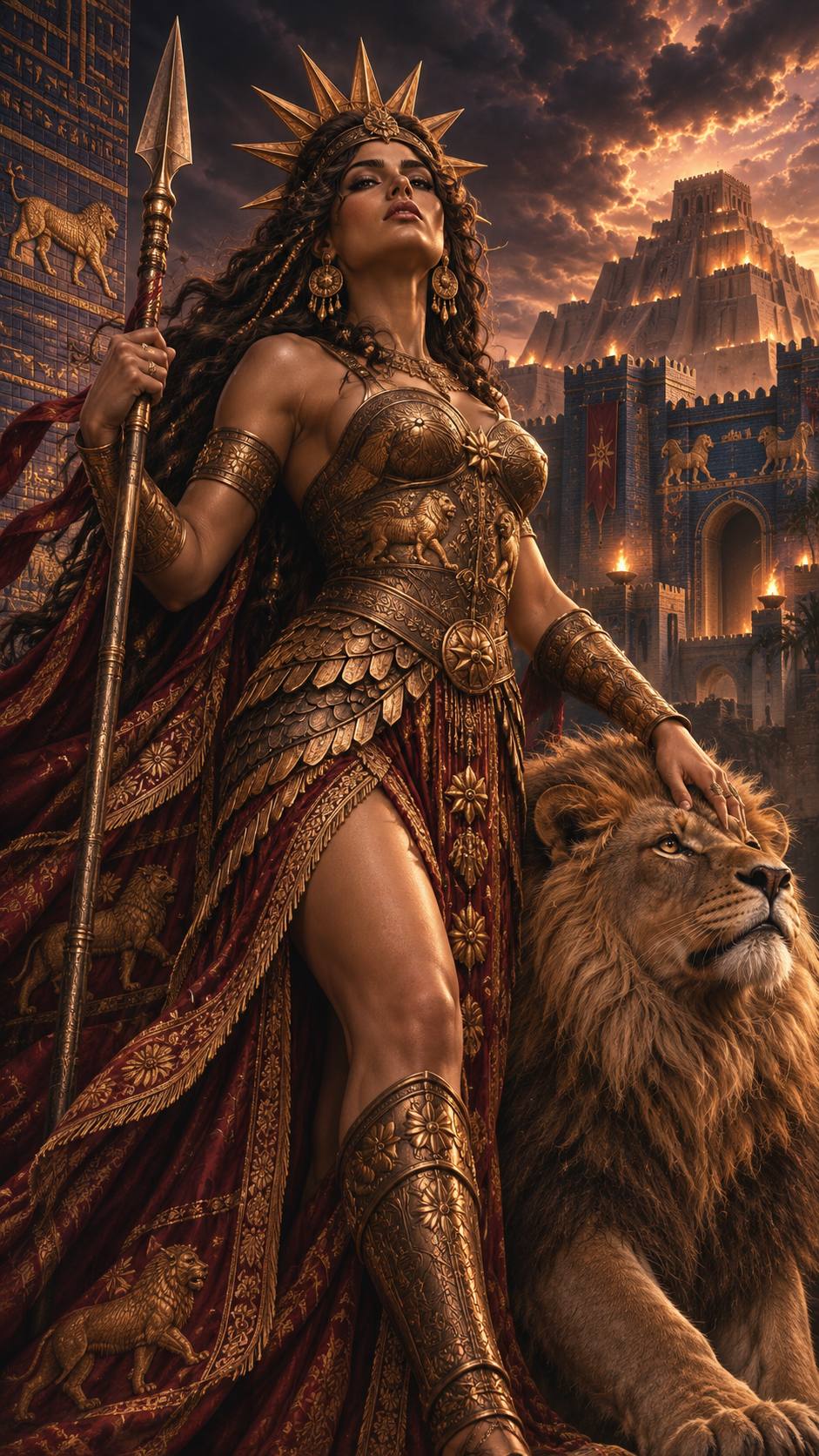
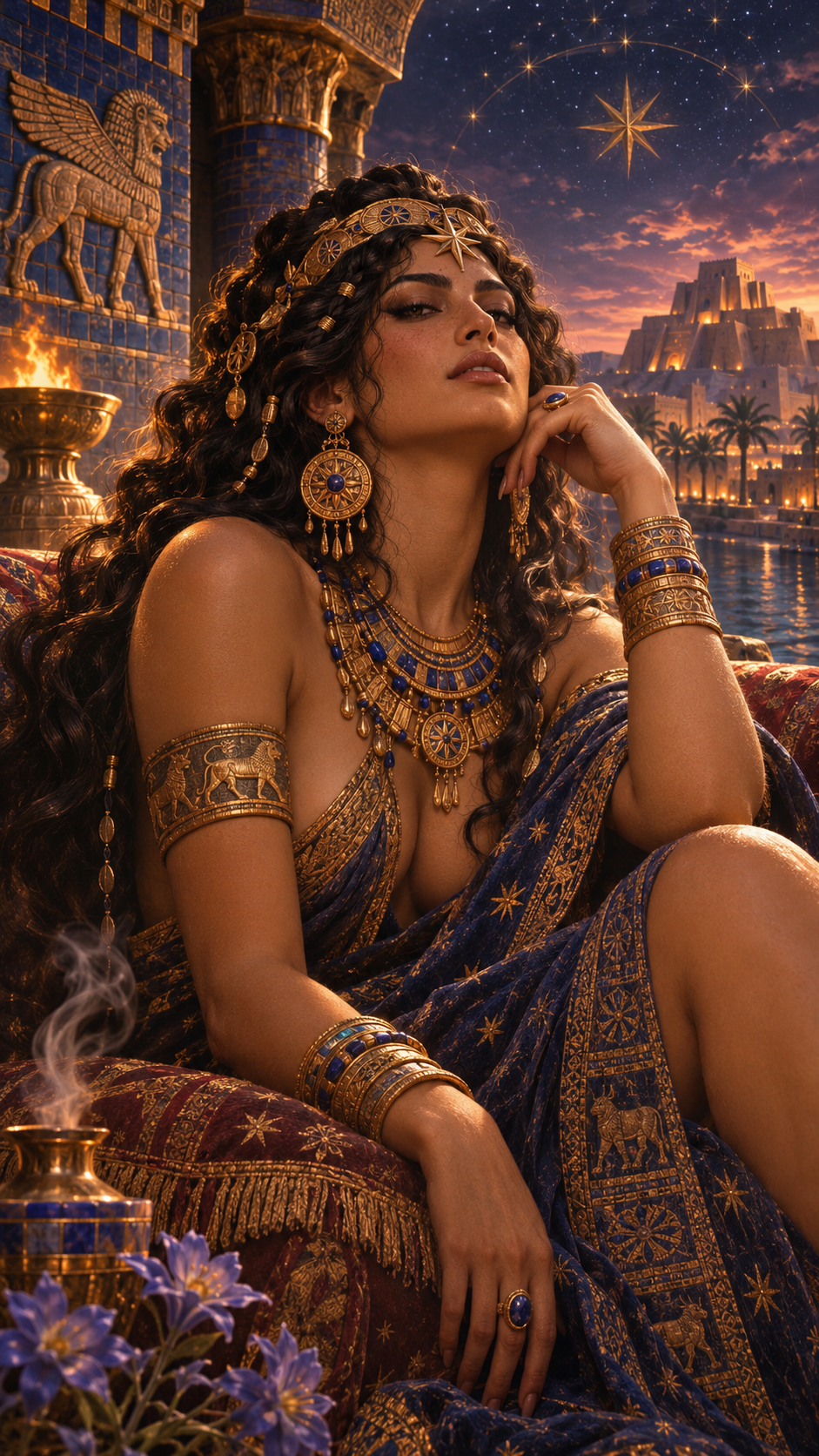
Inanna goddess of love and war was the most worshipped Sumerian goddess, patron of Uruk and associated with the planet Venus. She is bold, ambitious and often dangerous, taking divine powers (the me) from Enki and descending to the underworld. Ishtar is her Akkadian counterpart. They are closely linked and often merged in later texts, but Inanna’s Sumerian myths and Ishtar’s Babylonian and Assyrian cult are not exactly the same, so it is safest to call them “related, not identical”. Inanna and Ishtar are the most visually popular figures in this topic, with the eight-pointed star and lion as signature symbols. The Ishtar Gate of Babylon, built under Nebuchadnezzar II, is named for her.
Ereshkigal
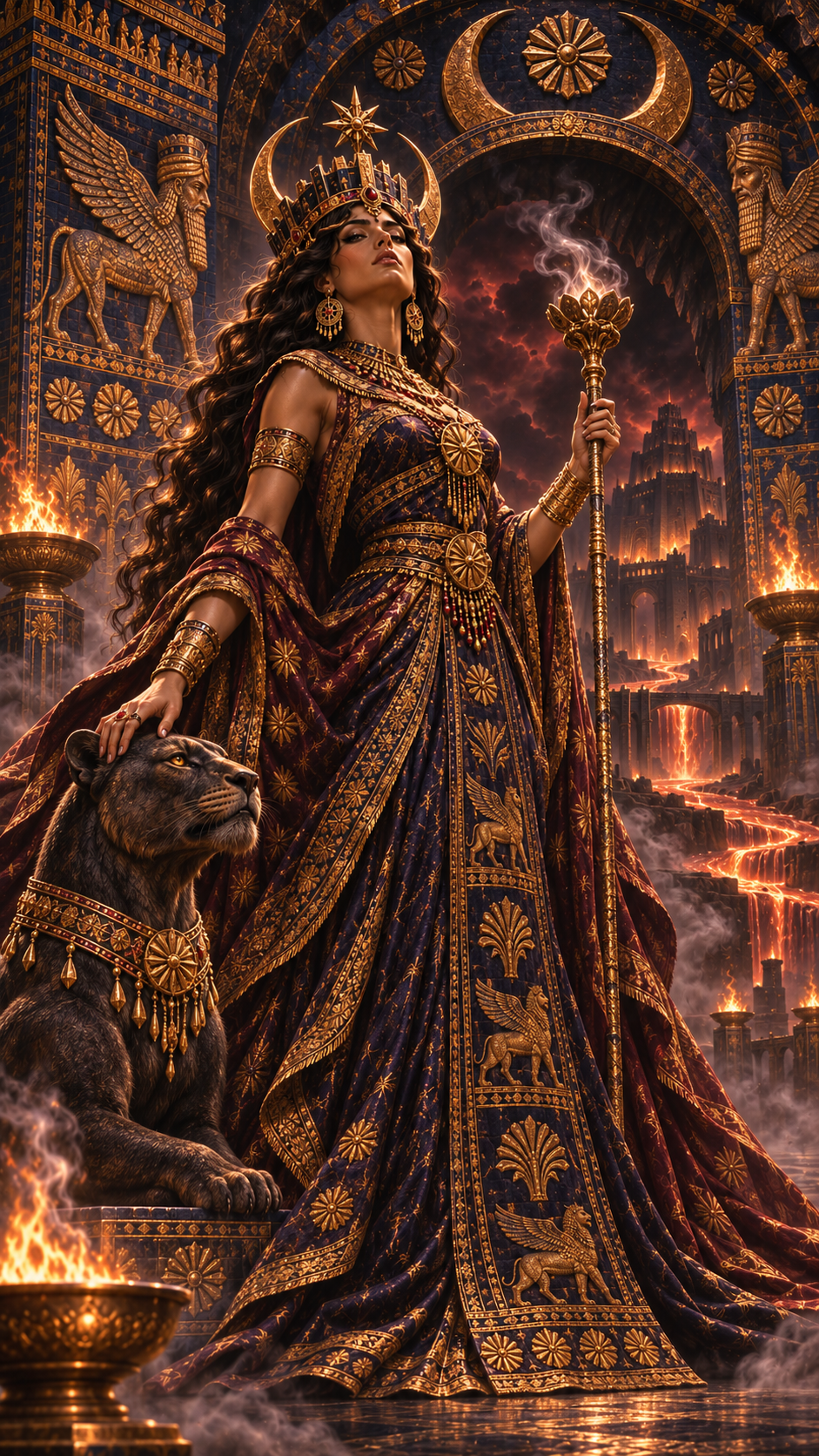
Ereshkigal, “Lady of the Great Earth”, rules the underworld and is Inanna’s sister in Inanna’s Descent. She is feared but not simply “evil”; she is a queen enforcing the rules of her realm. Later she is paired with Nergal.
Tiamat
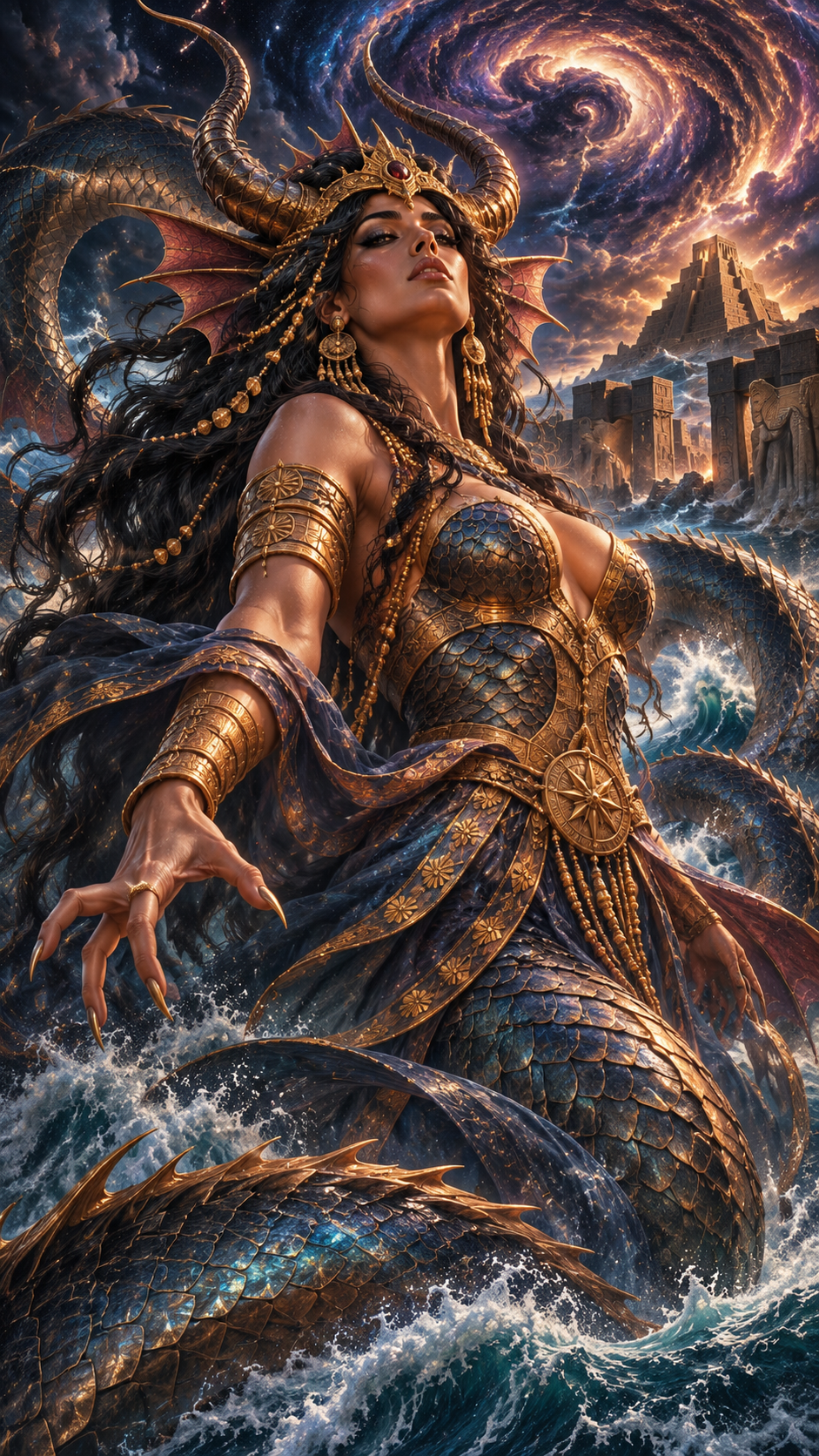
Tiamat is the primordial sea goddess in the Babylonian Enuma Elish. Modern fantasy often draws her as a five-headed dragon. That image comes largely from games and fiction; the ancient text describes monsters in her army and her body being split, but not a fixed dragon design. Some scholars read her as chaos, others as a mother figure; both are interpretations.
Ninhursag, Nammu, Nisaba and Gula
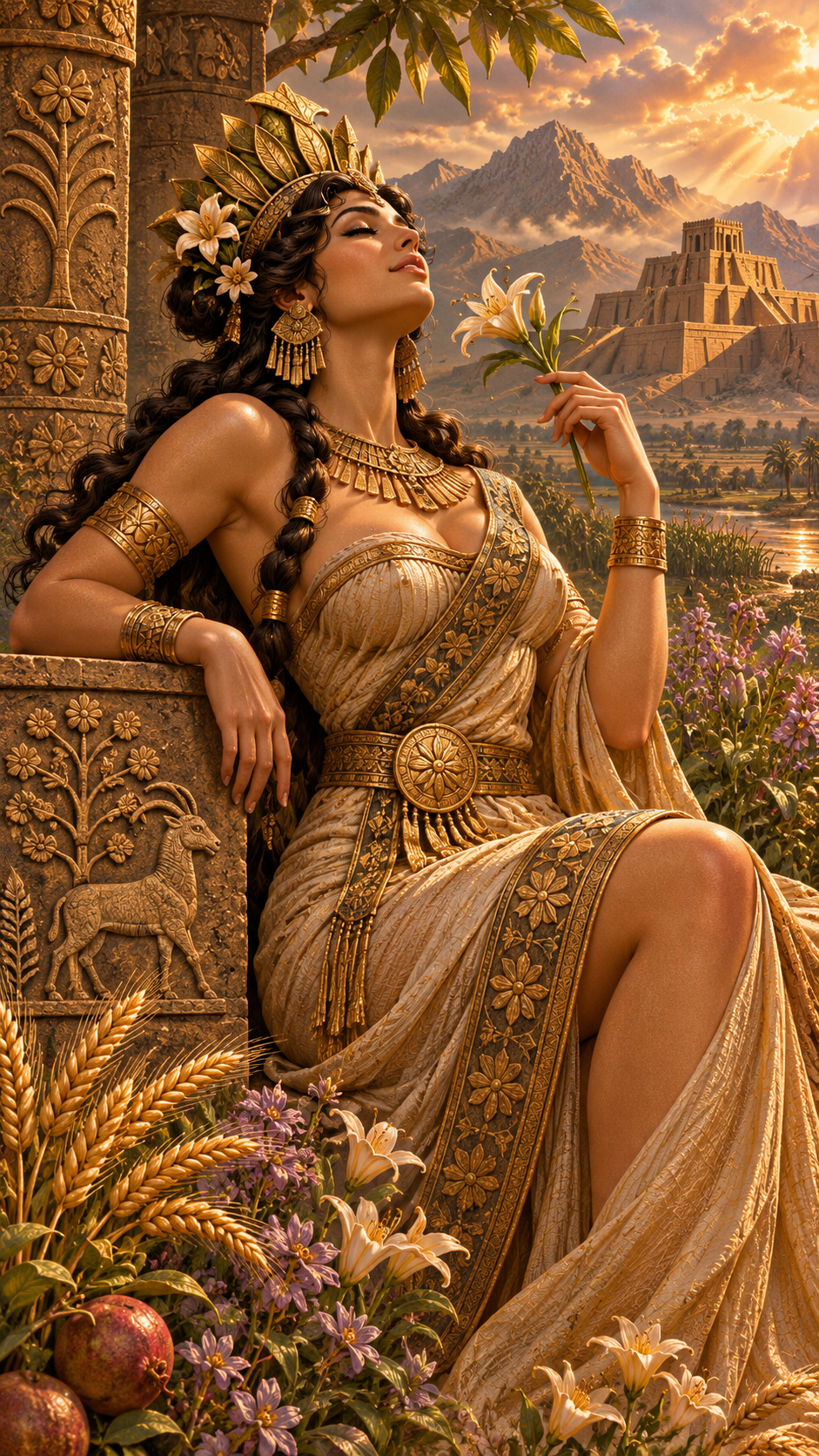
Ninhursag is a mother goddess associated with mountains, wild animals and birth, central in Enki and Ninhursag, which is set in the paradise-like land of Dilmun. Nammu is the primeval sea. Nisaba is goddess of grain and writing, patron of scribes. Gula is a healing goddess, shown with a dog.
Geshtinanna, Siduri and Shamhat
Geshtinanna is Dumuzi’s sister who agrees to spend half the year in the underworld in his place. In the Epic of Gilgamesh, Siduri is the tavern keeper who advises Gilgamesh to enjoy life, and Shamhat is the woman who introduces Enkidu to human society.
Ancient tradition vs modern fantasy: sculpted “sexy goddess” artwork and Ishtar costume designs are modern. Ancient depictions usually show goddesses with horned crowns, layered robes and symbols, not fantasy outfits. Both are fine as art, but only one is archaeology.
Mesopotamian Mythology Family Tree
There is no single Mesopotamian mythology family tree, because genealogies differ by city and period. Here are commonly attested relationships, with caveats:
- An and Ki (heaven and earth) are early parents of the gods; in some texts Nammu is the mother of An and Ki.
- Enlil is usually the son of An; his consort is Ninlil.
- Enki is son of An in many texts, but sometimes presented as Enlil’s brother or described by other ancestry.
- Nanna / Sin, the moon, is generally the son of Enlil and Ninlil; his wife is Ningal.
- Utu / Shamash is the son of Nanna and Ningal in Sumerian tradition.
- Inanna is most often daughter of Nanna (in Ur tradition), but is also called daughter of An or Enki in other texts.
- Ereshkigal is Inanna’s sister in the descent myth.
- Marduk is the son of Ea (Enki) in Babylonian tradition.
Use any single family tree chart as a simplified guide. For a better-documented comparison, see our Greek mythology guide.
The Epic of Gilgamesh
The Epic of Gilgamesh is one of the oldest great works of literature. Its best-known form is the Standard Babylonian version, in twelve tablets, usually credited to the scribe Sin-leqi-unninni, built from older Sumerian poems about Gilgamesh. Gilgamesh was probably a real early king of Uruk, listed in the Sumerian King List, but the epic is literature, not biography.
Gilgamesh and Enkidu
Gilgamesh is a powerful but oppressive king. The gods create the wild man Enkidu to match him. Shamhat brings Enkidu into human life; he fights Gilgamesh, and they become close friends.
Humbaba and the Bull of Heaven
The pair travel to the Cedar Forest and kill its guardian Humbaba. Back in Uruk, Ishtar proposes to Gilgamesh and is rejected, and she sends the Bull of Heaven against the city. The heroes kill it too, and the gods decide one of them must die.
Enkidu’s death and the search for immortality
Enkidu dies, and a grief-stricken Gilgamesh fears his own death. He journeys past the scorpion men to find Utnapishtim, the survivor of the flood who was granted immortality. Gilgamesh fails a test to stay awake for seven days, loses a plant of rejuvenation to a snake, and returns to Uruk accepting that his lasting legacy will be his city’s walls.
Mesopotamian Flood Myths
Mesopotamia preserves several versions of a great flood story, and they are not the same:
| Text | Flood hero | Reason for flood | Notes |
|---|---|---|---|
| Eridu Genesis (Sumerian) | Ziusudra | Gods decide to destroy humanity (fragmentary text) | Hero receives eternal life |
| Atrahasis (Old Babylonian) | Atrahasis | Human noise annoys Enlil; population control | Enki warns the hero; birth limits follow |
| Epic of Gilgamesh, Tablet XI | Utnapishtim | Gods decide to destroy humanity | Borrows heavily from Atrahasis |
The hero builds a boat, loads it with family and animals, survives, and releases birds to find land. Scholars note clear similarities with the biblical Noah story, and many think the later account was influenced by Mesopotamian traditions, but the exact lines of transmission are debated and should not be stated as proven. Geological evidence also shows serious river floods in Mesopotamia, which may have fed memory, but no single event has been proved to be the source.
Mesopotamian Mythical Creatures and Monsters
The best-known Mesopotamian mythical creatures fall into two groups: protective beings placed at gates, and hostile monsters defeated by heroes.
Lamassu
The lamassu is a protective figure with a human head, a bull or lion body and bird wings, placed in pairs at the gates of Assyrian palaces such as those at Nimrud, Khorsabad and Nineveh. It is a guardian, not a monster. Many are now in museums like the British Museum, the Louvre and the Met.
Mushussu: the Babylonian dragon
The mushussu (“furious serpent”) is a composite creature with a scaly body, snake head, lion front legs and eagle back legs, shown on Babylon’s Ishtar Gate as the sacred animal of Marduk. It is the best candidate for a Mesopotamian dragon, though it is not the same as a European dragon.
Humbaba, Anzu and the Bull of Heaven
Humbaba (Huwawa) guards the Cedar Forest for Enlil, and is shown in art with a face made of coiled entrails. Anzu is a huge lion-headed bird who steals the Tablet of Destinies from Enlil and is defeated by Ninurta. The Bull of Heaven is the divine bull sent by Ishtar.
Scorpion men and the Apkallu
The Girtablilu, scorpion men, guard the twin mountains where the sun rises in Gilgamesh. The Apkallu are the “seven sages”, wise beings sent by Enki before the flood to teach civilization; in art they appear as fish-cloaked or bird-headed figures with a bucket and cone, used in protective rituals.
Mesopotamian Demons and Spirits
Mesopotamians believed illness and misfortune could be caused by spirits and demons, and used incantations, amulets and figurines to protect homes. Their concept of “demon” was different from the modern Christian one: many such beings were part of the natural order and could even be protective.
Pazuzu
Pazuzu is known from first-millennium BCE amulets and statues: a figure with a doglike face, bulging eyes, scaly body, wings and a scorpion tail. He is a king of wind demons who protected people, especially pregnant women, against the more dangerous Lamashtu. Hollywood’s The Exorcist later made him famous as a movie villain. Our full guide is here: Pazuzu: real story from Mesopotamia to The Exorcist.
Lamashtu and other spirits
Lamashtu is a female demon blamed for harming mothers and babies, shown with a lion’s head, donkey teeth and a suckling pig and dog. Other documented spirits include the utukku (various ghosts and spirits) and lilitu, a female wind spirit sometimes linked to later Lilith traditions; see our Lilith article, which treats that link carefully.
Mesopotamian Underworld and Afterlife
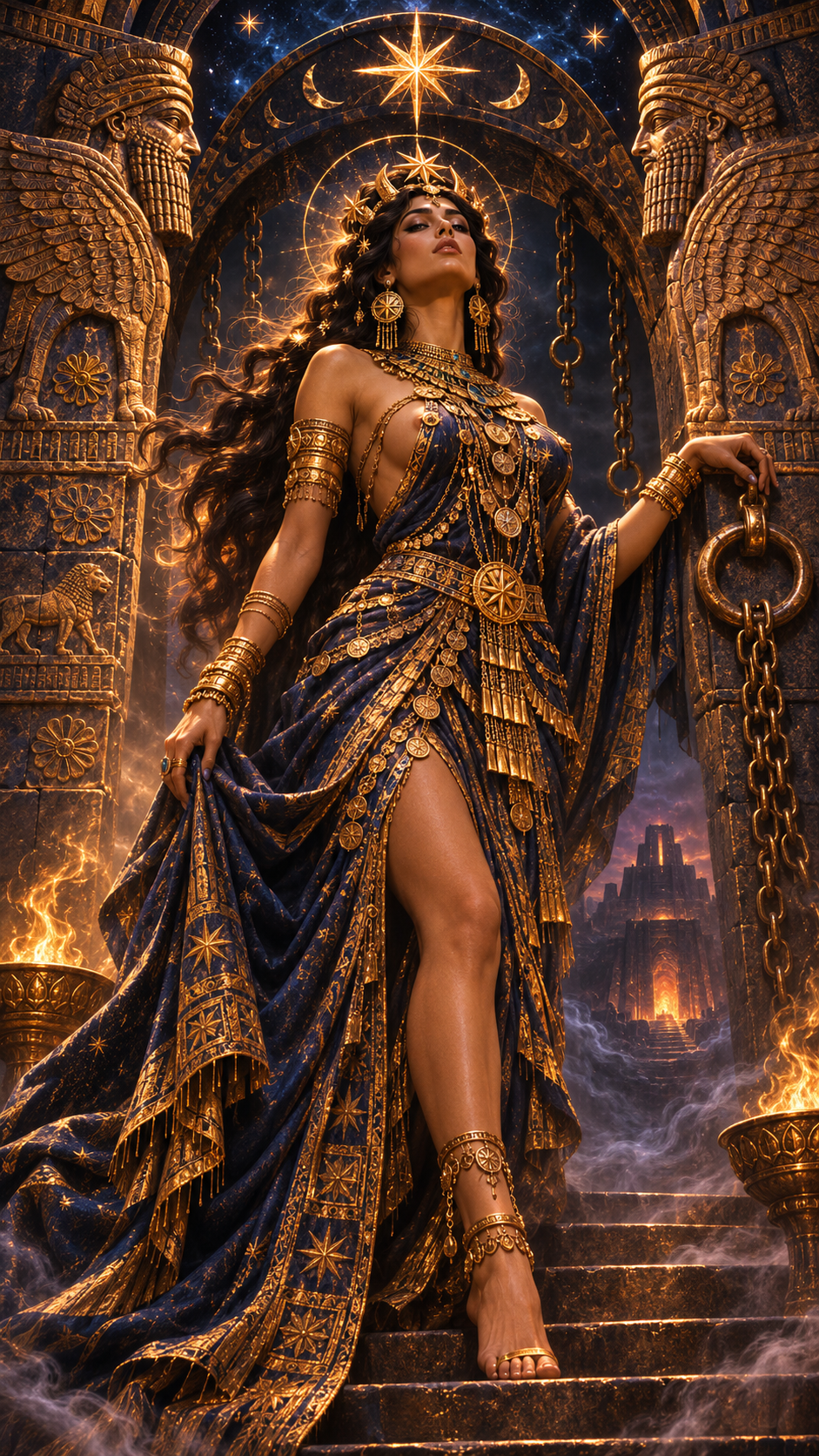
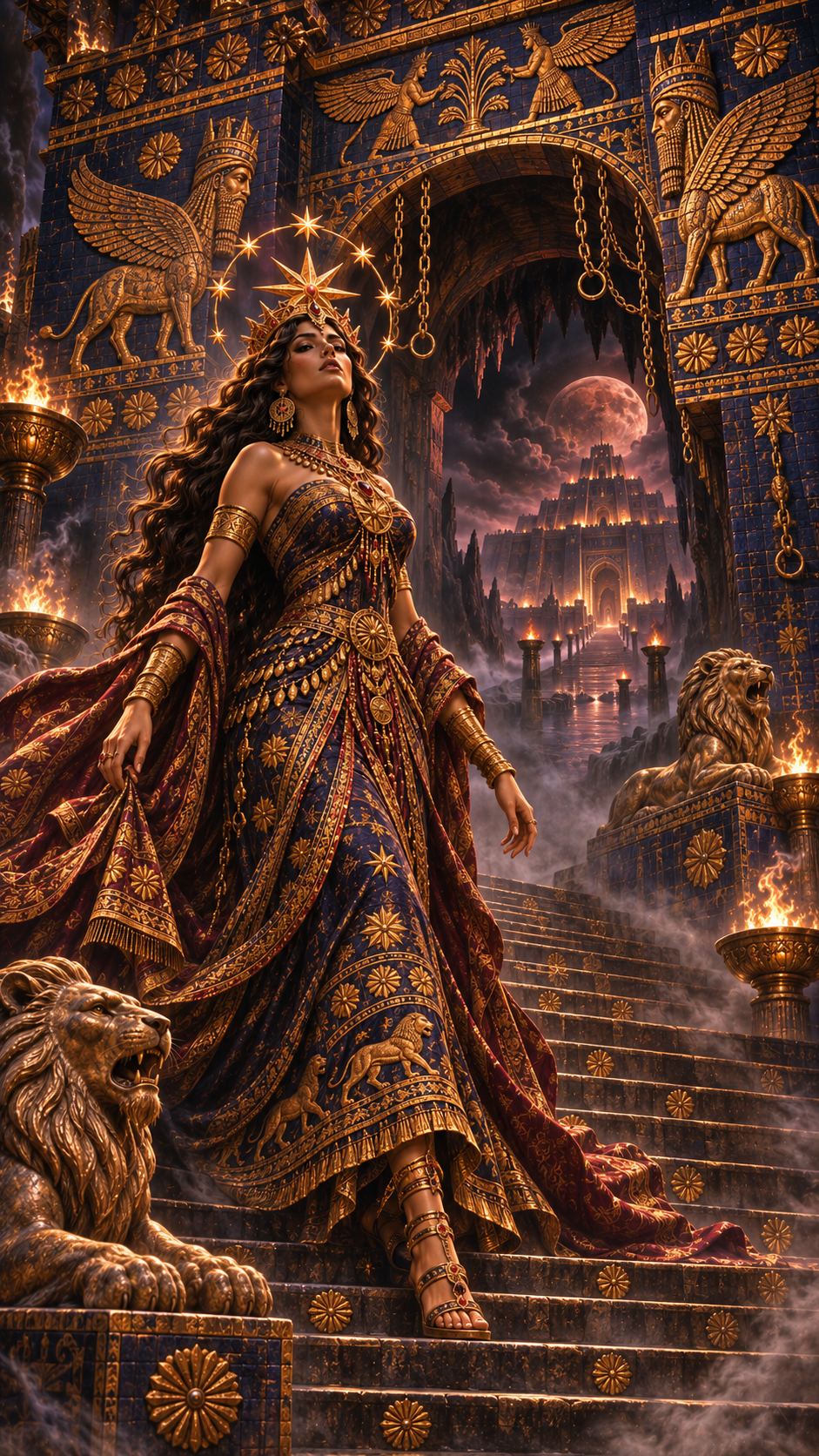
The Mesopotamian underworld was called Kur, Irkalla or the “Land of No Return”. It was a dim, dusty place below the earth where the dead eat clay and see little light. It was not a place of reward or punishment for everyone; the dead were mainly dependent on offerings from living relatives.
Ereshkigal and Nergal
Ereshkigal rules the underworld. A later myth tells how Nergal went down, nearly lost to her, and then became her husband and co-ruler. The Anunnaki sit as judges in some texts.
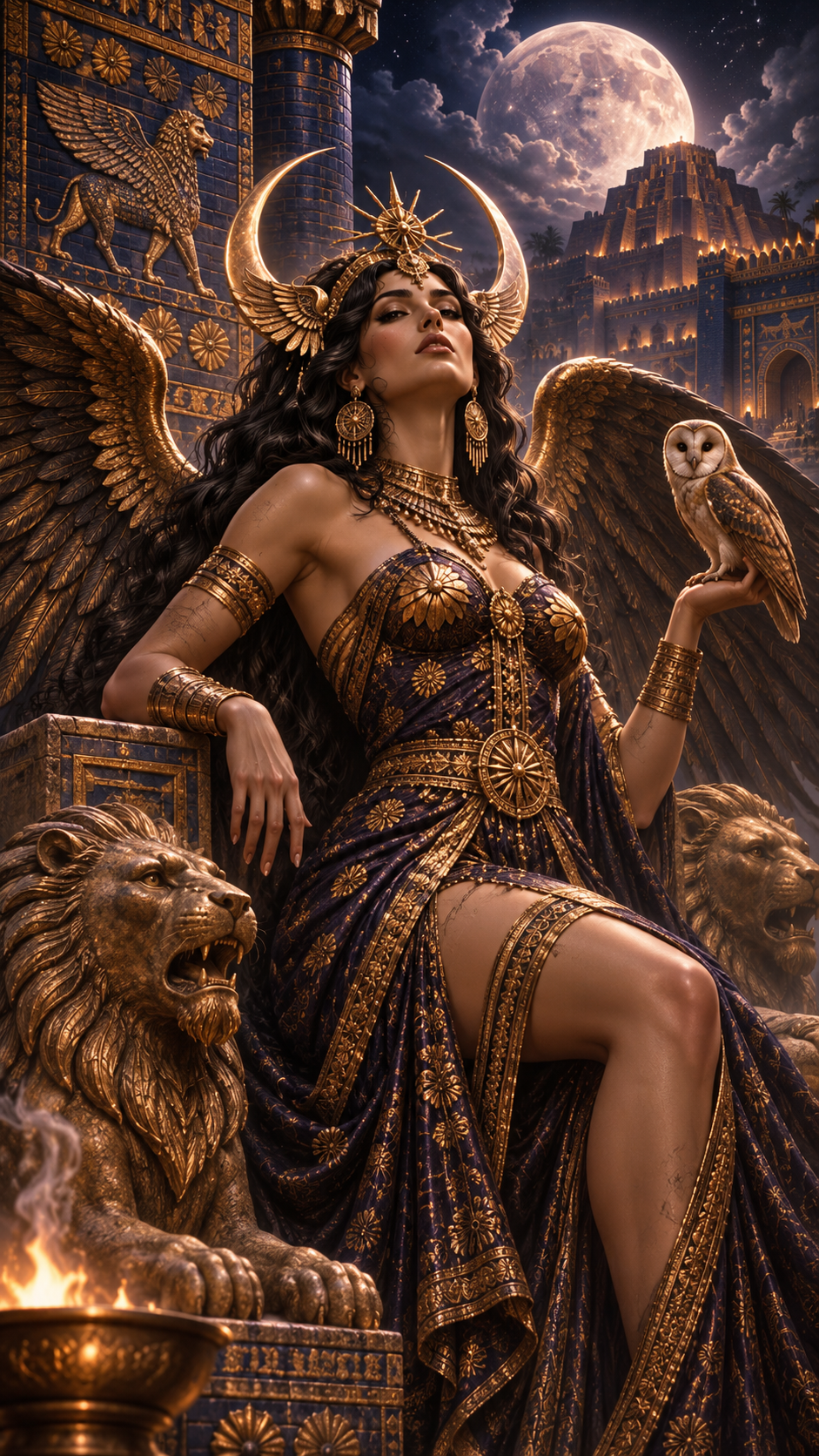
Inanna’s descent into the underworld
In this Sumerian poem, Inanna travels to the underworld, perhaps to attend a funeral or to claim rule. At each of seven gates she must remove a piece of her royal regalia until she arrives bare. Ereshkigal and the judges fix their eye of death upon her and she dies. Enki sends two beings to revive her, but a substitute must take her place; Inanna finds her husband Dumuzi enjoying himself and gives him to the demons. His sister Geshtinanna agrees to share his fate, so the two spend alternating parts of the year below. Scholars read this as a myth about death, power and seasonal cycles, but the poem does not state those meanings.
For comparison, see our guides to the Egyptian Duat and the Norse Helheim.
Mesopotamian Symbols and Their Meanings
| Symbol | Associated with | Attested meaning |
|---|---|---|
| Eight-pointed star | Inanna / Ishtar, Venus | The goddess and the planet Venus |
| Rod and ring | Divine kingship, Shamash | Held by gods as authority or justice; shown on Hammurabi’s stele |
| Crescent moon | Nanna / Sin | The moon god |
| Winged disk | Ashur, Shamash | Divine protection and kingship in Assyrian art |
| Horned crown | Any major god | Divinity; more horns mean higher rank |
| Sun disk | Shamash | The sun god and justice |
| Sacred tree | Assyrian palace reliefs | Debated: possibly fertility, kingship or divine order |
| Cuneiform | Writing, scribes, Nisaba | A writing system, not a single magic symbol |
These meanings come from inscriptions and art. Modern esoteric books attach extra “secret” meanings to the same shapes, but these are not supported by the ancient texts. The meaning of the sacred tree in particular is still discussed by scholars.
Mesopotamian Mythology Tattoo Designs and Meanings
Mesopotamian mythology tattoo designs are popular because the symbols are bold and graphic. There are no fixed ancient “tattoo meanings”; the meanings below are modern interpretations built on known symbolism.
- Ishtar star tattoo: the eight-pointed star, usually read as the goddess and Venus.
- Inanna goddess tattoo: a crowned woman with a lion and star; suggests love, power and independence.
- Anunnaki tattoo inspiration: usually horned-crown gods or winged disks. Note that “ancient alien” styles are modern.
- Lamassu tattoo: protection, strength, guardianship.
- Sumerian symbols tattoo: crescent, rod and ring, sun disk.
- Cuneiform tattoo ideas: real cuneiform is a script, not decorative art; ask a qualified Assyriologist or use a museum-sourced inscription. Do not trust random online “translations”.
- Mesopotamian dragon tattoo: the mushussu, associated with Marduk.
For another tradition’s tattoo culture, see our Egyptian mythology tattoo guide.
Mesopotamian Mythology Art and Mobile Wallpapers
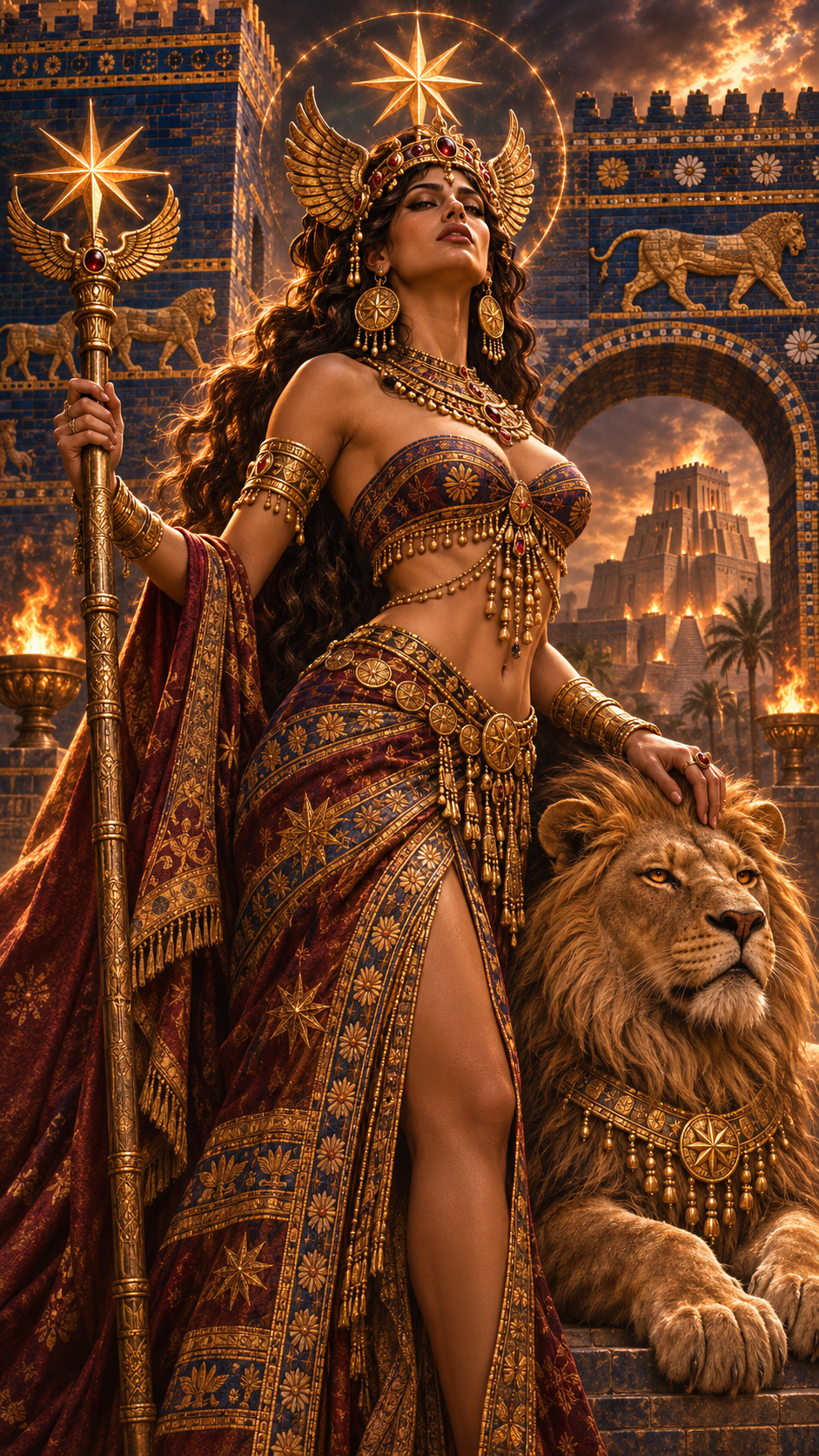
Authentic Mesopotamian art includes cylinder seals, stone reliefs, glazed brick, statues and clay plaques in museums worldwide. Modern Sumerian mythology art, Inanna goddess art, Ishtar goddess wallpapers, Anunnaki fantasy art, Lamassu artwork and Gilgamesh fantasy art are interpretations by modern artists. They can be beautiful, but they are not archaeological artifacts, and many mix fantasy costume with limited ancient evidence.
Popular visual themes include a starry Ishtar, a winged-bull lamassu gate, Gilgamesh with Enkidu, the Babylonian dragon and a dark Ereshkigal throne. The matching artwork for this article will be added later, so please do not treat this page as a downloadable wallpaper pack until those files appear.
Mesopotamian Mythology vs Other Mythologies
- Egyptian: Egypt stresses a ruler-god and a hopeful afterlife; Mesopotamia pictures a bleak underworld and gods who needed human labour. See Egyptian vs Greek mythology.
- Greek: Greek myths show a gods’ succession (Ouranos, Kronos, Zeus) like the sequence in Enuma Elish; some scholars study possible Near Eastern influence, which remains debated. See our Greek mythology guide.
- Norse: both traditions have a primordial being whose body forms the world (Ymir, Tiamat). See Norse mythology.
- Hindu: both include flood stories (Manu) and protective composite beings. For the Indian side, see Hindu mythical creatures.
Similar themes do not prove direct borrowing; humans in similar conditions often tell similar stories.
Frequently Asked Questions
What is Mesopotamian mythology?
The myths and religious beliefs of the ancient Sumerians, Akkadians, Babylonians and Assyrians between the Tigris and Euphrates, preserved on cuneiform tablets.
Who were the main Sumerian gods?
An (sky), Enlil (wind and authority), Enki (water and wisdom), Nanna (moon), Utu (sun) and Inanna (love and war).
Who were the Anunnaki?
A group of major gods, usually the children or court of An, who decree fates; later sometimes associated with the underworld.
Were the Anunnaki really aliens?
No. Ancient texts describe them as gods, and there is no credible archaeological evidence that they were extraterrestrials. The alien idea is a modern theory rejected by Assyriologists.
Did the Anunnaki create humans according to ancient myths?
Myths say gods, with Enki’s help, made humans from clay and divine blood to serve them. These are religious stories, not genetic records.
What is the difference between Enki and Enlil?
Enki rules fresh water, wisdom and craft and often helps humans; Enlil embodies wind, order and divine authority. They are not simply good and evil.
Who was Inanna in Sumerian mythology?
The goddess of love, war and kingship, patron of Uruk and linked to Venus, famous for her descent to the underworld.
Are Inanna and Ishtar the same goddess?
They are closely related and often merged, with Ishtar the Akkadian form, but their cults and myths are not exactly identical.
Who was Ereshkigal?
The queen of the underworld and Inanna’s sister, later paired with Nergal.
What is the Epic of Gilgamesh?
A Babylonian epic about the king of Uruk, his friend Enkidu, and his failed search for immortality, including the flood story told by Utnapishtim.
Who was Tiamat in Babylonian mythology?
The primordial salt-water goddess in the Enuma Elish, defeated by Marduk, whose body is used to form heaven and earth.
What are the most famous Mesopotamian mythical creatures?
The lamassu, mushussu, Humbaba, Anzu, the Bull of Heaven, scorpion men and the Apkallu, plus demons such as Pazuzu and Lamashtu.
What is the meaning of the eight-pointed star of Ishtar?
It is the symbol of Inanna and Ishtar and of the planet Venus, widely attested in seals and art.
What is the Mesopotamian creation myth?
There are several: Nammu’s primordial sea, Enki and Ninmah, Atrahasis, and the Babylonian Enuma Elish in which Marduk defeats Tiamat.
What is the difference between Sumerian and Babylonian mythology?
Sumerian myths are older and written in Sumerian; Babylonian mythology is later, in Akkadian, with Akkadian god names and Marduk at the centre.
Conclusion
Mesopotamian mythology is the oldest major written mythology we have, and it shaped later stories of creation, floods, heroes and the underworld. Its gods were deeply connected to cities, kings and daily work, and its literature, from Gilgamesh to Inanna’s Descent, still moves readers. The most useful approach is to read the tablets as ancient literature and religion, keep Sumerian, Babylonian and Assyrian traditions separate, and treat modern Anunnaki alien theories as popular fiction rather than evidence.
Reference sources: ORACC, Ancient Mesopotamian Gods and Goddesses; Electronic Text Corpus of Sumerian Literature; Encyclopaedia Britannica; British Museum; Metropolitan Museum of Art; Institute for the Study of Ancient Cultures (University of Chicago); World History Encyclopedia; standard translations of the Epic of Gilgamesh, Atrahasis and Enuma Elish.












Share Your Opinion
Comments are closed on this post.