 Vista
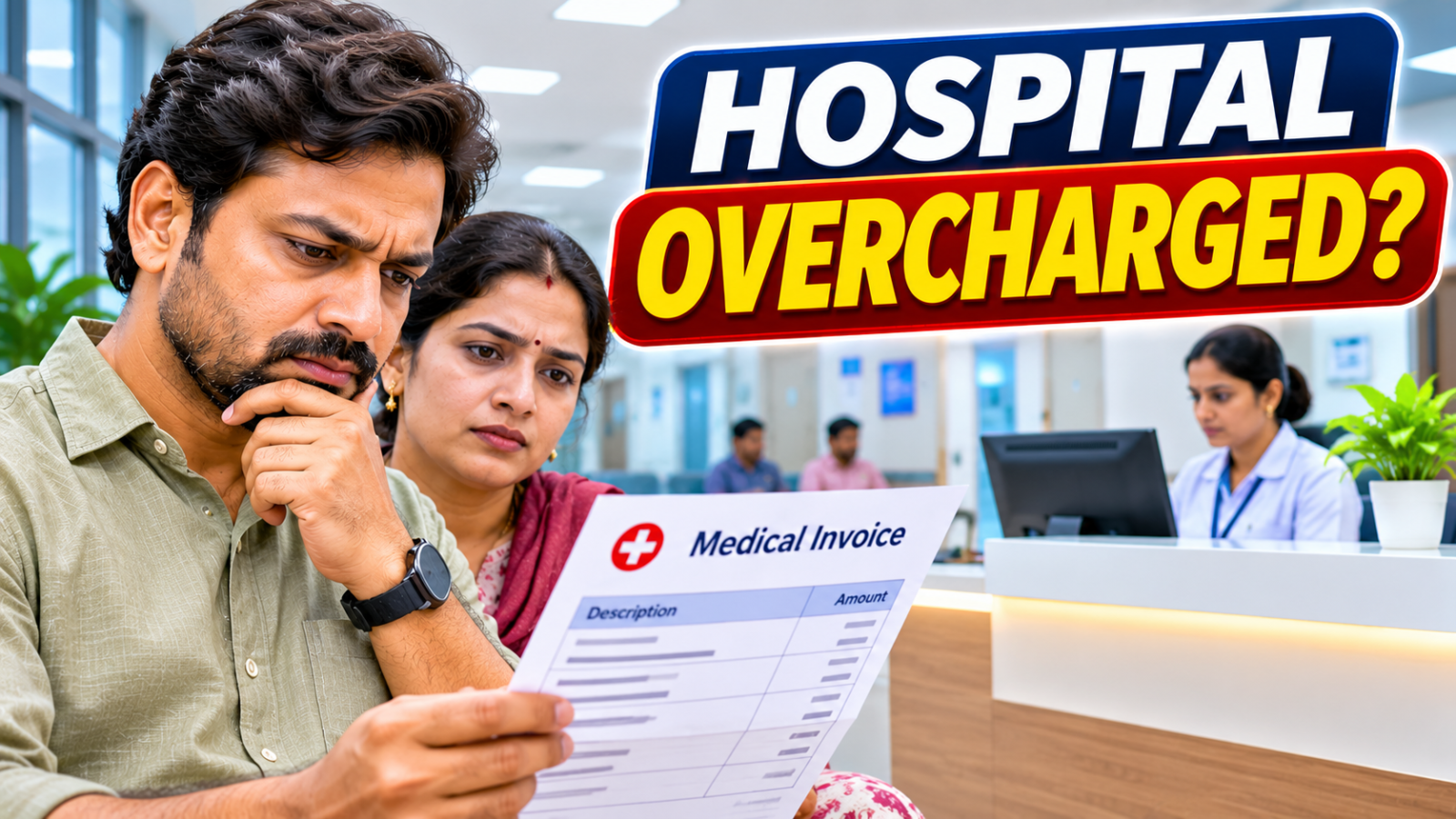
If a hospital charges you more than expected, includes a service you believe was never provided, refuses to supply medical records or appears to have made a treatment error, protect the patient’s health first. Do not postpone essential treatment because of a billing dispute. Request an itemised invoice, relevant medical records and a written explanation. Billing disputes and allegations of medical negligence require different evidence and may involve different authorities. This guide explains how to approach hospital management, health regulators, medical councils and consumer commissions in India.
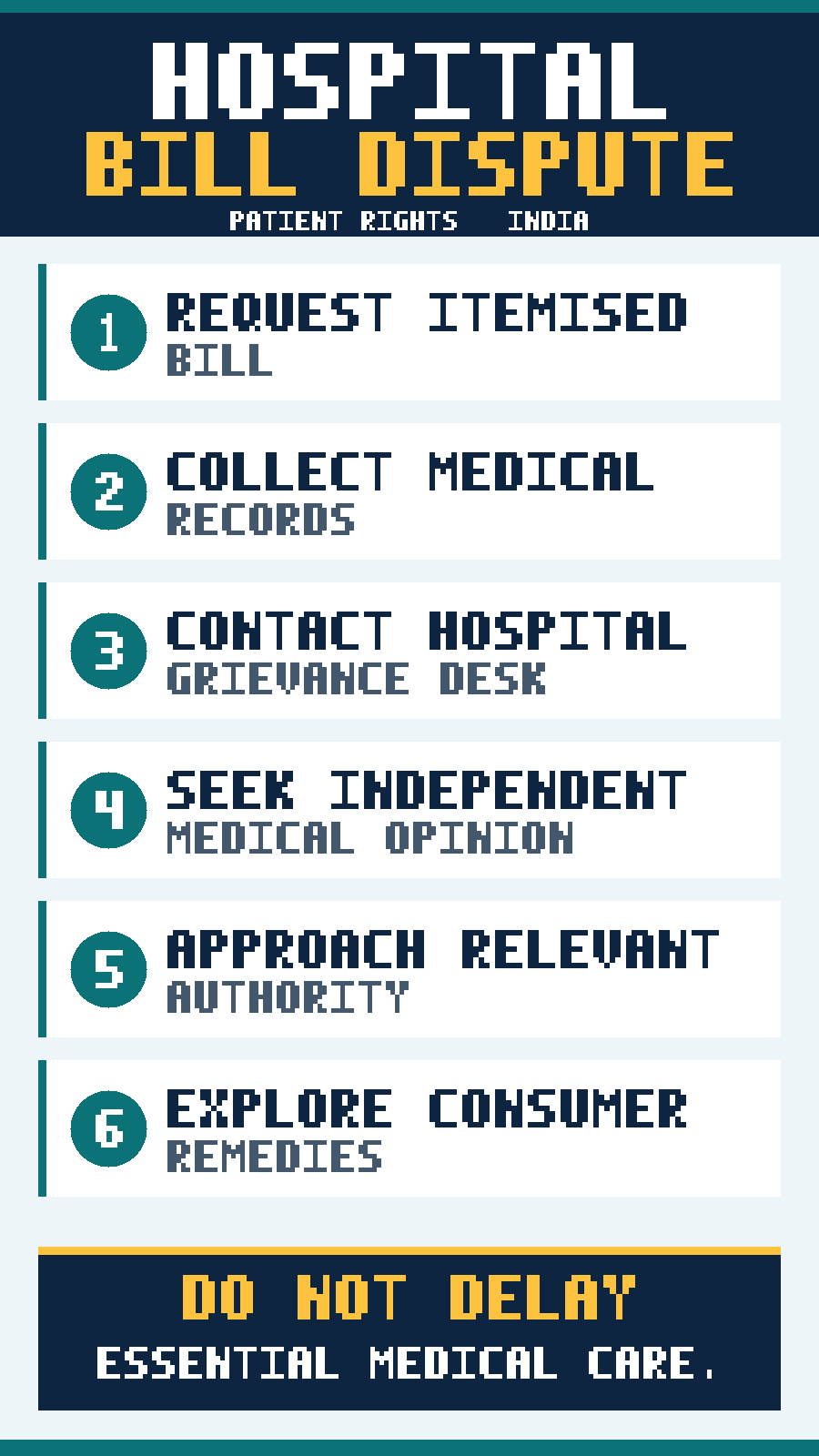
Legal references reviewed: 24 November 2026 | India
1. How to identify possible hospital overbilling
A large hospital bill is not automatically unlawful. Start by comparing the admission estimate, package terms and final invoice. Review the room and ICU charges, professional fees, medicines, investigations, procedures, equipment and other services separately. Reconcile deposits already paid, discounts and insurer payments. Ask the billing department to explain unclear descriptions and provide the applicable tariff or package terms.
For example, an operation initially quoted at a package price may legitimately become more expensive if an unexpected complication requires additional care outside that package. However, a duplicate charge, a test never performed or a service already included in the package may warrant a correction. Mark the disputed entries with their dates and amounts. Request a written explanation for each entry instead of assuming every difference is fraudulent. The Ministry of Health and Family Welfare’s Charter of Patients’ Rights supports transparent billing and access to information. Its implementation and the relevant statutory requirements vary by jurisdiction.
2. How to request medical records and a discharge summary
Send a written request to the medical records department or medical superintendent. Identify the patient, hospital registration number, admission and discharge dates, and documents required. Include the patient’s authorisation or appropriate evidence of representation where necessary. Relevant documents may include the discharge summary, investigation reports, medication charts, clinical notes, procedure records and consent forms. An invoice alone cannot establish everything that happened during treatment.
Regulations 1.3.1 and 1.3.2 of the 2002 medical ethics regulations provide for maintaining inpatient records for three years and issuing requested medical records to the patient, authorised attendant or relevant legal authority within 72 hours. The NMC placed its 2023 professional conduct regulations in abeyance in August 2023 and adopted the 2002 regulations. These requirements do not create unrestricted access to another person’s confidential records. Retain proof of the request and any response. If records are incomplete, identify the specific missing documents in a follow-up letter. Preserve copies securely and avoid publishing private medical information on social media.
3. File a written complaint with the hospital grievance desk
If the billing department cannot resolve the discrepancy, contact the hospital’s grievance officer, medical superintendent or management. Provide a short chronology and copies of the estimate, invoice, receipts and other relevant documents. Specify the remedy you want, such as an explanation, corrected invoice, refund of an unsupported charge or internal review of a suspected treatment problem. Request a complaint reference number and a written response. Keep your originals or retain complete copies before submitting records.
Where the patient remains admitted, discuss ongoing treatment with the clinical team separately from the financial dispute. Do not stop prescribed medication or arrange an unsafe discharge merely to avoid a bill. Seek a medically appropriate transfer if needed. If your concern involves withholding a patient or deceased person’s body over unpaid bills, read our separate guide: Hospital withholding patient or dead body over bills.
4. Health authority, insurance and PM-JAY complaint options
For alleged violations of hospital registration requirements, applicable tariffs, minimum standards or facility regulations, contact the relevant district or state health authority. Depending on the state, this may be the Chief Medical Officer, Chief Medical and Health Officer or designated clinical establishment registration authority. The Clinical Establishments (Registration and Regulation) Act, 2010 has not been adopted uniformly across India. States outside that framework may have their own hospital or nursing home legislation. Check the rules applicable where the hospital operates.
For an eligible Ayushman Bharat PM-JAY cashless treatment package, raise suspected improper charges with the hospital’s Ayushman help desk, State Health Agency or the scheme helpline, 14555. Confirm whether the disputed service is included in the approved package. A private health insurance claim rejection is not necessarily a hospital billing error. For an insurer-related dispute, use the insurer’s grievance procedure and, where applicable, IRDAI’s Bima Bharosa portal or Insurance Ombudsman mechanism. Preserve the insurer’s written coverage decision and hospital communications.
5. What counts as medical negligence?
A suspected treatment error is different from an incorrect invoice. A negligence claim generally requires establishing a duty of reasonable care, a breach of the applicable standard and harm attributable to that breach. An unsuccessful treatment, known complication or adverse outcome does not by itself establish negligence. The appropriate standard depends on the patient’s circumstances, the information available at the time and accepted medical practice.
Request an independent opinion from a qualified specialist in the relevant field. Provide the complete records rather than only the documents that support your suspicion. Ask the specialist to explain whether the treatment was clinically reasonable and whether a possible departure from the appropriate standard contributed to the harm. The Supreme Court reaffirmed these principles in a judgment dated 30 January 2026. Expert opinion can help establish the facts, though formal expert evidence is not mandatory in every consumer dispute. If the patient has urgent symptoms, obtain medical attention rather than waiting for an opinion prepared for litigation.
6. Complain to the State Medical Council about a doctor
Where a registered medical practitioner’s professional conduct is in question, approach the relevant State Medical Council through its prescribed complaint process. Use the NMC’s official directory to locate it. Identify the practitioner, registration number if known, hospital, dates and conduct complained of. Include the relevant records and explain what you believe requires disciplinary examination. A council may consider professional misconduct and impose appropriate disciplinary sanctions, subject to its procedures. It is not generally a substitute for a compensation claim. Criminal allegations require a separate legal assessment: criminal medical negligence has a substantially higher threshold than ordinary civil negligence. Consult a lawyer promptly in serious cases.
7. Consumer commission complaints and compensation
The framework established in Indian Medical Association v. V.P. Shantha (1995) allows qualifying medical services to fall within consumer protection law. A related curative petition was dismissed in September 2026, leaving the existing framework undisturbed; a separate challenge has also been brought. Check the latest legal position when filing. Services provided entirely free to everyone may fall outside consumer jurisdiction, while insurance-funded and mixed paid/free arrangements can require different analysis.
Contact the National Consumer Helpline at 1915 or consumerhelpline.gov.in for pre-litigation assistance. For a formal consumer complaint, use e-Jagriti. Under the 2021 jurisdiction rules, the value paid as consideration determines the forum: district commission up to ₹50 lakh, state commission above ₹50 lakh through ₹2 crore, and national commission above ₹2 crore. Section 69 of the Consumer Protection Act, 2019 ordinarily requires filing within two years of the cause of action, subject to permitted condonation for sufficient cause. Request appropriate relief supported by evidence, including a refund, compensation or litigation costs where applicable. Do not assume an award is guaranteed.
Frequently asked questions
Is every unexpected hospital charge illegal?
No. Compare the actual services, tariff, package terms and applicable rules.
How quickly should requested medical records be supplied?
The applicable medical ethics regulation provides a 72-hour period for qualifying requests.
Should I report every treatment complication to the police?
No. A complication is not proof of criminal negligence. Obtain independent medical and legal advice when warranted.
Do I need a lawyer for a consumer complaint?
Self-representation is possible, but professional assistance can be valuable in complex medical cases.
Where can I report improper PM-JAY charges?
Contact the scheme’s hospital help desk or call 14555 for eligible service-related complaints.
Conclusion and official references
Prioritise essential care and gather the documents needed to support your complaint. Choose the authority according to whether the issue is billing, hospital regulation, professional conduct or compensation.
Official resources: NMC medical ethics regulations, NMC regulations, State Medical Councils, Consumer protection legislation and Clinical Establishments portal.
General medical and legal information, not a diagnosis or individual legal advice.
For all topics: Where to Complain in India: Police, Courts, Consumer, Banking and Government Legal Help



















Share Your Opinion
Comments are closed on this post.