 Vista
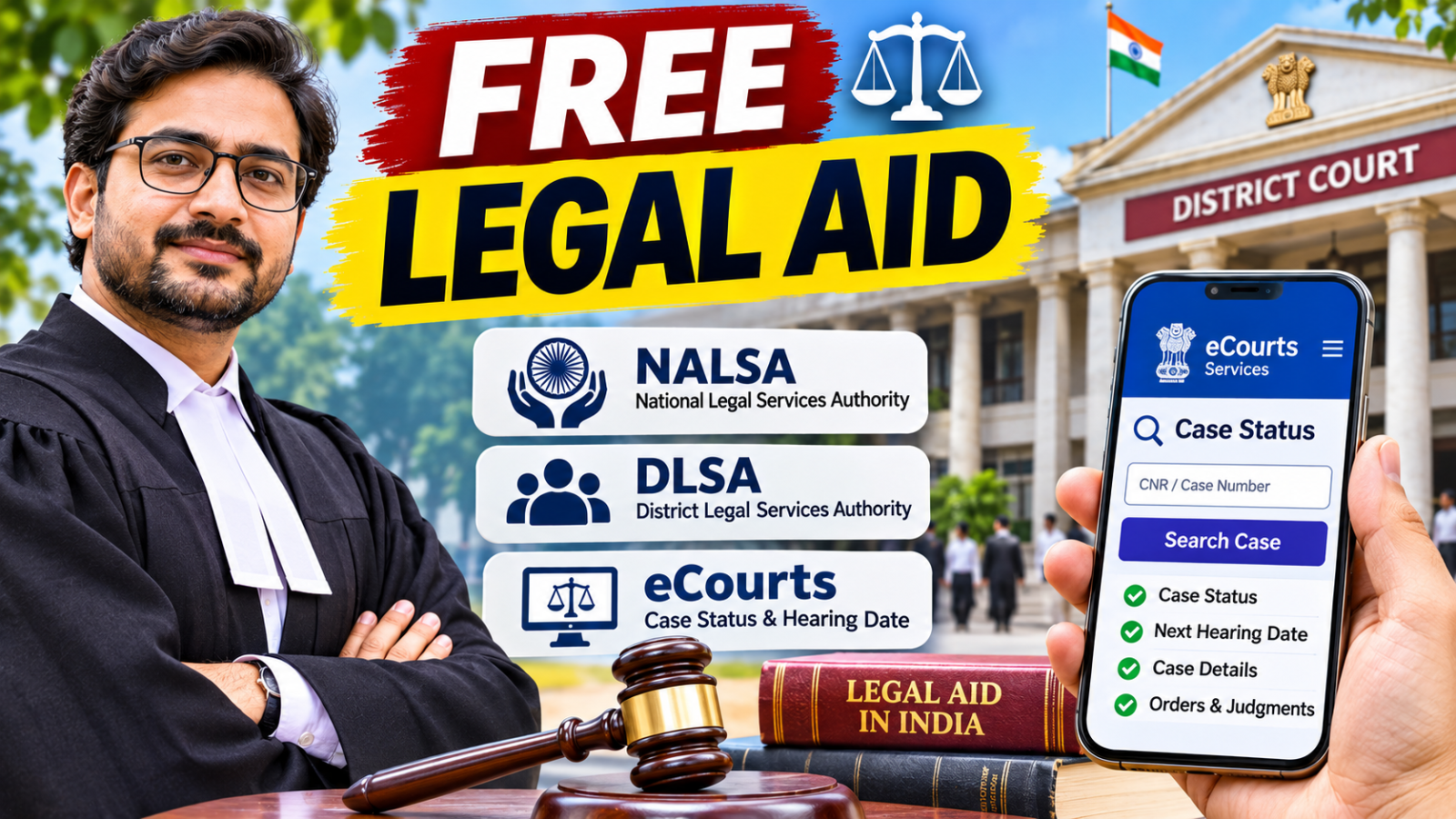
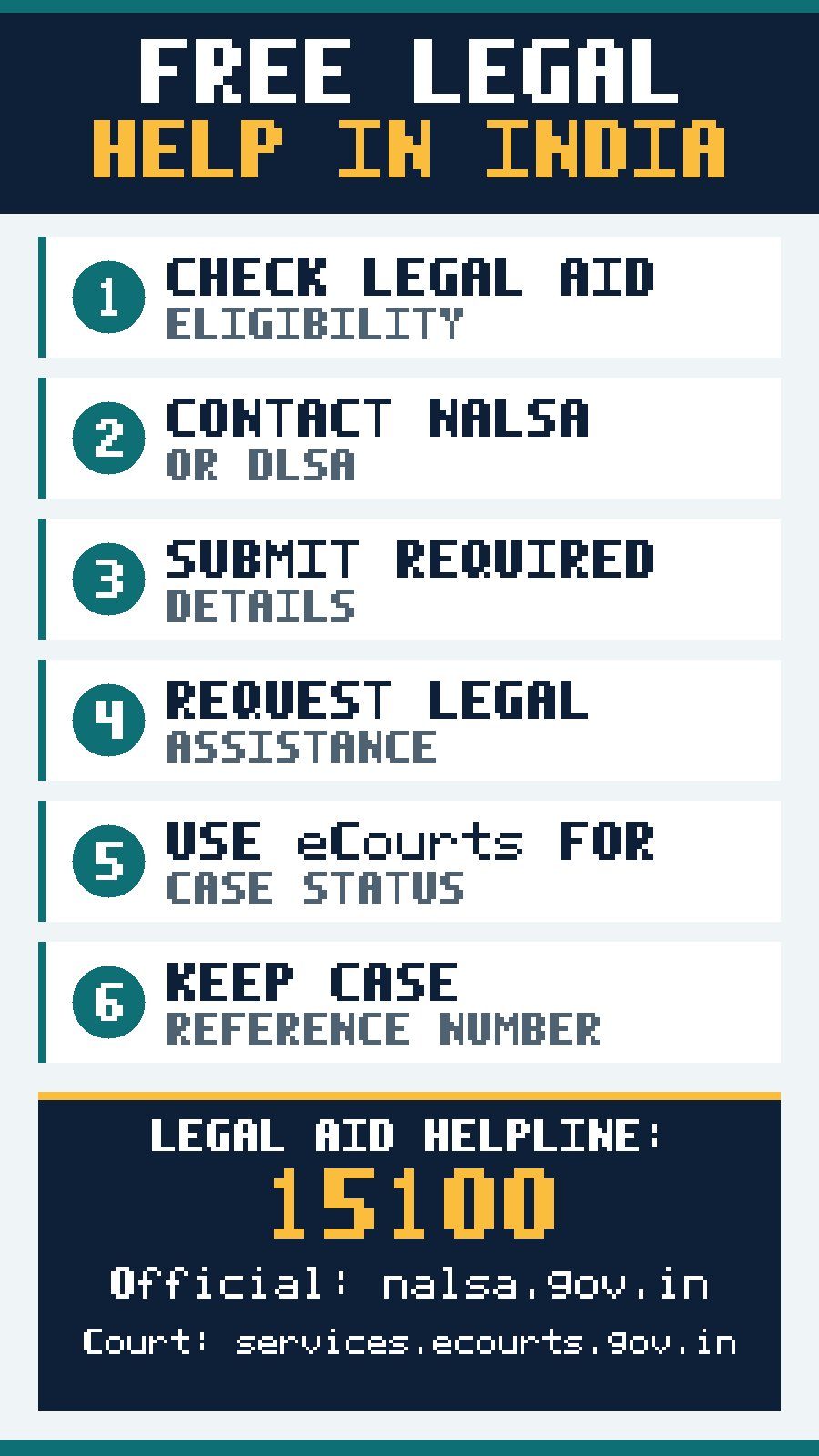
If you cannot afford a lawyer in India, you may qualify for free legal assistance through the legal services authorities. Visit the District Legal Services Authority (DLSA), generally located at the district court, apply through the National Legal Services Authority (NALSA) website or call the toll-free legal aid helpline at 15100. If you already have a court case and want to find its next hearing date, use the official eCourts portal. Applying for a lawyer and tracking a court case are separate procedures. This guide explains both, including eligibility, documents, CNR searches and certified court orders.
Official information reviewed: 24 November 2026 | India
1. What is free legal aid in India?
Free legal aid is a statutory mechanism designed to improve access to justice. The Legal Services Authorities Act, 1987 establishes the framework for providing legal services to eligible people. A legal aid lawyer represents or advises the beneficiary; this is different from a public prosecutor, who conducts criminal prosecutions on behalf of the state. You do not have to be facing a criminal charge to request legal assistance.
Depending on the approved assistance and the nature of the matter, services can include legal advice, preparing documents, representation before a court or other competent authority, and support with applicable litigation expenses or copies of judicial records. For example, an eligible worker with unpaid wages or a person defending an existing lawsuit can approach the appropriate legal services institution. Legal aid does not guarantee a successful outcome or exemption from every possible expense unrelated to the approved service.
2. Who qualifies for a free lawyer under sections 12 and 13?
Section 12 of the Legal Services Authorities Act identifies several independent eligibility categories. These include:
- Members of Scheduled Castes and Scheduled Tribes.
- Women and children below eighteen years of age.
- Eligible persons with disabilities or mental illness.
- Victims of trafficking or forced labour covered by the Act.
- People affected by specified disasters, caste atrocities, ethnic violence or other qualifying circumstances of undeserved want.
- Industrial workmen and persons in custody.
- Applicants whose annual income falls below the applicable statutory ceiling.
There is no single income ceiling for all courts across India. For example, the Madhya Pradesh State Legal Services Authority lists an income ceiling of ₹2 lakh, while NALSA states that the income criterion for Supreme Court proceedings is below ₹5 lakh annually. Check the current rules applicable to your state and court. Women can qualify through their independent statutory category rather than the income category. Section 13 additionally requires the authority to be satisfied that there is a prima facie case to pursue or defend. An income affidavit may generally suffice for income-based eligibility unless the authority has grounds to question it.
3. Where to apply: NALSA, SLSA, DLSA and court committees
NALSA coordinates legal services nationally. State Legal Services Authorities (SLSAs) administer services at state level, and DLSAs serve districts. Taluka Legal Services Committees provide local access where applicable. For proceedings in a High Court or the Supreme Court, approach the respective High Court Legal Services Committee or Supreme Court Legal Services Committee. Select the authority according to the court and jurisdiction involved in your matter, rather than assuming every application must go to the national office.
If you are unsure where to start, call 15100 or visit the legal services front office at the district court. Explain the issue and whether you have an approaching hearing or urgent deadline. A person who cannot prepare a written application may request help from a legal services official or para-legal volunteer. People in custody may also request assistance through the relevant prison legal aid facility or court.
4. How to apply for free legal aid online or offline
- Visit nalsa.gov.in and choose Legal Aid Application under e-Services.
- Select the relevant legal services institution and provide the requested location and contact information.
- Identify your eligibility category and explain the problem and legal assistance you need.
- Attach relevant available documents as requested by the official form.
- Submit the application and save the generated reference number for follow-up.
Alternatively, submit a written application at the appropriate legal services office. A plain-paper request explaining the facts can be used. Depending on the circumstances, useful documents include identification, contact details, evidence of eligibility, an income affidavit if applicable, and copies of court notices, an FIR or other relevant records. Do not assume that every applicant must produce every document. Explain any missing records to the authority and ask how to proceed.
Under the NALSA Free and Competent Legal Services Regulations, 2010, a decision on the application should be made promptly and within seven days of receipt. That is not a deadline for completing your court case. If you have not received a decision, contact the institution with the application reference. Once a lawyer is assigned, obtain their contact information and discuss the documents, hearing schedule and next steps. Report problems with the assigned service to the appropriate legal services secretary. You should not be charged for obtaining or submitting the legal aid application or receiving approved free legal services.
5. How to check court case status online using a CNR number
For district and taluka court proceedings, open the official eCourts Services portal. A CNR (Case Number Record) is a sixteen-character alphanumeric identifier used to retrieve a case. It differs from an ordinary case registration number and may appear on court documents or the online case details page. Ask your lawyer or court office if you cannot locate it.
- Open the Search by CNR Number section.
- Enter the complete sixteen-character identifier without spaces or hyphens.
- Complete the CAPTCHA and select Search.
- Confirm the court, parties and case details before relying on the results.
- Review the case history, next hearing date and available orders.
For High Court matters, use High Court Services or the relevant High Court website. Supreme Court case information is available through sci.gov.in. Some specialised tribunals maintain separate systems. A search in the district court portal will not automatically cover all proceedings nationwide.
6. Find a court case by party name without knowing the CNR
Choose Case Status in the district court portal and select the correct state, district and available court complex or establishment. Depending on the search form, you can use the party name, registration number, advocate name or another offered identifier. Enter the relevant year and select pending or disposed cases as appropriate. Complete the CAPTCHA and review the results. If a matching case appears, verify its court, case type, parties and year, then record the CNR for future searches.
People can share identical names. A matching name alone does not prove that the case concerns you. If no result appears, check alternative spellings, the registration year and the selected court. Recent filings may take time to appear online, and access to some sensitive records may be restricted. Do not interpret an unsuccessful search as definitive proof that no proceedings exist. For police records, see our separate FIR copy and case status guide.
7. Hearing dates, downloadable orders and certified court copies
Pending generally means the matter remains before the court. Disposed means the proceeding has been concluded at that level; it does not necessarily indicate which party succeeded. Read the actual order and consult your lawyer where necessary. A listed hearing date can change, so confirm it with the court or counsel, particularly before travelling. Missing a legally required appearance can have consequences even if you misunderstood an online status entry.
When available, open the Court Orders or case history entry to view the order or judgment PDF. A normal downloaded PDF is not necessarily a certified copy accepted for every legal purpose. If a certified copy is required, approach the court’s copying section or its official electronic certified-copy service, where offered. Follow that court’s application, authentication and fee rules. An eligible legal aid beneficiary can ask the appointed lawyer or authority for assistance obtaining the necessary records.
Frequently asked questions
Can I get a free lawyer for an existing case?
Yes. Eligible applicants can seek assistance during ongoing proceedings or at the appeal stage.
Is the legal aid application free?
Yes. Do not pay unofficial intermediaries to obtain or submit an application.
Can a woman apply regardless of income?
Women have an independent eligibility category under section 12(c), subject to the applicable legal aid assessment.
Do I need a lawyer to search eCourts?
No. You can search publicly available records yourself using the official portal.
Is my legal aid application number the same as a CNR?
No. The application reference tracks legal assistance; the CNR identifies a court case.
Conclusion and official resources
Use NALSA Legal Aid, its official FAQs and state authority information for eligibility and applications. Track court proceedings through eCourts. Keep both reference numbers safely and avoid sharing personal documents with unverified agents.
General legal information, not individual legal advice.
For all topics: Where to Complain in India: Police, Courts, Consumer, Banking and Government Legal Help

























Share Your Opinion
Comments are closed on this post.