 Vista
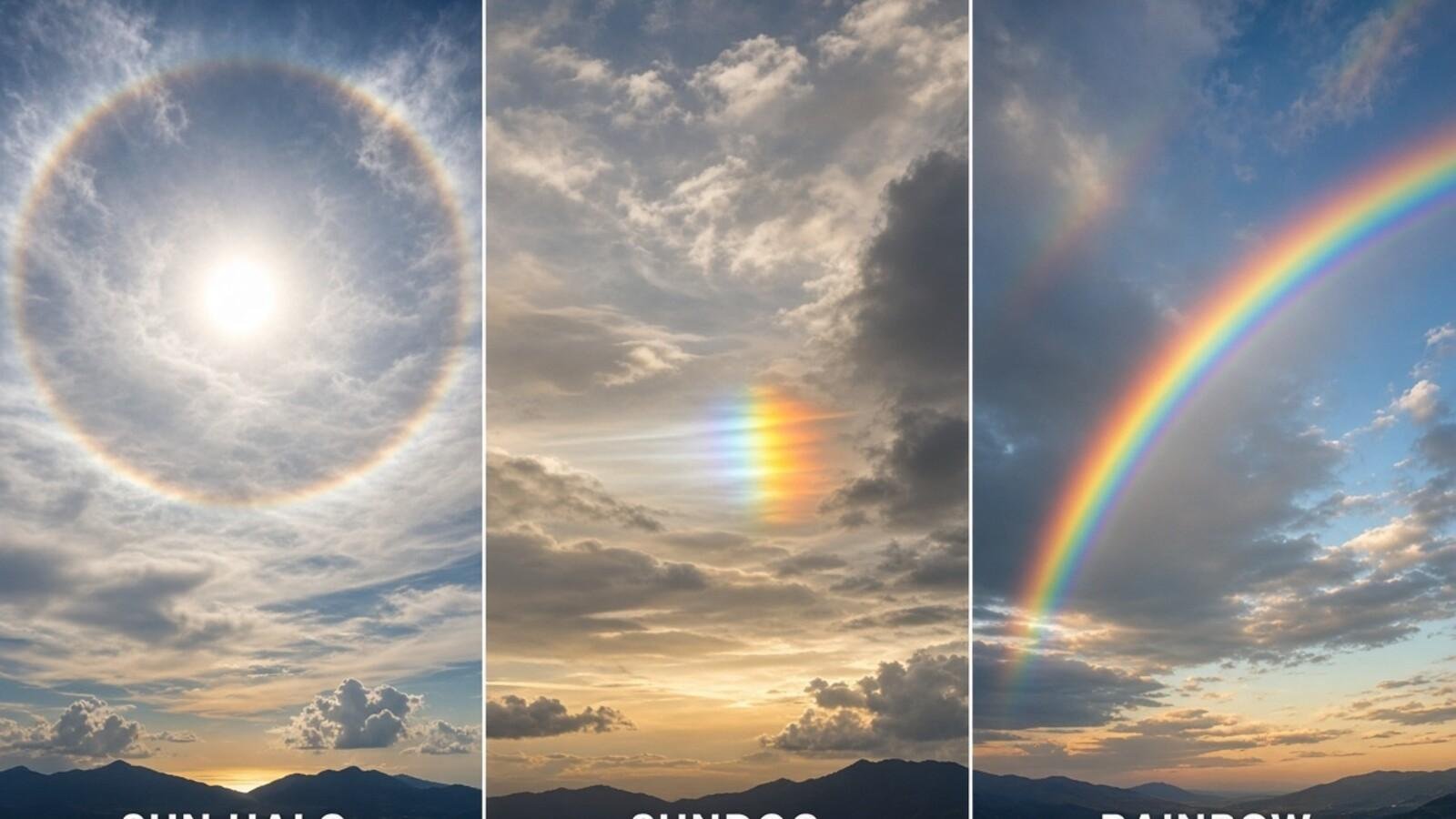
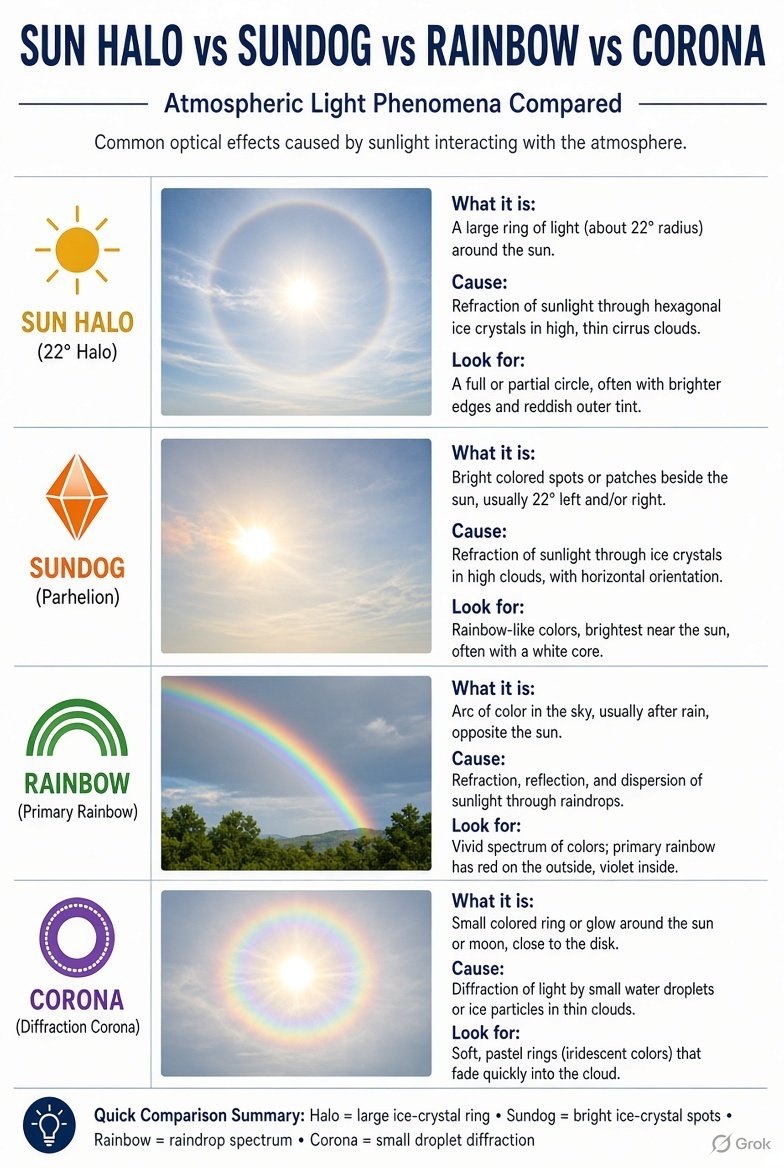
Quick answer: A sun halo is usually a large ring around the Sun created by light interacting with ice crystals in high clouds. A sundog is a bright patch commonly appearing about 22° to the left or right of the Sun. A rainbow typically appears opposite the Sun in rain droplets, while a corona is a much smaller coloured ring close to the Sun or Moon caused by diffraction in tiny droplets. Their colours can look alike, but their geometry and physics differ.
Updated: 21 November 2026.
Sun halo: why a big ring surrounds the Sun
A common 22-degree solar halo is a broad circular ring centred on the Sun. Its apparent radius is approximately twenty-two angular degrees, a measure of how far it appears from the light source in the sky, not the physical size of an object. The ring forms as sunlight refracts through suitably oriented and shaped ice crystals, often in high cirrus or cirrostratus clouds. In many photos it looks mostly white with a faint red inner edge, but colours can vary with atmospheric conditions and image exposure.
Thin high clouds can be difficult to notice until the halo appears. Because those clouds sometimes precede weather fronts, people historically regarded halos as a sign that weather might change. However a halo is not a guaranteed forecast of rain, thunderstorms or snowfall on a specific day. Local weather also depends on pressure systems, winds, humidity and regional conditions. If you see a halo, use the official forecast rather than a viral claim that a ring in the sky predicts an extreme event. The optical ring itself is a natural phenomenon, not a dangerous energy field.
Sundogs or parhelia: the two bright ‘extra suns’
Sundogs, also known as parhelia or mock suns, are localised bright spots that may appear at the same approximate elevation as the Sun, about twenty-two degrees to its left, right or both. They are produced when sunlight passes through ice crystals, often hexagonal plates aligned as they fall. A sundog may show a warm reddish side nearest the Sun and cooler colours farther away. The effect can be especially striking when the Sun is relatively low and a thin ice-crystal layer is present.
A sundog is not actually a second star, a new planet or a supernatural sign. It is an atmospheric light pattern whose apparent position is related to the Sun and the observer. Sometimes a halo and two sundogs occur together, giving the familiar ‘three suns’ picture. At other times only one spot is visible. The absence of a complete ring does not rule out a sundog. A bright reflection in a camera lens, however, can also create ghost images, so compare photographs with what was actually visible in the sky before assigning a confident identification.
Rainbow: why the Sun is normally behind the observer
A rainbow forms when light interacts with water droplets, involving refraction, internal reflection and dispersion. A common primary rainbow is seen in the portion of the sky opposite the Sun, often while rain is falling in front of the observer and sunlight is reaching the scene from behind. Its circular geometry is defined around the antisolar point, and only part of the circle is typically visible from the ground. A secondary rainbow can appear outside the primary bow with reversed colour order.
This is a key distinction from a solar halo. In a real primary rainbow photograph, you would not normally expect the Sun to sit at the centre of the arc. A halo is a ring centred on the Sun itself; a rainbow surrounds the point opposite the Sun. Rainbows need water droplets, whereas the most familiar 22-degree halos use ice crystals. There are special optical phenomena involving droplets near other light sources, but the classic rainbow-versus-halo rule remains an excellent first diagnostic. The presence of rainfall does not automatically mean every colourful sky ring is a rainbow.
Corona: small coloured rings caused by diffraction
A corona often appears as a tight set of coloured rings surrounding the Sun or Moon, near the bright light source, when thin clouds contain sufficiently small droplets. Unlike the typical 22-degree ice-crystal halo, a corona is caused chiefly by diffraction: light is bent and redistributed by tiny droplets. The droplet size affects the angular size of the corona; smaller droplets generally produce larger rings. The colours can be delicate, and the phenomenon may be hard to see against intense daytime sunlight.
Coronas are particularly easy to observe around the Moon because the background sky is darker. Photographs of the Sun can exaggerate or suppress visible rings depending on exposure and lens design. An overexposed corona may appear as a vague glow, while processing can create artificial colour bands. If the ring appears only a few degrees from the light source rather than a huge circle, corona is one candidate. But a full identification still needs knowledge of the clouds and whether the pattern was visible to the naked eye, safely and without staring at the Sun.
Halo vs corona vs sundog vs rainbow: quick comparison
The simplest comparison uses four questions. First, is the optical feature centred on the Sun? A large, roughly 22-degree ring suggests a halo; a much smaller set of rings can suggest a corona. Second, is there a bright patch off to one side of the Sun? A sundog may be present. Third, is the Sun behind the viewer, with an arc opposite it? That is characteristic of a rainbow. Fourth, are thin high ice-cloud conditions or liquid water droplets involved? The answer helps distinguish the physical causes.
A single photograph can hide the information needed to answer all four questions. Zoom level affects the apparent size of a ring in pixels, and HDR camera processing may strengthen colours. Compare multiple photographs taken from different orientations, but never point optical devices into the Sun or look directly at it for a better view. If a feature is barely visible, do not force an identification. A scientific explanation should leave room for uncertainty and for other phenomena such as circumzenithal arcs, sun pillars or cloud iridescence.
Other phenomena often mistaken for a rainbow
A circumzenithal arc can look like an upside-down rainbow high in the sky, but it is associated with sunlight passing through oriented ice crystals rather than ordinary raindrop geometry. A sun pillar forms as a vertical shaft-like glow above or below a low Sun, commonly involving reflection from falling ice crystals. Iridescent clouds can display pastel colours in patches near the Sun when small droplets or particles diffract light. These examples show why ‘rainbow in the sky’ is too broad a description for every coloured arc.
The location and shape are more useful than a sensational caption. An upside-down arc well above the Sun is not necessarily a broken rainbow. A bright vertical column at sunset is not a ‘laser beam’ sent from the ground. A colourful edge on a thin cloud is often related to droplet size and light scattering or diffraction, not a hole in the atmosphere. For a blog image gallery, use precise labels and avoid combining unrelated phenomena into one fabricated realistic news scene. A well-labelled comparison earns trust because it makes the reader better at looking at the actual sky.
Does a sun halo mean rain is coming?
High cirrus or cirrostratus clouds can sometimes precede weather fronts. Under the right atmospheric conditions, those clouds can produce a 22-degree halo. This creates a real observational connection between some halos and approaching weather changes. But the halo itself does not cause rainfall, and the presence of a halo does not guarantee rain within twenty-four hours or any particular period. A frontal system may weaken, move away or fail to deliver rain at the observer’s location.
If rain timing matters for travel, farming or an outdoor event, check regional meteorological services, radar and the local forecast. Social media captions claiming that a halo predicts an earthquake, cyclone or other disaster should be treated as unsupported unless there is specific scientific evidence. The appearance of a halo is not a reliable earthquake precursor. Instead of treating the sky as a countdown clock, enjoy the optics and use trained weather forecasters for decisions. A high cloud layer can be interesting without being an alarm.
How to photograph a halo or sundog safely
The first rule is not to stare directly at the Sun. Never use binoculars, telescopes or a camera optical viewfinder to look into it without properly rated specialist equipment. To photograph a ring, choose a wider composition that includes surrounding clouds and if possible block the bright solar disk behind a building or tree. Adjust exposure to preserve sky detail, and avoid turning a lens towards the Sun unnecessarily. Follow the camera manufacturer’s warnings regarding intense light and sensor damage.
A wide-angle photograph can show the shape of the ring and the relative position of sundogs better than an extremely zoomed-in image. Note the date, location, time and approximate Sun position if you want an accurate caption. Do not apply filters that invent colourful lines or claim a faint camera artifact is an optical event witnessed by everybody. For educational use, pairing a clear true photo with a separately labelled explanatory diagram is more useful than a realistic-looking AI composite that places a rainbow on the same side as the Sun.
Frequently asked questions
Is a sun halo the same as a rainbow?
No. A typical solar halo is centred on the Sun and usually involves ice crystals; a primary rainbow appears opposite the Sun and uses water droplets.
Why do I see two suns beside the Sun?
Bright patches roughly 22° to either side may be sundogs, also known as parhelia. Confirm they are not lens reflections.
What is the difference between a halo and a corona?
A common halo is a large ice-crystal ring, usually about 22° from the Sun; a corona is a smaller diffraction pattern often caused by cloud droplets.
Does a 22-degree halo predict rain tomorrow?
Not reliably. Some halo-producing clouds accompany approaching weather systems, but a local forecast is needed.
Is it safe to look directly at the Sun to see a halo?
No. Avoid staring at the Sun and never use unprotected magnifying optics to view it.
Conclusion
These effects can all produce colourful skies, but their light paths and viewing geometry differ. Use the Sun’s position, ring size and surrounding clouds to identify a likely phenomenon, and never stare at the Sun while photographing it.
Sources
- US National Weather Service — Halos, sundogs and sun pillars
- UK Met Office — Optical effects
- NOAA — What causes a rainbow?
Educational explanation, not a substitute for official local weather forecasts.






















Share Your Opinion
Comments are closed on this post.