 Vista
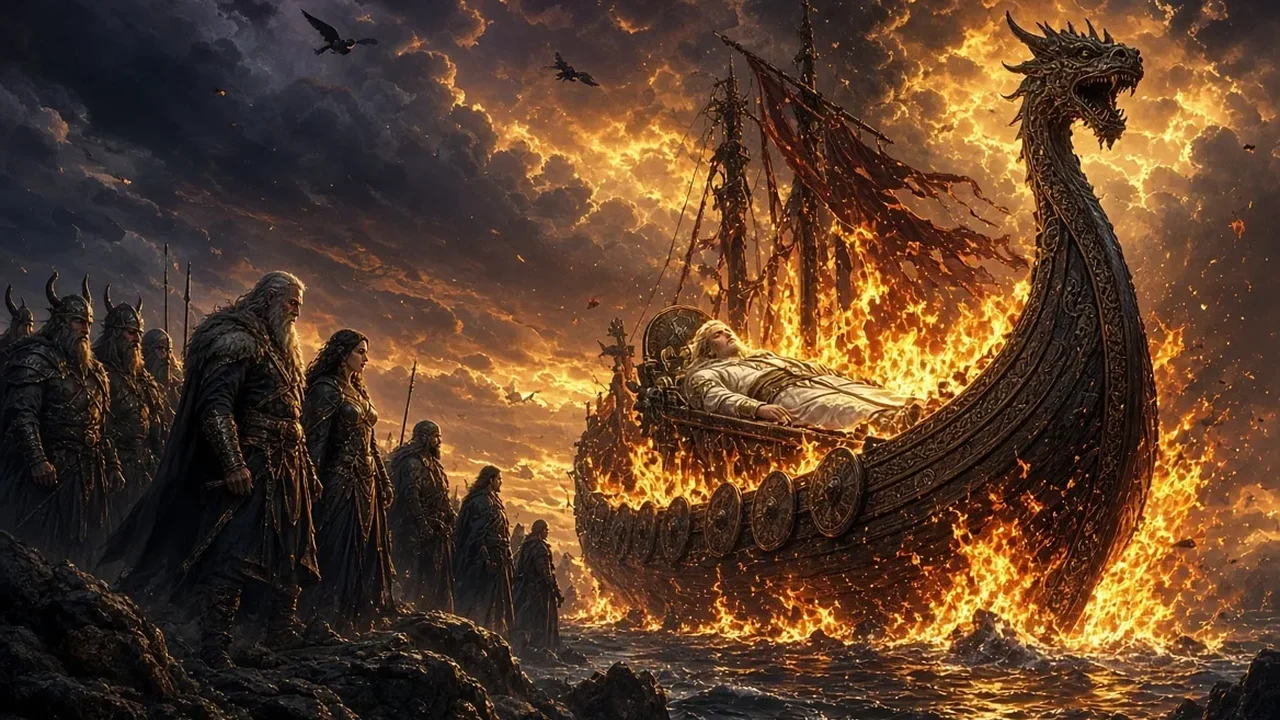
Baldr’s funeral in Norse mythology takes place on his great ship Hringhorni, which becomes a burning funeral pyre. In Snorri’s Gylfaginning, the gods cannot launch the huge ship until they summon the jötunn woman Hyrrokkin. Baldr’s wife Nanna dies from grief and is placed on the same pyre. Thor blesses it with Mjölnir, while Odin places the ring Draupnir among the funeral offerings. The scene is one of the most memorable descriptions of loss and ritual in medieval Norse literature.
This guide explains Baldr funeral ship Hringhorni, the death of the beloved god, Hyrrokkin’s unusual arrival, Nanna’s fate, Odin’s ring, the mourners, and the attempted return of Baldr from Hel. The images are modern artistic interpretations, not photographs of a documented funeral.
Why Did Baldr Die? Mistletoe, Höðr and Loki
Before the funeral, Baldr is known as the beloved son of Odin and Frigg. His mother seeks oaths from living things not to harm him, but the overlooked mistletoe becomes a fatal vulnerability. In Snorri’s version Loki discovers the weakness and arranges for the blind Höðr to throw a mistletoe weapon at Baldr. The blow kills him. The ancient poetic and prose materials preserve different emphases, and it is important not to claim that every surviving source depicts the death in an identical courtroom-like sequence. Baldr’s death begins a series of events that include grief, a journey toward the underworld and later punishment of Loki. Modern illustrations may show the missile as a shining arrow or spear. The safe factual description is that mistletoe and Höðr are central to the familiar version, with Loki’s involvement especially clear in Snorri. The funeral story becomes meaningful because the divine community cannot easily reverse the loss of a figure they treasured.
What Is Hringhorni, Baldr’s Funeral Ship?
Hringhorni is named as Baldr’s vessel in Gylfaginning and described as the greatest of ships. The Æsir intend to use it as a funeral pyre at the shore. They bring Baldr’s body toward the vessel but discover they cannot push it into the sea. This obstacle, rather than a spectacular battle, creates the next crucial scene. Modern pictures often show an elaborate Viking longship covered in runes, dragon heads and bright shields. Such imagery can be effective, but the source does not provide a complete archaeological blueprint for Hringhorni. It belongs to mythological literature and should not be identified as a ship found in an excavation. Some stories about actual Viking ship burials are known from archaeology, but they are a separate category of evidence and do not authenticate this exact supernatural event. In an infographic, the name Hringhorni, the funeral pyre and the difficulty moving the ship are essential details.
Who Is Hyrrokkin, and Why Do the Gods Need Her?
The gods send to Jötunheimr for Hyrrokkin, a jötunn woman strong enough to move the ship. She arrives riding a wolf and using a serpent as reins, an arresting mythic image. Odin instructs warriors to restrain her mount, but they struggle until it is overcome. Hyrrokkin goes to the ship and pushes it in a single mighty movement, producing sparks from the rollers and shaking the land. Thor becomes angry and reaches for his hammer, but the gods intervene to keep him from striking her. These details show that a powerful being from outside the divine household helps perform an essential task at the funeral. Calling Hyrrokkin a villain who destroys Baldr’s boat would be wrong. The source presents her as the one capable of launching it. Modern artwork can show a giant woman on a wolf beside a dark shore, but the exact look of her weapons, helmet and body is invented by the artist.
What Happens to Nanna, Baldr’s Wife?
Nanna, identified as the daughter of Nep in Snorri, is Baldr’s wife. When she sees her husband’s body being placed on the ship, she dies from grief in the familiar prose telling. Her body is then placed beside his on the funeral pyre. Some simplified summaries write that Nanna is killed by the same mistletoe projectile or that she willingly walks alive into the flames. That is not what this Gylfaginning passage says. It presents her death as a sudden consequence of overwhelming sorrow. The episode is tragic, and a sensitive article does not need to glorify death from grief as an ideal to imitate. Nanna and Baldr appear together later in Hermóðr’s underworld visit, which makes their story more than a single funeral image. The source should be cited clearly, since details of Nanna differ across other medieval material. A caption can simply state that the funeral includes both Baldr and Nanna in Snorri’s telling.
What Does Thor Do with Mjölnir at the Pyre?
Thor stands near the funeral fire and hallows it with his hammer Mjölnir. The action is striking because the same weapon that destroys enemies appears in a consecrating role. Snorri also relates the odd incident of a dwarf named Litr running in front of Thor; the god kicks him into the fire. That episode is disturbing and sometimes omitted from child-friendly retellings, but it is part of the prose scene. It should not be made into a cheerful joke about a real funeral. Nor does the mention of the hammer provide a fully standardized archaeological manual for every Viking burial practice. Mythic episodes can inform our understanding of religious ideas but require care when compared with material evidence. A poster may show Thor holding the hammer beside the ship, and its caption should explain the act of hallowing rather than claiming he burns the vessel by summoning a lightning strike, which is not the central source detail.
Why Does Odin Place Draupnir on the Ship?
Odin lays his gold ring Draupnir on Baldr’s funeral pyre. In Snorri’s account the ring has a miraculous quality: eight rings of equal weight emerge from it every ninth night. The offering is therefore an important treasure associated with Odin, not simply an anonymous wedding ring. The funeral also includes Baldr’s horse with its trappings, and mourners from different divine and jötunn groups. Readers may connect Draupnir with a different myth about the dwarf-made treasures of the gods. Both references belong to the larger network of Norse stories, but the funeral does not explain the ring’s entire manufacturing history. A truthful caption can mention Odin’s offering without inventing a detailed inscription or magical energy effect. Modern pictures of glowing rings above the flames are interpretations. The source-grounded symbolism is the dedication of an extraordinary valued object at the funeral of a beloved son.
Who Attends Baldr’s Funeral?
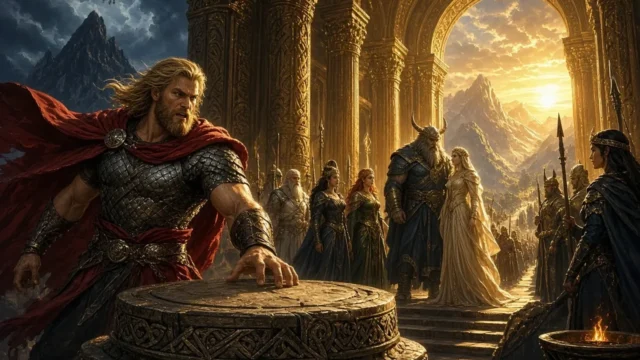
The assembly includes Odin, Frigg, Valkyries and ravens, as well as figures such as Freyr, Heimdallr and Freyja with their characteristic animals or transport. Snorri also mentions different kinds of jötnar among the witnesses. This diverse attendance conveys how deeply the event touches the mythic world. It is not limited to Odin standing alone beside a fire. Artists may make the mourners look like a council of movie superheroes, but the exact costume and arrangement are not prescribed in a full visual scene. A reliable article can name notable participants without pretending every god from every Norse poem attended. Freyr’s boar and Freyja’s cats are particular recognizable details in Snorri’s description. A careful gallery might use one wide ship-funeral picture for atmosphere and another poster for named attendants. The visual emphasis should remain on mourning and the enormous ship rather than misleadingly portray Baldr’s funeral as a victorious military celebration.
Hermóðr’s Journey to Hel: Could Baldr Return?
Frigg seeks someone willing to ride to the realm of Hel and negotiate Baldr’s return. Hermóðr takes Odin’s horse Sleipnir and travels through dark regions toward the dead. In the familiar prose telling, Hel says Baldr may return if all things weep for him. Almost everything does, but a figure called Þökk refuses, and the return fails. Snorri associates the refusal with Loki in a form or disguise. The episode is connected to the funeral but should be distinguished from the ship-launch scene. Some modern retellings simply say Odin resurrects Baldr during the burning, which contradicts the core narrative of failed recovery. Later prophecy allows Baldr’s return after Ragnarök in the renewed world, an entirely different context. A useful timeline therefore has Baldr’s death, funeral, Hermóðr’s attempt and later renewal as distinct moments. This avoids mixing beautiful art from different parts of the myth into one inaccurate historical sequence.
Baldr Funeral Images, Hringhorni Wallpaper and Viking History
Search phrases including ‘Baldr funeral ship’, ‘Hringhorni Viking ship’, ‘Hyrrokkin wolf Norse mythology’, ‘Nanna Baldr wife’ and ‘Odin Draupnir funeral’ reveal multiple reader questions. A wide featured image can show Hringhorni at sea with mourning gods and fire, while a vertical poster can explain the ship, the helper, Nanna and the offerings. ALT text should name only the elements visible: if Hyrrokkin is absent, do not describe her riding a wolf in the picture. Some websites use real archaeological ship-burial photographs for Baldr’s funeral without explaining the distinction between evidence and myth. A genuine burial site can illustrate historic practices, but it cannot document this fictional divine ceremony. Good visual SEO combines compelling art with clear labels for medieval story versus modern reconstruction, and it preserves the names that help readers investigate the source themselves.
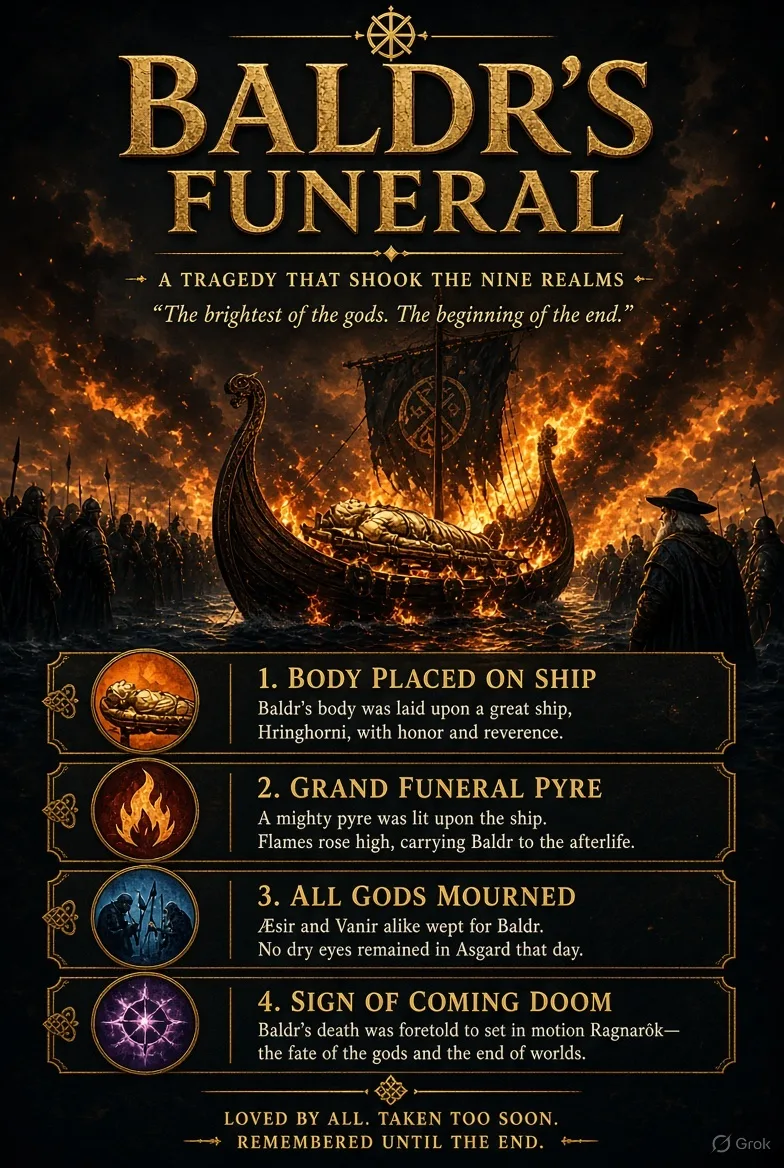
Artwork and source The line in quotation marks is modern poster copy. In Snorri’s account, Þökk refuses to weep, and in the Ragnarök poems Baldr returns after the catastrophe.
Frequently Asked Questions
What was Baldr’s funeral ship called?
Hringhorni, described in Gylfaginning as the greatest of ships.
Who pushed the funeral ship into the sea?
Hyrrokkin, a powerful jötunn woman.
How did Nanna die?
In Snorri’s telling she dies from grief when she sees Baldr’s body.
What did Thor do at the funeral?
He hallowed the pyre with Mjölnir.
What did Odin place on the funeral pyre?
The extraordinary gold ring Draupnir.
Did Baldr immediately return from Hel?
No. Hermóðr’s attempt fails in the familiar account; Baldr is later associated with renewal after Ragnarök.
Conclusion
Baldr’s funeral on Hringhorni is a richly detailed scene of grief: Hyrrokkin moves the vessel, Nanna is placed alongside Baldr, Thor hallows the pyre and Odin offers Draupnir. Its emotional power is strongest when illustrated carefully without treating supernatural literature as an archaeological record.
Sources and illustration note
Gylfaginning: Baldr’s ship Hringhorni and funeral; Völuspá: Baldr, Höðr and the mistletoe; Baldr’s Dreams — Poetic Edda.
Reviewed 15 November 2026. Artwork is a modern myth-inspired rendering.












Share Your Opinion
Comments are closed on this post.