 Vista
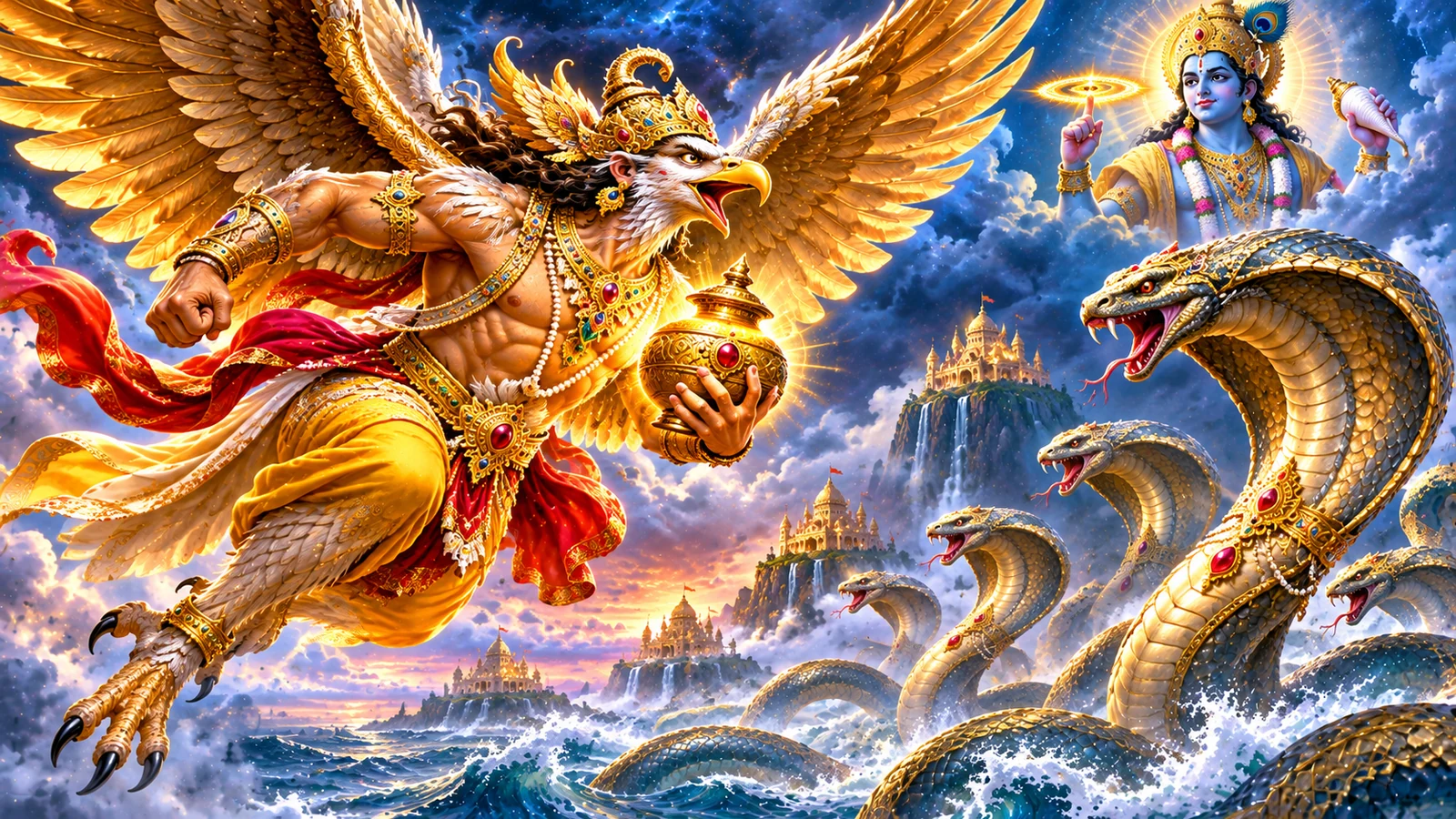
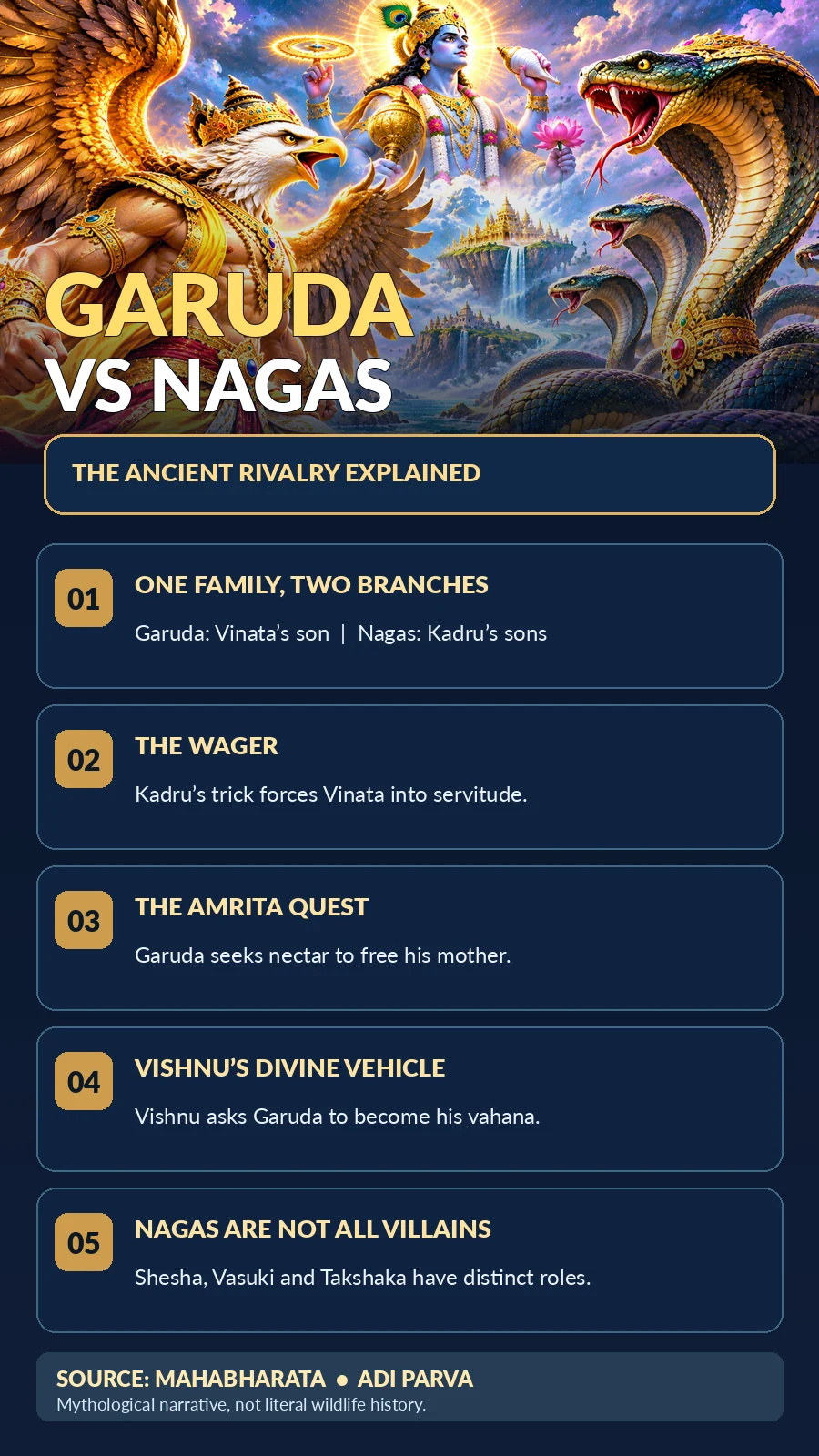
Quick Answer: Garuda and the Nagas are traditional rivals in Hindu mythology because of a conflict between their mothers, Vinata and Kadru, both associated with the sage Kashyapa. In the Mahabharata’s Adi Parva, Kadru wins a deceptive wager involving the celestial horse Uchchaihshravas, and Vinata is forced into servitude. Garuda, Vinata’s powerful birdlike son, sets out to obtain amrita, the nectar of immortality, to win his mother’s freedom from the serpent family. His mission brings him into conflict with the Nagas and the gods, but it also leads to an extraordinary relationship with Vishnu, who asks Garuda to serve as his vehicle, or vahana. This is the short answer to the often-searched questions “Why does Garuda hate snakes?” and “How did Garuda become Vishnu’s mount?” The full story is richer than a simple bird-versus-snake battle. It explores deceit, family obligations, courage, difficult bargains and the possibility of restraint. Garuda and the Nagas are mythological beings, not historical animal species; the stories belong to religious literature rather than wildlife science.
Who Are Garuda, Vinata, Kadru and the Nagas?
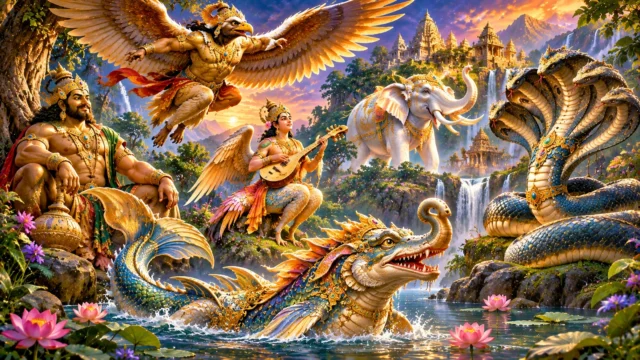
Garuda, sometimes called Vainateya, Suparna or the king of birds, is represented as an extraordinary avian being. Indian art may portray him as an immense eagle-like bird, a winged human with a beak, or a powerful hybrid figure wearing a crown and jewelry. He is not simply an ordinary eagle that has been enlarged. Vinata is his mother. Kashyapa is commonly identified as his father in the epic family story, and Aruna, associated with the chariot of Surya, is his brother. Kadru is Vinata’s sister or co-wife in the broader account, and she is the mother of the Nagas, a great lineage of serpent beings. This makes Garuda and many of the Nagas relatives through Kashyapa, an intriguing part of the rivalry that popular retellings often omit.
The Sanskrit word naga refers to serpent beings in these narratives, but their forms and functions vary. Some appear as serpents with many hoods; others take human or mixed forms, inhabit splendid palaces, guard treasures or exercise considerable spiritual power. They are not interchangeable with venomous snakes found in fields and forests today. Shesha or Ananta, Vasuki and Takshaka are among the best-known figures, yet their stories should not be combined into one biography. Keeping these distinctions clear helps explain why Hindu worship can revere a serpent in one context while depicting Garuda pursuing another in a different story.
The Wager of Uchchaihshravas: How the Rivalry Began
A dramatic episode in the Mahabharata’s Adi Parva tells how Kadru and Vinata disagree about the color of the celestial horse Uchchaihshravas, which emerges in the larger mythic context of the churning of the ocean. Vinata describes the horse as white, while Kadru asserts that its tail is black. The sisters agree on a wager: whoever loses must serve the winner. Kadru then instructs her serpent sons to make the horse’s tail appear dark by attaching themselves to it like black hairs. Some serpent sons refuse to participate in the deception. The epic narrates Kadru’s anger and a curse connected to the later destruction of snakes during King Janamejaya’s sacrifice.
When the wager is judged, the apparent color of the tail causes Vinata to lose. Her forced service to Kadru sets up the conflict in which Garuda will later become involved. The episode has more than one moral complication. Kadru seeks victory through manipulation, but not all her sons consent to the trick; their refusal prevents the reader from treating an entire lineage as equally guilty. Vinata’s suffering is a consequence of the wager, not evidence that she committed the same deception. The story offers a classic epic pattern: a private act of dishonesty grows into a conflict between families and eventually affects many beings. Translation word choices and chapter divisions differ across editions, so the safest reference is the Adi Parva’s Astika narrative rather than an unsupported precise modern date.
Why Garuda Had to Bring Amrita
Garuda discovers that his mother remains bound to Kadru’s service. He asks the serpents what they demand in exchange for Vinata’s freedom, and the answer is the amrita that is guarded by the gods. This is not a mission to drink the nectar himself or to make the Nagas rulers of the universe. His immediate aim is the release of his mother. In the epic, the quest becomes a sequence of extraordinary trials, involving immense physical strength, encounters along the journey and the guarding of a celestial treasure.
The amrita is the nectar associated with immortality in Hindu mythological literature. The term appears in several stories, including the churning of the ocean, but readers should not imagine one scientifically tested drink whose formula has been recovered. It is a narrative object with profound religious symbolism. The demand also raises an uncomfortable ethical question: is it just for a powerful group to require a nearly impossible price before releasing someone from bondage caused by a deceptive wager? Garuda’s determination can be admired without pretending every surrounding character behaves fairly. That difference between courage and fairness is one reason the episode stays memorable even when we know the outcome.
How Garuda Reached the Nectar: The Mythic Journey
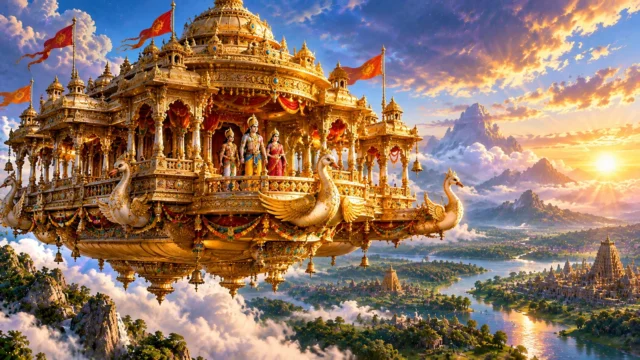
The Adi Parva depicts Garuda as possessing exceptional speed, scale and strength. When he approaches the protected nectar, he must overcome formidable barriers. Some versions describe a revolving sharp wheel at the entrance and fearsome serpent guardians. Garuda contracts or changes his form to pass the obstacle and uses strategy to defeat the guards. The details matter because they show that his triumph is not merely raw force: observation and judgment complement strength. Some later illustrated versions add new visual flourishes, but the underlying narrative is a celestial quest, not a record of ancient aviation technology.
After taking possession of the amrita, Garuda does something striking. Although he could pursue immortality through the nectar, the story emphasizes his resolve and his encounter with Vishnu instead. This departure from simple greed creates a transition from conflict to divine recognition. The episode also anticipates the involvement of Indra, who wants the nectar returned to the gods. Garuda becomes a memorable epic hero because he balances filial loyalty with acts that make even powerful divine beings take notice. A responsible retelling distinguishes the epic narrative from modern inventions, such as precise distances, mechanical specifications or claims about the “real location” of the nectar.
How Did Garuda Become Lord Vishnu’s Vehicle?
The meeting between Garuda and Vishnu is a turning point. In the Adi Parva narrative, Vishnu offers Garuda boons; Garuda asks to be immortal and free from disease without first drinking the amrita. Garuda then offers Vishnu a boon in return. Vishnu requests that Garuda become his vehicle, and an association with the divine banner or standard is also described. Garuda accepts. This is the textual answer to “Why is Garuda the vahana of Vishnu?” It is an alliance formed through mutual recognition and a remarkable exchange, not the straightforward story of Vishnu trapping a bird and forcing it into service.
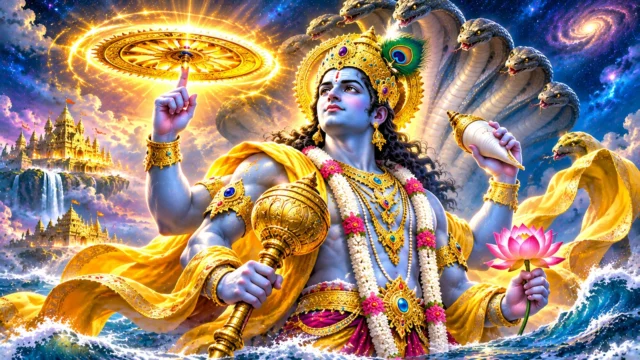
A vahana in Hindu iconography is more than modern transportation. It helps identify a deity in sculpture and painting, and its qualities can complement the deity’s symbolism. Garuda’s powerful wings evoke speed, courage and the capacity to travel beyond normal limits. Vishnu’s role as sustainer is therefore visually paired with a vigorous guardian and messenger. Other artistic traditions picture Garuda kneeling in devotion, carrying Vishnu above his shoulders or spreading his wings beneath the deity. Artworks from India, Nepal and Southeast Asia attest to the motif’s long cultural life, although every sculpture should be dated and described on its own terms.
Indra, the Amrita and Why Snakes Have Forked Tongues
Indra confronts Garuda after the nectar is taken. In an often-told episode, Indra strikes with his vajra, the thunderbolt. Garuda acknowledges the weapon and the sage associated with its origin, and allows a single feather to fall rather than treating the encounter as a deadly personal feud. Indra and Garuda come to an understanding concerning the amrita. Garuda can fulfil the condition for Vinata’s release without letting the serpents consume the nectar.
Garuda places the vessel on kusa grass and tells the Nagas to perform purification before drinking. While they are away, Indra takes back the nectar. When the Nagas return, they find no vessel and lick the grass where the amrita rested. The epic explains the split or forked tongues of snakes through this event. It is an etiological myth: a traditional narrative that gives a story-based explanation for an observable feature of animals. It is not a biological account of how forked tongues evolved. Modern zoology explains snake anatomy through natural history, not a celestial bargain. The distinction lets readers appreciate both the story’s inventive imagery and the independence of scientific explanations.
Are All Nagas Evil? Shesha, Vasuki and Takshaka
No. Treating the Nagas as a single villainous army erases important characters and their sacred functions. Shesha, also called Ananta in many contexts, is a primordial serpent closely associated with Vishnu and cosmic support. Devotional art shows Vishnu resting upon Ananta’s coils beneath a protective hood. Vasuki is a prominent naga king and appears in the Samudra Manthan story, where he functions as the serpent used in the churning of the ocean. Takshaka belongs to a different narrative cycle involving the death of King Parikshit and the later snake sacrifice of Janamejaya. These figures have distinct stories, loyalties and meanings.
The Mahabharata also contains the story of Astika, who intervenes to halt Janamejaya’s destructive snake sacrifice. That episode changes the emotional register: a tale that began with a curse and the fear of serpents becomes a story about rescue, mediation and the limits of collective revenge. The Nagas may be dangerous in some narratives, but they are not uniformly condemned across Hindu traditions. In temple art and regional practice, serpent guardians can signify fertility, protection, water, sacred territory or continuity. To say “Garuda is Vishnu’s mount and therefore Vishnu hates all Nagas” is plainly too simplistic, especially given the images of Vishnu resting upon Ananta.
Why Is Vishnu Associated With Both Garuda and Ananta?
This is among the most interesting questions for new readers: how can Vishnu travel on Garuda, the famous enemy of serpents, and rest upon the serpent Ananta? The answer is that religious symbols function in particular narratives and theological contexts; they are not bound by a single animal rivalry. Garuda can express energetic devotion and swift action, whereas Ananta can express continuity, shelter, immeasurable time or the stability of the cosmic waters in different traditions. Their connection to Vishnu does not require every serpent and every bird to be allies.
In art, context matters. A panel featuring Vishnu seated on Garuda emphasizes a movement or presence of the deity, while a Vishnu-on-Ananta image may evoke cosmic repose. Some communities offer prayers involving serpent deities; others highlight Garuda’s protection from snake danger through religious symbolism. Neither makes an actual eagle or a wild snake morally good or bad. This distinction is especially valuable for global audiences familiar with mythology through films and games, which sometimes turn complex deities and beings into fixed factions. Hindu stories can hold apparent tension without becoming incoherent: the same tradition can portray conflict, reverence and reconciliation in different settings.
Garuda and Nagas in Art, Temples and Southeast Asia
Garuda appears widely in South and Southeast Asian visual cultures. The representation can differ substantially from a modern digital painting: some Indian images show a human torso, beaked face and wings; other artworks emphasize an eagle form or a kneeling attendant. Vishnu riding Garuda is a major sculptural motif, and the bird-serpent opposition appears in reliefs and decorative schemes. In parts of Southeast Asia, stories of Garuda and serpent beings have been adapted to local religious, royal and artistic settings. Such depictions reflect cultural transmission, not proof that the mythic encounters occurred as physical battles.
Naga forms likewise vary. One-headed or many-hooded serpents may guard a deity, a sacred place or a threshold. The presence of a naga in a temple does not automatically mean it depicts Kadru’s deception or Garuda’s pursuit. A good caption identifies the object, location, approximate date and the iconographic details that are actually visible. Readers can start with an image of Vishnu on Garuda, compare it with Vishnu on Ananta, and then explore an ancient naga relief. That practice makes mythological study more thoughtful than sharing an exciting picture with an invented historical claim.
Five Lessons From the Garuda–Naga Rivalry
First, the wager shows how a dishonest shortcut can trap innocent people and create consequences much larger than expected. Second, the Nagas who resist Kadru’s instructions remind us that individuals in one family or group do not automatically share the same moral responsibility. Third, Garuda’s effort to free Vinata embodies courage grounded in care, not merely a craving for status. Fourth, his negotiation with Vishnu and Indra shows that an epic conflict need not end with the total destruction of every opponent. Fifth, Astika’s later intervention in the snake sacrifice provides an important counterweight to cycles of vengeance.
These are contemporary readings of epic literature rather than rigid lessons officially agreed upon by every Hindu school. The stories contain violent and unsettling details, including descriptions shaped by the social assumptions of their textual settings. Readers need not endorse every behavior in order to understand the ethical questions. A balanced account honors the religious context while allowing careful comparison and reflection. For students, a useful discussion question is: which choice most directly caused the long rivalry—the original wager, the act of deception, the demand for amrita or the later decisions of those involved?
Garuda and Nagas: Quick Timeline
The basic sequence can be followed without mixing together all the serpent stories. First, Vinata and Kadru become connected through the family of Kashyapa. Next, the sisters disagree about the color of the horse Uchchaihshravas. Kadru’s attempted deception leads to the wager being decided against Vinata, who is bound to serve. Garuda learns of his mother’s condition and receives the demand to bring amrita. He passes the defenses of the nectar, meets Vishnu and enters into the association of vahana and divine emblem. Indra and Garuda then reach an understanding about the nectar. Finally, Vinata gains freedom while the serpents fail to consume the amrita. The later Astika and Janamejaya cycle explores the threatened destruction and eventual survival of the naga lineage.
The timeline is an order of events within an epic narrative, not a list of verified prehistoric dates. Specific numbering of Adi Parva chapters differs among the critical edition, regional editions and nineteenth-century English translations; readers should match the passage by its story and title as well as its numbering.
Frequently Asked Questions
Who is Garuda in Hindu mythology?
Garuda is Vinata’s extraordinary birdlike son, celebrated as a powerful winged being and the vahana of Vishnu in many Hindu traditions.
Why do Garuda and Nagas fight?
Their rivalry grows out of Kadru and Vinata’s wager, Vinata’s bondage and the demand that Garuda bring amrita to secure her freedom.
Is Garuda a real eagle?
Garuda is a mythological figure, often portrayed with eagle or human-bird features, not a scientifically identified bird species.
Who are Garuda’s parents and brother?
Vinata is his mother, Kashyapa is commonly named as his father, and Aruna is his brother in the epic genealogy.
Why is Garuda the vehicle of Lord Vishnu?
In the Mahabharata’s Adi Parva, Vishnu asks Garuda to become his vehicle during an exchange of boons; Garuda agrees.
Did the Nagas drink the amrita?
In the famous account, Indra removes the nectar before they can drink it. Licking kusa grass gives a mythic explanation for snakes’ forked tongues.
Are Shesha and Vasuki enemies of Vishnu?
No. Shesha or Ananta is closely associated with Vishnu’s cosmic repose; Vasuki is significant in the ocean-churning myth. Nagas have varied roles.
Does Garuda Purana tell the same story?
Do not confuse the Garuda–Naga feud in the Mahabharata’s Adi Parva with every topic covered by the Garuda Purana, a different body of religious literature.
Related Reading
- Vishnu’s ten avatars and their meaning
- Garuda Purana: afterlife and what the text says
- Brahma, Vishnu and Shiva explained
Sources and Textual Notes
The primary narrative is in the Mahabharata, Adi Parva (Astika cycle); chapter numbering varies across editions. Read the texts and compare translations.
- Mahabharata, Adi Parva, Section XX (wager)
- Mahabharata, Adi Parva, Section XXV (bondage)
- Mahabharata, Adi Parva, Section XXXIII (Vishnu and Indra)
- Mahabharata, Adi Parva, Section XXXIV (amrita and kusa grass)
- Mahabharata, Adi Parva, Section LIV (Astika and snakes)
- Traditional edition: Adi Parva Chapter 29 (text and variants)
Editorial note: This article describes mythological narratives and cultural symbolism, not independently verified zoological or historical events. Reviewed 13 November 2026.

Share Your Opinion
Comments are closed on this post.