Many families hear the name Garuda Purana only after a death at home. Someone says the book talks about Yamaloka, punishment, and shraddha, and fear fills the room before anyone has opened a page. That reaction is common. It is also incomplete. This article stays with the same traditional picture given in Hindu Puranic teaching: what the Garuda Purana is, how it frames the afterlife, what it says about death rituals, and where later internet talk adds extra claims the source text of this explainer does not make.
The aim is simple. Read the Garuda Purana afterlife death rituals material as scripture teaching — not as a horror reel, not as a court file, and not as a “scientifically proven” map of the next world. Where the Purana speaks in story and symbol, it will be marked as Puranic narrative. Where today’s websites offer PDFs and summaries, that will be marked as a modern access habit. No extra statistics, no invented quotes, and no verses rewritten as English poetry.
What the Garuda Purana Is — and Why Families Open It After a Death
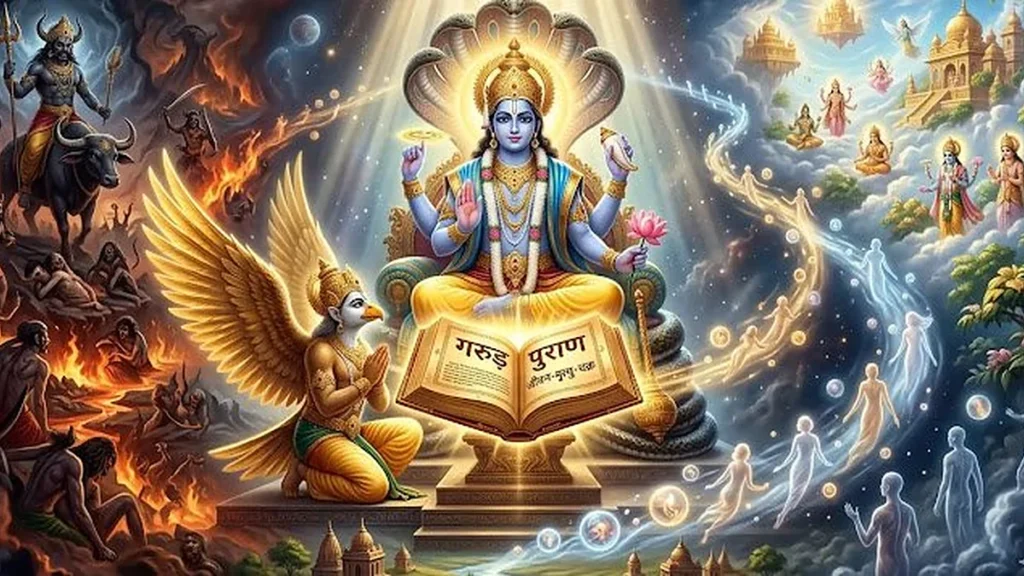
In the traditional Hindu list, the Garuda Purana is one of the eighteen Mahapuranas. It is also classed as a Vaishnava Purana. The name comes from Garuda, the divine vahana of Bhagavan Vishnu. The book is framed as a dialogue: Vishnu speaks, Garuda asks, and the answers cover the secrets of creation, the cycle of birth and death, the fruit of karma, papa and punya, swarga and naraka, and the path toward moksha.
That framing is Puranic narrative. It is how the tradition presents the teaching. It is not the same thing as a dated historical transcript, and this article does not invent a composition year, a verse count, or a “who wrote it in which century” claim that the source material does not give. What the tradition does say is clear enough: Vishnu himself explains to Garuda how a human life is weighed, why conduct matters while the body is still here, and what the soul is said to meet after the last breath.
People often reduce the whole book to “the punishments after death.” That is the part that travels fastest in conversation. The wider book is larger than that fear. It also talks about how to live — dharma, niti, worship, dana, and the duties that keep a household and a society from rotting. When a family opens it after a funeral, they are usually looking for two things at once: a map of the afterlife, and a reminder of which rites the living still owe the departed. Both sit inside the same Vaishnava teaching: Vishnu as the one who holds the order of the world, Garuda as the one who receives the teaching, and karma as the thread that ties this life to the next.
If you hold that shraddha tone, the book stops looking like a threat and starts looking like a warning with a purpose. The warning is not “be terrified of Yama.” The warning is “do not waste the years you still have.” That is why an honest explainer has to hold both halves — the living code and the pretakatha — instead of selling only the dark chapters.
Two Khandas: Living Well First, Then the Pretakatha
The Garuda Purana is commonly described in two large parts. The first is the Purva Khanda, also called the Achar Khanda. The second is the Uttara Khanda, also called the Preta Khanda. That split matters, because most viral talk never leaves the second half.
The Purva Khanda is about living. Traditional summaries place here dharma and niti, jyotisha, Ayurveda, methods of puja and patha, the value of different vratas, the fruit of dana, and counsel on how a person may make this life cleaner and more useful. This is the section that treats the reader as someone who still has time. It does not begin with the funeral pyre. It begins with conduct — how you speak to parents and gurus, how you treat a guest, how you handle wealth that is not yours, how worship and charity shape the inner life. In a household that only hears “Garuda Purana” as a book of hells, this first half is the part that usually never gets read.
The Uttara Khanda is the reason the book stays in public talk. Here the text describes the journey of the soul after death, Yamaloka, the punishments attached to different sins (the material people call “Garuda Purana ki saja”), the picture of naraka, the importance of shraddha karma, and the means spoken for a sadgati and, finally, moksha. This is scripture teaching about afterlife and death rituals, not a modern forensic report. The Preta Khanda is read in many families in the days after a death precisely because it ties the living rites — offering, remembrance, shraddha — to the welfare of the departed soul as the Purana understands that welfare.
Hold the two khandas together and the book’s own logic appears. The first half says: live in such a way that the second half does not become a terror. The second half says: even after the body falls, karma and the rites of the living still matter. The Purana, in the source teaching used here, is not written only to wake the fear of death. It is written to push a person toward a life that still has meaning when the breath stops.
Garuda Purana Afterlife Death Rituals: The Soul’s Journey
The Garuda Purana does not treat death as a full stop. In its Puranic picture, death is the start of another stage. The sequence it describes is what families mean when they search garuda purana afterlife death rituals: the last moments in the body, the coming of the Yamadutas, the long road to Yamaloka, the account of deeds, and then swarga, naraka, or another birth.
Near death, the text says, the senses grow slack. Prana begins to leave the body, and the person is described as facing pain that is hard to bear. This is narrative teaching about the difficulty of the crossing, not a medical chart. After the prana leaves, the messengers of Yama come for the soul. The Purana distinguishes the two arrivals. Souls with punya are said to be taken by Yamadutas of a divine form. Sinful souls are said to be dragged by Yamadutas of a terrible form. The contrast is moral, not cinematic. The same office — Yama’s messengers — changes face according to the life that has just ended.
Yamaloka is described as thousands of yojanas from the earth. The journey is long and hard. On that road the soul meets many kinds of suffering. Again, this is Puranic geography of the afterlife, not a measured map. The point the text keeps repeating is that the crossing is not casual. When the soul reaches the presence of Dharmaraja — Yama — the account of every deed is laid out. Chitragupta is named as the deity who keeps the record of each being’s good and bad acts. From that account comes the next movement: swarga, naraka, or rebirth in a new body.
Death rituals enter this picture through shraddha and the duties of those who remain. The Uttara Khanda’s interest in shraddha is not decoration. In the Purana’s own terms, the living still have a role after the pyre. Food, water, remembrance, and the rites offered in the name of the departed are treated as help for the soul on that road. That is cultural-religious explanation as the tradition gives it. It is not a promise that a single ceremony erases a lifetime, and this article does not invent such a promise. Karma still decides the larger direction. The rites are the living family’s part of the same teaching.
FACT BOX
Traditional place: one of the eighteen Mahapuranas; classed as a Vaishnava Purana. Frame of the book: a dialogue in which Vishnu teaches Garuda — Puranic narrative, not a modern historical minute-book. Two parts named in common teaching: Purva Khanda / Achar Khanda (life, dharma, worship, dana) and Uttara Khanda / Preta Khanda (afterlife, Yamaloka, punishments, shraddha, moksha). Afterlife sequence as the Purana describes it: last moments and pain of leaving the body → Yamadutas → hard journey to Yamaloka (thousands of yojanas) → account before Yama, with Chitragupta keeping the record → swarga, naraka, or another birth by karma. Mahamrityunjaya mantra is often recited around death and moksha themes; the source teaching used here states it is not a mantra unique to the Garuda Purana. Modern PDFs: easy to find on religious sites and online libraries; many files are summaries or selected chapters. Authenticity depends on the source you choose — no official “one true file” is named here. Pap, Punya, and the Punishments Named in the Text
The most repeated topic in popular talk is the list of punishments. The source teaching is blunt about the purpose. The aim is not to freeze people in fear. The aim is to pull them off adharma and keep them on the path of dharma. The hells named below are Puranic descriptions. They are part of the scripture’s moral language. They are not presented here as laboratory proof, and they are not turned into clickbait scenes.
Disrespect to guru and parents is tied to Raurava naraka, a place of pain that is said to be unbearable. Bhroon hatya or bal hatya — killing of the unborn or of a child — is named among the gravest sins. Those who commit it are described as being cast into Kumbhipaka, where they are cooked in boiling oil. Seizing another person’s wealth or theft is tied to Asipatravana, a forest whose leaves are like swords, through which the sinner must pass. Insult or exploitation of a woman is tied to Tamisra, a naraka of darkness and pain.
Killing living beings without cause is tied to Andhakupa, where other beings torment the sinner. Lying and cheating are tied to Maha Raurava. Even the dishonour of an atithi — a guest — is said to meet punishment in Yamaloka. The list is moral before it is visual. Parents, teacher, child, woman, guest, another’s wealth, another’s life, and the truth of speech — these are the relationships the Purana refuses to treat as cheap.
The same source teaching adds a second layer that popular retellings often drop. These descriptions work symbolically to say that every act returns as fruit. That is why the book spends so much time on achar: if the fruit is real, conduct cannot be a side hobby. A person who only memorizes the names of narakas and never changes how they treat parents, guests, or the weak has missed the Purana’s own use of the list. Punya is not a slogan here. It is the other side of the same scale that names Raurava and Kumbhipaka.
Swarga Is Temporary; Moksha Is the Stated Goal
The Garuda Purana is not only a book of papa and naraka. It also speaks of punya and swarga. A person who does good work in this life, who gives dana, who helps others, and who stays with dharma is said to reach swarga after death. There the soul finds sukha and shanti. That picture belongs to the same Puranic teaching as the hells. It should be read with the same honesty: this is what the text says, not a travel brochure.
Then the book makes a harder point. Swarga itself is a temporary stop. When the fruit of punya has been enjoyed, the soul must take birth on earth again. Heaven, in this teaching, is not the last address. It is a rest earned by good karma, and rest ends. That is why a reader who stops at “be good and you will go to swarga” has only read half the sentence. The Purana’s last aim is moksha: the state in which the soul is freed from the bond of birth and death and merges in Paramatma.
How does the text say moksha becomes possible? Through nishkama karma, through the path of bhakti, and through atma-jnana. Work without clinging to the fruit, devotion that turns the mind toward Vishnu, and knowledge of the self — these are the three doors named in the source teaching used here. None of them is a shortcut slogan. Nishkama karma is the opposite of doing dharma for display. Bhakti is not only a festival mood. Atma-jnana is not a quote on a wall. Together they explain why the Purva Khanda bothers with ordinary life at all. If moksha is the goal, the kitchen, the guest, the gift, and the honest word are already part of the path.
This is also why the afterlife chapters should not be isolated from the living chapters. A soul that only fears Yama still lives by desire and fear. A soul that aims at moksha is being asked to stand a little above moha and maya while the body is still here. The Purana’s own climax is not the longest list of narakas. It is release.
Mantras People Recite With This Purana — What the Source Actually Says
The Garuda Purana is mainly a narrative shastra, a book of teaching in story and discourse. Even so, Vishnu-bhakti mantras sit inside its world, because the Purana itself is dedicated to Vishnu. Families looking for “the Garuda Purana mantra” should hear the distinction the source material already makes. Some verses belong to the Vaishnava stream of this book. Some verses are recited around death because of theme, not because they are unique to this Purana.
The Mahamrityunjaya mantra is the clearest example. It is not, in the source teaching used here, a mantra special to the Garuda Purana. It is recited often in talk of death and moksha because of what it asks. It is offered to Bhagavan Shiva, and it is japa for protection from untimely death and for the seeking of moksha. The verse is kept here in the same form, not turned into English rhyme:
ॐ त्र्यम्बकं यजामहे सुगन्धिं पुष्टिवर्धनम्।
उर्वारुकमिव बन्धनान् मृत्योर्मुक्षीय मामृतात्॥
Because the Garuda Purana is Vishnu’s book in the Vaishnava list, mantras of Vishnu carry the weight the text itself would recognise. Vishnu Sahasranama and the nama-mantra ॐ नमो भगवते वासुदेवाय are named as japa that help the shuddhi of the soul and a sadgati. The source teaching says this japa brings shanti to the mind and spiritual strength to the atma. That is a faith claim inside the tradition, not a lab result, and it is left in that register.
Two cautions keep this section honest. First, a narrative Purana is not the same thing as a short mantra-paddhati. Reciting a nama does not replace the achar the Purva Khanda spends so many pages describing. Second, mixing every death-related verse into “Garuda Purana mantras” is a modern habit of search language. The Mahamrityunjaya stays in this article because the source itself mentions that habit and then corrects it. The correction is the respectful part: name the verse, keep the Sanskrit, and do not paste a false label on it.
Garuda Purana PDF Today: What You Usually Get, and What to Check
In the internet age, people look for a Garuda Purana PDF the same week they look for the meaning of Yamaloka. The source teaching used here says the original text or a sara in PDF form is easy to find on various religious websites and online libraries. That is a modern access claim, not an ancient one. The Purana did not arrive in the world as a download button. What arrived in our time is convenience — and with convenience, uneven quality.
What should a reader expect inside a typical file? Often the Sanskrit mula, a Hindi anuvad, and sometimes a simple vyakhya. Some sites do not give the whole book. They give a sara or a gathering of selected adhyayas — especially the chapters people want after a death. That is useful if you know what you are holding. It is misleading if the file is titled as the full Purana and is only a digest of punishments.
Authenticity is the real work. The source material says to download from a reliable source so the information stays pramanik. This article will not invent a list of “official” sites, a government stamp, or a single publisher as the only correct PDF. Those names are not in the source. The practical test is older and simpler: does the file present itself as mula plus translation, or as a scare-summary? Does it keep the Purva Khanda at all? Does it mark later commentary as commentary? A household that wants to study at home can do that now in a way earlier generations could not. The duty that comes with that ease is to know whether you are reading the Purana or a pamphlet that borrowed its name.
PDF study also does not replace the living context of shraddha. A file on a phone can explain why the Uttara Khanda cares about rites. It cannot become the rite. That line keeps modern access in its place.
What This Scripture Asks the Living to Carry
If the Garuda Purana were only a museum of afterlife scenes, it would not have lasted as a household name. The source teaching treats it as a book that teaches the art of living. The lessons it repeats are few, and they are heavy.
Karma comes first. Every act has fruit. That single line is why the narakas are named and why dana is praised. If fruit is real, then the next hour of speech and work is already a religious fact. Naitikta and dharma come next: satya, ahimsa, dana, paropkara. These are not festival decorations. They are the conduct the Purva Khanda keeps returning to. Death’s reality is the third lesson. The book asks a person to accept that death will come, and to become spiritually ready rather than shocked. Readiness here is not panic shopping for mantras. It is a life that can meet Yama without having cheated its own people.
Duty toward family and society is named as well — toward members of the household, toward gurus, toward the wider samaj. The punishments for insulting parents, teacher, woman, and guest only make sense if those relationships are sacred while everyone is still alive. Last comes the path of moksha: rising a little above moha and maya, and walking toward the parama lakshya. That is the direction the whole book points when it is not cut down to a list of hells.
Seen this way, Garuda Purana afterlife death rituals teaching is a mirror held up to the living. The journey after death, in the Purana’s own words, is already being written by the life you are in. Shraddha after a death is the family’s remaining work. Achar before death is your own.
The book is an extraordinary Hindu shastra because it will not let life and death sit in two different rooms. Present conduct shapes the future the soul is said to enter. The text, in the teaching followed here, is meant to push a person toward a dharmic, moral, and purposeful life — so that there is sukha here, sadgati after death, and moksha as the last aim. Hold it as a guide. Do not hold it only as a book that manufactures fear.
FAQ
Is the Garuda Purana only about hell and punishment?
No. That is the part that travels fastest in talk. Traditional teaching also gives a Purva Khanda on dharma, niti, worship, vratas, dana, jyotisha, and Ayurveda. The Uttara Khanda holds the afterlife, Yamaloka, punishments, shraddha, and moksha. The source used here says the book is not written only to raise the fear of death.
Are the narakas and Yamaloka “history” or scripture teaching?
They are Puranic narrative — the way this Vaishnava Purana teaches karma-phala. This article does not treat them as modern historical minutes, and it does not invent scientific “proof.” The same source also says the punishment stories work symbolically to show that every act returns as fruit.
What death rituals does the Purana actually stress?
The Uttara Khanda / Preta Khanda stresses shraddha karma and the idea that the living still owe rites that help the departed toward a sadgati. It also describes the last moments, the Yamadutas, the journey to Yamaloka, and the account before Yama with Chitragupta’s record. It does not, in the source used here, reduce all of that to a single one-line ritual formula.
Is the Mahamrityunjaya mantra from the Garuda Purana?
The source teaching used here says no: it is not a mantra unique to this Purana. It is often mentioned because it belongs to the same circle of death and moksha. It is a mantra to Bhagavan Shiva. Vishnu mantras such as ॐ नमो भगवते वासुदेवाय sit more naturally with a Vaishnava Purana dedicated to Vishnu.
Can I trust every Garuda Purana PDF online?
No automatic yes. Files are widely available on religious sites and online libraries. Many contain Sanskrit plus Hindi translation; many others are only a sara or selected chapters. The source advice is to use a reliable source so the reading stays authentic. This article does not name a single official file.
Disclaimer
This is a respectful English explainer of traditional Garuda Purana teaching for readers of vhoriginal.com. It follows the same names, divisions, and claims as the Hindi source article. It is not a substitute for a guru, a family priest, or a full mula-patha. Afterlife scenes are presented as Puranic teaching, not as laboratory fact. Mantras are kept in their received Sanskrit form. No funeral decision should rest on a web article alone.