What is the Ikai Dahai Sekda Hajar Chart?
The Ikai Dahai Sekda Hajar chart, often referred to as a place value chart, is a fundamental educational tool designed to help children grasp the concept of how the position of a digit in a number determines its value. In simple terms, each digit in a number occupies a specific ‘house’ or place, which dictates its worth. These places are known as Ikai (Ones), Dahai (Tens), Sekda (Hundreds), and Hajar (Thousands) in Hindi. In English, these correspond to Ones, Tens, Hundreds, and Thousands.
Think of a number as a train, where each carriage represents a place value. Starting from the rightmost digit, we have the Ikai (Ones) place. Moving left, we encounter the Dahai (Tens) place, followed by the Sekda (Hundreds) place, and then the Hajar (Thousands) place. As we move from right to left, the value of each place increases tenfold. This core principle of place value is what the chart helps to reinforce.
- Ikai (Ones): Represents the value of individual digits (1s place).
- Dahai (Tens): Represents groups of ten (10s place).
- Sekda (Hundreds): Represents groups of one hundred (100s place).
- Hajar (Thousands): Represents groups of one thousand (1,000s place).
For example, in the number 3,482, the digit ‘2’ is in the Ikai place, ‘8’ is in the Dahai place, ‘4’ is in the Sekda place, and ‘3’ is in the Hajar place. Reading this number in Hindi, it becomes ‘three thousand four hundred eighty-two’. Consistent practice with the chart helps children read and write numbers accurately and quickly.
Parents can make learning engaging by playing a simple game: say a 3 or 4-digit number and ask the child to identify the place value of each digit using the chart. This five-minute activity can be very effective, especially before exams.
The Indian Numbering System: From Ikai to Mahashankh

In India, large numbers are commonly expressed using the Lakh (Lakh) and Crore (Karod) system. You’ll often hear figures like ‘two crore rupees’ or ‘five lakh people’ in news and daily conversations. Therefore, an Indian numbering system chart is essential for both school learning and everyday understanding.
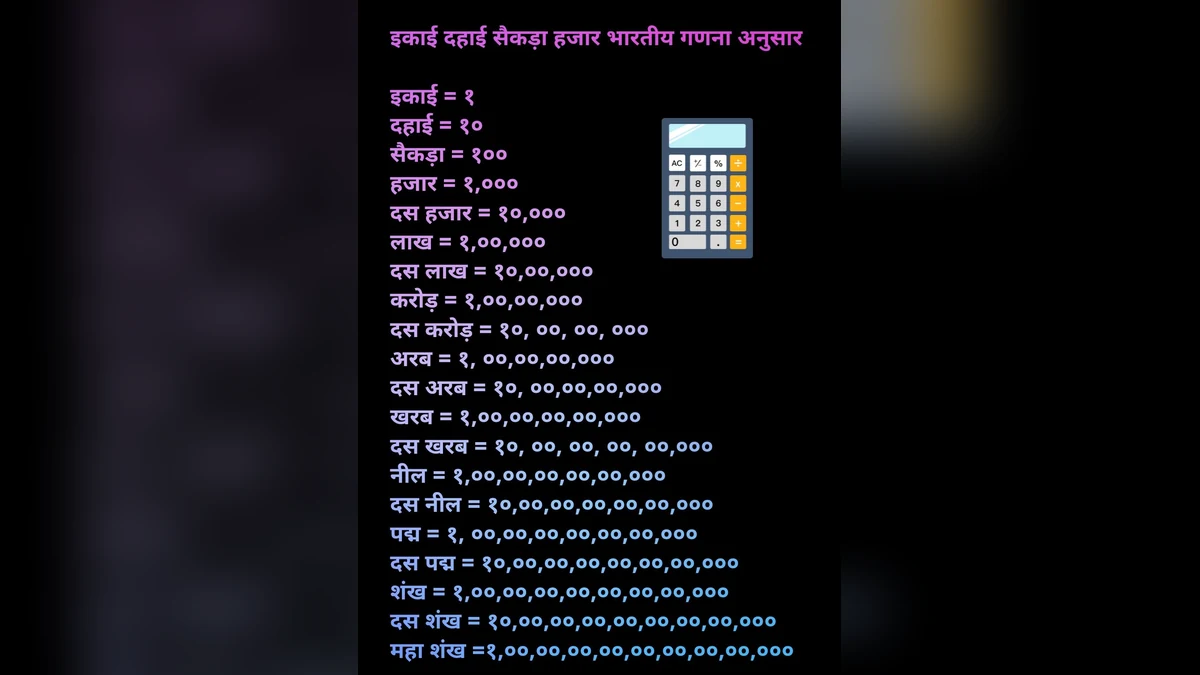
The chart visually represents the sequence of place values, along with the number of zeros associated with each:
- Ikai = 1
- Dahai = 10
- Sekda = 100
- Hajar = 1,000
- Das Hajar (Ten Thousand) = 10,000
- Lakh (Hundred Thousand) = 1,00,000
- Das Lakh (Ten Lakh) = 10,00,000
- Crore (Ten Million) = 1,00,00,000
- Das Crore (Hundred Million) = 10,00,00,000
- Arab (Billion) = 1,00,00,00,000
- Das Arab (Ten Billion) = 10,00,00,00,000
- Kharab (Hundred Billion) = 1,00,00,00,00,000
- Further places like Neel, Padma, Shankh, and Mahashankh follow in a traditional sequence.
It’s important to note that the placement of commas (grouping) in the Indian system can differ from the international system. For instance, one lakh is written as 1,00,000 in India, while internationally it might be represented as 100,000. Both signify the same value, just grouped differently. Showing both chart versions side-by-side can help clear any confusion for a child.
A helpful trick for remembering these larger units is to associate them with familiar terms. Lakh and Crore are frequently heard, making them easier to recall. For less common terms like Arab or Kharab, having the chart visible on a wall can aid memorization through regular exposure rather than rote learning.
How to Read a Place Value Chart: A Step-by-Step Guide
Some children may initially feel intimidated by the long names of place values. However, the reading process is straightforward. Here are four simple steps, best practiced with a parent or teacher:
- Start from the Right: Take any number, for example, 57,306. Begin with the rightmost digit, which is ‘6’ in the Ikai place. Move left: ‘0’ is in the Dahai place, ‘3’ in Sekda, ‘7’ in Hajar, and ‘5’ in Das Hajar (Ten Thousand).
- Identify Each Digit’s Place: State the place value for each digit: ‘Five Das Hajar, Seven Hajar, Three Sekda, Zero Dahai, Six Ikai.’ When a digit is zero, it means there’s nothing in that place, but the place itself is still counted to maintain the number’s structure.
- Combine into the Full Number Name: Combine these place values to form the complete number name in Hindi. For 57,306, this would be ‘Sattawan Hajar Teen Sau Chhah’ (Fifty-seven thousand three hundred six). If the child hesitates, guide them by pointing to the chart and the number again.
- Practice with Varying Number Sizes: Start with 2-digit numbers (Dahai-Ikai), then move to 3-digit (Sekda), and gradually to 4-5 digit numbers (Hajar). There’s no need to rush; consistent, short practice sessions are more effective than cramming.
A quick home test (5 minutes) can reinforce learning: Write a number and ask the child to: (1) identify the digit in the Ikai place, (2) state the number’s name in Hindi, and (3) predict the new number if the Ikai digit changes. These questions solidify the understanding of place value.
A common mistake is counting from the left instead of the right, leading to incorrect place value identification. Remind the child to always start from the Ikai place on the right. Coloring the Ikai column on the chart can help reduce this error.
International Numbering System (Million / Billion)

The internet, YouTube, and English-language books often use terms like Million, Billion, and Trillion. This is the international numbering system, which groups numbers differently than the Indian system. Children might sometimes confuse a million with a lakh.
- 1 Thousand (1,000) = One Thousand
- 1 Million (1,000,000) ≈ 10 Lakh
- 1 Billion (1,000,000,000) ≈ 100 Crore (1 Arab)
- 1 Trillion follows further in the sequence.
A simple way to remember the comparison is: 1 Million is approximately 10 Lakh, and 1 Billion is approximately 100 Crore (or 1 Arab). If you hear about ‘2 billion people’ in the news, it translates to roughly 200 crore people.
This chart is also useful for school projects where teachers might ask about international number names. It’s crucial to understand that neither system is incorrect. The Lakh-Crore system is practical for daily communication in India, while the Million-Billion system is prevalent in global literature and software. A proficient student learns to understand both, not by rote memorization, but by comparing them using the charts.
Using the Chart at School and Home
Simply downloading a chart isn’t enough; regular practice is key to reaping its benefits. Here are practical tips for both school and home environments:
In School:
- Paste a small chart on the inside cover of math notebooks or write it out in pencil.
- When encountering word problems with large numbers, use the chart to help read and understand them.
- Spend 5 minutes before class tests reviewing the Ikai, Dahai, Sekda, and Hajar places.
- If teachers request a place value chart, a printable HD version can be provided.
At Home (for Parents):
- Display an A4-sized chart near the study table or on a wall where it’s easily visible. Constant exposure aids memory.
- Use everyday items like grocery bills to ask your child to read the numbers.
- Turn phone numbers or PIN codes into fun Ikai-Dahai games.
- Set a weekly goal: first, master reading 4-digit numbers correctly, then progress to Lakhs.
- For younger children (Classes 1-2), focus initially on Ikai and Dahai. Introducing Sekda and Hajar too early can cause confusion.
- Older children (Classes 4-5) can practice comparing Lakh-Crore with Million-Billion.
- Remember that each child learns at their own pace. Compare their progress to their previous week, not to other children.
Vivek Bhai’s Advice: Don’t let the chart just be a decoration. Implement a ‘7-minute rule’ daily: write the current date, then create a random 4-5 digit number and ask your child to read it in Hindi. If mistakes occur, don’t scold; gently guide them by referring back to the chart. End the week with a small ‘chart quiz’. Memory is strengthened by repetition and encouragement, not fear. Consistent practice throughout the month is far more effective than last-minute cramming before an exam.
How to Download and Print the Chart
The HD images provided are ready for saving and printing. The quality remains consistent with the original chart files.
- Mobile: Long-press on the image and select ‘Download’ or ‘Save image’.
- Computer: Right-click on the image and select ‘Save image as…’ to save it as a JPG file.
- Printing: A4 color prints are ideal for display on walls or in notebooks. For larger copies, open the full-size image via the link before printing to avoid low-quality thumbnails. If a printer is unavailable, practicing directly from the saved image on a phone screen is also effective. Color prints look more appealing for school projects, but black and white is perfectly acceptable as long as the digits are clear.
Frequently Asked Questions (FAQ)
Who needs an Ikai Dahai Sekda Hajar chart?
This chart is most beneficial for children in Classes 1 to 5, students struggling with homework, and parents teaching numbers at home. It’s also useful for revising Lakh-Crore concepts in higher grades.
How many are 1 Million and 1 Billion in the Indian numbering system?
Approximately: 1 Million ≈ 10 Lakh; 1 Billion ≈ 100 Crore (1 Arab). Refer to the international chart image for the complete sequence.
Can the chart be printed?
Yes, you can save the HD images and print them in A4 color or black and white. They are suitable for display on walls or in notebooks.
What comes after Shankh?
In the traditional sequence, names like Das Shankh (Ten Shankh) and Mahashankh (Great Shankh) follow. The complete sequence is shown in the Indian chart image. In daily use, Lakh and Crore are far more common.
Why does a child repeatedly get the place value wrong?
Often, children start counting from the left instead of the right. Remind them to always begin from the Ikai place on the right. Coloring the Ikai column on the chart can help reduce this mistake.
Conclusion: Understanding Through Charts, Not Rote Memorization
The Ikai Dahai Sekda Hajar chart is more than just a picture; it’s a map to understanding place value. The Indian system teaches Lakh-Crore, while the international system uses Million-Billion. These are not conflicting concepts but complementary ones. There’s no need to overwhelm a child; consistent daily practice and pointing to the chart are sufficient. The clear advice for 2026 is to save the HD chart, display it, and practice reading a few numbers in Hindi weekly. This approach will make school tests, homework, and even news reports featuring large numbers seem much more manageable. This guide offers clear calculations and home study tips, avoiding exaggerated claims or miracle cures.
Note: This is an educational guide. The chart image URLs are from the original files. Individual school syllabi may vary, so always prioritize the teacher’s curriculum. No fabricated statistics or ranking claims are made.























Share Your Opinion
Comments are closed on this post.