 Vista

Understanding Osho’s View of the Mind
Osho, a mystic and philosopher whose words resonated deeply with millions, presented a perspective on the mind that can initially seem paradoxical. When he stated, “The mind is your greatest enemy,” it might shock us. After all, the mind is essential for thought, planning, and experiencing emotions. So, how can it be an enemy? Osho wasn’t advocating for the destruction of the mind; rather, his statement stemmed from a profound understanding of human psychology.
According to Osho, the mind isn’t a tangible entity. It’s a continuous flow of thoughts, emotions, memories, desires, fears, and future projections. It’s a mechanism that constantly gathers information from the past and plans for the future, rarely residing in the present moment. This constant dwelling on the past or future prevents us from fully experiencing the ‘now’.
The Mind’s Nature: A Cycle of Past and Future
- A Collector of Experiences: The mind replays past events and conjures future scenarios, trapping us in a cycle that obstructs present awareness.
- Source of Identity: We often equate our identity with our thoughts and beliefs (“I think this, therefore I am this”), distancing us from our true selves.
- Repository of Conditioning: Our minds store childhood experiences, societal conditioning, prejudices, and fears, influencing every thought and action.
- A Tool, Not a Master: Osho likens the mind to a powerful computer. It’s an incredible tool for processing information and solving problems. The issue arises when the tool becomes the master.
When and Why the Mind Becomes an Enemy

The mind itself is not inherently an enemy. It becomes one when we are unconscious of its workings and allow it to take control. When we blindly accept every thought as truth and follow it without awareness, the mind begins to dictate our lives.
1. Lack of Awareness
When we don’t merely observe our thoughts but become completely identified with them, the mind exploits this lack of awareness. We become slaves to our thoughts. For instance, a negative thought, if accepted as reality, can lead to immense suffering.
2. The Cycle of Endless Desires
The mind is rarely satisfied. One desire fulfilled often gives rise to another, keeping us in a perpetual race for more. This insatiable craving prevents true peace and contentment, leaving us feeling hollow.
3. Source of Fear and Insecurity
The mind is often preoccupied with future anxieties and the fear of the unknown. It conjures up threats that haven’t materialized, causing stress and insecurity in the present. This fear inhibits us from living life fully.
4. Comparison and Competition
The mind constantly compares us to others – who has more, who is better. This comparison breeds envy, inferiority, and superiority complexes, leading to inner turmoil.
5. Escape from the Present
The mind is perpetually lost in past memories or future plans, preventing us from living in the ‘here and now’. The present moment is the only reality, the only place where life truly happens, and the mind keeps us detached from it.
Does Osho Advocate for ‘Killing’ the Mind?
This is a common misconception. Osho never suggested destroying or suppressing the mind. He viewed the mind as a remarkable instrument. Just as you wouldn’t destroy a powerful computer, Osho advised learning to control and use the mind effectively. The goal is not to eliminate the mind but to understand it, to make it a servant rather than a master. Suppressing the mind only makes it more potent, driving it into the subconscious where it can cause further disturbance. Osho emphasized observing, understanding, and transcending the mind, not eradicating it.
Transforming the Mind from Enemy to Friend: Osho’s Solutions
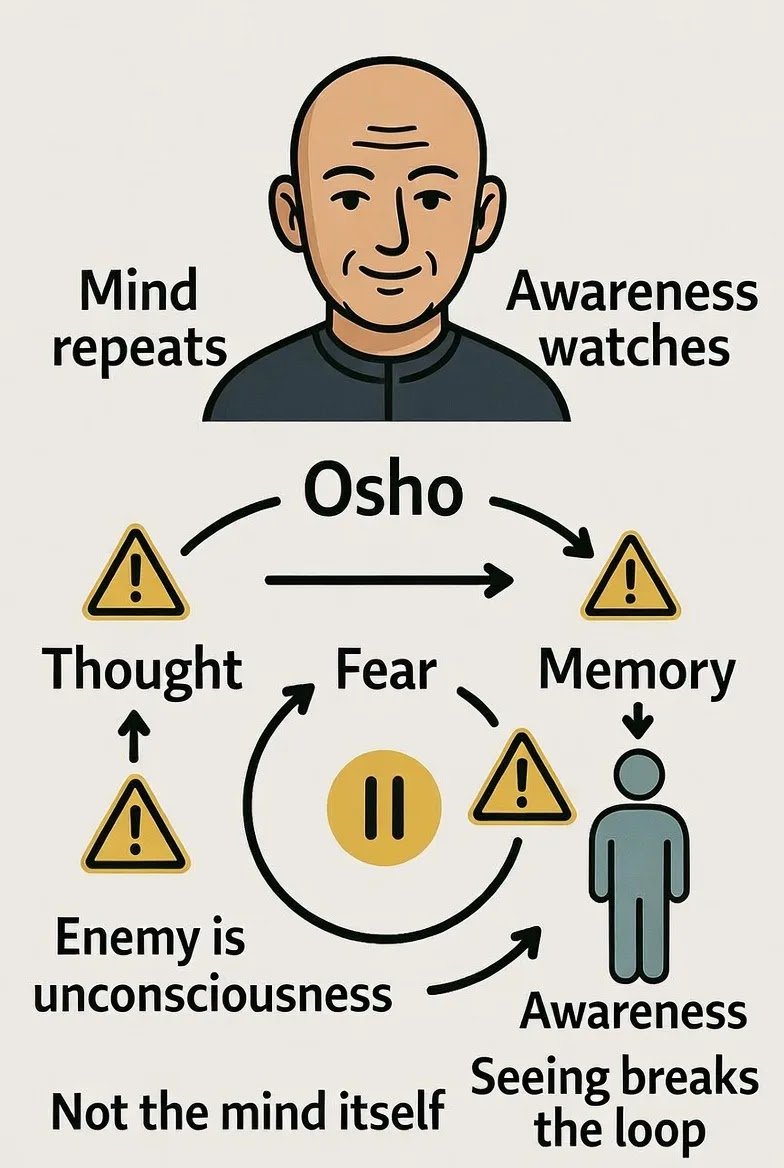
Osho offered practical paths to overcome the mind’s dominance, focusing on understanding and rising above it, rather than fighting it.
1. Witnessing (Sakshi Bhav)
This is a cornerstone of Osho’s teachings. Witnessing means observing your thoughts, emotions, and sensations as a detached spectator. Imagine sitting by a river and watching it flow without getting swept away. When you observe your thoughts without judgment, they lose their power. You become separate from the mind, and it begins to serve you.
2. Living in the Present
Osho stressed that the mind resides in the past or future. Practice being present. When eating, focus solely on eating. When walking, focus on the act of walking. This practice calms the mind and anchors it in the present, where problems cease to exist.
3. Meditation
Meditation is Osho’s most powerful tool. Various techniques, such as Dynamic Meditation and Kundalini Meditation, help quiet the mind, dissolve thoughts, and experience deep inner peace. Meditation cleanses the mental clutter and brings you closer to your true nature.
4. The State of No-Mind (A-man)
This is not the absence of mind but freedom from its control. It’s a state where the mind exists as a tool but doesn’t dominate you; you are its master. This state is achieved through deep practice of witnessing and meditation.
5. Understanding and Acceptance
Understanding the nature of the mind and accepting it is crucial. The mind will generate thoughts; it’s its function. However, it’s our choice how we react to these thoughts. Understanding the mind’s patterns helps us avoid getting entangled in its games.
Relevance of Osho’s Teachings in Modern Life
In today’s world, saturated with digital information and constant stimulation, Osho’s insights are more relevant than ever. Social media, relentless comparison, stress, and competition have amplified mental agitation. Osho’s emphasis on witnessing, living in the present, and meditation offers a path out of this mental chaos. These practices help us maintain inner peace and balance, regardless of external circumstances.
Conclusion
Osho called the mind the greatest enemy because, when unchecked by awareness, it pulls us away from our true potential, inner peace, and authentic self. It confuses, frightens, and traps us in a cycle of endless desires. However, this statement was not meant to induce despair but to awaken us. It’s a reminder that we are not slaves to our minds; we can become their masters. Through awareness, witnessing, and meditation, we can transform our mind from an enemy into our greatest friend and ally, guiding us towards success and contentment in all aspects of life.
A Practical Tip: Making Your Mind Your Friend
The core idea is simple: don’t let your mind run on autopilot. When you notice your mind racing or stuck on a thought, pause for a moment. Focus on your breath for just 10 seconds – feel it coming in, feel it going out. This brief pause creates a separation from your thoughts, reminding you that you are larger than your mind. This small ‘reset’ can make a significant difference. Practicing this daily can lead to greater inner peace.



























Share Your Opinion
Comments are closed on this post.