 Vista
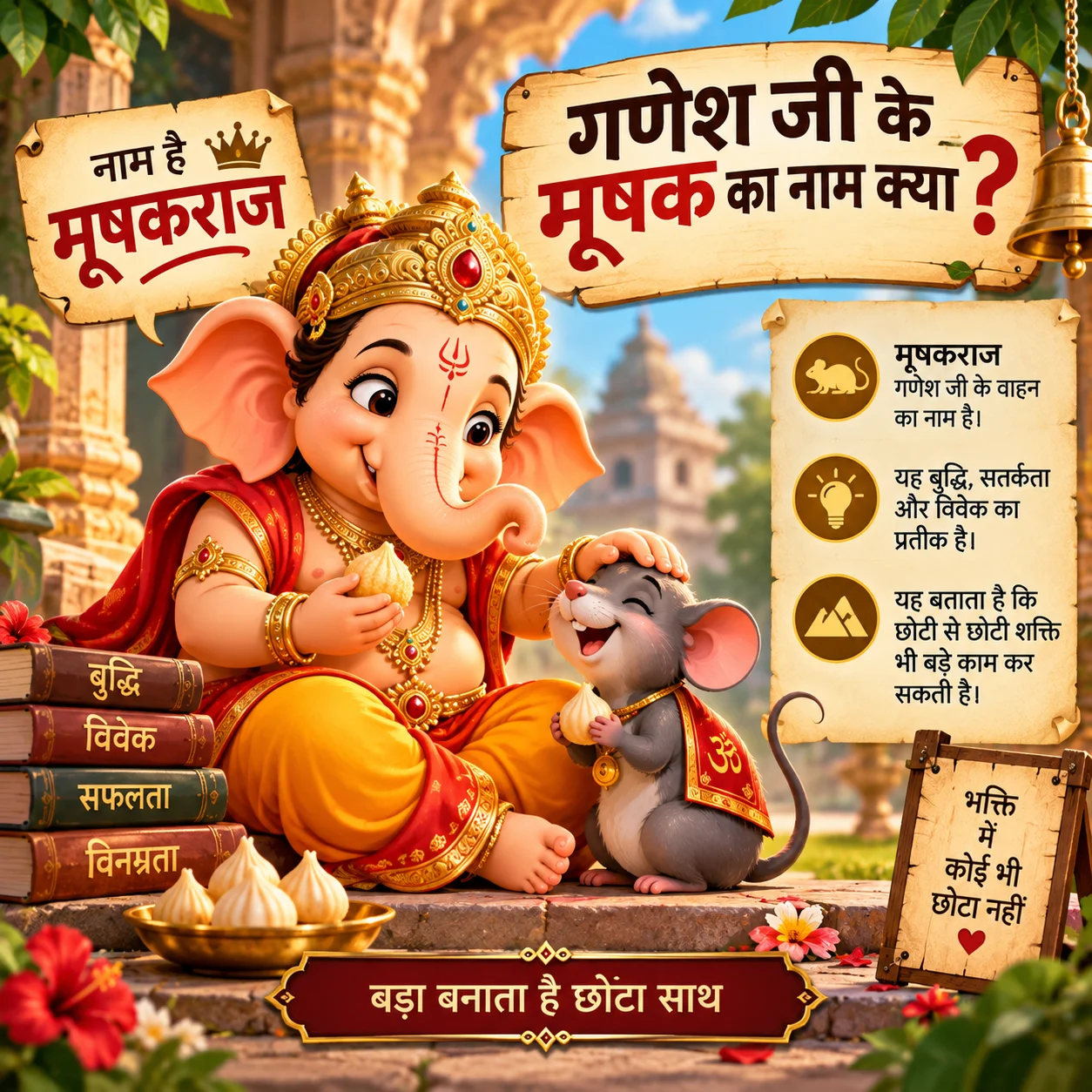
What is the Name of Lord Ganesha’s Mouse? Mushakraj and Other Names
When people search for the name of Lord Ganesha’s mouse, the most common answer is Mushakraj. In Sanskrit-Hindi folklore, “Mushak” means mouse, and “Raj” signifies respect, elevating Ganesha’s vehicle to a king-like status. Some regions might pronounce it as Mushkaraj, but the meaning remains the same. Simply calling it “Mushak” is also not incorrect, as many aartis and bhajans include lines like “Mushak Vahan Sohat Dware” (The mouse vehicle sits majestically at the door), conveying the same sentiment.
Before understanding the name, it’s crucial to clarify that Hindu narratives are not like newspaper reports but rather a vast ocean of traditions. Therefore, finding multiple names for the same character is not surprising. While one story calls him Mushakraj, another points to his original form as Kraunch, and yet another adds the name Dink in his state as a vehicle. This is not a contradiction but diversity. We at Vista Hub do not claim “only this is the correct name”; we advocate for knowing the most popular name, understanding the story, and holding faith.
Lord Ganesha is revered as the remover of obstacles (Vighnaharta) and the deity of wisdom. The fact that his vehicle is small is not seen as a coincidence by devotees; it teaches that strength is not measured by size but by discipline and devotion. Knowing the name of Ganesha’s mouse is, therefore, not just trivia; it’s a gateway to understanding the glory of this humble companion. The following narrative will detail the journey from Kraunch to Mushakraj.
FACT: The popular name is Mushakraj; the original form in many tales is the Gandharva Kraunch/Kronch. Some accounts mention Dink after becoming the vehicle, and an alternative story includes Gajmukhasur. Variations in names are found in the stories – this is the honest conclusion. Claims of percentage of miracles or “guaranteed results” are not the language of scriptures.
The Tale of Kraunch the Gandharva – The Curse of Sage Vamadeva
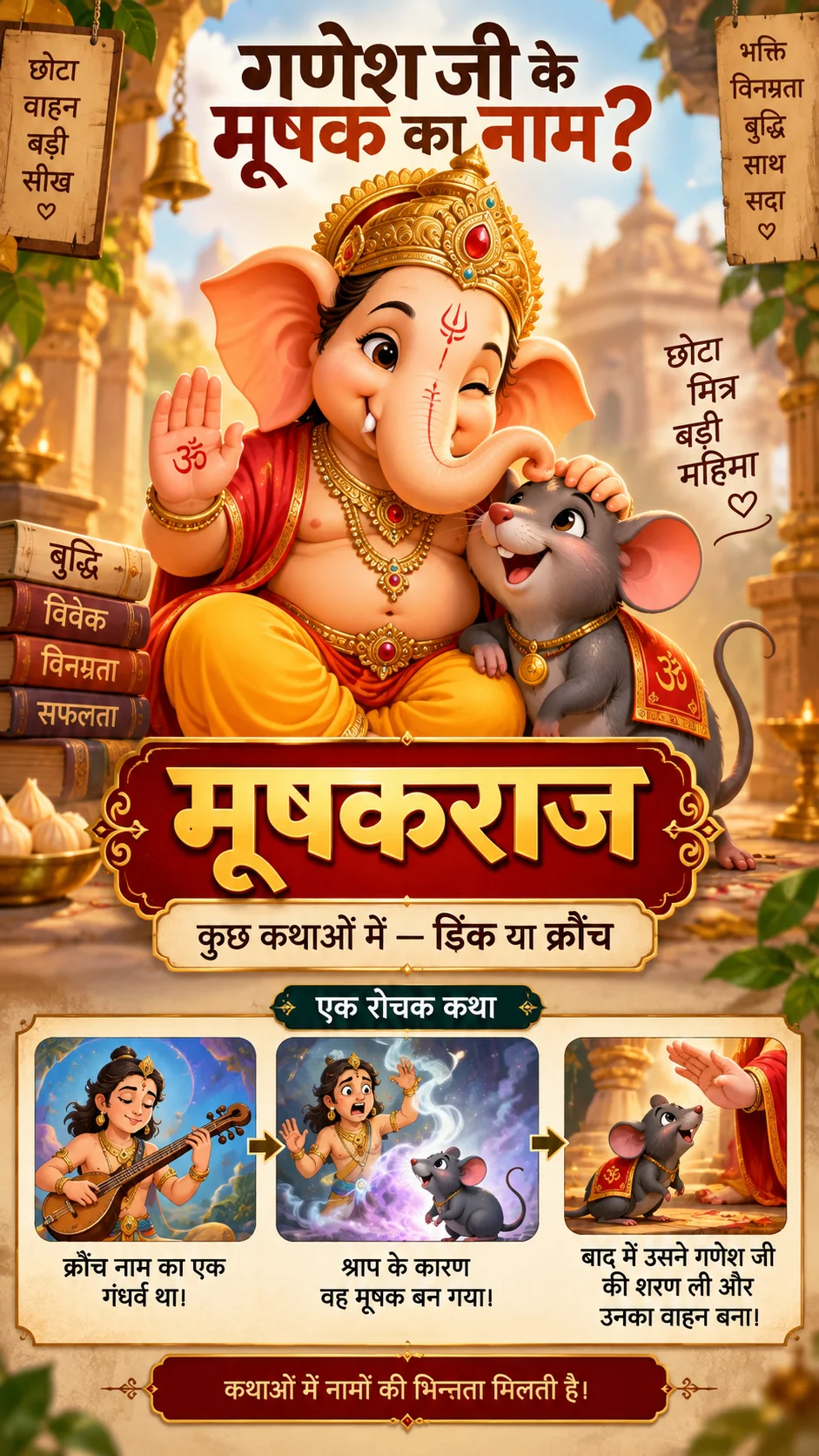
An interesting and widely narrated story is about Kraunch, a Gandharva in the celestial realms, associated with music, dance, and divine arts. Gandharvas can sometimes be depicted as beautiful and proud beings. In one incident, Kraunch insulted Sage Vamadeva – some versions mention an accidental stumble or carelessness, while others cite arrogant behavior. The insult to a meditating sage was not taken lightly. In anger and a sense of upholding righteousness, the sage cursed Kraunch, stating that his divine form would be lost, and he would become a mouse. Instantly, the Gandharva’s radiance vanished, leaving him as a small, swift-running mouse. This transformation marks a turning point in the story: one who was once a singer in heaven now wandered the earth as a tiny creature. Many folk tales emphasize here that no matter how high one’s ego, a moment’s mistake can change the course of life – this is a moral lesson, not a promotion of terrifying punishment.
After becoming a mouse, Kraunch’s strength and hunger both increased. The story says he began causing destruction in fields, homes, and even hermitages. Great destruction in a small body – this paradox leads to his encounter with Lord Ganesha. Remember: this is a mythological narrative; it is not an “event log” to be proven in the laboratory of history. Listen with faith and understand that details may vary slightly in different Puranas and folk texts.
How Did He Become Mushakraj? The Story of Bappa’s Noose and Vehicle
When the mischief of Kraunch in the form of a mouse escalated, the gods and sages sought refuge in Lord Ganesha, the remover of obstacles. The sentiment was that only the Vighnaharta could quell the disturbance. Lord Ganesha bound the mouse with his Pasha (noose/restraint). A beautiful turn in the story occurs here: not punishment, but compassion followed. The mouse begged for forgiveness, sought refuge, and prayed for meaningful service. Lord Ganesha made him his vehicle, and since then, he has been known as Mushakraj in folklore. The word “Raj” here signifies respect, not arrogance: one who fell due to pride was uplifted through devotion to become the vehicle at Bappa’s feet. Many households teach children this very lesson – that after a mistake, seeking refuge and rendering service is the true transformation.
A weighty tale is also associated with this: it is said that when Bappa rides the mouse, the burden of the entire universe is symbolically not borne by that small vehicle alone, but balance is maintained through devotion and divine will. Some accounts mention that in a context related to the mouse’s trembling or stumbling, Bappa cursed/referenced the moon – this connects to the folk belief of not looking at the moon during Ganesh Chaturthi. Details vary by region; the essence is that the small vehicle appears to manage great divine play – and this wonder awakens devotion. In this entire episode, the name of Ganesha’s mouse ceases to be just a label; it becomes the entire journey of Kraunch’s fall and Mushakraj’s service. Devotees who smile seeing the mouse in the idol are, in fact, bowing to this story of compassion.
The Spiritual Meaning of the Mouse – Wisdom, Discernment, and Humility
To consider the mouse merely a “rat” is incomplete. In symbolism and saintly interpretations, it is considered a symbol of wisdom, alertness, and discernment. A mouse finds its way even in dark holes – similarly, a seeker must exercise caution in the darkness of the mind. The mouse seated at Ganesha’s feet reminds us: control over desires (which run like mice in the mind) comes through devotion and discernment. The second lesson is humility. Such a great deity having such a small vehicle – this sight itself says that nothing is too small in devotion. Charity, service, or cleaning the temple – whatever is done with faith is valuable. The third lesson is the balance of success: small power can accomplish great deeds, provided the direction is right. The mouse that destroyed fields, when it became Ganesha’s vehicle, destruction turned into service – this transformation is the spiritual message. Many interpreters say the mouse symbolizes “Desire” or the restless mind, and Ganesha riding it teaches that intellect should rule the mind – not the other way around. This can also be understood in modern psychological terms, but retain the original flavor of devotion. Avoid excessive scientific claims or the pressure of superstition – simply integrate the symbol into life as humility and caution.
The Importance of the Mouse in Worship – Idol, Chaturthi Offering, and Vows
In the Ganesh idol at home or in a pandal, a small mouse is often shown near Bappa – sometimes near his feet, sometimes on a separate seat. While performing worship, many families offer flowers, akshata (unbroken rice), or a small prasad (offering) to the mouse as well. The sentiment is that the vehicle is also a part of the divine play; do not overlook it. If your idol does not have a mouse, do not worry – a picture, meditation, or mental salutation is also devotion.
During Ganesh Chaturthi, modaks, laddoos, and homemade offerings are made to Bappa; in many traditions, a small portion is also set aside for the vehicle. This is less a rulebook and more a habit of love. Even during vows (mannat), some devotees say, “Bappa, and your Mushakraj…” – praying with the little companion makes the prayer taste more familial.
Children connect with worship by seeing the mouse in the idol; this is the living form of the story passed down through generations. Remember the simplicity of worship: a clean space, a lamp and incense where possible, and concentration of the mind. If the idol is eco-friendly, the environment is also included in service. Narrating the story along with the aarti and mantra is especially enjoyable for children – “Look, these are Mushakraj, they were Kraunch before…” Until immersion, ensure the vehicle is not accidentally knocked, and it is immersed along with the idol in water/mud – respect both local customs and administrative rules.
Dink, Gajmukhasur, and Variations in Names in Stories
Honesty is important: variations in names are found in stories. In some sources, the name after becoming the vehicle is given as Dink. Some folk/regional narratives also connect episodes involving Gajmukhasur – the details are not uniform. The spelling of Kraunch/Kronch is also written in two ways. This does not mean any is “wrong”; it means oral and written traditions have flowed for centuries. Sometimes, a single post online claims – “Only this is the real name, the rest is false.” Avoid such assertive claims. Vista Hub’s advice is simple: know the most prevalent name, Mushakraj; remember the original form in the story as Kraunch the Gandharva; and where family, guru, or temple teach a different name, respect it. Variation does not weaken faith – it shows the breadth of culture.
If you narrate the story to children, three sentences are enough: (1) Kraunch the Gandharva insulted a sage and became a mouse, (2) After causing mischief, Lord Ganesha bound him with his Pasha and forgave him, (3) Since then, he has been the vehicle Mushakraj – a small companion with great glory. The footnotes about other names can come later. This balance protects both faith and knowledge.
FAQ – Ganesha’s Mouse Name
Q1. What is the name of Lord Ganesha’s mouse?
The most prevalent name is Mushakraj (or Mushak/Mushkaraj). In many tales, the original name is given as Kraunch the Gandharva.
Q2. Why did Kraunch become a mouse?
According to the story, Kraunch became a mouse due to the curse of Sage Vamadeva for insulting him. Later, he sought refuge with Lord Ganesha and became his vehicle.
Q3. Who are Dink and Gajmukhasur?
In some accounts, another name for the vehicle is Dink; some have an alternative story involving Gajmukhasur. Variations in names are common.
Q4. What should be offered to the mouse in worship?
According to family tradition, flowers, akshata, or a small prasad. There is no single mandatory list – sentiment and family tradition are paramount.
Q5. Is there only one “real” name?
No. Variations in names are found in the stories. Mushakraj is the most recognized name; respect other traditions.
Disclaimer: This article is for faith, folklore, and cultural information. Regional/textual variations are possible in mythological stories. No miracle, medical, or legal guarantees are provided. For worship rituals, consult your family, temple, or almanac.


















Share Your Opinion
Comments are closed on this post.