Old Thakurmar Jhuli books: start with the copy
A childhood storybook may remain vivid in memory even when its publisher and edition have been forgotten. Searching for old Thakurmar Jhuli books then brings together three different things: a remembered cover, an aged physical copy and the work’s first edition. Useful research keeps them separate and records the evidence inside the book.
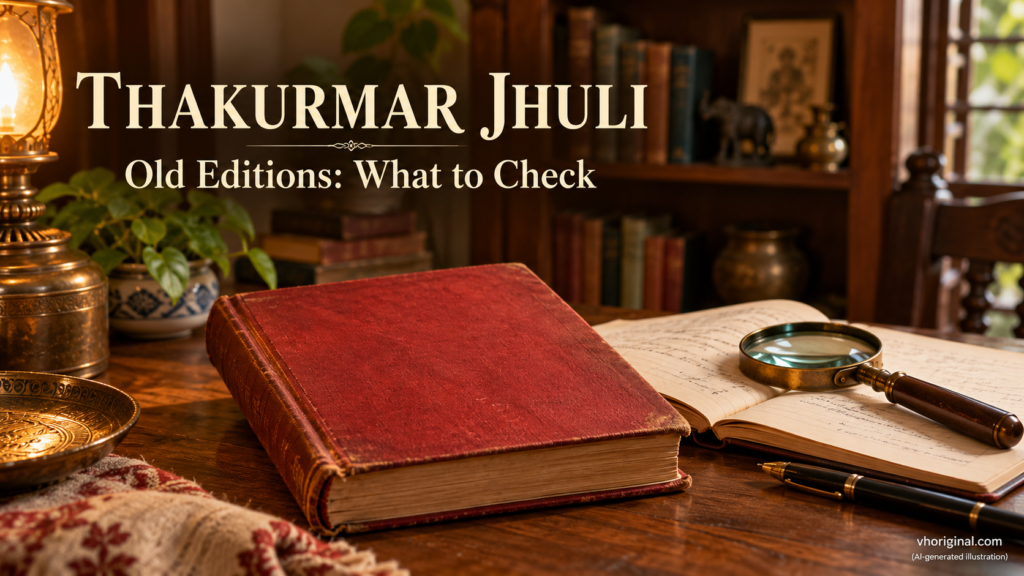
This guide concerns the Bengali collection ঠাকুরমার ঝুলি. It provides a route to actual digital items and a way to compare copy details. The three new images are conceptual AI scenes, not authenticated historical covers or scans.
What the 1907 publication reference establishes

Research literature dates the first publication of Dakshinaranjan Mitra Majumdar’s Bengali folktale collection to 1907. References include Lopamudra Maitra’s 2007 Indian Folklore Research Journal paper and Daisy Majumdar’s study in the Vidyasagar University repository.
A later copy may record the work’s original publication year. That does not mean the particular book in front of you was printed that year. Ask which edition and printing the physical copy represents.
This article does not establish a definitive colour, binding or illustration as the first-edition cover. An independently authenticated photograph of that cover has not been established for this guide. We therefore do not label a newly made visual as the first edition.
Details to record inside the book
Start with the title page: transcribe the complete title, author or compiler and publisher. Look behind it, in the following pages or at the end for edition and printing information. Its location varies.
Record the date exactly as printed. Do not silently treat a Bengali-calendar year as a Gregorian year. Without a verified month and day, avoid inventing a precise calendar date. Keep a proposed conversion separate from the original inscription.
Record publisher address, edition number, pagination and any illustrator or editor credit. Note possible rebinding or replacement covers. The date of the text block and the date of an outer binding need not be identical.
FACT: First publication of the work, publication of your edition, purchase of a particular copy and upload of a scan are different records. One old year does not automatically establish all four.
Where to start a digital search
Internet Archive has an item titled Thakurmar jhuli Banglar Rupkatha, identifier dli.scoerat.2596thakurmarjhulibanglarrupkatha. The linked item is a concrete starting point. Its existence does not certify a first edition; inspect available preliminary pages alongside the record.
Its Addeddate is 2022-08-26, which records digital addition rather than the book’s original printing. OCR can help locate words, but check names and numerals against page images.
Try ঠাকুরমার ঝুলি, Thakurmar Jhuli, Thakumar Jhuli and Dakshinaranjan Mitra Majumdar. If results favour cartoons, audio or modern retellings, add book, scan, edition or Banglar Rupkatha. These are query suggestions, not guarantees of complete coverage.
Reader and file access may change. Do not promise a complete scan where only a record is visible. A librarian may be able to help with a title, compiler name and approximate date range.
How to check a first-edition cover claim

Trace a social-media cover image to its earliest accessible source. Ask for collection or owner, catalogue identifier and photographs of internal publication details. An attractive “rare original” caption is not authentication.
Compare the title page, edition statement and final printed information, then consult a library record for the same edition. A similar front cover alone cannot finish the check. If a scan lacks its cover, do not invent a cover colour or drawing to fill the gap.
Different page counts can raise questions about missing leaves, another edition, abridgement or scan numbering. Distinguish a PDF viewer’s page count from printed pagination before comparing figures.
AI-filled letters, reconstructed covers and newly colourised images are not original historical evidence. Label an edited reading copy separately and preserve the unedited reference. Transcribe unclear dates as uncertain.
Advice: document and handle your copy
Keep title, compiler, publisher, printed date, edition, pagination, owner or collection, and source URL or identifier in one record. Separate what you can read from a family recollection so another person can retrace the conclusion.
Use clean, dry hands and a clear surface. Library of Congress handling guidance advises supporting an open book rather than forcing it flat. Protect a fragile binding before trying to obtain a more dramatic photograph.
If safe to open, document front cover, spine, title page, edition information and the final printed page. Review personal names or addresses before sharing publicly. Check terms and credit before republishing another person’s scan.
A useful caption might read: “Family copy of Thakurmar Jhuli; title page available; printing year not independently verified.” Update the status when evidence improves. Age alone is not a valuation, and this guide does not appraise a copy.
Five frequently asked questions
Is this an authentic first-edition cover gallery? No; AI scenes are separated from links to digital sources.
Does a printed 1907 reference prove the copy’s date? No; inspect its edition and printing details.
Is the upload year the publication year? No.
Does rebinding make a book fake? Do not infer that alone; check the text block and records.
Can AI restoration establish an unclear date? Generated letters are not original evidence.
Sources and AI image disclosure
General literary and collection research, not a certificate of authenticity or value. All three images are AI-generated conceptual scenes, not genuine covers, scans or first-edition photographs. Sources checked: 24 October 2026.
- Lopamudra Maitra, Indian Folklore Research Journal 2007: 100 years of Thakurmar Jhuli
- Daisy Majumdar, Vidyasagar University repository: Thakurmar Jhuli research
- Internet Archive: Thakurmar jhuli Banglar Rupkatha — item record, not first-edition certification
- Library of Congress: handling books
How to research old schoolbook covers and editions