 Vista
Celtic mythology is the name we give to the myths, legends and religious ideas of the Celtic-speaking peoples of Ireland, Wales, Scotland and ancient Gaul. It is not one pantheon or one holy book. The surviving stories come from different regions, different centuries and very different kinds of sources, from Roman accounts and carved inscriptions to medieval Irish and Welsh manuscripts. This guide covers Celtic gods and goddesses, Celtic mythology creatures, the great Celtic mythology stories, Celtic symbols and meanings, seasonal festivals and tattoo designs, and it keeps ancient evidence, medieval literature and modern revival clearly apart.
What Is Celtic Mythology?
Celtic mythology is an umbrella term for related but distinct traditions. The Celts were never a single empire. They were a network of peoples who shared language families, art styles and some religious ideas, spread from Iberia and Gaul to Britain, Ireland and parts of central Europe. Their myths survive unevenly: Ireland and Wales preserved the richest story literature, Scotland and the Isle of Man preserved a great deal of folklore, and Gaul left mostly inscriptions, statues and Roman commentary.
Why “Celtic” needs care
Many popular lists put Irish, Welsh and Gaulish gods side by side as if they belonged to one family. They did not. A god such as the Dagda appears only in Irish sources, Rhiannon only in Welsh ones, and Cernunnos only in continental inscriptions and images. Treat any “Celtic pantheon” chart as a convenient index, not an ancient religious system.
Quick facts:
- Main regions: Ireland, Wales, Scotland, Brittany, Cornwall, Isle of Man and ancient Gaul.
- Main sources: medieval Irish and Welsh manuscripts, Roman writers, inscriptions, sculpture and later folklore collections.
- Biggest caution: the stories were written down by medieval, mostly Christian scribes, so they are filtered through a later world.
History and Origins of Celtic Mythology

Celtic-speaking peoples appear in Greek and Roman writing from roughly the 5th century BCE onward, and the archaeological cultures of Hallstatt and La Tène are traditionally linked with early Celtic art. From these roots, religious ideas developed differently in each region. The table below gives a concise comparison.
| Tradition | Main sources | Typical themes | Notable figures |
|---|---|---|---|
| Irish | Medieval manuscripts such as the Book of the Dun Cow and Book of Leinster | Divine peoples, kingship, heroes, cattle raids, the Otherworld | Dagda, Lugh, Morrigan, Cu Chulainn, Fionn mac Cumhaill |
| Welsh | Mabinogion tales in the White Book of Rhydderch and Red Book of Hergest | Magic, transformation, marriage, sovereignty, Annwn | Rhiannon, Pwyll, Arianrhod, Cerridwen |
| Scottish and Manx | Later folklore, Gaelic oral tradition | Water spirits, shapeshifters, fairy lore | Kelpie, Selkie, Cat Sith |
| Gaulish and continental | Inscriptions, sculpture, Roman authors | Local and tribal gods, Romano-Celtic cults | Cernunnos, Taranis, Epona, Belenus |
Oral storytelling and medieval manuscripts
Celtic traditions were largely oral. Irish and Welsh stories reached us because monks and scholars copied them between roughly the 8th and 14th centuries. That means the gods often appear as kings, heroes or fairy folk, shaped by scribes who were Christian. This is valuable evidence, but it is not a direct window onto Iron Age belief.
Archaeological evidence
Archaeology gives us votive offerings, sacred bog and river deposits, carved heads, the Gundestrup cauldron and the Coligny calendar, a Gaulish bronze calendar from the Roman period. These sources confirm that ritual and many local gods existed, though they rarely tell us the stories. For related reading, see our guides to the Ogham alphabet and Pictish stone symbols.
Celtic Gods and Goddesses List

The table lists major Celtic gods and goddesses by tradition. Roles are summaries of how the figures appear in surviving sources, and many overlapped or changed over time.
| Name | Tradition | Associations | Symbols or notes |
|---|---|---|---|
| Cernunnos | Gaulish | Antlered god linked with animals and abundance | Stag antlers, torc; name known from one inscription |
| Dagda | Irish | Father figure, kingship, abundance | Club, cauldron, harp |
| Lugh | Irish | Many skills, kingship, warrior | Spear; Lughnasadh named for him |
| Nuada | Irish | King of the Tuatha De Danann | Silver hand, sword |
| Manannan mac Lir | Irish, Manx | Sea, Otherworld crossings | Magic cloak, boat |
| Aengus | Irish | Youth, love, poetry | Songbirds, Brug na Boinne |
| Ogma | Irish | Eloquence, associated with Ogham tradition | Credited by medieval writers as its inventor |
| Goibniu | Irish | Smith, brewer, feast | Forge, ale of immortality |
| Belenus | Gaulish, Alpine | Healing, light, often compared by Romans with Apollo | Known from inscriptions |
| Taranis | Gaulish | Thunder | Wheel and thunderbolt in Romano-Celtic art |
| Esus | Gaulish | Obscure deity named by a Roman poet | Little reliable detail survives |
| Morrigan | Irish | War, fate, sovereignty | Ravens, crows |
| Brigid | Irish | Poetry, healing, smithcraft | Fire, well; later St Brigid |
| Rhiannon | Welsh | Sovereignty, horses, birds in Mabinogion | White horse, singing birds |
| Epona | Gaulish and Romano-Celtic | Horses, protection of riders | Mare, patera, keys |
Cernunnos: the antlered god

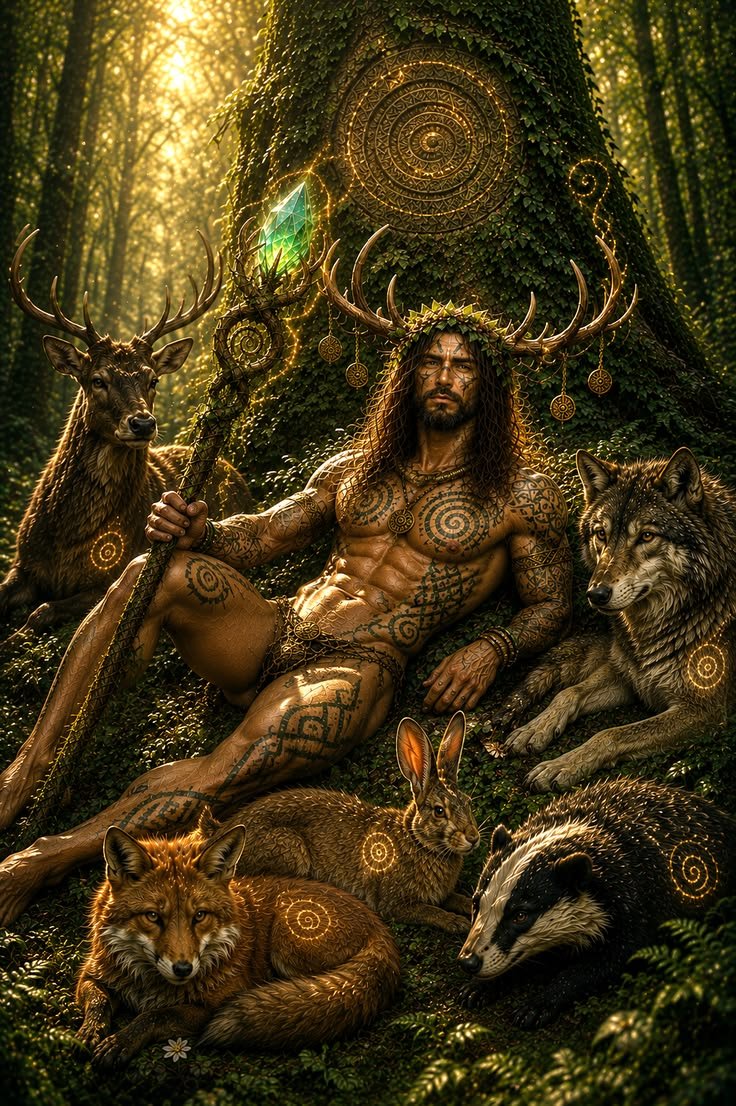
Who is Cernunnos? The name Cernunnos, meaning roughly “the horned one”, appears on a single inscription from Roman Paris, the Pillar of the Boatmen. Antlered figures also appear on the Gundestrup cauldron and other images, and scholars often link them to Cernunnos, though the connection is an interpretation. Most claims about a universal “Celtic horned god” of nature are modern.
The Dagda: father of abundance
In Irish tradition the Dagda is a powerful, earthy father figure with a huge club, an inexhaustible cauldron and a harp that commands the seasons. He appears in the Second Battle of Mag Tuired as a leader and trickster-like figure, and later writers made him father of Brigid and Aengus.
Lugh: the skilled one
Lugh wins entry to Tara by claiming mastery of every craft, then leads the divine host and defeats the Fomorian Balor in the Second Battle of Mag Tuired. A god named Lugus is attested on the continent, but how closely he matches the Irish Lugh remains debated.
Nuada, Manannan, Aengus, Ogma and Goibniu
Nuada loses an arm in the first battle and is later given a silver replacement. Manannan mac Lir rules sea and Otherworld voyages. Aengus is the youthful god of love and music. Ogma is credited with eloquence and, in medieval tradition, the invention of Ogham. Goibniu forges weapons and serves an ale that keeps the gods from aging. For continental figures, Taranis (thunder), Belenus (healing) and Esus survive mostly as names in inscriptions and Roman texts, so detailed myths about them are speculative.
Celtic Mythology Female Characters and Goddesses


Searches for Celtic goddess names and Celtic warrior women mix very different kinds of figures. Some are goddesses, some are legendary queens or heroines, some are folklore spirits, and some are modern fantasy inventions. The table separates them.
| Figure | Type | Source tradition | Known for |
|---|---|---|---|
| The Morrigan | Goddess | Irish | Battle, prophecy, fate, sovereignty |
| Brigid | Goddess | Irish | Poetry, healing, smithcraft |
| Macha | Goddess or sovereignty figure | Irish, Ulster | Horse race legend, Emain Macha |
| Rhiannon | Mythological figure | Welsh | Horse rider, wife of Pwyll, mother of Pryderi |
| Epona | Goddess | Gaulish, Romano-Celtic | Horses and protective roles |
| Scathach | Legendary warrior and teacher | Irish | Trained Cu Chulainn |
| Medb | Legendary queen | Irish | Instigates the Cattle Raid of Cooley |
| Niamh | Otherworld heroine | Irish, Fenian cycle | Takes Oisin to Tir na nOg |
| Banshee | Supernatural spirit | Irish folklore | Wail that foretells a death |
| Selkie women | Shapeshifter folklore | Scottish, Orcadian, Irish | Seal skin, sea and land lives |
The Morrigan: raven goddess of war and fate
The Morrigan (often translated “great queen” or “phantom queen”) appears before battles, prophesying and shaping outcomes. In Cath Maige Tuired she announces victory and foretells the end of the world. In the Ulster Cycle she meets Cu Chulainn in several forms. She is sometimes grouped with Badb and Macha, but the sources vary on who counts as her sister and whether the names refer to one figure or several. The raven link is real but belongs especially to Badb, a battle-crow figure.
Brigid: poetry, healing and the forge


Medieval Irish writers describe Brigid as a daughter of the Dagda with three aspects tied to poetry, healing and smithcraft. She shares her name and many attributes with the Christian St Brigid of Kildare, and scholars debate how much of the saint’s cult preserves older goddess traditions. Treat claims of a single unbroken pagan-to-Christian Brigid with caution.
Rhiannon and Epona: horses and sovereignty
Rhiannon is a figure in the First Branch of the Mabinogi. She rides a pale horse no one can catch, marries Pwyll, is falsely accused after her son disappears, and is forced into a humiliating penance before he returns. Many scholars link her name to a divine “great queen”, and her horse imagery has encouraged comparison with Epona, though that link is a scholarly proposal, not a documented fact.
Epona is the best-attested horse goddess. Her image appears across Gaul and the Roman Empire, especially among cavalry and stable workers, and she is unusual as a Celtic deity who joined Roman state cult. No myths about her survive, only images and dedications.
Macha, Scathach, Medb, Niamh, Banshee and Selkie women
Macha is linked to the Ulster capital Emain Macha. In one legend she is forced to race the king’s horses while pregnant and curses the men of Ulster with weakness in their hour of need. Scathach, a warrior woman who trains heroes in a martial school, is a Celtic warrior woman of legend, not a historical person. Medb of Connacht is a formidable queen who launches the Cattle Raid of Cooley. Niamh of the Golden Hair is the Otherworld woman who carries Oisin away. The Banshee and the Selkie belong to later folklore, covered below. Modern “Celtic warrior woman” artwork is fantasy art. It borrows these names but is not ancient religious imagery.
Tuatha De Danann and Fomorians
The Tuatha De Danann, “the peoples of the goddess Danu”, are the divine race of Irish tradition. In the medieval Lebor Gabala Erenn (the Book of Invasions) they arrive in Ireland, defeat earlier inhabitants and are eventually driven underground by the Milesians, the ancestors of the Gaels. They then become the fairy folk of the mounds. Danu herself is barely described in the sources, so detailed “mother goddess” claims are mostly modern.
The Fomorians are their rivals, often shown as monstrous or sea-linked beings, though the stories also include marriages and shared kin. The central clash is the Second Battle of Mag Tuired. King Bres, half Fomorian and half Tuatha De, rules badly. The one-eyed Fomorian Balor is defeated by his grandson Lugh, and the Morrigan prophesies the outcome. The Fomorians are not simply “evil”: the stories show a conflict over kingship and fairness as much as good versus evil.
Celtic Mythology Family Tree
There is no unified Celtic family tree. Irish, Welsh and Gaulish gods come from separate traditions, so any chart that links them in one genealogy is invented. Within single traditions, some relationships are documented:
- Irish: the Dagda is father of Brigid and, in some accounts, of Aengus (with Boann). Lugh is a grandson of Balor through his mother Eithne and of Dian Cecht through his father Cian. Nuada is a king of the Tuatha De Danann.
- Welsh: Pwyll and Rhiannon are parents of Pryderi. In the Fourth Branch, Arianrhod is a sister of Gwydion and a mother of Lleu and Dylan, in a story of magic and fate.
- Gaulish: inscriptions give names and dedications, rarely family links.
Details differ between manuscripts, so treat these as story relationships rather than fixed theology.
Celtic Mythical Creatures and Monsters

Most famous Celtic mythology creatures come from later folklore rather than ancient religion. Always name the region: a Scottish kelpie and an Irish pooka are not the same tradition.
| Creature | Region | What it is |
|---|---|---|
| Banshee (bean si) | Ireland | Female spirit whose cry warns of a death in certain families |
| Kelpie | Scotland | Water horse that lures riders into rivers and lochs |
| Each uisge | Scottish Highlands | Water horse said to be more dangerous, found in lochs and sea |
| Selkie | Scotland, Orkney, Shetland, Ireland | Seal that sheds its skin to become human |
| Dullahan | Ireland | Headless rider carrying his own head |
| Puca (pooka) | Ireland | Shapeshifting spirit, often a dark horse |
| Cat Sith | Scottish Highlands | Fairy cat or witch in cat form |
| Cwn Annwn | Wales | Spectral hounds of Annwn |
| Aos si | Ireland, Scotland | Fairy folk of the mounds |
Banshee
What is a banshee? The name comes from Irish bean si, “woman of the fairy mound”. She is a mourning spirit, usually attached to old Irish families, whose keening is said to foretell a death. She is a warning, not a threat.
Kelpie and Selkie
A kelpie is a dangerous water horse that appears tame, then carries riders into the water. A selkie is a different idea: a seal-person, often a woman, who sheds her skin. The classic story has a man hide the skin to keep her on land, and she returns to the sea when she finds it. The key difference is intent. Kelpies are predators, selkies are shapeshifters caught between two lives.
Dullahan, Puca, Cat Sith and Cwn Annwn
The dullahan is an Irish headless rider whose appearance is an omen. The puca changes shape and may help or trick people. The cat sith is a large black Highland fairy cat. The Cwn Annwn are the ghostly hounds of the Welsh Otherworld. Dragons and serpents appear in Celtic art and later saints’ lives, but there is no standard “Celtic dragon” in the early myths. Be wary of modern “Celtic dragon” claims.
Celtic Fairies, Spirits and the Otherworld
The Celtic Otherworld is not one place. In Irish tradition it is reached through mounds, lakes, caves or the western sea, and it overlaps with the dwellings of the aos si. Names include Tir na nOg (“Land of the Young”), the land of eternal youth where time moves differently. In Welsh tradition the Otherworld is Annwn, a realm of cauldrons, feasts and dangerous hunts, glimpsed in the Mabinogion and in the poem Preiddeu Annwfn.
Journeys and fairy traditions
Irish tales include voyages (immrama) to magical islands and visits to the sidhe. Folk tradition grew a large set of rules around fairies: avoid fairy paths and mounds, do not accept their food, and respect their space. These beliefs are a living folklore tradition and were later romanticised by Victorian writers. The tiny, winged “fairy” of modern children’s books is mostly a later invention.
Famous Celtic Mythology Heroes


Cu Chulainn is the great hero of the Ulster Cycle. Born Setanta, he takes his name (“hound of Culann”) after defeating a guard dog and taking its place. He is trained by Scathach and defends Ulster alone in the Cattle Raid of Cooley, fighting in a battle frenzy (the riastrad) that distorts his body. His story ends in a fated final battle.
Fionn mac Cumhaill (Finn McCool) is the leader of the Fianna in the Fenian Cycle, a warrior-hunter band. He gains wisdom from the Salmon of Knowledge. Oisin is his poet son, who goes to Tir na nOg with Niamh. The Ulster and Fenian cycles are separate story groups with different tones: the first is about kings, honor and tragedy, the second about hunting, poetry and wandering. In Scotland and Ireland Fionn also appears in landscape legends, including the Giant’s Causeway story.
Famous Celtic Mythology Stories
Children of Lir
Lir’s four children, Fionnuala, Aodh, Fiachra and Conn, are turned into swans by their jealous stepmother Aoife. They must spend 900 years in exile, 300 each on Lough Derravaragh, the Sea of Moyle and the western sea, before the curse ends. They keep their human speech and sing. It is a story of loss and endurance, and its Christian ending, when they hear a church bell, shows the medieval setting of the surviving text.
The Salmon of Knowledge
The young Fionn serves the poet Finnegas, who has spent years trying to catch the salmon that carries all knowledge. Fionn is told to cook it but not eat it. He burns his thumb, puts it in his mouth, and gains the wisdom. It is a story of fate, patience and unplanned luck.
Oisin and Niamh
Niamh takes Oisin to Tir na nOg, where he lives happily for what seems like three years. When he returns to Ireland, centuries have passed. Warned never to touch the ground, he falls from his horse and instantly ages. The story explores homesickness, time and the cost of the Otherworld.
The Battle of Mag Tuired
Two battles share the name. In the second, the Tuatha De Danann under Lugh fight the Fomorians over King Bres’s tyranny. Nuada is restored to kingship, Balor is defeated, and the Morrigan proclaims the victory. It is the central divine war of Irish tradition.
Tain Bo Cuailnge
Queen Medb of Connacht wants the great Brown Bull of Cooley to match her husband Ailill’s prize bull. Ulster’s warriors are disabled by Macha’s curse, so the young Cu Chulainn holds the border alone in single combat. The tale survives in the Book of the Dun Cow and the Book of Leinster, and is the core story of the Ulster Cycle.
The Mabinogion
The Mabinogion is a collection of medieval Welsh tales. Its Four Branches (the Mabinogi proper) include Pwyll and Rhiannon, Branwen, Manawydan, and Math, with the magician Gwydion and the doomed Blodeuwedd, a woman made from flowers. Other tales include Culhwch and Olwen, an early Arthurian-flavored quest. The stories are literary works with much older roots, not a pagan scripture.
Celtic Symbols and Their Meanings

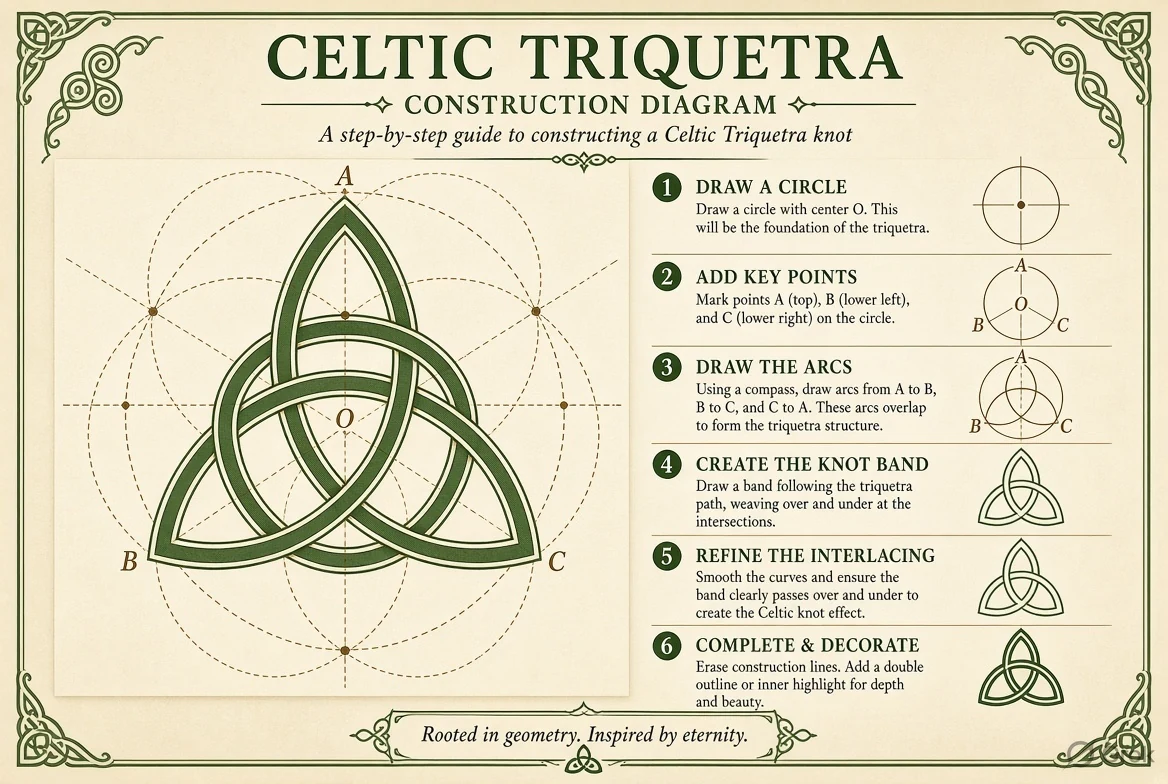
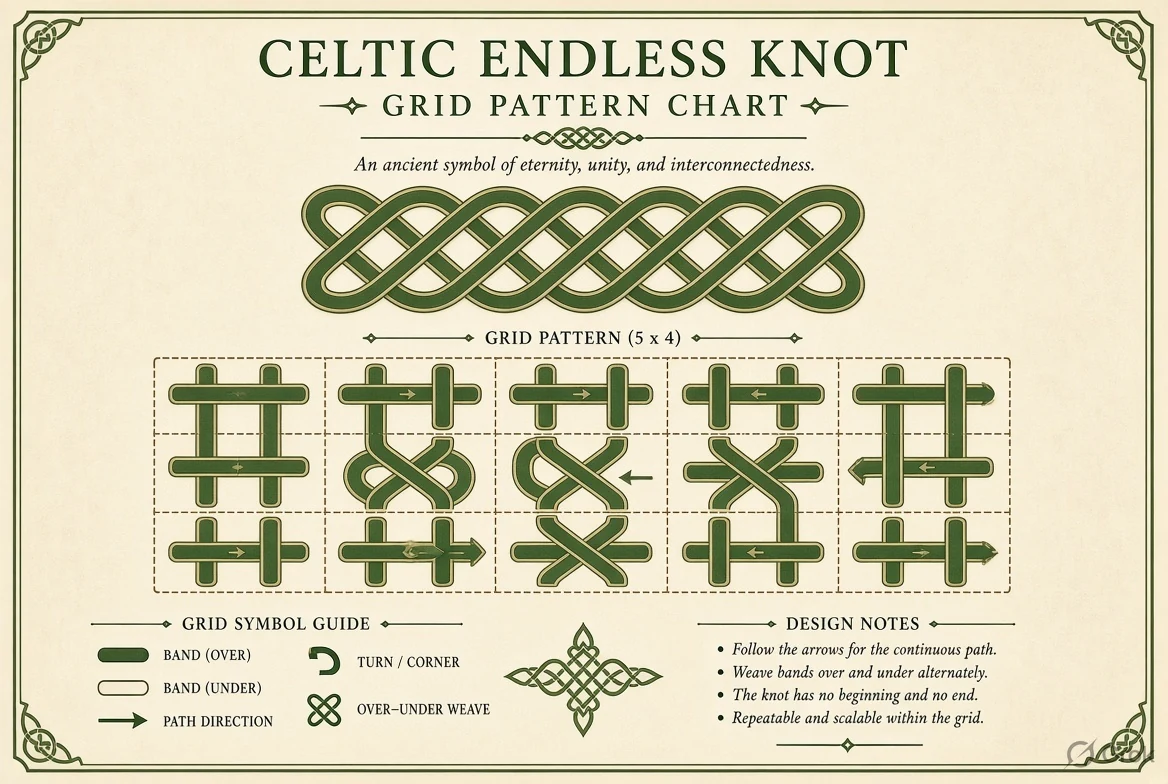
Celtic symbols and meanings are among the most searched topics in this field, and also the most muddled. Three layers get mixed together: ancient archaeological motifs, medieval Christian art, and modern Celtic revival symbolism. A knot with a famous “ancient meaning” often turns out to be a 19th or 20th century interpretation. There is no good evidence for fixed ancient Celtic “protection symbols”, “love symbols” or “strength symbols”. Those labels are modern marketing categories, and the table treats them that way.
| Symbol | How to recognize it | Historical context | Interpretation | Common uses today |
|---|---|---|---|---|
| Celtic knot (interlace) | Endless looping strands | Insular art from about the 7th century, in manuscripts and stone crosses; not unique to Celts | Often read as continuity or interconnection; modern reading | Jewellery, tattoos, decoration |
| Triskelion (triskele) | Three spirals or legs joined at a center | Triple spirals at Newgrange predate the Celts; spirals also appear in La Tene art | Modern readings include movement, cycles and triple themes | Logos, tattoos, flags |
| Triquetra (trinity knot) | Three interlaced arcs | Found in early Christian manuscripts and other cultures | Christian Trinity in medieval art; modern pagan “triple” readings | Jewellery, tattoos |
| Celtic cross | Cross with a ring | Irish high crosses from about the 8th to 10th centuries; Christian | Christian faith and Irish identity | Gravestones, jewellery |
| Claddagh | Hands holding a crowned heart | Linked to Galway from the 17th century; not ancient | Love, loyalty and friendship (hands, heart, crown) | Rings, weddings |
| Awen | Three rays above three dots | Awen means inspiration in Welsh; the symbol was devised by Iolo Morganwg in the 18th century | Poetic inspiration in Druid revival | Modern Druidry, tattoos |
| Tree of Life (Crann Bethadh) | Tree with joined roots and branches | Sacred trees (bile) are attested in Irish sources; the design is mostly modern | Connection of earth and sky; modern interpretation | Wall art, jewellery, tattoos |
| Spirals | Single or double coil | Neolithic carvings and La Tene art | Meaning uncertain | Decoration |
| Dara knot | Interlaced oak-root pattern | Modern design linked to the Irish word for oak | Strength and wisdom as modern readings | Jewellery |
Celtic knot, triskelion, triquetra and Tree of Life

The Celtic knot meaning people usually quote, eternity or interconnection, is a modern reading, since the manuscripts do not explain their own patterns. The Celtic Tree of Life meaning is similar: trees mattered in early Irish culture, but the symmetrical roots-and-branches emblem is mostly a revival design. For a detailed look at construction, see our Celtic knot geometry guide.
The triskelion meaning and triquetra meaning are frequently confused. The triskelion is a three-armed spiral, the triquetra a three-lobed knot. Either can carry “three” themes (land, sea and sky, or past, present and future) in modern use, but no single ancient meaning is documented.
Celtic Festivals: Samhain, Imbolc, Beltane and Lughnasadh
Four seasonal festivals are documented in Irish tradition, marking the quarter days between solstices and equinoxes. Early Irish texts mention them, and later Gaelic folk custom kept many alive. The Celtic Wheel of the Year with eight festivals, however, is a modern creation of 20th century neopaganism that added solstices and equinoxes. It is not an established ancient Celtic calendar.
| Festival | Date | Documented tradition | Modern interpretation |
|---|---|---|---|
| Samhain | 1 November (eve of 31 October) | Start of winter, gatherings, thin boundary with the Otherworld in stories | Neopagan new year; Halloween links |
| Imbolc | 1 February | Spring marker linked to lactation of ewes; connected to St Brigid | Festival of Brigid and early spring |
| Beltane | 1 May | Bonfires, cattle driven between fires for protection | Fertility and summer festival |
| Lughnasadh | 1 August | Harvest gatherings and games linked in myth to Lugh and Tailtiu | First harvest festival |
Samhain and Halloween
Is Halloween connected to Samhain? Partly, but the story is debated. Halloween comes from the Christian All Hallows’ Eve before All Saints’ Day, and Gaelic Samhain customs such as bonfires, disguises and honoring the dead influenced how it was celebrated in Ireland and Scotland. Historians disagree about how direct the line is, so “Halloween is just Samhain” oversimplifies. The Gaulish Coligny calendar includes a month named Samonios, which may be related, but its use is not fully understood.
Druids and Ancient Celtic Religion


Our best ancient Celtic religion evidence is indirect. Roman writers such as Julius Caesar and Pliny describe Druids as a learned class of priests, judges and teachers in Gaul and Britain, but these writers had political reasons and often relied on second-hand reports. Claims about extreme ritual practices or sacred mistletoe rites come mainly from Roman sources and should be read critically. Rome suppressed Druidism, and the Roman campaign against the Druids of Anglesey in 60 or 61 CE is the best-known episode.
Medieval literature versus modern Druidry

Medieval Irish and Welsh literature mentions druids and poets, but reshapes them for Christian audiences. Modern Druidry began in the 18th century, with figures such as Iolo Morganwg inventing or adapting rituals. It is a real contemporary spiritual movement and deserves respect, but it is a modern tradition, not proof of an unbroken ancient one.
Celtic Mythology Tattoo Designs and Meanings
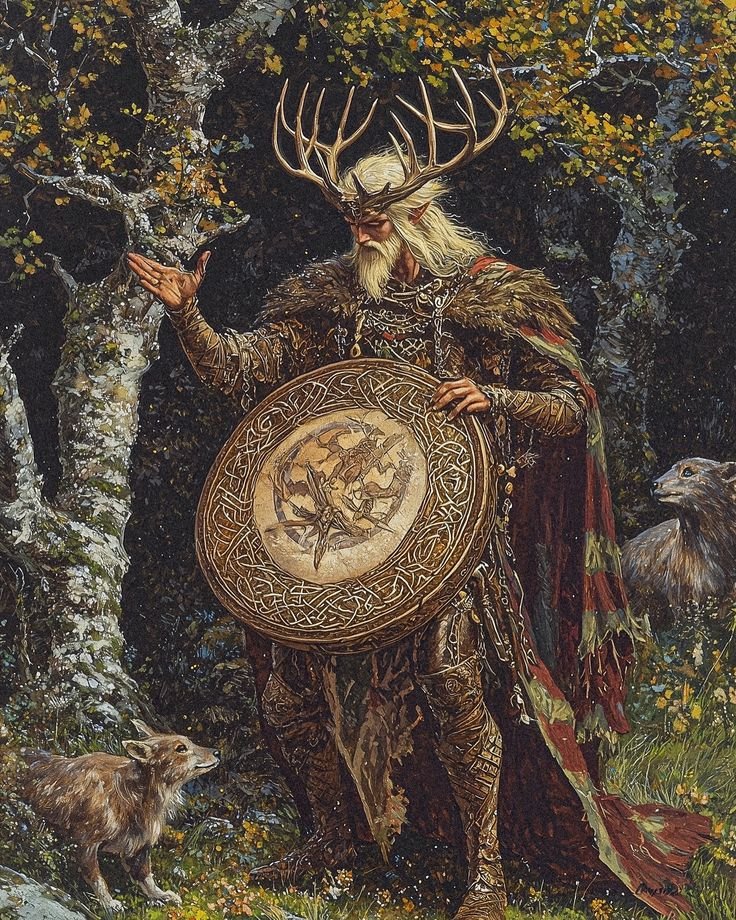
Celtic tattoo designs are popular because knotwork is bold and balanced. The history needs care: Roman writers describe Britons and Picts using body paint or marks, but whether this was tattooing, and what the designs meant, is uncertain. There is no documented ancient system of Celtic tattoo meanings. The interpretations below are modern, drawn from the symbols and stories in this article.
- Celtic knot tattoo: continuity and connection, in a modern sense.
- Celtic Tree of Life tattoo: growth, family and rootedness.
- Triskelion and triquetra tattoos: triple themes such as past, present and future, or in Christian use the Trinity.
- Celtic Cross tattoo: Christian faith or Irish heritage.
- Celtic warrior and sleeve designs: Cu Chulainn, shield knotwork and heroic imagery mixing myth with modern fantasy.
- Morrigan and raven tattoo designs: fate, battle and transformation. Ravens and crows are linked to the Morrigan and Badb in Irish tales.
- Celtic wolf tattoo: wolves appear in Celtic art, but no standard “Celtic wolf meaning” is documented.
- Celtic dragon tattoo: a popular modern fusion. The Welsh red dragon is a later national emblem.
- Celtic goddess tattoo: Brigid, Epona or Rhiannon, popular with women. Men often choose knotwork, warrior and Cu Chulainn themes, but styles are not gender-limited.
Pick a design for its look and personal meaning rather than a claimed ancient code. For a comparison from another tradition, see our Egyptian mythology tattoo guide.
Celtic Mythology Art and Mobile Wallpapers

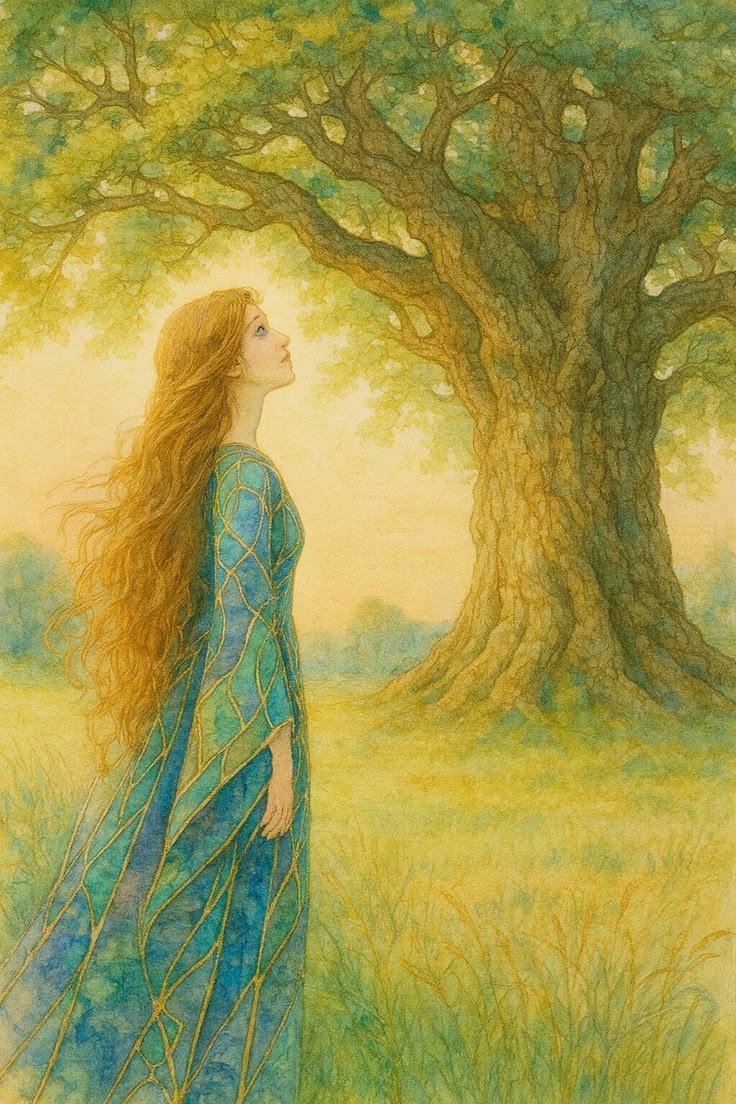
Real historic Celtic art includes La Tene metalwork, the Book of Kells, carved high crosses and Pictish stones. Modern Celtic mythology art and dark fantasy artwork is a separate genre, popular themes being a Morrigan raven goddess, a Celtic warrior woman, forest spirits, selkies and glowing knot motifs. Such images are creative interpretations, not authentic religious imagery.
Popular themes for goddess and creature wallpapers include a dark forest at dusk, a Morrigan with a murder of crows, a Brigid with fire and a well, a kelpie at a misty loch, and a Tir na nOg shoreline. Images for this article will be added later, so treat this section as a guide to styles, not a download page.
Celtic Mythology vs Norse Mythology

The two are often lumped together, but they are separate traditions. Celtic cultures spoke Celtic languages and flourished in Gaul, Britain and Ireland, with their medieval stories from Ireland and Wales. Norse mythology comes from Scandinavian and Icelandic sources such as the Poetic Edda and Prose Edda. The cultures met in the Viking Age, and Irish and Scottish folklore contains Norse influence, but the myths are not equivalents.
| Topic | Celtic | Norse |
|---|---|---|
| Main sources | Irish and Welsh manuscripts, Roman accounts, inscriptions | Eddas and skaldic poetry from Iceland |
| Divine structure | Regional gods; no single pantheon | Aesir and Vanir in a shared cosmology |
| Otherworld | Sidhe, Tir na nOg, Annwn | Asgard, Hel, Valhalla and others |
| Creatures | Banshee, kelpie, selkie, puca | Fenrir, Jormungandr, giants, dwarfs |
| Famous symbols | Knotwork, spirals, high crosses (some modern) | Runes, Mjolnir, Yggdrasil |
| End-of-world story | No clear surviving Celtic equivalent | Ragnarok |
Avoid direct equivalences such as “the Dagda is Odin”. Both are chief-like figures with magic and wisdom, but their stories differ. To explore the northern side, read our guides to Ymir and Norse creation, the Aesir-Vanir war, Odin’s ravens, Norse mythology images and Egyptian vs Norse mythology. For the Mediterranean, see Greek mythology explained.
Celtic Mythology in Modern Culture
- Literature: the Celtic Revival of the late 19th century, led by writers such as W. B. Yeats and Lady Gregory, retold Irish myth for a new audience.
- Fantasy: novels, games and films borrow banshees, selkies, fairy courts and Arthurian-adjacent Welsh themes, often blending them freely.
- Halloween: costumes, bonfires and jack-o’-lanterns draw on Gaelic customs mixed with Christian and later traditions.
- Music and art: Celtic knotwork inspires album covers, jewellery and illustration.
- Living culture: Irish, Scottish and Welsh languages, storytelling and festivals keep many of these traditions in active use.
Enjoy the fantasy versions, but remember that games and films usually combine sources and invent details.
Frequently Asked Questions
What is Celtic mythology?
It is the group of myths and legends of Celtic-speaking peoples, mainly Irish, Welsh, Scottish and Gaulish. They are related traditions, not a single religion.
Who are the main Celtic gods and goddesses?
Well-known figures include the Dagda, Lugh, the Morrigan, Brigid and Manannan mac Lir (Irish), Rhiannon (Welsh), and Cernunnos, Taranis and Epona (continental). They belong to different traditions.
Who is the Morrigan in Celtic mythology?
An Irish figure tied to battle, prophecy, fate and sovereignty. She appears in the Battle of Mag Tuired and the Ulster Cycle and is associated with ravens and crows.
Who is Brigid in Celtic mythology?
An Irish goddess linked with poetry, healing and smithcraft, and a daughter of the Dagda in medieval texts. She shares much with St Brigid of Kildare.
Who is Cernunnos?
An antlered deity known by name from a single Roman-era Gaulish inscription. Related antlered images exist, but most detailed claims about him are modern.
What are the Tuatha De Danann?
The divine race of Irish tradition, “the peoples of the goddess Danu”. After defeat they become the fairy folk of the mounds.
What is a Banshee in Irish mythology?
A female spirit, from bean si, whose wail foretells a death in certain old families. She is a messenger of loss, not its cause.
What is the difference between a Kelpie and a Selkie?
A kelpie is a dangerous Scottish water horse that lures riders into the water. A selkie is a seal that can shed its skin and become human, with stories centered on love and loss.
Who was Cu Chulainn?
The chief hero of the Ulster Cycle, a warrior who defends Ulster in the Tain Bo Cuailnge and is known for his battle frenzy and tragic fate.
What is Tir na nOg?
The “Land of the Young”, an Irish Otherworld of eternal youth where time passes differently, famous from the story of Oisin and Niamh.
What are the most important Celtic symbols?
The Celtic knot, triskelion, triquetra, Celtic cross, Claddagh, Awen and Tree of Life are the best known. Many carry modern meanings, so check each symbol’s history.
What does the Celtic Tree of Life symbolize?
In modern use it stands for growth, connection and the link between earth and sky. Trees were important in early Irish culture, but the emblem itself is largely a revival design.
What are popular Celtic tattoo designs?
Knots, the Tree of Life, triskelion, triquetra, the Celtic cross, ravens linked to the Morrigan, goddess portraits and warrior sleeves. Their meanings are modern, not ancient rules.
Is Halloween connected to Samhain?
Partly. Halloween comes from the Christian All Hallows’ Eve, and Gaelic Samhain customs influenced it, but historians disagree on how direct the link is.
What is the difference between Celtic and Norse mythology?
They are separate cultures with different sources. Celtic myths survive mainly in Irish and Welsh manuscripts and inscriptions, Norse myths in the Icelandic Eddas, with different gods, creatures and Otherworlds.
Conclusion
Celtic mythology is best understood as a family of regional traditions rather than a single belief system. Its gods, heroes and spirits reach us through medieval manuscripts, Roman commentary, carved stone and living folklore, each with its own limits. Keeping those layers apart, and separating ancient evidence from modern revival symbolism and fantasy art, makes the stories richer, not poorer. Start with the Irish cycles, then explore Welsh tales, Scottish folklore and the Gaulish evidence.
References: Encyclopaedia Britannica; CELT: Corpus of Electronic Texts, University College Cork; World History Encyclopedia; National Museum of Ireland; National Museum Wales; National Library of Ireland; translations of the Mabinogion; Lebor Gabala Erenn; Tain Bo Cuailnge; Julius Caesar, Gallic War; academic work on Celtic archaeology and religion.







Share Your Opinion
Comments are closed on this post.