 Vista
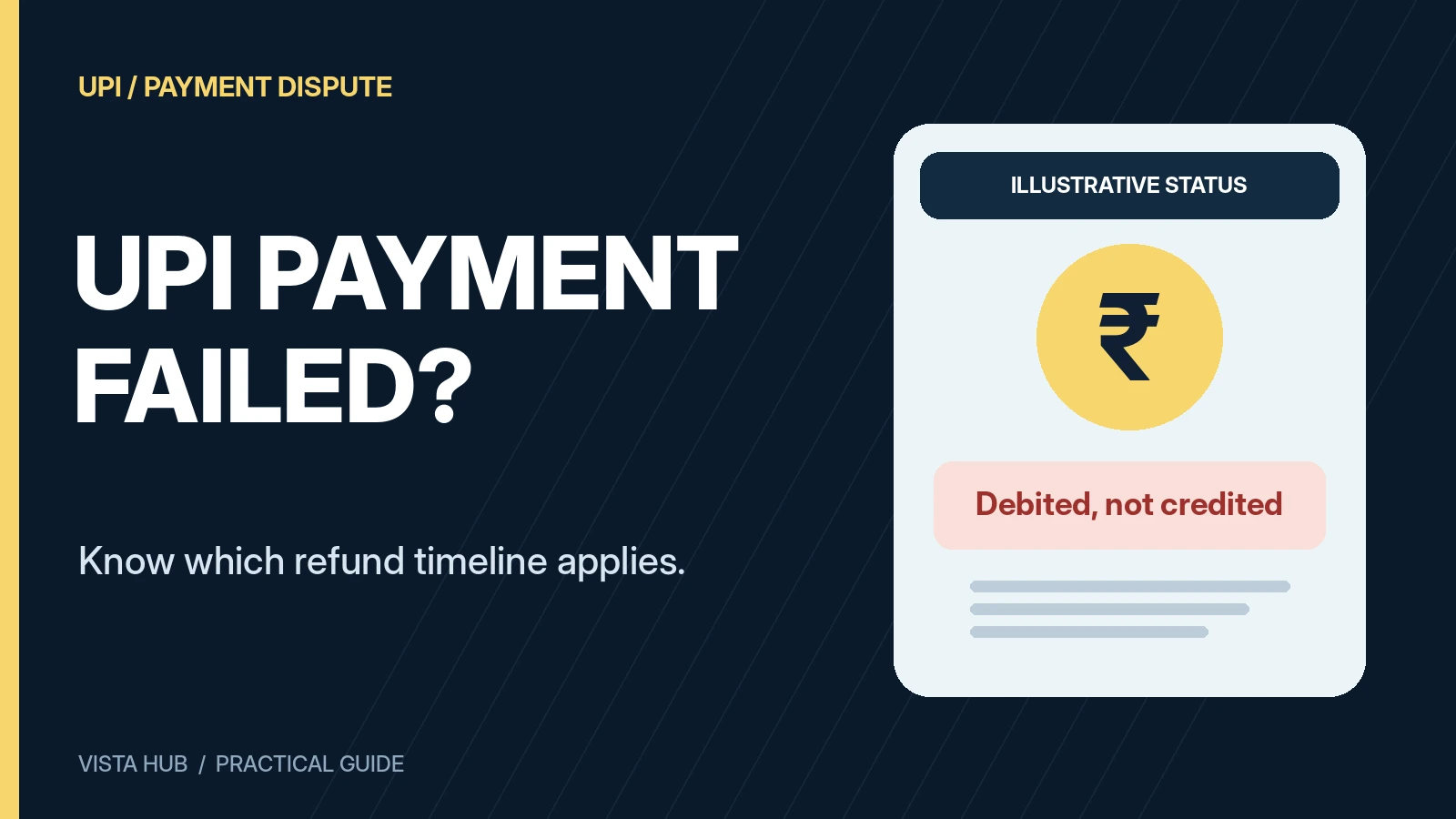
Updated 24 November 2026. If a UPI payment has failed but the money has been debited from your bank account, do not immediately send the same amount again. Check the transaction status and your bank statement. India’s RBI framework distinguishes a failed UPI transfer to another account from a failed merchant payment. For eligible domestic failed transactions, the applicable reversal deadline is generally T+1 or T+5 calendar days, depending on the type of transaction. Delays beyond the applicable deadline attract compensation under the RBI framework. A successful payment to the wrong person, fraud and a merchant refund are different problems.
1. Identify what happened to your UPI transaction
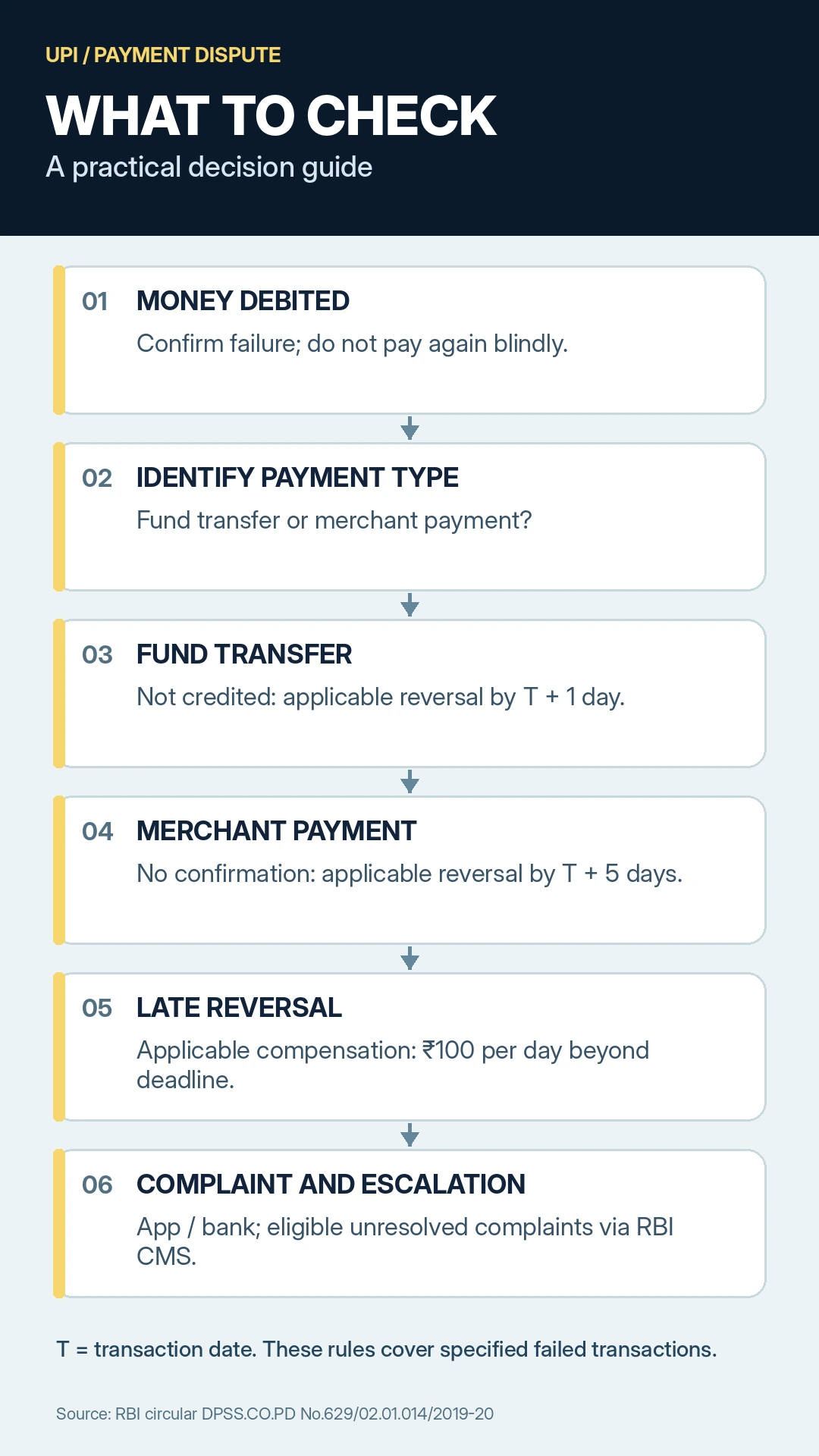
Open the payment app used for the transaction and locate its transaction history. Save the amount, date, transaction ID or UTR where displayed, and the current status. Then check the actual debit in your bank statement or official banking app. Do not rely only on a payment notification, a screenshot sent by a recipient or an SMS that may have arrived late.
| Status or situation | What to do first |
|---|---|
| Failed, account debited | Check the applicable reversal deadline and raise a transaction complaint if needed. |
| Pending or processing | Check final status and bank records before retrying. |
| Successful but recipient says not received | Ask the bank or app to trace the transaction using its reference. |
| Successful payment to wrong UPI ID | Contact the bank/app promptly; this is not an ordinary failed-payment reversal. |
| Successful merchant payment, order cancelled | Request the merchant’s refund reference and trace that refund separately. |
| Unauthorised or fraudulent debit | Notify your bank immediately and report cyber fraud without waiting for a reversal. |
The displayed app status is useful evidence, but it may not show the complete settlement picture. For a disputed transaction, ask the bank or payment provider to confirm whether the beneficiary was credited, the funds were reversed or the payment remains unresolved.
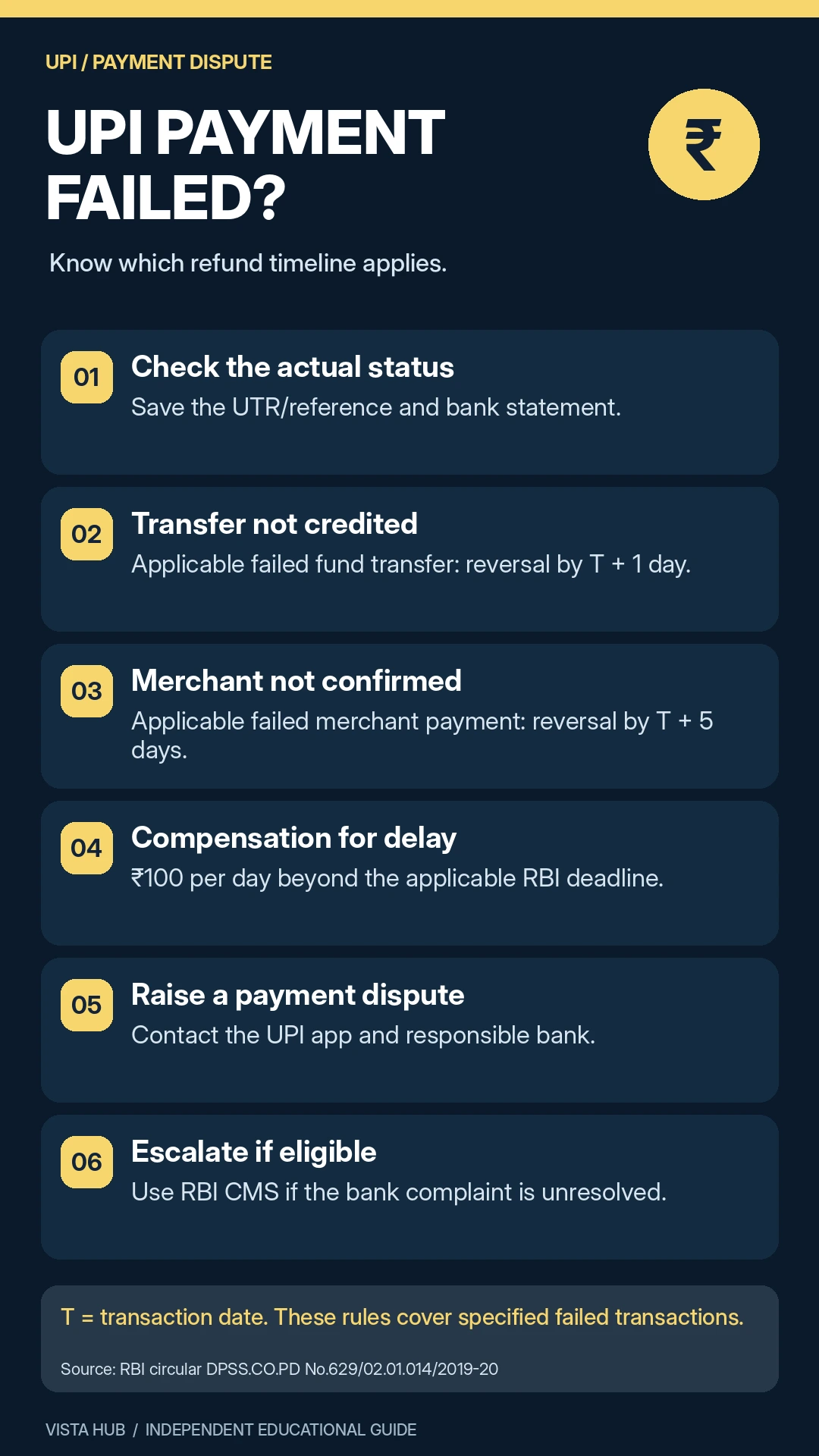
2. RBI UPI refund time: T+1 and T+5 explained
The RBI’s September 20, 2019 turnaround-time and compensation circular sets a framework for failed transactions in authorised payment systems. In its UPI section, the rules distinguish fund transfers from merchant payments.
| Eligible UPI failure | Maximum reversal timeline | Compensation for delay beyond timeline |
|---|---|---|
| Sender debited but beneficiary account not credited in a funds transfer, where credit cannot be completed | T+1 day | ₹100 per day |
| Account debited but transaction confirmation not received at merchant location | T+5 days | ₹100 per day |
T is the calendar date of the original transaction. These deadlines are outer limits for the specified failed-transaction situations, not a requirement that every payment takes that long. A reversal may happen earlier. The framework concerns domestic transactions and failures not attributable to the customer, as defined in the RBI directions.
For example, if an eligible funds transfer fails on 10 November and the beneficiary cannot be credited, the applicable reversal deadline is 11 November. If an eligible merchant-payment confirmation failure occurs on 10 November, the relevant deadline is 15 November. Do not count only banking working days: the framework defines T by calendar date. These examples illustrate the rule, not a guarantee that a specific transaction qualifies.
3. When does the ₹100 per day compensation apply?
Compensation applies to delays beyond the prescribed turnaround time for qualifying failed transactions. It is not a fixed ₹100 refund for every UPI failure. If a qualifying transfer has a T+1 deadline and reversal is completed three days after that deadline, the illustrative compensation is ₹300. If reversal occurs within the deadline, the delay-based compensation is not due under this rule.
The RBI framework directs that applicable compensation should be credited automatically rather than made dependent on a separate compensation claim. If you do not receive the applicable reversal or compensation, write to the bank or relevant regulated entity. Ask it to confirm the transaction category, the applicable deadline, the actual reversal date and the reason for any missing compensation.
A legitimate merchant refund after a successful purchase is not the same as a failed merchant transaction. Similarly, a successfully completed transfer to an incorrect beneficiary is not automatically covered by the failed-transaction compensation timetable. Fraud disputes and unauthorised transactions are governed by separate considerations. Classify the transaction correctly before asserting a particular entitlement.
4. How to complain through your payment app and bank
- Open the original transaction in your UPI app.
- Use its help, dispute or report-a-problem option for that payment.
- Choose the most accurate issue, such as debited but beneficiary not credited, if applicable.
- Save the complaint reference and check the response.
- Contact your bank through its official customer service or grievance channel if the issue persists.
- Request transaction tracing, reversal and any compensation that applies.
The NPCI UPI FAQ explains UPI transaction problems and complaint routes. App menus vary by provider and version. Use your payment provider’s genuine support channel rather than a phone number posted by an unknown person online. For bank complaints, keep a written record even if you also speak with customer care.
Useful evidence includes your transaction reference, amount, date and time, bank statement showing the debit, current app status, merchant order number if relevant and previous complaint IDs. Provide full account details only where required through a secure official process. Never post sensitive financial information publicly.
5. RBI CMS escalation: current Ombudsman scheme
When a regulated entity does not address an eligible service complaint, escalation may be possible through the RBI Complaint Management System. The Reserve Bank – Integrated Ombudsman Scheme, 2026 became effective on 1 July 2026. Under the scheme’s official FAQ, a complaint can be filed if the entity’s response is unsatisfactory or no response arrives within 30 days or any higher timeline prescribed by RBI, NPCI or card-network guidelines, where applicable.
This is a distinct escalation rule, not permission for the bank to ignore the shorter failed-payment reversal deadline. First lodge the complaint with the regulated entity and preserve its acknowledgement. Check the scheme’s eligibility, exclusions and filing deadlines. Explain what happened, what remedy you asked the entity to provide and why the response is inadequate. The Ombudsman is not a universal dispute resolution service for every merchant order or private disagreement.
Refer to the RBI 2026 Ombudsman FAQ for the applicable conditions. The regulator’s official complaint channel does not require you to pay an intermediary to file an eligible complaint.
6. Sample bank complaint for failed UPI payment
Subject: UPI transaction debited but not completed — request for tracing and reversal. On [date and time], ₹[amount] was debited for UPI transaction [reference]. The app shows [status]. The beneficiary/merchant confirmation has not been received, as applicable. My previous complaint reference is [number, if any]. Please trace the transaction, confirm its final status and applicable turnaround time, and arrange reversal or other appropriate resolution. Please credit any compensation applicable under RBI directions and provide a written response.
Use accurate facts rather than a copied claim that does not match your situation. If the transaction eventually becomes successful, check the recipient or merchant records and update the complaint. Keep a record of any second payment made for the same purchase to avoid losing track of duplicate debits.
7. Beware of refund scams and duplicate payments
You do not need to enter a UPI PIN merely to receive an ordinary refund. Never share your PIN, OTP or banking credentials, scan an unknown QR code to receive money, or install a screen-sharing application at the request of an alleged support representative. If you suspect an unauthorised transaction, inform the bank promptly, use its fraud-reporting channel and report the incident through the national cybercrime portal or 1930. Recovery is not guaranteed, and delaying a fraud report while waiting for a failed-payment reversal may cause further harm.
Frequently asked questions
Does every failed UPI transaction take five days to refund?
No. The applicable RBI framework distinguishes eligible funds transfers with T+1 and eligible merchant confirmation failures with T+5 deadlines.
Is a ₹100 compensation payment guaranteed for every failure?
No. It applies per day of delay beyond the applicable deadline for qualifying cases.
Should I retry a pending payment?
Check final status and bank records first. Retrying while the original payment remains unresolved can create a duplicate payment.
Can I get an automatic refund after sending money to a wrong UPI ID?
A completed payment to an incorrect beneficiary is different from a failed transaction. Contact the bank/app promptly and follow the applicable dispute process.
Where can I complain if the bank does not resolve the issue?
Use the bank’s grievance process and, if eligible, RBI CMS under the current Ombudsman scheme.
Conclusion
Identify the payment type, check the bank debit and final status, use the correct reversal timeline and keep the complaint reference. Official sources: RBI failed-transaction framework, NPCI and RBI CMS. This is general financial-service information, not a guarantee of the outcome of an individual dispute.
Printable PDF resource
A4 assistance checklist or complaint template in Hindi and English. This is not an official government form.
Download PDF (Hindi + English)Related tools and guides: Bank Application Letter Generator – Letter to Bank Manager · PFMS Payment Rejected? Scholarship Bank and NPCI Error Fixes




















Share Your Opinion
Comments are closed on this post.