 Vista
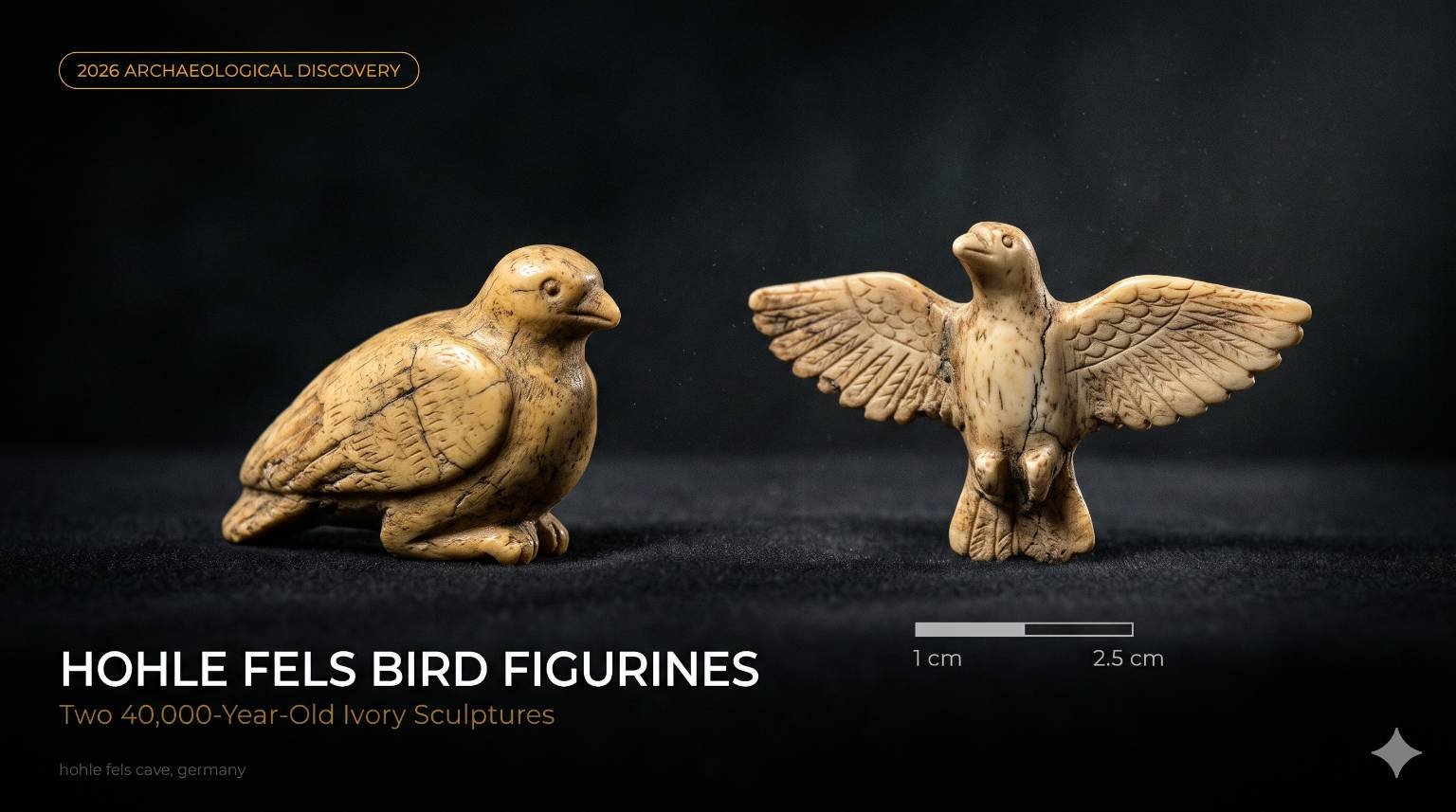
Hohle Fels bird figurines are two tiny mammoth-ivory sculptures found during 2025 excavations in southwestern Germany and announced in July 2026. They date to around 40,000 years ago. One bird appears to rest or brood, while the other spreads its wings. Explore their measurements, history, symbolism, picture guide and the distinction between archaeological objects and explanatory illustrations.
What are the Hohle Fels bird figurines?
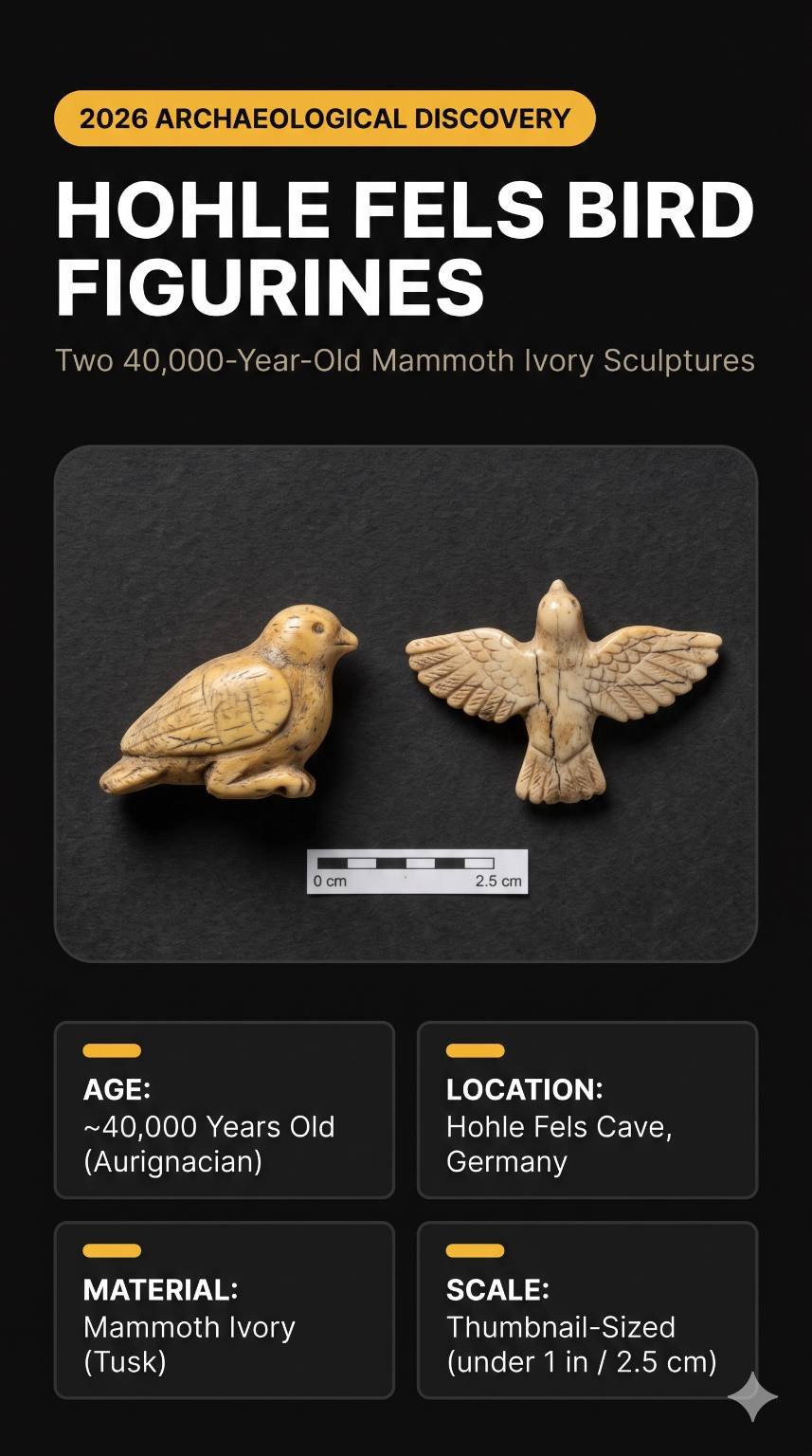
The Hohle Fels bird figurines are two tiny mammoth-ivory carvings dated to roughly 40,000 years ago, from the Aurignacian layers of a cave in southwestern Germany. They became international archaeology news in July 2026 when the University of Tübingen presented them as its find of the year. The discoveries are not a modern artist’s interpretation of ancient birds, but evidence that people living during the last Ice Age could carve exceptionally small and detailed representations of animals. Their most intriguing feature is that they depict different positions: one bird is resting or possibly brooding, while the second spreads its wings. The exact species represented cannot be identified confidently. Researchers have proposed birds such as ptarmigans or other locally familiar species, while acknowledging alternatives. Anyone seeking Hohle Fels bird figurines pictures should distinguish photographs of the excavated pieces from newly made educational scenes. The authentic pieces are small, weathered ivory objects, not polished statues with every feather perfectly intact. Their historical importance lies in the careful observation, fine carving and symbolic possibilities of early art.
When and where were the two carvings discovered?
Excavators from the University of Tübingen recovered the pieces during the 2025 field season at Hohle Fels Cave near Schelklingen, in the Swabian Jura region of Baden-Württemberg. The artefacts came from lower Aurignacian archaeological deposits, associated with the period about 40,000 years before the present. They were separated by approximately 1.5 metres within the same archaeological layer, a detail that matters because researchers cannot prove the same individual made both objects. The formal presentation was held on 29 July 2026 at the Blaubeuren Museum of Prehistory and Ice Age Art, often called urmu. Thus a headline saying “discovered in 2026” compresses two dates: the excavation took place in 2025 and the public announcement in 2026. This is not an entirely new archaeological cave; Hohle Fels has yielded important evidence of early modern human culture for decades. Accurate articles and image captions must preserve the distinction between excavation, age of artefacts and the moment they entered the news.
How small are the Ice Age bird sculptures?
Both birds are close to the size of a thumbnail and weigh approximately 1.3 grams and 0.7 grams, according to the researchers. The outstretched-wing figure measures about two centimetres long, one centimetre across and half a centimetre high. The university described it as the smallest known Ice Age artwork within this specific UNESCO World Heritage region, not necessarily the smallest prehistoric sculpture anywhere on Earth. Many other Ice Age figures from the Swabian Jura measure roughly three to nine centimetres. These comparisons help explain the exceptional craftsmanship: a small piece of mammoth tusk had to be shaped into recognisable features despite offering little room for error. A scale bar in a scientific photograph is crucial because a cropped online image can make a two-centimetre carving look enormous. Readers should also know that small photographs cannot always show every fracture or worn surface. The significance is not simply miniaturisation but the artists’ precision in representing wings, eyes and posture at an unusually delicate scale.
The resting bird: what might its posture mean?
One sculpture depicts a compact bird with conspicuous rounded eyes, its head pulled back toward its body and its legs tucked under. The Tübingen team considered whether the posture might represent a bird at rest or even brooding eggs. This is an interpretation based on the pose, not a proven record of an ancient person’s intention. The head and body were carved as an integrated miniature form, suggesting familiarity with the way actual birds settle onto a surface. A bird is not just a decorative outline here; it appears to be doing something. That detail makes the carving useful for discussing observation and representation in early art. Still, different viewers may see resting, nesting or another form of quiet behaviour. The object itself provides the shape, while archaeology supplies context about when and where it was made. We cannot ask its creator which bird was depicted, so responsible reporting preserves uncertainty rather than presenting a single modern species label as established fact.
The wing-spread bird: what is preserved?
The second carving shows a bird with wings spread wide and a long neck. Its prominent beak and parallel incisions along the wings suggest attention to plumage. An important corrective detail from the university release is that the left wing is broken and could not be reattached because parts are missing. Therefore a perfectly symmetrical modern picture with two complete wings should not be mistaken for a literal record of the excavated object’s current state. Researchers have considered whether the pose suggests flight, a landing on water, a threat display or a courtship display. Those are hypotheses, not certainty. The animal’s actual species is similarly unresolved: ptarmigan-like forms, other gamebirds and even some raptors have been raised as possibilities. A reconstruction of the missing wing can help viewers imagine the intended form, but it should be described as a reconstructed element. The difference between a preserved object and a plausible restoration is a useful lesson for every archaeology image search.
Why mammoth ivory was an extraordinary material
Mammoth tusks provide dense, workable ivory that prehistoric artisans could carve into small figures, jewellery and other objects. During the Aurignacian, people living in the region had access to materials from large Pleistocene animals and developed impressive skills with stone tools. Working ivory requires planning: carving too deeply can crack a tiny figurine, while feather lines and other details require careful control. We do not know exactly how long either Hohle Fels bird took to make, how many attempts the artist needed, or whether both were made in the same workshop. Researchers suggest that different art sites may show distinctive preferences for animal subjects, almost like local artistic signatures. The presence of miniature bird carvings demonstrates an interest in animals that would have been heard and seen in the environment. It does not prove that the figures were toys, religious icons or currency. Those are possible functions to investigate, not documented uses written on the objects.
Why is Hohle Fels so important in world archaeology?
The cave belongs to a remarkable concentration of Upper Palaeolithic sites in the Swabian Jura and is part of the UNESCO-listed Caves and Ice Age Art of the Swabian Jura. Earlier excavations there produced the Venus of Hohle Fels, a famous figurative representation of a human, along with ancient musical instruments and other artworks. Researchers also found an ivory waterbird about a quarter of a century before the 2025 excavations. The two new sculptures mean that Hohle Fels has yielded three known bird representations, whereas several other nearby art sites are better known for mammoths, cave lions, horses and other animals. This pattern prompts questions about the interests, symbolic choices and traditions of particular groups. However, archaeological layers span time; it is misleading to imagine all artefacts were made by the same artists or during one short gathering. A collection of related finds supports broader conclusions about early human creativity while leaving many individual motivations uncertain.
What do these figures tell us about Ice Age thinking?
A miniature bird is an act of abstraction: the carver selected significant features of a living animal and translated them into a small durable object. The resting posture and wing-spread pose may indicate close observation of movement, behaviour and feather patterns. Some researchers wonder whether such objects served as individual amulets, cultural symbols or parts of social practice. The available evidence cannot establish a single function, especially because the pieces were not accompanied by written explanations. Their real importance is that people approximately 40,000 years ago possessed not just technical skill but an ability to communicate natural forms through art. Birds could have been important as food, environmental signals or sources of sound, yet this does not prove that the two sculptures represent a particular ceremony. Art historians and archaeologists compare contexts, materials, wear and regional parallels to develop interpretations. Readers should value these open questions rather than treat uncertainty as a flaw in the discovery.
Photo guide: identifying the originals and interpreting posters
For an accurate visual comparison, inspect a published photograph supplied by the research team with a scale bar. Look first for the resting figure’s rounded eye detail and then the incisions on the bird with spread wings. Note that a broken portion of the latter cannot be reconstructed with absolute certainty. The educational poster in this article shows how two bird poses might be communicated clearly, but it does not replace a museum photograph or establish the specimens’ exact present condition. When a picture has polished edges, symmetrical wings or large dramatic lighting, its role may be to aid understanding rather than document every preserved feature. Google Images often clusters pictures under a familiar title even when the object or era is different. Cross-check the name Hohle Fels, the 2025 excavation date, the University of Tübingen attribution and the July 2026 release. Do not confuse these figurines with the older Hohle Fels waterbird or the famous Lion Man from another site.
Where can people see the newly announced objects?
The University of Tübingen stated that the two carvings would be displayed at the Museum of Prehistory and Ice Age Art in Blaubeuren, near the cave region, in an exhibition running until 4 April 2027. Exhibition dates, opening times and object availability can change, so visitors should check the museum’s current programme before travelling. The institution’s announcement is also a useful primary reference for the archaeology: it contains the date of presentation, weights, measurements and discussion of the birds’ possible poses. The details make a stronger article than a vague claim that a pair of mystical objects suddenly emerged from the ground. For educators, the ideal activity is to compare the two forms using a scale drawing and ask students to separate directly observable shape, archaeological context and suggested interpretation. Doing so makes these beautiful finds a lesson in evidence rather than merely another viral photograph of an ancient object.
Hohle Fels bird figurines: FAQ
How old are the Hohle Fels bird figurines?
They come from Aurignacian layers dating to approximately 40,000 years ago.
Were they discovered in 2026?
Excavators found them in 2025; the formal public presentation was on 29 July 2026.
What material are they made from?
Both are carved from mammoth ivory.
Are the birds known to be ptarmigans?
No. Ptarmigan-like birds are among the possibilities, but the species identification remains uncertain.
Is the outstretched bird complete?
No. The researchers report that its left wing is broken and missing pieces could not be refitted.
Where are they displayed?
The Tübingen announcement named the urmu museum at Blaubeuren and an exhibition running until 4 April 2027; confirm current visiting details.
Conclusion and primary research sources
The 2026 presentation of these ancient birds gave fresh attention to how carefully people during the Ice Age observed and represented animals. The valuable facts are the size, material, archaeological layer and preserved details, while the precise species and purpose remain open to interpretation. Reviewed 23 November 2026.
Read: University of Tübingen release, 29 July 2026; Nature report on the bird carvings; Smithsonian magazine context.
Related science reading
- Stonehenge Altar Stone 2026: Scottish Origin Questioned as New Geology Rules Out Sites
- Herugavialis Cairensis: Ancient Crocodile Skull and Sphinx Rock Connection

























Share Your Opinion
Comments are closed on this post.