 Vista
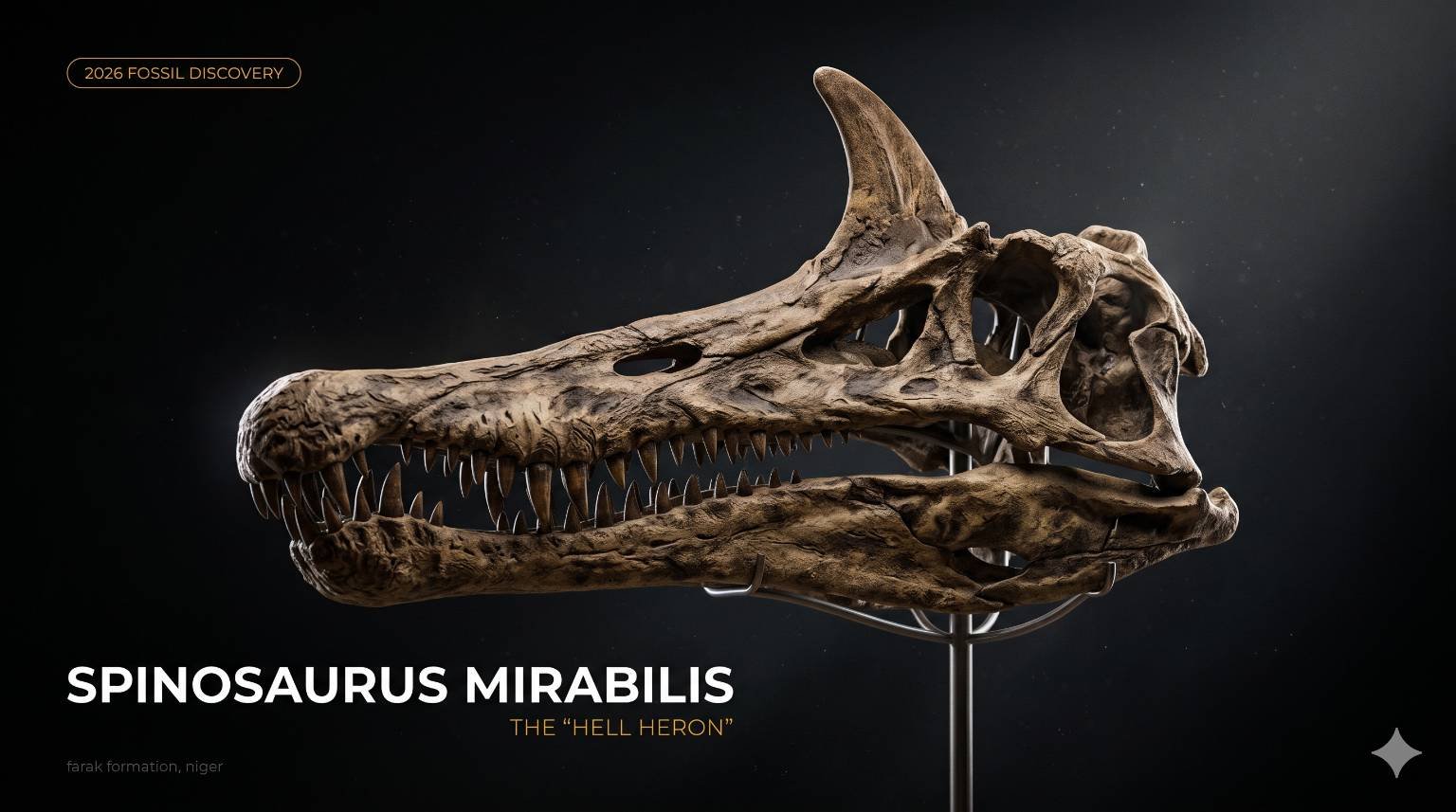
Spinosaurus mirabilis is a newly described dinosaur species from Niger with an extraordinary curved skull crest. The February 2026 discovery matters not only because of its spectacular head shape but because it lived in an inland river environment roughly 95 million years ago. This picture guide explains the fossils, crest, possible feeding behaviour and differences from Spinosaurus aegyptiacus.
What is Spinosaurus mirabilis?
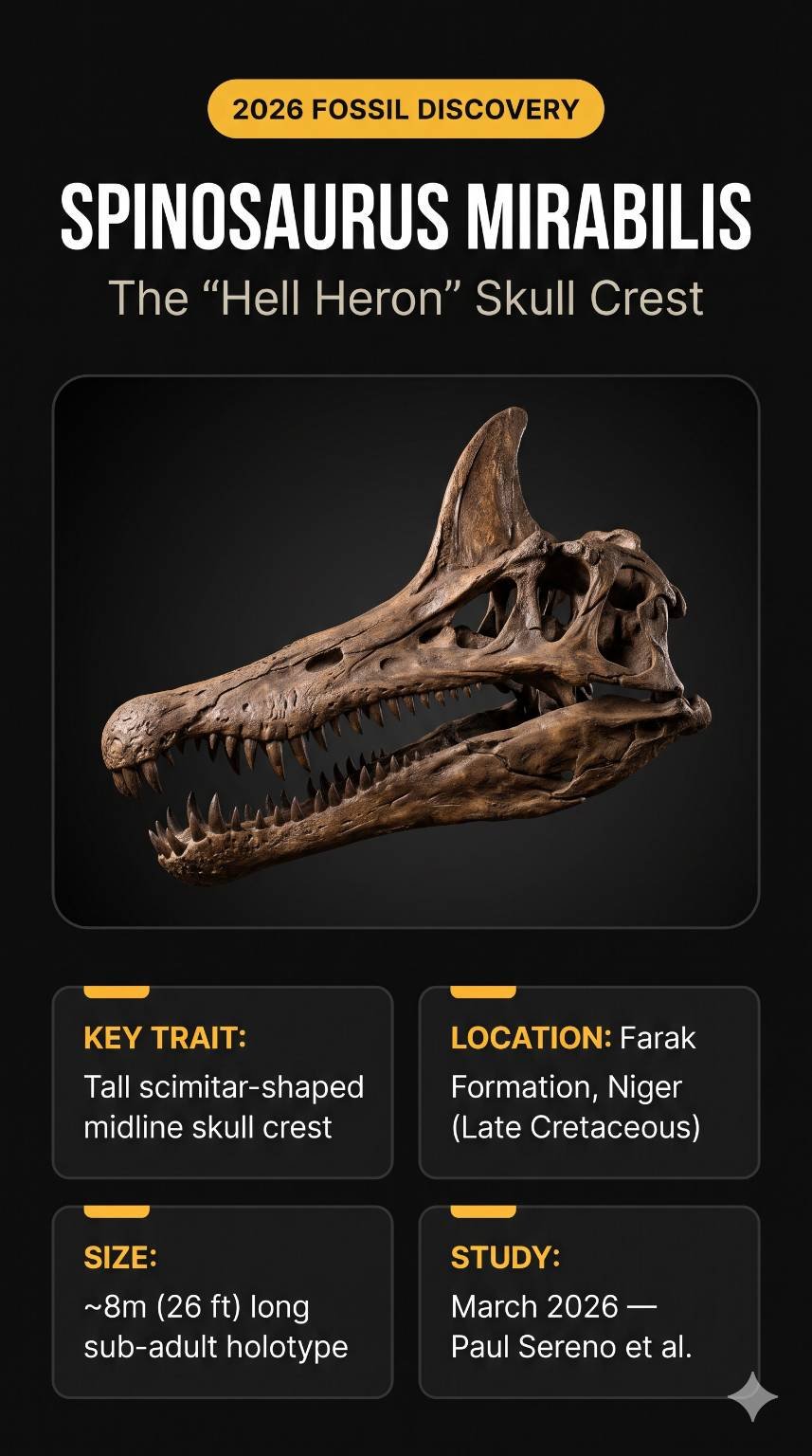
Spinosaurus mirabilis is a large, fish-eating spinosaurid dinosaur formally described in February 2026 from fossils discovered in Niger, in the central Sahara. A team led by University of Chicago paleontologist Paul Sereno identified the new species through its extraordinarily tall, curved crest rising from the skull. The scientific name mirabilis means remarkable or astonishing, an appropriate reference to an anatomical feature unlike any previously documented Spinosaurus crest. The new find does not mean all other Spinosaurus fossils belong to the same species or that the dinosaur was first alive in 2026. It lived approximately 95 million years ago during the Cretaceous Period, when the region was a river-dominated environment. The formal study was published in Science in February 2026. People searching “Spinosaurus mirabilis pictures” should know that most full-body visuals are reconstructions informed by fossil anatomy and comparisons, not complete skeleton photographs. This distinction becomes especially important when examining the striking skull crest and imagining its function.
Where was the new Spinosaurus discovered?
The fossil locality belongs to the Farak Formation in Niger, far from the coastline of the ancient Tethys Sea. The team’s field expeditions include discoveries made in 2019 and a return in 2022, when additional fossil crests and jaw material helped establish the new species. The University of Chicago describes the site as 500 to 1,000 kilometres from the nearest marine shore at that time. River sediments, the remains of other large dinosaurs and evidence of forested inland habitat are important clues about the environment. It was not a dinosaur that wandered through today’s Sahara dunes as we know them. Geological time transforms landscapes: parts of the modern desert were once greener places with rivers and productive freshwater systems. An informative location map should therefore show modern Niger only as a reference and distinguish that from the reconstructed Cretaceous geography. No dinosaur fossil should be described as having been found inside a modern Egyptian pyramid; these are unrelated stories and times.
Why is the scimitar-shaped skull crest important?
The feature that gives Spinosaurus mirabilis its identity is a very tall, curved bony crest on the midline of the head. The team initially found curved fossil pieces that were difficult to interpret. More field discoveries and 3D reconstruction helped the researchers realise these were parts of an unusual cranial ornament. Evidence from surface texture and internal vascular canals suggests the crest may have had a keratin covering in life, much as keratin covers the beaks, claws and horns of some living animals. Scientists have suggested the crest could have been conspicuous and perhaps used for display to other animals. However, exact colour, pattern, mating behaviour and display rituals cannot be demonstrated from those bones alone. A brightly coloured reconstruction is therefore one possible visual hypothesis, not an observed historical scene. If a poster says the crest was definitely red or functioned as a weapon, it has overstated what the fossils currently show.
What does the Spinosaurus mirabilis skull reveal?
The skull material includes a long, crocodile-like snout and interlocking rows of teeth that were well suited for catching slippery fish. The University of Chicago explains that some lower teeth fit between the upper teeth, creating an effective gripping arrangement. Paleontologists used CT scans and digital models of the bones to reconstruct the head, making it possible to test whether separate fossil fragments fit a single anatomical pattern. This process is far more informative than simply placing loose teeth beside one another. The uploaded skull picture on this page is a helpful illustration of the spectacular crest and jaw layout, but readers interested in preserved specimens should compare it with the figures in the original Science paper. The preserved evidence tells us important things about feeding structure and head ornamentation; it does not independently settle the precise skin covering, tongue, colour or full-body movement of the living animal.
How big was Spinosaurus mirabilis?
The new species belonged to a large-bodied group of theropods. The researchers described the new animal as comparable in general skeletal form and scale to Spinosaurus aegyptiacus, the older and better-known species. However, numerical length estimates for extinct animals depend on which skeleton elements are present and whether the type individual was fully grown. Some web graphics present an exact adult body length or mass as if directly measured in the field. That is not how the evidence works. The holotype material includes skull elements from an individual not necessarily representing the largest possible adult. Measurements or estimates from a reconstruction should be labelled with their source and assumptions. It is better to describe the new species as a large spinosaurid with a spectacular crest than to promote an unsupported ‘biggest dinosaur ever’ ranking. Its claim to fame is the unique head ornament and what the inland locality teaches about ecology.
Was Spinosaurus mirabilis a swimmer or a wading predator?
For years, paleontologists have debated the extent to which spinosaurids hunted underwater, swam actively or foraged mainly by wading near riverbanks. The 2026 fossils are especially relevant because they were found so far inland. Sereno’s team interpreted the animal as a fish-catching predator that could wade into shallow water, comparing it to an enormous heron-like hunter. The nickname ‘hell heron’ communicates that concept vividly, but it is not the scientific name and should not be mistaken for a literal bird relationship. Such ecological models remain interpretations open to evidence-based debate. The fossil locality, interdigitating teeth and limb anatomy contribute to the discussion; no single feature proves exactly how the animal spent every hour of its day. A responsible visual comparison can show shallow-water stalking, riverbank movement and potential swimming as scenarios without portraying one unobserved behaviour as certain.
Spinosaurus mirabilis vs Spinosaurus aegyptiacus
The most frequently requested comparison is with Spinosaurus aegyptiacus, known from North African fossil discoveries described more than a century ago. Both belonged to the genus Spinosaurus and share elongated jaws, specialized teeth and traits associated with an aquatic-linked food source. The new species differs particularly in the height and shape of the bony skull crest and in its more inland discovery setting. Comparative diagrams also take into account other skull features, geological ages and preservation of the available fossils. They should never compare one fully reconstructed adult with a smaller fragmentary juvenile and announce an exact size winner without context. The 2026 Science study used skull anatomy and a broader picture of spinosaur evolution to support a separate species. A well-labelled two-column visual should indicate which parts are fossil-backed and which are restored based on relatives. This serves students better than a dramatic side-by-side battle scene.
How scientists reconstructed the new dinosaur
The team described work in the Sahara using field photographs, digital scanning, three-dimensional skull assembly and collaboration among researchers and paleoartists. An especially memorable detail in the university account is that solar-powered equipment was used in the desert while the team began putting digital models together. Back in Chicago, fossil preparation and CT scanning allowed more refined study of the internal and external anatomy. Paleoartists then produced reconstructions of the whole animal using the known bones and comparative anatomical evidence. Such artwork is an important communication tool when the evidence is fragmentary, but it remains an interpretation. If the original fossil shows only part of the head, an illustration of the body posture is not equally certain. When browsing Google Images, look for captions such as skull cast, fossil fragment, anatomical diagram or paleoart. These labels help users distinguish different scientific purposes without reducing the excitement of the discovery.
What are the biggest misconceptions about Spinosaurus mirabilis?
First, the discovery did not identify a dinosaur living in the modern Sahara. Second, the tall crest is documented in fossils, but its exact living colour remains uncertain. Third, the 2026 paper does not prove that Spinosaurus mirabilis was either permanently aquatic or never swam; scientists are investigating several lines of evidence. Fourth, the label ‘hell heron’ is a descriptive nickname, not an official genus. Fifth, the fossil did not originate in Egypt: the new species was described from Niger. Sixth, a spectacular online skull graphic is not automatically an unaltered photograph of the holotype. Scientific understanding comes from fossils, measurements and peer-reviewed analysis, not a single illustration or viral headline. Asking these six questions turns a visual dinosaur story into a useful fact-check and classroom resource.
Why the discovery matters beyond dinosaur fans
Spinosaurus mirabilis reveals that the ecological and anatomical diversity of spinosaurids was richer than older textbooks suggested. Its inland river setting complicates any explanation that imagines all members of the group as coastal specialists. The scimitar-like head crest adds another example of exaggerated ornamentation in theropod dinosaurs, where visual signalling may have evolved alongside feeding adaptations. The find also demonstrates the role of field collaborators and local knowledge: the expedition’s success depended in part on guidance from a person familiar with the remote Niger landscape. Scientific discoveries are cumulative, from fragmentary field evidence to detailed digital reconstruction and comparison. There is value in revisiting conclusions as new material becomes available, rather than treating any single announcement as the final word on dinosaur biology. The best search content gives readers clear diagrams, accurate chronology and the original paper to explore further.
Spinosaurus mirabilis FAQ
When was Spinosaurus mirabilis announced?
The peer-reviewed description appeared in Science in February 2026, based on fossils collected during earlier Niger expeditions.
Where were the fossils found?
In the Farak Formation of Niger’s central Sahara, within an ancient inland river environment.
What is the key difference from S. aegyptiacus?
A distinctive, exceptionally tall, curved skull crest is a prominent diagnostic feature.
Was its crest certainly bright red?
No. Researchers discuss a possible keratin covering and display role, but exact colour is not preserved.
Did it hunt fish?
Long jaws and interlocking teeth support a fish-oriented feeding interpretation; the details of its locomotion remain debated.
Does the poster show a complete fossil skull?
The visual illustrates the reconstructed skull. Consult the paper’s specimen figures for the preserved elements.
Conclusion and scientific sources
Spinosaurus mirabilis is notable for a fossil-backed scimitar crest and a major inland fossil locality. Readers should distinguish what the bones establish from what reconstructed pictures help us imagine. Updated: 23 November 2026.
Sources: Sereno et al., Science (2026), peer-reviewed research; University of Chicago research explanation; Natural History Museum explanatory article.
Related science reading
- Leopardus Tilcayo Pictures: New Wild Cat Species Discovered in Bolivia
- Indian Bramble Shark (Echinorhinus roinee): New Kerala Deep-Sea Species, Photos & Facts
























Share Your Opinion
Comments are closed on this post.