 Vista
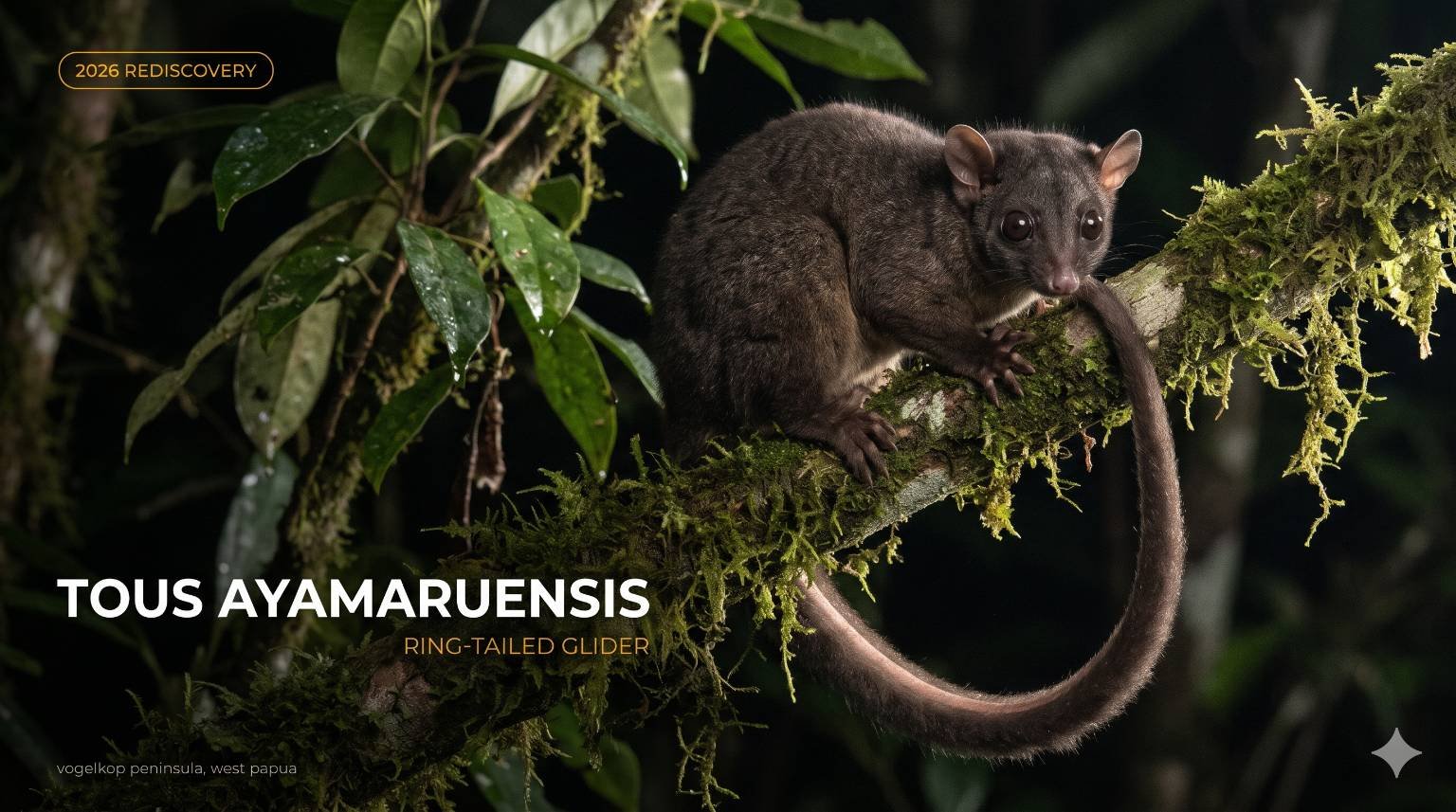
Tous ayamaruensis, the ring-tailed glider, is a small tree-dwelling marsupial recognised from living West Papuan animals in a study published on 6 March 2026. It had long been associated with archaeological remains and was presumed absent from the modern record for roughly 6,000 years. Its gliding membrane, nearly naked ears and grasping tail make it a remarkable rainforest animal. Explore the pictures, species facts and rediscovery story here.
What is Tous ayamaruensis, the ring-tailed glider?
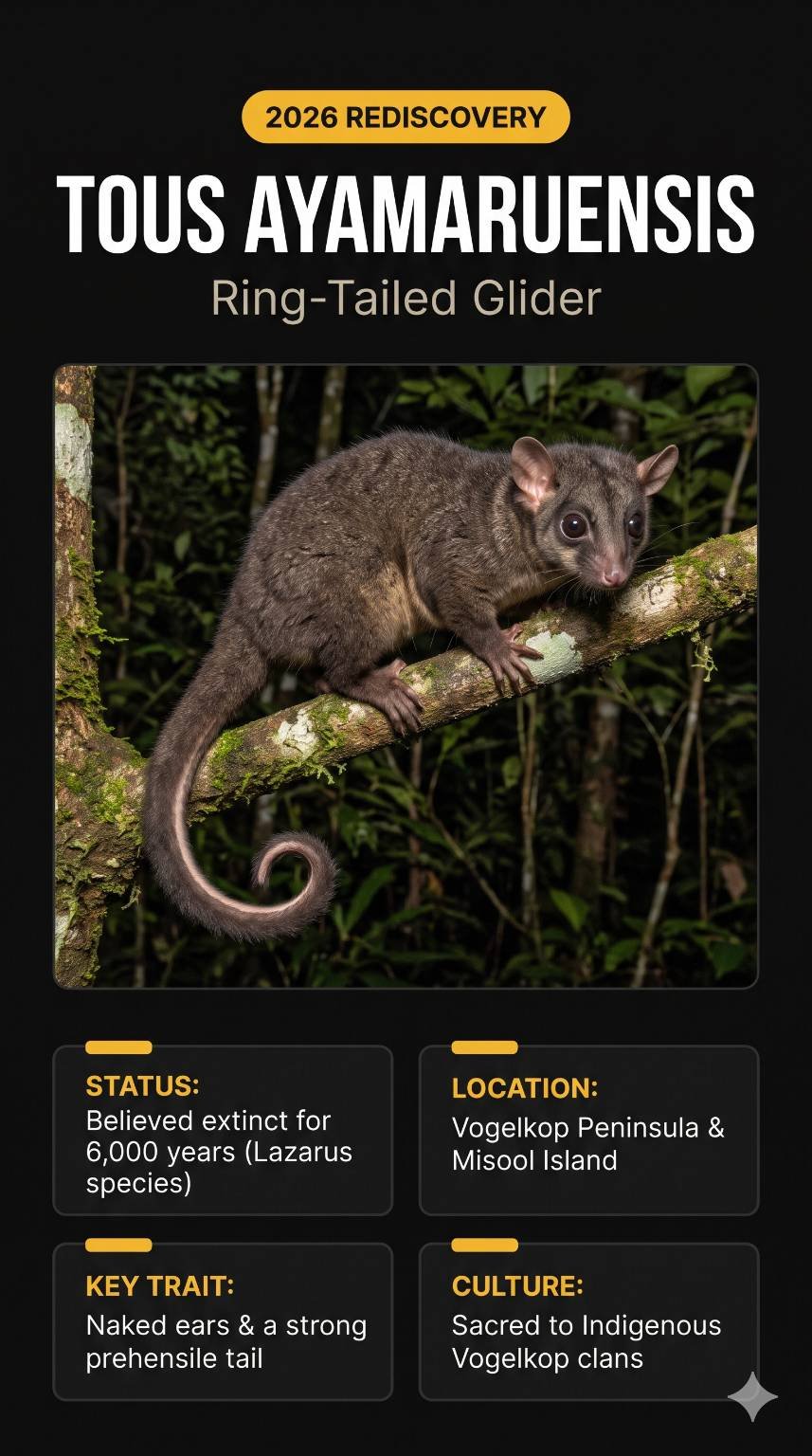
Tous ayamaruensis is a small gliding marsupial from western New Guinea, described in modern scientific records in March 2026. It is commonly called the ring-tailed glider. The name may look unfamiliar because older literature placed the animal under Petauroides ayamaruensis, while the 2026 study erected the new genus Tous. Scientists had previously known the species from ancient archaeological material rather than clearly recognised living individuals. The modern evidence therefore changed its status from a seemingly vanished animal to a living representative of a distinctive glider lineage. That does not mean the animal evolved recently or suddenly returned from extinction. It means researchers closed a long gap in formal zoological evidence. The story is particularly interesting to people searching for Tous ayamaruensis pictures because its ring-like tail posture and large eyes are memorable, but those characters alone cannot establish a specimen’s identity without proper scientific context. Its discovery illustrates the value of combining community observations, museum specimens and modern taxonomic analysis.
Where does Tous ayamaruensis live?
The original scientific study links living ring-tailed gliders with the Vogelkop, also called Bird’s Head, Peninsula and nearby regions of western New Guinea. Documented modern localities include the Sorong area and Misool Island, while early archaeological material came from the Ayamaru Lakes region. This needs a careful geographical distinction: much of the Vogelkop region is part of Indonesian West Papua. Papua New Guinea is an independent country farther east. The research also describes archaeological material from Sandaun Province in Papua New Guinea, showing that the historical record is wider than some modern sightings. The authors discuss possible additional survival in other New Guinea locations, but these possibilities should not be reported as confirmed present-day populations. Dense lowland forests, tall trees and connected canopy provide the kind of habitat relevant to a gliding arboreal mammal. A reliable map should mark confirmed records separately from historical fossils and potential range extensions rather than colouring an entire island as if every forest contains the species.
What made the 2026 rediscovery possible?
The 2026 recognition was not based on one photograph circulating on social media. The researchers reviewed skeletal material, older fossils and field information and compared the animal with relatives in Australia and New Guinea. The original type specimen’s identity was anchored in early Holocene archaeological evidence, especially jaws and teeth. Access to additional historical remains, including upper teeth, helped the team reassess its evolutionary relationships. At the same time, observations of living animals from West Papua showed that this supposedly missing form was still present. The formal paper appeared in Records of the Australian Museum on 6 March 2026 and named Tous as a new genus. A genus is a scientific category that may include more than one related species; it is not simply a catchy nickname. When reading “found alive after 6,000 years,” interpret the figure as referring to the apparent gap in the scientific record, not proof that the same individuals survived thousands of years or that the species had literally been extinct and then revived.
Tous ayamaruensis pictures: ears, tail and body details
Several anatomical characteristics distinguish the ring-tailed glider from better-known Australian gliders. The scientific description discusses almost naked external ears, prominent forward-facing eyes, a compact muzzle and a very strong prehensile tail. A prehensile tail can grip or hold onto objects such as branches; it is useful for stability while moving through the canopy. The gliding membrane, known as the patagium, stretches between limbs and allows controlled glides rather than powered bird-like flight. The original study estimates an approximate weight of 300 to 400 grams, but that is an estimate and should not be presented as a measured average for a large population. It describes grey and brown colour variation in animals observed on Misool, with darker eye rings and lighter undersides. In a useful picture guide, a body profile is paired with a diagram of the patagium, the ear and the underside of the tail. Illustrative pictures can teach morphology, but they are not substitutes for authenticated specimen records.
How does the ring-tailed glider move between trees?
Like other gliding possums, Tous ayamaruensis cannot flap its forelimbs to fly as birds do. Instead, it can launch from a height and spread the membrane between its limbs to slow and direct its descent toward another tree. Such gliding can help a nocturnal forest mammal access feeding sites without descending to the forest floor as frequently. Its powerful gripping tail is an additional feature that differentiates it from some relatives. The broad movement mechanics are inferred from gliding marsupial anatomy, but specific maximum glide distances or speeds for Tous ayamaruensis were not established by the 2026 paper. A responsible visual diagram should label glide, climb and tail grip separately rather than inventing performance numbers. Because the animal is rarely observed and has only recently been formally recognised as living, its daily activity schedule, preferred diet and home-range size deserve further field research. It is a good example of how an animal can have eye-catching adaptations yet remain incompletely studied in the wild.
Ring-tailed glider vs Australian greater glider
Australian greater gliders belong to Petauroides, close living relatives discussed by the scientists who studied Tous. Both groups are marsupials with gliding membranes, and both spend much of their time in trees. The differences are important. The 2026 researchers describe Tous as smaller than Australian greater gliders and especially distinctive for its naked ears and functional prehensile tail. Their analysis also places it among a wider lineage with a long fossil history in Australia. The new genus is not a synonym for Australia’s greater glider, and a photo of Petauroides should not automatically carry the label Tous ayamaruensis. The lemuroid ringtail, Hemibelideus lemuroides, is another living relative in eastern Australia, although it does not have exactly the same combination of features. For an easy chart, compare scientific name, locality, ear covering, tail function and gliding anatomy. Do not add unsupported claims about which species is fastest, smartest or most endangered based only on appearance.
Why is it important to Indigenous communities?
Researchers highlighted the role of traditional landowners and Papuan collaborators in understanding the animal’s range and natural history. Among Maybrat communities in the Vogelkop region, the ring-tailed glider has cultural significance that extends far beyond a scientific press release. The paper records traditional knowledge that animals use hollows high in large rainforest trees for resting and that a pair produces only a single young in a year. These are important accounts from people with long-term familiarity with the forest, and they should be attributed as such rather than presented as universally measured species-wide reproductive data. Local knowledge also helped scientists learn where to look and how to interpret the animals’ presence. International science works better when it recognises the expertise of communities living with the biodiversity under study. A modern post should therefore describe this discovery as collaborative, not as one explorer wandering into a supposedly unknown world and single-handedly finding a secret animal.
Conservation: what threatens the ring-tailed glider?
The 2026 scientific paper expresses serious concern about logging and forest conversion in West Papua and other regions of New Guinea. Large trees matter for an animal that glides between trunks and may rest in tree hollows. Removing mature timber can destroy roost sites and interrupt the connected canopy. Fragmented forest can force longer movements between suitable patches and make animals harder to survey. However, the number of gliders alive today has not been firmly established from the evidence discussed here. A dramatic population estimate, exact decline percentage or formal IUCN category should not be invented. The most defensible conclusion is that a species with recently recognised living populations merits urgent field research and habitat protection. The original authors say more work is needed to determine how broadly it survives. Future studies should examine canopy use, reproduction, diet and range, ideally working closely with local communities and respecting their knowledge and conservation priorities.
Tous ayamaruensis vs Dactylonax kambuayai: two discoveries, not one animal
A common source of confusion is that March 2026 coverage discussed two rediscovered marsupials together. Tous ayamaruensis is the ring-tailed glider; Dactylonax kambuayai is the pygmy long-fingered possum. Both were linked to the Vogelkop Peninsula and both had intriguing gaps in their recognised modern records, but they are different species with different family relationships and anatomical traits. The pygmy long-fingered possum is notable for the elongated fourth finger associated with extracting insect larvae from timber. The ring-tailed glider stands out for its gliding membrane, naked ears and strong tail. A comparison picture should keep their labels separate and avoid implying that one is merely a young or female version of the other. They also have distinct scientific papers. In a properly linked visual knowledge hub, readers can move between two articles and see how independent evidence led researchers to revise their understanding of both animals.
How to verify the pictures and claims
Start by checking the species name written next to a picture. The scientific name should be italicised in formal writing and ideally accompanied by a location, date and reference. Next, distinguish a labelled specimen or documented field image from a graphic that merely illustrates the animal’s appearance. Finally, compare any dramatic claim with the 2026 Australian Museum paper. If a website says the glider is definitely found throughout every island of New Guinea, ask for locality evidence. If it promises the first-ever photograph, check older museum and regional records. If it describes the animal as newly evolved, remember that scientific recognition in 2026 reflects our knowledge, not the date of origin of the lineage. The reliable takeaway is both exciting and modest: a distinctive gliding marsupial thought absent from the modern scientific record has living representatives, and its future deserves serious study.
Frequently asked questions about Tous ayamaruensis
Is Tous ayamaruensis really extinct?
No. Living animals are documented in the 2026 research. The rediscovery refers to a gap in the recognised scientific record.
What country is the ring-tailed glider found in?
Modern confirmed records come from western New Guinea, including the Indonesian West Papua region. Archaeological evidence also exists farther east.
Can it fly like a bird?
No. It glides between trees with a patagium, a membrane stretched between its limbs.
What is special about the tail?
Researchers describe a strongly prehensile tail, useful for gripping while moving in trees.
Is it the same as Dactylonax kambuayai?
No. They are different marsupials described in separate 2026 papers, with different anatomy and classifications.
Is it threatened?
The primary research raises substantial concerns about logging and forest conversion; a precise population total is not established.
Conclusion, dates and trusted sources
The most useful lesson of the ring-tailed glider story is that careful taxonomy and community knowledge can reveal living wildlife in places where the scientific record was incomplete. The major publication date is 6 March 2026, not the animal’s date of origin. The species remains a promising subject for photographs, diagrams and focused habitat research. Last reviewed: 23 November 2026.
Scientific sources: Flannery et al., Records of the Australian Museum, 2026 (original research); Australian Museum research announcement; Bishop Museum announcement.
Related science reading
- Indian Bramble Shark (Echinorhinus roinee): New Kerala Deep-Sea Species, Photos & Facts
- India Deep Ocean Mission Discoveries 2026: New Sharks, MATSYA-6000 & 2028 Dive Target

























Share Your Opinion
Comments are closed on this post.