 Vista
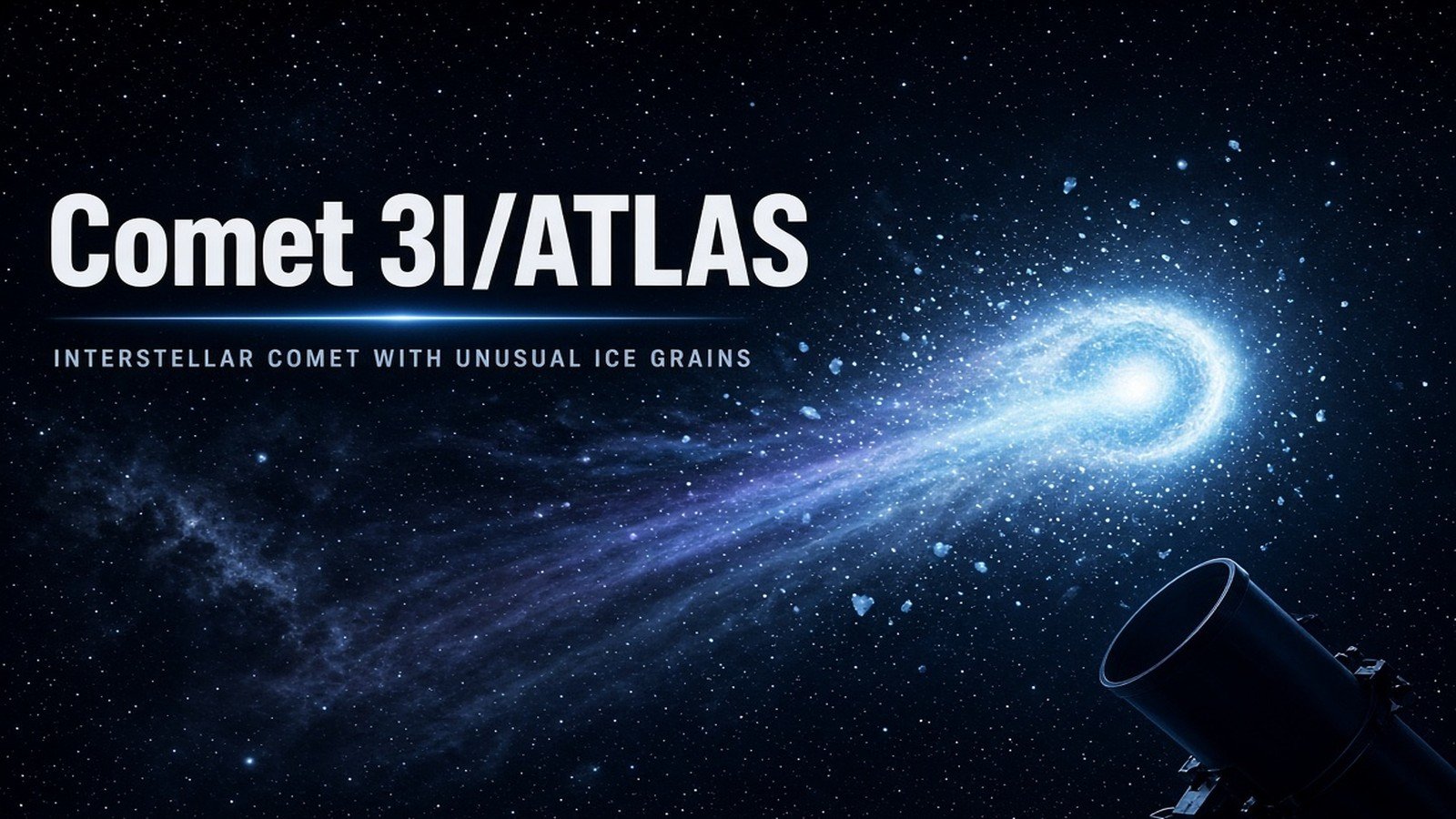
3I/ATLAS JWST ice research: an October 26, 2026 study explains an unusual infrared pattern in tiny, dust-rich water-ice grains surrounding the interstellar comet. JWST saw a strong 3-micrometre band but weak 1.5- and 2-micrometre bands. The result concerns natural cometary material, not extraterrestrial technology.
Updated: November 22, 2026 | Research announced: October 26, 2026
What did JWST discover about comet 3I/ATLAS ice in 2026?
NASA’s James Webb Space Telescope (JWST) has helped researchers identify an unusual physical form of water ice in the coma surrounding interstellar comet 3I/ATLAS. A study led by Southwest Research Institute and announced on 26 October 2026 reports that the best explanation for its infrared signatures is an abundance of very small, dust-rich aggregates containing water ice. Their characteristic dimensions are about a micrometre or smaller. The finding matters because the comet formed beyond our Solar System, so its material can offer clues to how solid building blocks developed around another star.
The word ‘ice’ does not mean that the telescope photographed giant transparent ice blocks. Researchers measured changes in infrared light with JWST’s Near-Infrared Spectrograph, or NIRSpec, and compared the resulting spectrum with physical models. Those models suggest microscopic ice mixed with non-volatile, or refractory, dust. The 2026 result builds on observations taken across 2025 and 2026; it is a new analysis of an observed natural comet, not an announcement that the comet first appeared in October 2026.
Importantly, the unusual spectrum is not evidence of an alien spacecraft or manufactured object. Astronomers identified a cometary coma, gases and dust, and an interpretation grounded in spectroscopy. An unusual material mixture is a scientific result worth reporting in its own right without sensational claims.
What is an interstellar comet, and why is 3I/ATLAS special?
An interstellar object comes from outside the Solar System and passes through it on a path that is not permanently bound to the Sun. The designation 3I means the third confirmed interstellar visitor following 1I/‘Oumuamua and 2I/Borisov; ATLAS refers to the sky-survey system associated with its discovery. Comets often contain frozen volatile substances, darker minerals and dust. As they approach the Sun, heating can cause gases and solid grains to escape into a surrounding cloud called the coma.
For ordinary Solar System comets, scientists can compare different objects thought to have originated in our own early planet-forming environment. A visiting interstellar comet provides a rare natural sample from beyond that shared history. Scientists cannot assume its composition exactly matches any known comet, nor that one example represents all other planetary systems. The purpose of examining 3I/ATLAS is to test where its properties align with or differ from familiar comets and objects beyond Neptune.
The observed material came from the coma, not from a sample-return container brought to Earth. Instruments measure remote light, and researchers infer grain size and mixture from how that light is absorbed and scattered. Understanding that distinction prevents false headlines about NASA ‘collecting’ ice from a visitor.
JWST observation timeline: August 2025, December 2025 and April 2026
The underlying programme used JWST NIRSpec PRISM observations on 6 August 2025, 22 December 2025 and 1 April 2026. These three snapshots bracketed the comet’s late-October 2025 closest approach to the Sun, also called perihelion. By observing at different stages, the team could compare how water-ice signatures changed as the comet warmed near the Sun and then moved outward into colder space.
The technique spreads incoming light across wavelengths, much like separating colours but in the infrared. Molecules and solids leave spectral features that can be compared with laboratory measurements and models. The science programme did not merely rely on the comet’s apparent colour in an amateur telescope photograph. NIRSpec measurements provided a far more detailed physical record of material that was escaping from the comet.
The paper was publicised in October 2026, many months after its final April observation. This timing is crucial for search readers: a publication date tells us when the analysis became public, whereas an observation date tells us when the comet was actually measured. Treating older telescope images as a new November sighting would be an avoidable error.
Why did the 3-micron water-ice band stand out?
Water ice absorbs infrared light in several characteristic wavelength regions. In many previously studied ice-rich cometary grains, scientists expect features near 1.5 micrometres, 2.0 micrometres and 3.0 micrometres. The new study found a pronounced absorption near three micrometres in 3I/ATLAS but much weaker, or missing, features near 1.5 and two micrometres. The combination initially looked puzzling because it was not the simple spectral pattern associated with relatively pure cometary ice.
One way to visualize spectroscopy is to imagine a barcode. Different physical substances and structures change the strength of specific bands; astronomers measure those differences rather than judging ice by its brightness alone. The presence of a strong three-micrometre feature supports water ice, but the weak shorter-wavelength bands carry additional information about how the ice is arranged and mixed with other substances.
The important question is therefore not simply ‘does the comet contain frozen water?’ but ‘what kind of icy particles produce this particular pattern?’ The answer depends on models that include grain size, how deeply light passes through particles and the proportion of dust that absorbs or scatters light.
What are refractory-rich micron-sized ice grains?
Refractory means material that is relatively resistant to vaporizing compared with volatile ices. In the study’s context, it refers to dust or solid components mixed into tiny water-ice aggregates. A micrometre is one-thousandth of a millimetre. Thus the grains inferred from the spectrum are extremely small; they are not floating boulders that a telescope could resolve as individual objects.
The investigators modelled how infrared light interacts with grains of varying sizes and mixtures. Their preferred interpretation uses water ice combined with appreciable amounts of dark dust. In such particles, light travels a relatively short path through the ice. That can weaken the 1.5- and 2-micrometre features without erasing the distinctive three-micrometre absorption. The researchers emphasize that grain sizes broadly overlap those in some Solar System comets; the difference appears more related to the dust mixed into the ice than to an astonishingly different physical scale.
This is a model-supported interpretation, not a photograph of the internal cross-section of a single dust grain. Different microscopic structures can produce complicated spectra, which is why scientists compare multiple epochs, models and other icy bodies instead of making a conclusion from a single graphical curve.
Did the ice particles change after perihelion?
The team saw signs that the population of icy material in the coma evolved. By the 1 April 2026 observation, the spectrum favoured an additional ice-rich grain population, larger than the particles inferred earlier but still on the order of one micrometre. This change may say something about material ejected from the comet as its surface was heated and altered near the Sun.
However, the researchers did not claim they had uniquely established the mechanism. The later spectrum could reflect different solar heating of grains at each observing stage or the exposure of new, previously buried material as the comet’s surface eroded. Both are scientifically plausible. Distinguishing them would require more information about grain evolution and how coma material interacts with sunlight.
A picture of a brighter tail at one moment cannot on its own answer which process occurred. Brightness depends on geometry, the dust population, viewing angle and other factors. The stronger result is that the spectroscopy tracks real variation over time and offers specific hypotheses for further study.
Why compare 3I/ATLAS with objects beyond Neptune?
After studying the interstellar comet, researchers compared its infrared water-ice spectrum with that of trans-Neptunian objects (TNOs)—icy bodies orbiting beyond Neptune. Several of those distant Solar System objects show a broad three-micrometre feature and similarly lack strong 1.5- and two-micrometre water-ice absorption. This resemblance suggests that a family of grain structures might occur both here and in planet-forming environments around other stars.
The study notes similarities with some icy TNO spectra that separately show carbon-dioxide ice and organic-compound signatures. That does not mean every molecule measured on a TNO is present in the same amount inside the comet. The comparison concerns a particular shape of the water-ice spectral feature. Readers should avoid transforming a spectral resemblance into proof that the two bodies have identical full chemical compositions.
The scientific possibility is a continuum of material properties: from relatively pure icy grains to more dust-rich aggregates. If additional observations support this picture, it could indicate that some basic physical characteristics of ice grains take shape early in planet-forming disks and are partially preserved inside larger icy bodies.
Does 3I/ATLAS prove alien life or alien technology?
No. A comet’s icy and dusty coma can be unusual without being artificial. The researchers employed natural optical and thermophysical models, and their paper was published as a study of cometary materials. The term ‘interstellar’ means the object arrived from outside our Solar System, not that intelligent extraterrestrials built it.
Nor does water ice prove biology. Ice is widespread in space, and its infrared features reveal useful information about molecular structure and dust mixing, not DNA, cells or organisms. CO₂ and organic-related infrared features can likewise arise from non-biological chemical processes. None of the findings described by Southwest Research Institute announces extraterrestrial life.
A careful article can acknowledge that unusual spectra prompted researchers to investigate. But claiming the ‘missing 1.5-micron band’ is an engineered signal would misrepresent spectroscopy. No such conclusion appears in the study, and one should not confuse scientific uncertainty about grain heating with evidence for a spacecraft.
3I/ATLAS ice pictures: what is real and what is illustrative?
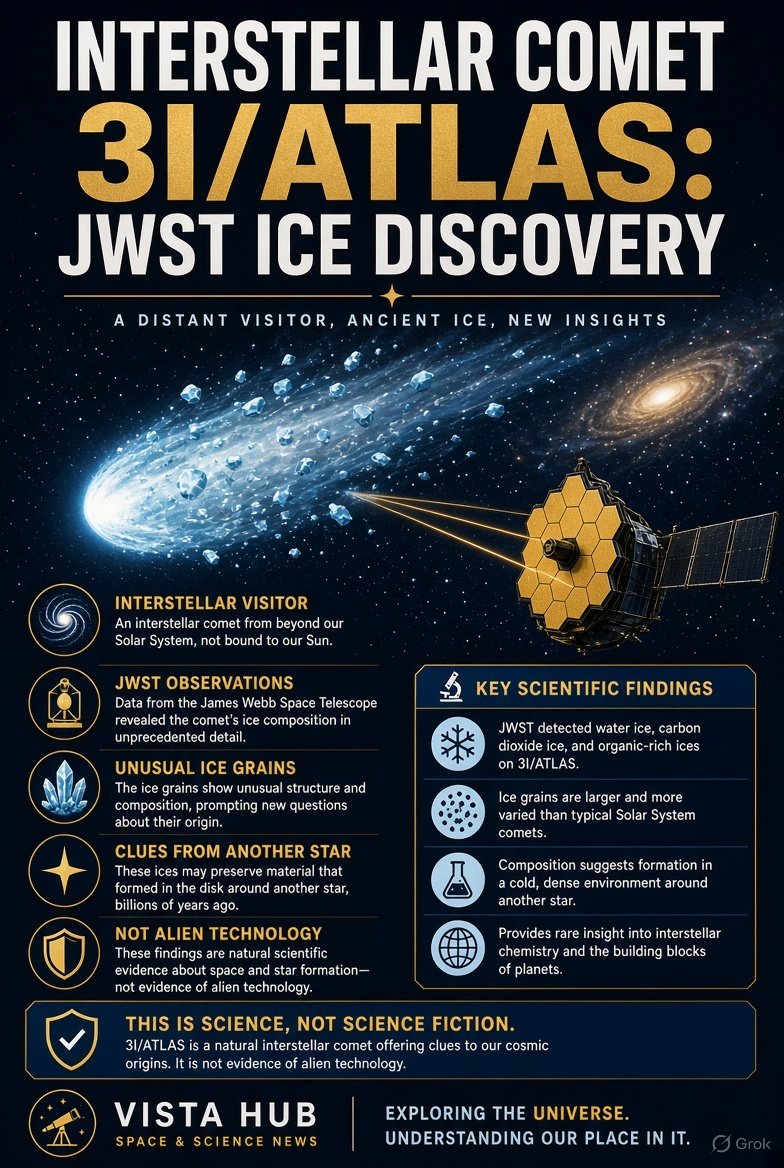
The informational poster accompanying this article summarizes the comet, the three observation dates and the main spectral comparison. It is an educational illustration. Spectral absorption bands are measured quantities plotted from telescope data; they are not coloured stripes painted onto actual ice grains. The associated featured image is likewise a concept visual rather than a claim that JWST photographed individual micron-size aggregates.
Readers who want the underlying observation should consult the paper’s NIRSpec spectra and the instrument images. Those show a faint extended coma and extracted light across wavelengths, not a detailed close-up of a rocky surface. A bright blue illustration of a comet is not necessarily false if it is labelled as artwork; it becomes misleading when passed off as a NASA natural-colour close-up.
When evaluating search results, compare image captions, instrument name, observation date and publication date. JWST imagery often involves processed infrared data and chosen display colours. A news infographic can help communicate an abstract finding, but it should never replace the primary research figure for exact quantitative interpretation.
What scientists still need to learn about interstellar ice
The current finding concerns one interstellar comet examined in a finite number of telescope visits. Researchers still want to know whether the grain characteristics are typical of many icy visitors, how the structures change with solar distance and how much of the observed difference comes from surface processing rather than original formation conditions.
Follow-up programmes could compare other interstellar comets, nearer Solar System comets and additional TNOs. New spectral data can test whether the suggested continuum from clean ice to dust-rich aggregates holds across more objects and wavelengths. Other JWST findings on 3I/ATLAS investigate gas composition and isotopes; they are related research lines but should not be conflated with this October paper about refractory-rich solid water ice in coma grains.
Useful likely questions include ‘3I ATLAS water ice 3 micron JWST’, ‘3I ATLAS ice grain size’, ‘3I ATLAS 2026 original science paper’, ‘why 1.5 and 2 micron water ice bands missing’, and ‘3I ATLAS vs TNO ice comparison’. These are plausible future searches, not invented measured search volumes. The strongest answer remains what the dated original study actually demonstrates.
3I/ATLAS Water Ice FAQs
Did JWST detect water ice in 3I/ATLAS?
Yes. The near-infrared spectrum supports water ice in the coma, with a prominent feature near three micrometres.
Why were the 1.5 and 2-micrometre bands weak?
Models favour micron-sized ice grains mixed with refractory dust, which can weaken those shorter-wavelength absorption bands.
When were the JWST observations taken?
On 6 August 2025, 22 December 2025 and 1 April 2026, before and after the comet’s late-2025 perihelion.
Are 3I/ATLAS ice grains visible as individual objects?
No. Grain sizes are inferred from spectra and models, not from a close-up photograph of each grain.
Does the research prove that 3I/ATLAS is artificial?
No. It is a natural comet-chemistry and grain-physics investigation and contains no alien-technology conclusion.
What was newly announced in October 2026?
The analysed grain properties and comparison with some trans-Neptunian objects, rather than the initial discovery of the comet.
Conclusion and original sources
The central finding is the physical state of water ice and its mixture with refractory dust, revealed through infrared spectroscopy. The original paper gives important qualifications about grain models and future research.
- Southwest Research Institute, 26 October 2026: JWST compares 3I/ATLAS ice with icy Solar System bodies
- The Astrophysical Journal Letters: JWST reveals refractory-rich water ice in 3I/ATLAS (DOI)
- Scientific paper and observation details (arXiv 2609.19286)
Image note: OG and informational graphics are educational illustrations, not authenticated close-up images of individual grains.
























Share Your Opinion
Comments are closed on this post.