 Vista
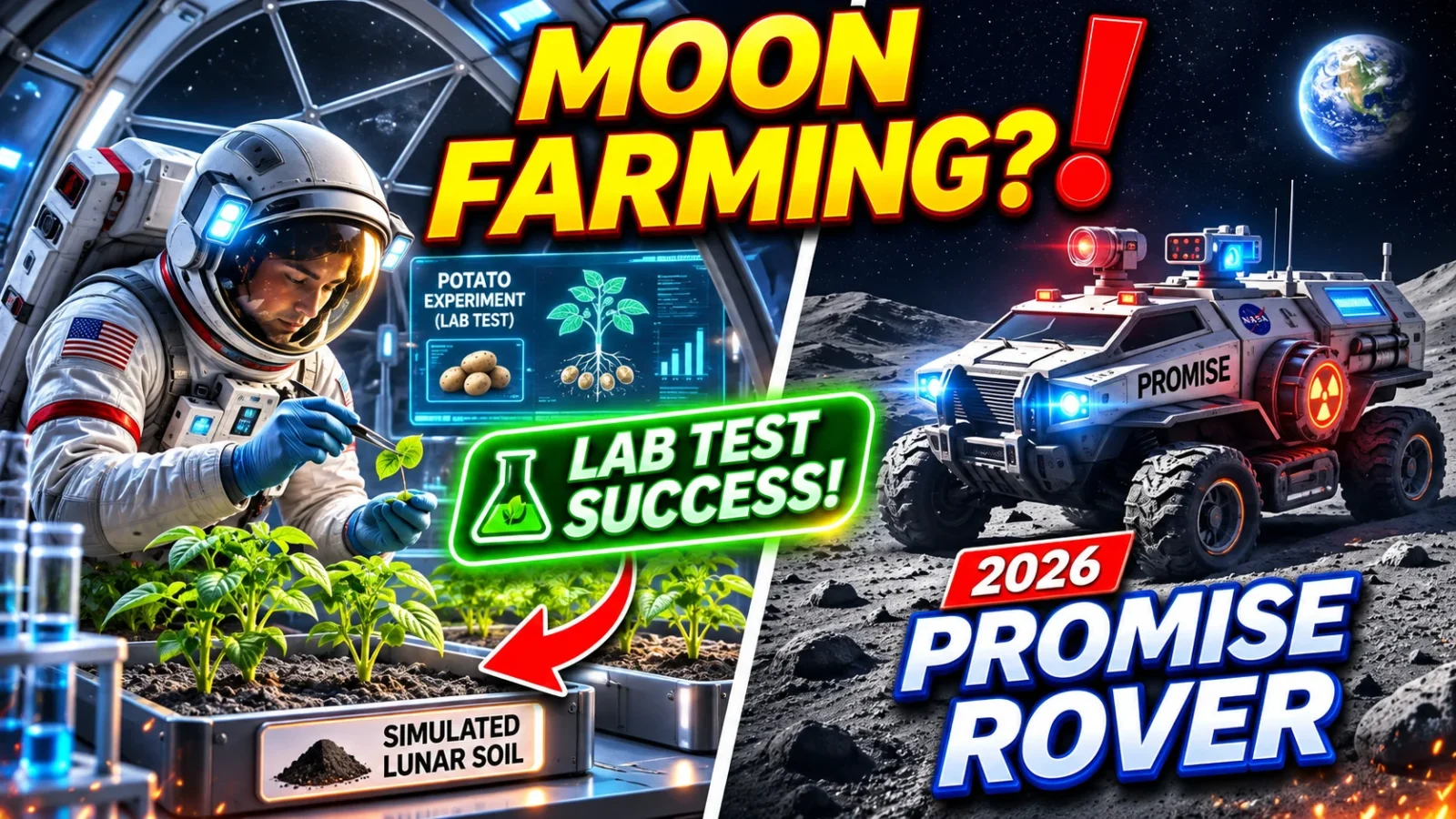
Can humans grow potatoes on the Moon? A peer-reviewed study published on 19 November 2026 shows that potato plants can produce harvestable tubers in simulated lunar soil on Earth when scientists add enough organic material. In one set of comparisons, a blend containing 30% vermicompost helped restore growth and yields toward levels observed in ordinary Earth soil. NASA also announced plans for PROMISE, a nuclear-powered lunar rover that will prospect for resources around the Moon’s south pole. These are two separate steps toward future lunar settlements: the potatoes were not grown on the Moon, and PROMISE has not yet landed. NASA is targeting a late-2028 launch.
Updated 22 November 2026. The potato result comes from Oregon State University researchers, whose paper in npj Microgravity studied five kinds of lunar regolith simulant under controlled greenhouse conditions. PROMISE is a planned NASA Jet Propulsion Laboratory rover using nuclear electrical power to work through darkness and explore permanently shadowed areas. Neither announcement proves that a working lunar farm already exists or that the rover is a food-growing vehicle.
Moon farming 2026: what scientists actually achieved on 19 November
The study, Growth and molecular responses of potato to lunar regolith simulants, appeared on 19 November 2026 in npj Microgravity (volume 12, article 100; DOI 10.1038/s41526-026-00668-z). The research team, led by Oregon State University plant scientist Aymeric Goyer and colleagues, examined whether potatoes can survive, grow, form tubers and maintain nutritional quality in materials designed to resemble the Moon’s loose surface deposits.
The crop was the Modoc potato, a relatively early-maturing variety with red skin and white flesh. Researchers used multiple lunar regolith simulants—Earth-made mineral mixtures with properties selected to model lunar material—and amended them with different levels of vermicompost, organic matter produced through earthworm composting. The plants grew in a controlled greenhouse on Earth where light, water and other environmental conditions could be managed. The study did not ship real Moon dust from a lunar sample-return mission into a Moon greenhouse.
In unamended simulant, plant biomass and yields were substantially restricted. Growth improved as suitable organic matter was added, and the paper reports that at a 30% vermicompost amendment, some growth and harvest outcomes approached those of plants cultivated in terrestrial soil under comparable conditions. The researchers also assessed leaf gene-expression responses and tuber metabolites. This is promising crop science, but a positive laboratory result is not equivalent to a field trial on an airless, irradiated celestial surface.
How did potatoes grow in fake Moon soil? Five simulants and vermicompost
Lunar regolith is the layer of dust, broken rock and fragmented material covering the Moon. In ordinary gardening language it is sometimes called “lunar soil,” but it differs from the fertile soils we know on Earth. Earth soils often contain weathered minerals, organic carbon, microbes and an active nutrient cycle. Lunar regolith lacks a living ecosystem and usable organic nutrients; it is also shaped by an entirely different environment. You cannot simply put a potato into unmodified Moon dust and expect the same results as a backyard planting.
The researchers evaluated five lunar regolith simulants, including materials known as JSC-1A, LHS-1E, LMS-1E, NUW-LHT-5M and OPRH4W30. Different simulants model different mineral properties. That matters because plant roots do not respond to “Moon soil” as a single universal product: physical structure, trace minerals, metal availability and water handling can change the plant’s performance. Treating one successful mix as proof that all lunar sites are farm-ready would ignore these differences.
Vermicompost helps supply organic matter and nutrients absent from bare regolith. It can improve water retention and create a more root-friendly growing medium. In the study, scientists used mixes with varying proportions; one highlighted comparison included 0%, 15% and 30% compost by volume in a particular simulant. At low amendment levels, growth was stunted in all tested simulants relative to normal Earth soil. Adding more organic amendment improved some measurements. The exact best blend could vary with crop, simulant, nutrient supply and greenhouse system.
What does “30% compost” mean in the headline?
It refers to a test substrate mixture, not evidence that Moon dust itself contains 30% compost. A mix of 70% selected simulated lunar mineral material and 30% vermicompost by volume was a notable successful treatment. The benchmark was potato growth under controlled Earth conditions. It is not an instruction that future Moon settlers need only add the same volume of compost to any actual lunar regolith and immediately eat the harvest. They will need reliable oxygen, water, nutrients, pressure control, light and food safety checks, among other systems.
Were the Moon potatoes safe to eat? Nutrients, heavy metals and limits
The researchers studied nutritional and biochemical characteristics of the harvested tubers, not merely how many potatoes appeared in a pot. The paper reports that tuber metabolite composition showed relatively little deviation from control plants and describes the tubers as nutritionally acceptable under tested conditions. This is meaningful because a plant that grows well but accumulates unsafe contaminants would be a poor food source in a habitat.
However, the analysis also reported modestly elevated concentrations of certain metals, including copper, zinc and aluminium, in tubers from some simulant treatments. That is a reason for further monitoring, not a license to label every product grown in lunar regolith safe in every quantity. “Safe to eat” headlines must be qualified by the study design, measured compounds, exposure thresholds and conditions. Actual lunar dust can contain features not perfectly reproduced by manufactured simulants, and a future food system would also need repeated-harvest testing.
For long-duration settlement, scientists must study how radiation, low gravity, closed-loop water recycling, microbial ecosystems, crop disease, dust handling and waste streams affect plants over many generations. The 2026 potato experiment is a valuable proof of feasibility for a controlled substrate; it is not a demonstration of sustainable commercial Moon farming or a completed astronaut diet plan.
NASA PROMISE nuclear rover: what the name means and what it will do
On 7 November 2026, NASA announced development of PROMISE — Polar Rover for Observation, Mapping, and In-Situ Exploration. The mission is intended for the Moon’s south polar region. NASA’s Jet Propulsion Laboratory (JPL) will manage and build the six-wheeled vehicle using available hardware from the Mars rover programme, including spare parts and engineering designs associated with Curiosity and Perseverance. The announced objective is lunar geology, engineering reconnaissance and resource prospecting—not planting potatoes.
PROMISE is planned to carry instruments for examining the surface and subsurface: a drill capable of accessing approximately one metre beneath the surface, spectrometers for material composition, thermal and radiation sensors, visible-light cameras, and technologies for more autonomous navigation and more capable spaceflight computing. One key target is evidence relevant to potential water ice and other resources around polar terrain. Resource identification helps future planners choose landing locations and establish infrastructure, including systems that could support people and eventually agriculture.
NASA’s stated schedule is a late-2028 target launch and a planned 18-month mission. Blue Origin received a delivery contract with a $94 million base award and an option period of up to $140 million to carry the rover to the south pole using the Mark 1 lander. These are plans and contractual arrangements announced in November 2026; actual launch and landing outcomes remain future events and can change.
How will the PROMISE nuclear-powered rover survive a lunar night?
At most lunar latitudes, sunrise and sunset are separated by long periods: a typical lunar day-night cycle includes roughly 14 Earth days of darkness. At the poles, lighting is more complicated because the Sun stays low and some crater interiors can remain in permanent shadow. Solar panels cannot deliver consistent energy in darkness, and storing enough power for every scenario can be difficult. That makes a reliable non-solar source attractive for polar missions.
PROMISE uses a radioisotope thermoelectric generator (RTG), according to NASA’s mission description. This nuclear generator converts heat from radioactive decay into electrical energy. It is not the same as a nuclear fission reactor and not an explosive system. NASA plans to use a spare multi-mission radioisotope thermoelectric generator alongside rover hardware informed by Curiosity and Perseverance. A radioisotope system can provide power through prolonged darkness and supports thermal management in a cold environment.
Solar systems remain valuable for sunlit lunar operations; nuclear and solar designs address different mission requirements. The purpose is not to declare solar panels obsolete but to extend what a rover can do in places where dependable sunlight is unavailable. PROMISE still needs to cope with terrain obstacles, communications, insulation, sensor reliability and the harsh environment. Power is one major enabling technology, not a guarantee of successful exploration.
Lunar potatoes vs PROMISE rover: why these stories belong together
Moon settlement requires multiple systems to mature together. A greenhouse needs a dependable food-growing medium, stored or recycled nutrients, liquid water, pressure, light and energy. A resource rover can help map the terrain, assess regolith and investigate potential deposits of useful materials. The 2026 potato study addresses one part of the food-production problem, while the PROMISE mission addresses robotic exploration and power in difficult polar terrain. Neither directly depends on the other, but both provide pieces of the larger scientific and logistical puzzle.
| Question | Potato study (Nov 2026) | NASA PROMISE rover |
|---|---|---|
| Where? | Greenhouse experiments on Earth | Planned Moon south-pole mission |
| What was tested? | Potato plants and simulated lunar soil with compost | Nuclear-powered exploration of lunar terrain |
| Main result or status | Positive crop-growth and nutrition findings in test mixes | Development announced; future launch target |
| Key date | Paper published 19 November 2026 | NASA announcement 7 November 2026 |
| Important limitation | No food was grown on the Moon itself | Rover has not yet launched or landed |
One should also distinguish PROMISE from the separate X-70 experimental aircraft mentioned in wider NASA technology announcements. X-70 is not a second lunar farming rover and does not belong in a headline claiming NASA has two Moon potato vehicles. Its aviation research purpose is a different subject and should be evaluated independently.
What must happen before astronauts can really farm potatoes on the Moon?
A future lunar greenhouse would likely be enclosed and pressurised to prevent water loss and protect plants from vacuum conditions. It must balance light supply, carbon dioxide, humidity, temperature and nutrients. The regolith may need treatment to mitigate mineral or particle hazards and support roots. Water supply and recycling must work with the habitat’s wider life-support system. If astronauts consume the harvest, robust food safety testing must cover contaminants and microbiological risks.
There are also engineering trade-offs. Transporting compost from Earth would be expensive, while manufacturing a safe nutrient amendment from available waste streams requires processing and sanitation. Growing potatoes uses space and energy; stored food offers reliability early in a mission. A real operational system may combine several crops and hydroponic or other substrates rather than rely entirely on mineral regolith. The 2026 experiment improves our understanding of one candidate approach without deciding every design choice.
Finally, researchers must evaluate reproducibility. A well-controlled one-season crop trial is the beginning of agricultural technology development, not the end. More cultivars, different simulated materials, repeated cycles, realistic radiation protection and eventually tests in lunar gravity conditions would give mission planners more confidence. The study team has indicated more potato-variety research is underway.
Moon farming and PROMISE FAQs
Did NASA grow potatoes on the Moon in November 2026?
No. Oregon State University researchers grew potatoes on Earth in controlled conditions using lunar regolith simulants. The study was NASA-supported; it was not a harvest from the Moon.
What is lunar regolith simulant?
It is an Earth-made material designed to resemble selected physical or chemical properties of lunar surface dust and rock. It is not identical to every type of actual Moon material.
Did 30% vermicompost make the plants grow?
One highlighted blend containing 30% organic compost amendment produced much better growth and yields approaching terrestrial controls in the study. Results depend on the substrate and greenhouse conditions.
Are potatoes grown in lunar simulant automatically safe to eat?
No. The study reported encouraging nutrient measurements but also modest increases in some metals under certain conditions. Real food systems require further contaminant and long-term safety work.
What does PROMISE stand for?
Polar Rover for Observation, Mapping, and In-Situ Exploration. It is NASA’s planned six-wheeled nuclear-powered lunar south-pole research rover.
When is PROMISE launching and why does it need nuclear power?
NASA is targeting late 2028 and an approximately 18-month mission. Its radioisotope generator can provide electricity during dark lunar conditions where solar energy is unreliable.
Primary research and NASA sources
Read the peer-reviewed potato paper indexed by PubMed and Oregon State University’s research summary. The official mission facts are in NASA’s 7 November 2026 announcement and NASA’s PROMISE mission page. These are the references for the study date, compost findings, rover instruments, generator type and future launch schedule.
Bottom line: Scientists have demonstrated a promising way to grow potatoes in amended simulated lunar regolith on Earth, while NASA is preparing a nuclear-powered rover to scout the south pole. The two announcements strengthen the case for future Moon habitats without proving that a permanent Moon farm already exists. This science explainer distinguishes results, laboratory limitations, renderings and planned missions; flight schedules and technical details may change.


























Share Your Opinion
Comments are closed on this post.