 Vista
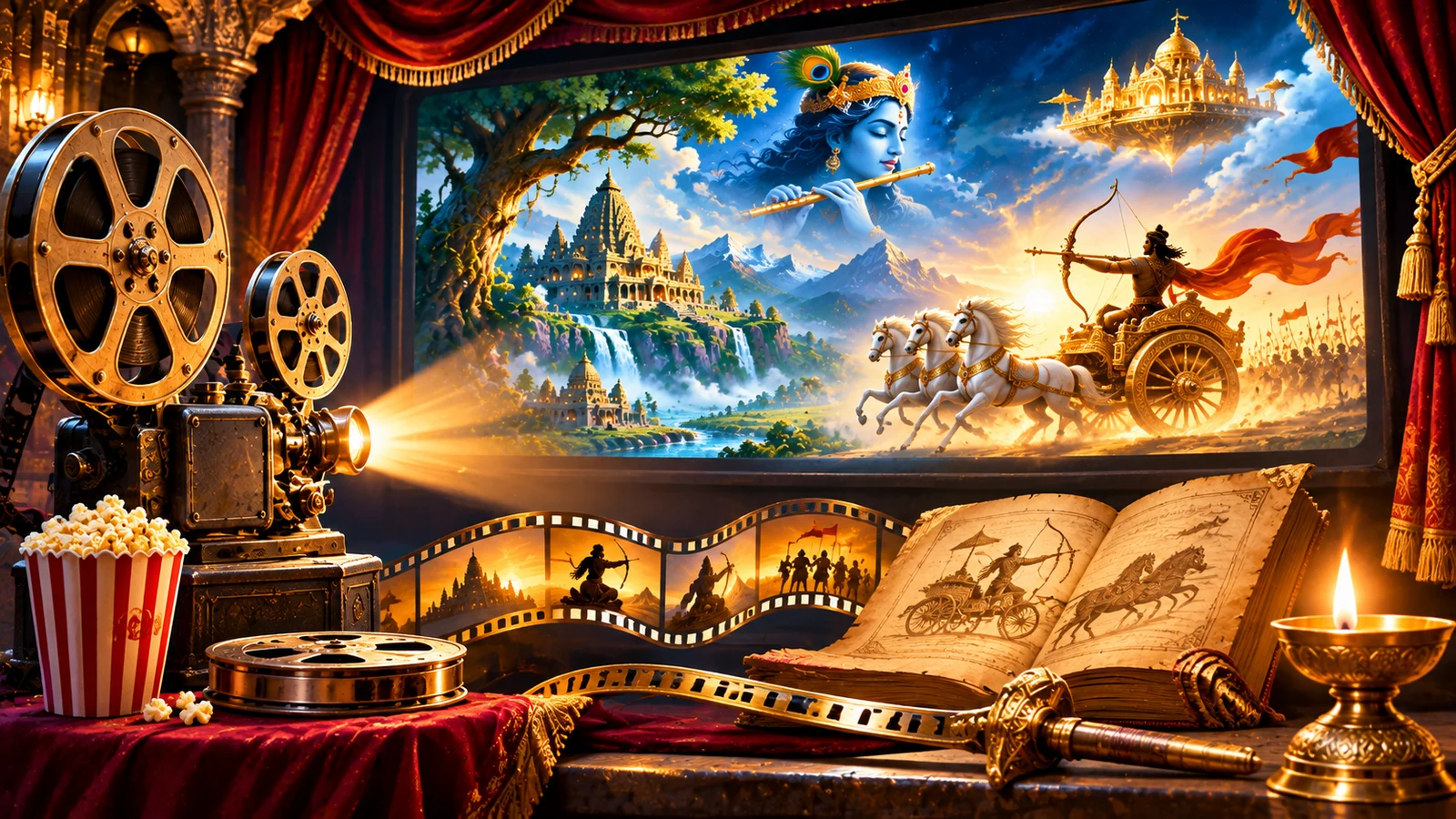
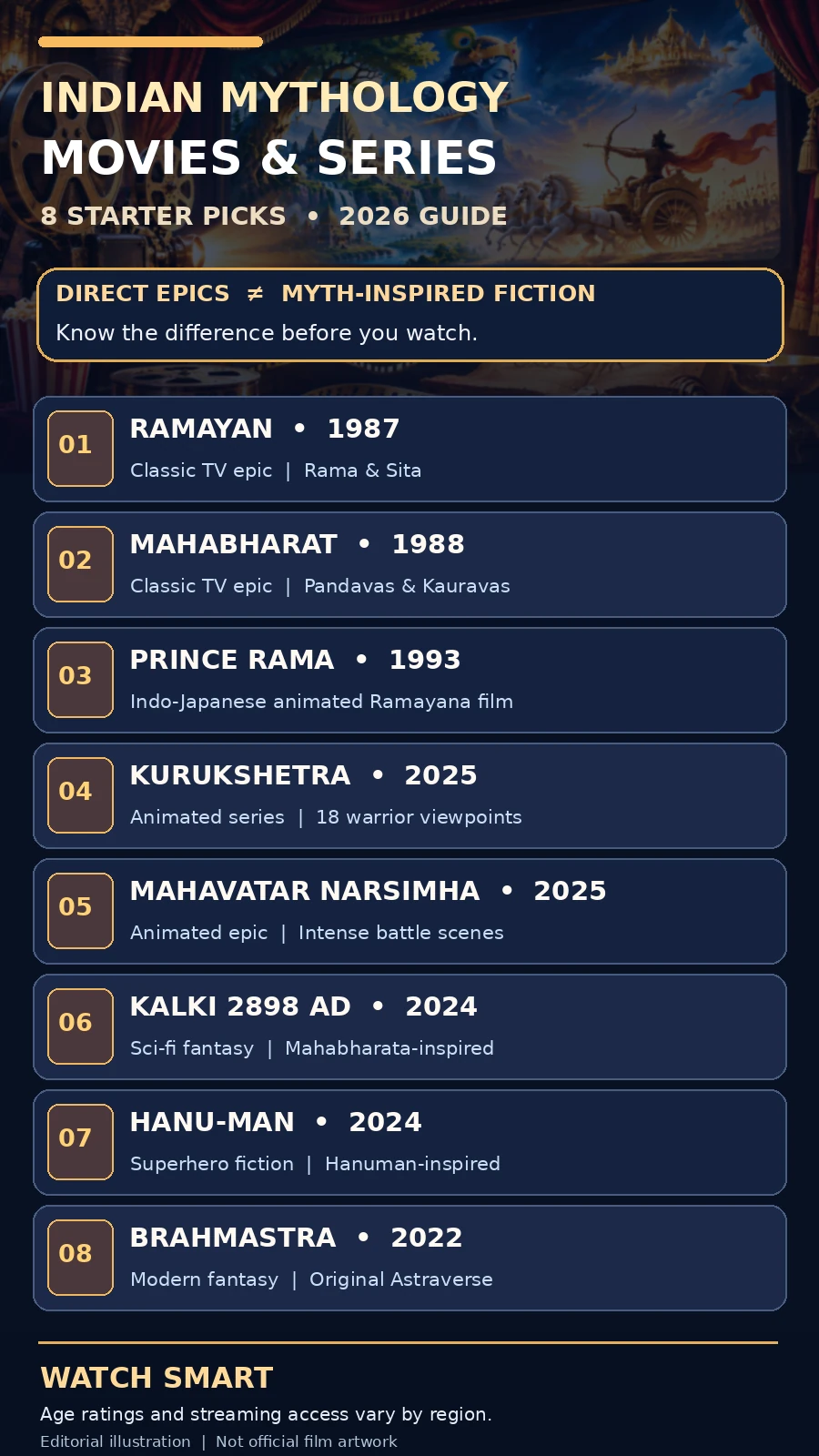
Quick answer: If you are looking for the best Indian mythology movies and web series, begin by deciding whether you want a direct retelling of the Ramayana or Mahabharata, an animated version of an epic episode, or an original fantasy inspired by Indian religious symbols. For classic television, try Ramayan (1987) or B. R. Chopra’s Mahabharat (1988–1990). For modern animation, Kurukshetra (2025), Mahavatar Narsimha (2025) and Ramayana: The Legend of Prince Rama are useful entry points. For original fiction rather than scripture-based retellings, choose Kalki 2898 AD, Hanu-Man or Brahmastra. This is a curated guide, not an invented box-office ranking or a promise that every title streams everywhere. Updated 13 November 2026, with basic story categories and age-suitability cautions.
How We Chose These Indian Mythology Movies and Series
A good recommendation should answer three questions: is the work based on a named epic or an original screenplay; what kind of viewing experience does it offer; and whom is it appropriate for? Our 12 picks include foundational television, modern animated storytelling, mythological science fiction, superhero fantasy, an adventure thriller and regional folklore-inspired drama. We avoided declaring the titles “most watched” or assigning unsupported scores. The categories are editorial judgments based on the films’ subjects, not a claim that every Indian viewer will prefer the same work. Some productions directly dramatize major episodes of the Ramayana or Mahabharata. Others use familiar names, weapons or spiritual ideas while inventing new characters and conflicts. That line is essential because a cinematic scene may feel convincing without appearing in the underlying text. A reader searching “Indian mythology movies on Netflix” has a different practical need from a parent seeking a gentle entry point for a child; this guide helps both narrow their options.
Quick Comparison: Which Indian Mythology Title Should You Watch?
| Title | Year | Type | Best starting reason |
|---|---|---|---|
| Ramayan (1987 television series) | 1987 | Epic adaptation | Classic epic |
| Mahabharat (1988–1990 television series) | 1988–90 | Epic adaptation | Classic epic |
| Mahabharat (2013 television series) | 2013 | Epic adaptation | Classic epic |
| Kurukshetra (2025 animated series) | 2025 | Animated epic | Distinctive screen storytelling |
| Ramayana: The Legend of Prince Rama (anime) | 1993 | Animated epic film | Distinctive screen storytelling |
| Mahavatar Narsimha (2025 animated film) | 2025 | Animated devotional film | Distinctive screen storytelling |
| Kalki 2898 AD (2024 film) | 2024 | Mythology-inspired science fiction | Distinctive screen storytelling |
| Hanu-Man (2024 film) | 2024 | Mythology-inspired superhero film | Distinctive screen storytelling |
| Brahmastra: Part One – Shiva (2022 film) | 2022 | Mythology-inspired modern fantasy | Distinctive screen storytelling |
| Karthikeya 2 (2022 film) | 2022 | Mythological mystery adventure | Distinctive screen storytelling |
| Kantara (2022 film) | 2022 | Regional folklore-inspired film | Distinctive screen storytelling |
| Tumbbad (2018 film) | 2018 | Original folklore-style horror | Distinctive screen storytelling |
The table mixes films and episodic shows intentionally. A film may be practical for one evening, while a historic serial can reward a longer commitment. “Based on mythology” is a broad marketing phrase: in this article it does not erase the difference between a dramatization and newly invented fiction.
12 Best Indian Mythology Movies and Web Series: What Each Offers
1. Ramayan (1987 television series)
Epic adaptation. Ramanand Sagar’s Ramayan is one of the most familiar screen introductions to Rama, Sita, Lakshmana, Hanuman and Ravana. Beginning in 1987, this television adaptation brought a devotional style of storytelling into Indian living rooms. Its slower pace can be a virtue: viewers have time to understand exile, loyalty, separation, cooperation and the painful consequences of decisions. The production’s performances, music and unmistakable visual language explain why it remains a cultural reference point. New viewers accustomed to fast cuts may find the theatrical acting and effects dated; that does not make the series less valuable as a window into an influential period of television history. Choose it if you want the classic, patient telling of the Ramayana rather than a modern fantasy spectacle. Remember that an adaptation follows editorial choices; it is not a substitute for comparing different Ramayana texts.
2. Mahabharat (1988–1990 television series)
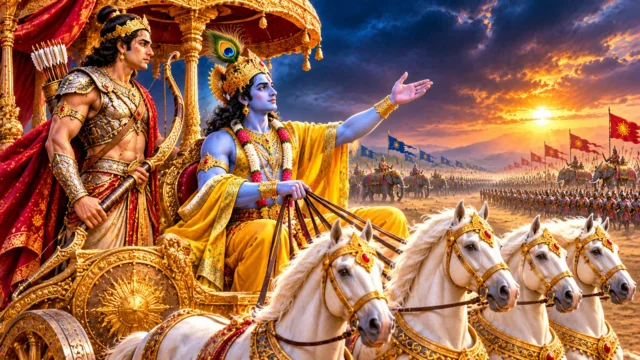
Epic adaptation. B. R. Chopra’s Mahabharat is a powerful starting point for the family conflicts, competing duties and moral discomfort that define the epic. The television series first aired from 1988 to 1990 and is commonly listed as 94 episodes. It spends time on the lives of Bhishma, the Pandavas, Kauravas, Draupadi, Karna and Krishna long before the final war. Its narration and dialogue encourage viewers to consider the cost of decisions rather than simply pick a hero. For global English-speaking audiences, the historically released episodes with English subtitles are particularly useful when available from legitimate rights holders. The visual effects reflect their era, and a lengthy episodic format requires commitment. Choose it for character, dialogue and cultural context. Do not confuse this original programme with the separate 2013 television adaptation of the same epic.
3. Mahabharat (2013 television series)
Epic adaptation. The 2013 Mahabharat television adaptation offers a different point of entry: polished costumes, more contemporary dramatic pacing and an emphasis on major relationships and visual storytelling. It is useful for viewers who find the older version too slow but still want the characters and central conflicts of the Sanskrit epic. Look for the specific 2013 version when searching, because streaming catalogs often contain several programmes titled Mahabharat. A modern adaptation may compress events, change conversations and heighten emotional confrontations for television. That is a reason to approach it as storytelling, not as an undisputed reconstruction of one fixed ancient manuscript. Watch it for accessible, character-driven television drama; follow with a trustworthy translation if a particular dialogue or scene raises a question about its original textual source.
4. Kurukshetra (2025 animated series)
Animated epic. Netflix’s Kurukshetra is an animated 2025 series that approaches the Mahabharata war through the perspectives of 18 warriors. The official listing describes 18 episodes, giving viewers a compact but many-voiced encounter with the 18-day conflict. Rather than another simple explanation of who wins, the premise asks what individual participants believe they are protecting and how their decisions affect families, loyalties and dharma. That makes it particularly suitable for viewers who already know the names but want to reconsider the human side of the epic. The official Netflix listing shows a teen-oriented rating in India; it should not automatically be treated as a cartoon for young children. Start with a short overview of the Mahabharata if the relationships are new to you. Availability, audio and subtitles depend on the viewer’s region and may change.
5. Ramayana: The Legend of Prince Rama (anime)
Animated epic film. Ramayana: The Legend of Prince Rama is the Indo-Japanese animated adaptation that gives the Ramayana an expressive hand-drawn visual language. Developed in the early 1990s, it is associated with a 1993 film release and received an Indian theatrical 4K re-release on 24 January 2025 with new Hindi, Tamil and Telugu dubs alongside an English version. This distinction matters because a 2025 listing does not mean the movie was first created in 2025. Its chief strength is a visual style that makes landscapes, journeys and battles approachable to audiences who are comfortable with animation. It also offers an excellent cross-cultural example of how an Indian epic can be respectfully adapted by an international creative team. Choose it for a film-length starting point rather than a long serial. The screenplay is still an adaptation; examine the underlying literature for textual differences.
6. Mahavatar Narsimha (2025 animated film)
Animated devotional film. The 2025 animated film Mahavatar Narsimha concentrates on the fierce Narasimha manifestation of Vishnu and the conflict involving Hiranyakashipu and his devoted son Prahlada. Its visual style is far more intense than a gentle children’s storybook. The Australian Classification Board recorded strong bloody animated violence, so families should check local age guidance instead of assuming animation automatically means child-safe viewing. For readers familiar with the Dashavatara, the film offers an accessible way to explore one dramatic incarnation. For newcomers, the important background is Prahlada’s devotion, the king’s extraordinary protections and a story about arrogance and divine intervention. Movie sequences may be amplified for dramatic effect, so not every spectacle can be attributed directly to a particular Purana. This is a focused devotional-fantasy adaptation, not a science-based record of a historical creature.
7. Kalki 2898 AD (2024 film)
Mythology-inspired science fiction. Nag Ashwin’s Kalki 2898 AD is a dystopian science-fiction film weaving a futuristic invented world with elements drawn from the Mahabharata, especially Ashwatthama and the expectation associated with Kalki. The International Film Festival of India’s description identifies the film as science fiction against a mythological background. That classification is vital: it is not an ancient story filmed exactly as written. Watch it if you enjoy speculative world-building, large-scale action and the question of what a modern director can do with familiar religious symbols. Audiences who have never heard of Ashwatthama may benefit from reading a short Mahabharata overview before watching. The plot includes invented people, technology and political structures; do not use them to make claims about scriptures. It also contains substantial action and dystopian imagery, so audience preferences matter more than a blanket recommendation for every family.
8. Hanu-Man (2024 film)
Mythology-inspired superhero film. Prasanth Varma’s Hanu-Man takes inspiration from Hanuman while telling an original superhero story in the fictional village of Anjanadri. India’s International Film Festival described the story of Hanumanthu gaining extraordinary abilities and facing a new antagonist. In other words, it is not simply a film of the Ramayana with a modern color grade. It is an accessible option for people who enjoy the rhythm of comic-book cinema but want a specifically Indian mythological inspiration. The devotion, courage and protective associations surrounding Hanuman inform the premise, while the character’s adventures are cinematic fiction. This difference is important for students: do not quote dialogue from the movie as a Sanskrit epic verse. Viewers seeking a lighter contemporary adventure than the long traditional epics may start here; still check ratings and availability for your region.
9. Brahmastra: Part One – Shiva (2022 film)
Mythology-inspired modern fantasy. Brahmastra: Part One – Shiva, directed by Ayan Mukerji, introduces an original fantasy setting known as the Astraverse. Disney’s official description explicitly presents it as a modern fictional universe inspired by Indian mythology, with powerful astras protected by a secret group. Despite its title, it is not the biography of Lord Shiva, and its characters and technological spectacle should not be mistaken for ancient documentation. The film suits viewers who want colorful effects, a contemporary love story and a quest centered on supernatural weapons. If the word Brahmastra sends you searching for the corresponding idea in the Ramayana or Mahabharata, follow that curiosity with a text-based explainer after the credits. This choice belongs in a mythology-inspired film guide precisely because it demonstrates how filmmakers build new fantasies from religious vocabulary, not because it directly recreates one complete epic.
10. Karthikeya 2 (2022 film)
Mythological mystery adventure. Karthikeya 2 is a Telugu-language adventure mystery following a modern doctor whose journey connects with a legendary object associated with Krishna. The film’s official ZEE5 listing identifies the 2022 release, director Chandoo Mondeti and several audio languages, including Hindi. It works for viewers who enjoy puzzles, travel, clues and the meeting of a contemporary hero with legendary material. Its archaeological and supernatural mysteries belong to a scripted thriller; they should not be introduced as discoveries independently confirmed by researchers. The film is a sequel, but its director has described it as watchable on its own. That makes it a convenient recommendation for someone who wants a single energetic story with mythological atmosphere. If subtitles or dubbing matter, check the title’s current legal service listing in your location; catalogs and language selections change.
11. Kantara (2022 film)
Regional folklore-inspired film. Rishab Shetty’s Kantara is best approached as a regional folklore-inspired drama rather than an adaptation of the Ramayana or Mahabharata. Its setting draws attention to the living Daiva worship traditions of coastal Karnataka, including Bhoota Kola, while presenting an invented dramatic plot about land, community and power. The distinction between living practice and fictional cinema deserves particular care. An interview with Shetty explains that local traditions were incorporated as the story developed; this does not make every event in the screenplay a religious rule. Viewers attracted by atmospheric storytelling, village landscapes and cultural context may appreciate the film. Yet readers should learn about Tulu Nadu’s traditions from local communities and scholarship too, not only from one popular movie. Some sequences are intense, and spectators should respect that sacred performances are not costumes to imitate casually.
12. Tumbbad (2018 film)
Original folklore-style horror. Tumbbad creates a dark fictional mythology around Hastar to examine greed, inheritance and fear. Its visual world may resemble an ancient legend, but the deity Hastar in this film should not be described as a figure established in Hindu scriptures. In an interview, co-director Adesh Prasad discussed the invented story concept behind the demon-like figure. The distinction protects viewers from viral posts that claim the film’s story was discovered in a lost Purana. Choose this if you prefer atmospheric horror and symbolic storytelling over straightforward devotional cinema. It is not designed for children or for people who dislike disturbing imagery. The practical value of placing it on a mythology-inspired list is to show how writers sometimes invent new folklore-style worlds using familiar themes, not to imply that every supernatural figure on screen belongs to a traditional canon.
Best Starting Picks by Viewing Mood and Audience
Want a classical epic rather than special effects?
Start with Ramayan (1987) for the Rama narrative or B. R. Chopra’s Mahabharat for the difficult choices of the Kuru family. Budget time for many episodes. A classic can be intellectually absorbing even when production values look old.
Want animation with a recognizable story?
Try Ramayana: The Legend of Prince Rama for a feature-length anime interpretation. Kurukshetra suits viewers interested in multiple warriors’ viewpoints. Mahavatar Narsimha centers one avatar, but its officially noted violent content means it is not our automatic pick for younger children.
Prefer action, mystery or science fiction?
Kalki 2898 AD and Brahmastra are speculative fiction; Hanu-Man is a superhero origin story. Karthikeya 2 offers a modern quest. Kantara explores a regional cultural setting, while Tumbbad is atmospheric horror for viewers comfortable with frightening material.
Are Mythology-Based Films Accurate to Hindu Scriptures?
There is no single accuracy scale that fits all twelve titles. A programme named Ramayan tells an adapted version of a tradition preserved through multiple texts and regional performances. A film such as Kalki 2898 AD announces an invented futuristic story, so demanding a verse number for every futuristic machine misunderstands its genre. The important journalistic question is whether the work or its promotion makes a verifiable claim about a source. If a film says a character uses a weapon, ask whether that is a creative invention or a passage in a named manuscript. If you want to learn the originals, start with trustworthy translations of Valmiki’s Ramayana, Vyasa-associated Mahabharata and relevant Puranic narratives. Different translations and versions vary. Enjoy the visuals, then separate narrative artistry, devotional interpretation and historical proof. That distinction neither mocks belief nor falsely promotes a cinematic invention as ancient technology.
Where to Watch with English Subtitles or Hindi Audio
Streaming rights change across countries and sometimes within the same platform over time. An official service page is better evidence than a recycled “all movies free” article. As examples, Netflix maintains an official page for Kurukshetra, and ZEE5 lists Karthikeya 2 with several Indian-language audio options. The distributor of Ramayana: The Legend of Prince Rama documented the 2025 Indian re-release and language dubs, but a theatrical re-release does not guarantee an active streaming license today. International viewers should check each title in their region, confirm a legitimate provider, and inspect audio, subtitles and content rating on the actual title page. Avoid unauthorized uploads labeled “full movie” merely because they promise instant access. For children, check not just language and duration but also the intensity of battles, frightening imagery and supernatural horror. Official age ratings are more dependable than calling all animation “family-friendly.”
Mythology, Folklore and Fiction: Three Different Categories
An epic adaptation selects and dramatizes material from named religious or literary traditions. A regional folklore-inspired movie may draw on living rituals whose significance belongs to communities today. A fantasy film may borrow images and vocabulary to tell an entirely original story. Ramayan and Mahabharat sit chiefly in the first group; Kantara is especially worth approaching with respect for the second; Brahmastra and Hanu-Man illustrate the third. The categories can overlap, but that does not erase their differences. Social media often presents an entertaining scene as a suppressed historical truth, especially when it involves unusual weapons, flying vehicles or cosmic battles. Such claims need primary texts and independent evidence. A good screen guide does not dismiss fantasy; it gives readers enough context to appreciate fantasy as fantasy and tradition as tradition.
Frequently Asked Questions
What are the best Indian mythology movies for beginners?
Start with the animated Ramayana: The Legend of Prince Rama for a film-length epic, or Ramayan (1987) for a classic television telling. Check age suitability for every title.
Which Mahabharata web series is animated?
Kurukshetra (2025) is an animated Netflix series using perspectives of 18 warriors across 18 episodes.
Is Kalki 2898 AD based on a true ancient story?
It is futuristic fiction inspired by Mahabharata characters and Kalki imagery, not a literal reconstruction of an ancient historical event.
Is Mahavatar Narsimha safe for small children?
Do not assume so. Classification information notes strong bloody animated violence; check local rating and individual suitability.
Are Hanu-Man and Brahmastra adaptations of the Ramayana?
No. They are original modern fantasy or superhero stories inspired by Indian religious ideas and characters.
Which mythological series has English subtitles?
Availability varies. A rights-holder release of the classic Mahabharat has been reported with English subtitles; check legitimate current listings for your region.
Is the god Hastar from Tumbbad in the Hindu scriptures?
The film’s Hastar mythology is a fictional creation. Do not treat it as a documented deity from a recognized scripture.
Where can I watch Indian mythology movies online?
Check official regional platform listings or rights-holder channels; licenses, dubbing, captions and availability change.
Conclusion: Pick the Right Story, Not Just the Biggest Poster
If you want a recognizable epic, begin with Ramayan, the classic Mahabharat or the hand-drawn Prince Rama film. For concentrated animation, choose Kurukshetra or—after checking the violence rating—Mahavatar Narsimha. For imaginative entertainment, Kalki 2898 AD, Hanu-Man, Brahmastra and Karthikeya 2 offer different flavors. Viewers exploring living regional beliefs may prefer Kantara; horror fans can consider Tumbbad while recognizing its invented mythology. The best choice depends on interest, age, language and time available. Keep authentic textual context separate from dramatic invention, and every kind of screen story becomes easier to appreciate.
More Indian Mythology Reading on Vista Hub
- Ramayana vs Mahabharata: stories and differences
- Kurukshetra: 18-day war rules and timeline
- Divine weapons in Hindu mythology
Sources and Verification
- Ramanand Sagar Ramayan, production page
- B. R. Chopra Mahabharat, Indian Express archival guide
- Mahabharat episodes with English subtitles, Scroll
- Ramayana: The Legend of Prince Rama, distributor Geek Pictures
- Kurukshetra: Netflix official series information
- Kurukshetra production, About Netflix
- Mahavatar Narsimha, Australian Classification Board
- Kalki 2898 AD, International Film Festival of India
- Hanu-Man, Government of India IFFI release
- Brahmastra, Disney press release
- Karthikeya 2, ZEE5 official listing
- Kantara and the living Daiva tradition, The News Minute
- Tumbbad: fictional Hastar interview, Shuffle Online
Editorial review: 13 November 2026. This curated list is not a numerical popularity ranking. Platform availability and ratings may change by country; fictional adaptations are not independently verified religious history.










Share Your Opinion
Comments are closed on this post.