 Vista
Devas vs Asuras: The Short Answer
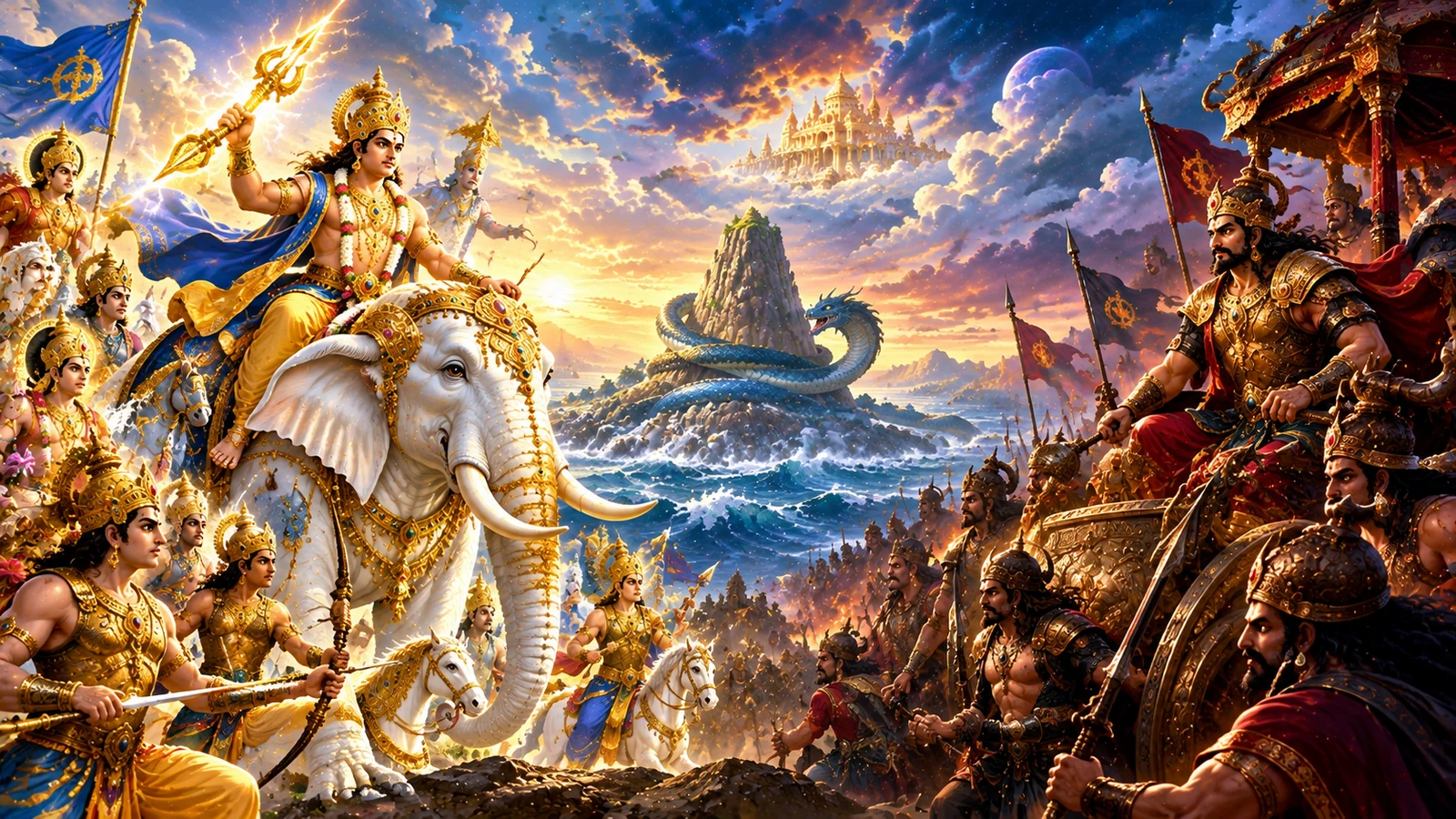
In Hindu mythology, Devas are generally celestial beings associated with sustaining cosmic order, while Asuras often appear as their powerful rivals. But the popular formula “Devas are good gods and Asuras are evil demons” is too simple. The meanings changed across periods and texts. Early Vedic language sometimes gives the title asura to respected divine figures; later epic and Puranic narratives more commonly portray Asuras as opponents of the Devas. Some Asura-born figures, especially Prahlada and the generous king Bali, are revered for devotion and integrity. Even celebrated Devas can make mistakes.
The famous conflicts are not one continuous historical war. They are distinct religious stories: Indra and Vritra in the Rigveda, Narasimha and Hiranyakashipu in the Vishnu traditions, Durga and Mahishasura in the Devi Mahatmya, and the remarkable occasion when Devas and Asuras cooperate to churn the ocean. Their common theme is the struggle over power, fear, duty and the right use of strength. This guide separates meaning, genealogy, major battles and moral interpretation without presenting sacred narrative as verified military history.
What Does Deva Mean in Hindu Tradition?
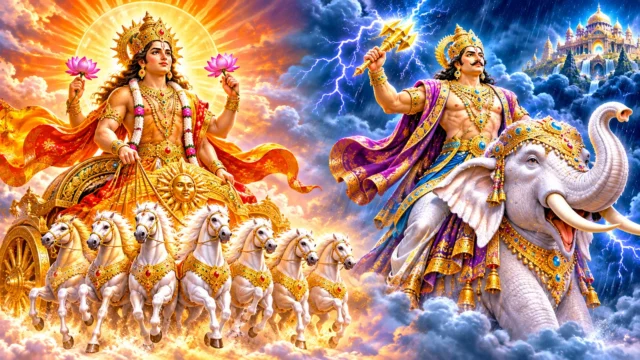
Deva is related to brightness or shining and often denotes a divine or celestial being. Vedic hymns address Indra, Agni, Varuna, Mitra, Surya and others in distinct settings. Indra is famous for his vajra and victory over Vritra, Agni for the role of fire in ritual communication, and Surya for solar imagery. A reader should not assume that all these figures perform exactly the same duties. Nor should the English word “god” be treated as a perfect translation for every Sanskrit philosophical term.
In many later stories the Devas inhabit Svarga, and Indra is their king. They possess extraordinary powers yet can experience insecurity, loss of position, jealousy or fear. Their victories often require help from Vishnu, Shiva or the Goddess. That makes an important distinction: “Deva” is not automatically an assertion that every character is omnipotent or morally flawless. The Devas frequently represent the side trying to preserve a cosmic arrangement, but the narratives allow readers to question the choices made by its guardians.
Hindu theology also includes varied ways of understanding supreme reality. Vishnu, Shiva or Devi may be viewed as ultimate divinity within particular devotional schools; reducing each to a subordinate member of Indra’s celestial court would misrepresent those traditions. When comparing Devas with Asuras, identify which text is being discussed before drawing universal conclusions.
What Is an Asura? Why the Word Is Complicated
In later popular Hindu stories, Asura often describes a powerful being competing with the Devas. English retellings frequently translate it as “demon,” but that word can suggest ideas from other religions that do not fit every Sanskrit narrative. Some Asuras are tyrannical rulers, some are clever scholars or ascetics, and some display remarkable devotion. They cannot be reduced to a single personality type or a real-world ethnic group.
The term also has a history. Scholars of early Indo-Iranian religion note that asura was not simply a negative label in the oldest Vedic layers; the language of lordship and power could be associated with important divinities. Over time its contrast with deva became much more pronounced in many Hindu narrative contexts. The related Iranian word ahura belongs to a different religious history and should not be used to invent a simplistic story that two modern populations were literally Devas and Asuras. Linguistic connections are not eyewitness reports of mythic battles.
Asura is also not a synonym for rakshasa, naga, daitya or danava in every text. Daityas and Danavas are specific genealogical groups in many Puranic accounts, whereas rakshasas occupy another broad category of beings with different origin stories. Good introductory writing keeps these distinctions visible, especially when a film or game freely mixes all the labels together.
Where Did the Devas and Asuras Come From?
A common Puranic genealogy traces several celestial and rival lineages to the sage Kashyapa and different mothers. Aditi is associated with the Adityas, while Diti and Danu are connected with Daityas and Danavas respectively. Names, family branches and genealogical details differ across Puranas. These are mythological family trees, not scientifically established ancestry. The shared-parent idea matters because it complicates the notion of a permanent divide between unrelated species.
Consider Prahlada. His father Hiranyakashipu is a formidable Daitya ruler who opposes Vishnu, yet Prahlada is celebrated as a devotee. King Bali is also linked with an Asura lineage, but stories praise aspects of his generosity and steadfastness. Family origin is therefore not a reliable shortcut to determining moral worth in these stories. Status, decisions and devotion often matter more than inherited labels.
The family framework also explains the recurring disputes about sovereignty. Many narratives describe the Devas losing their place, the Asuras gaining power, and a new intervention restoring balance. In another setting both parties negotiate or collaborate. Rather than asking whether the two groups belong to modern biological species, ask what the family conflict reveals about shared origins, ambition and how power is justified.
Devas vs Asuras: Key Differences at a Glance
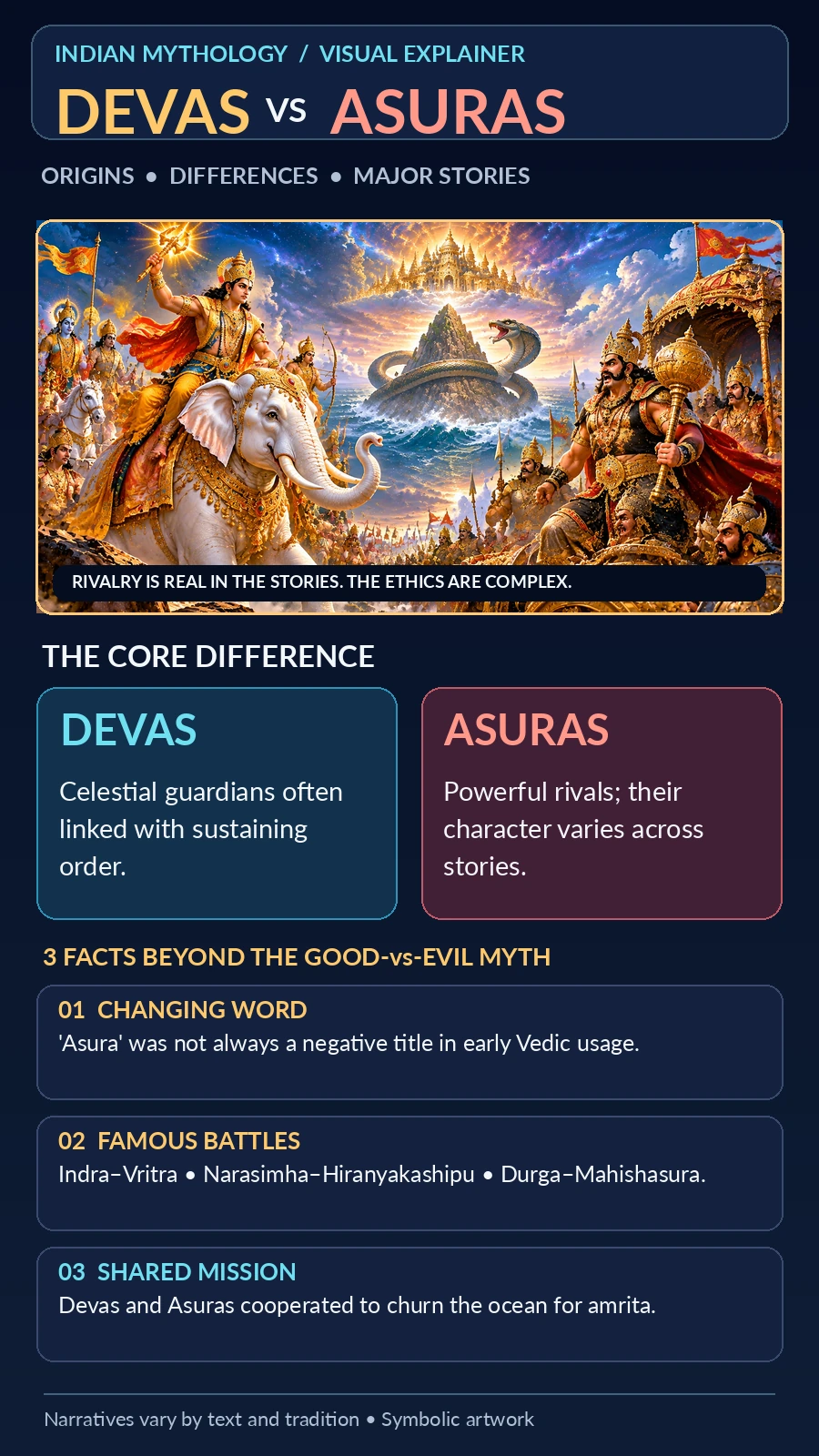
The comparison below summarizes a common epic-and-Puranic pattern, not a rule that applies identically to all Vedic hymns or regional traditions. The important distinction is narrative role, not a claim that every Deva is automatically virtuous and every Asura automatically wicked.
Notice especially the row about exceptions: the story-world contains morally complex actors. A generous Asura king can be admired, while a Deva may have to confront the consequences of pride. The categories are useful for locating characters in a mythological conflict, but not for assigning moral labels to living people.
| Question | Devas | Asuras |
|---|---|---|
| Typical later narrative role | Celestial protectors of order | Powerful rivals to celestial rule |
| Familiar examples | Indra, Agni, Varuna | Hiranyakashipu, Mahishasura, Bali |
| Moral complexity | May be proud or afraid | Prahlada and Bali can be exemplary |
| Genealogical association | Aditi / Adityas in some accounts | Diti / Daityas; Danu / Danavas |
| Shared episode | Ocean churning for amrita | Ocean churning for amrita |
Battle 1: Indra and Vritra in the Rigveda
One of the oldest famous conflicts is Indra’s victory over Vritra in Rigveda 1.32. The hymn praises Indra, the thunderbolt bearer, for defeating the obstructing serpent or dragon-like adversary and releasing waters. Interpretations of the imagery vary: scholars and traditional commentators have explored its relation to storms, rivers, ritual power and cosmic victory. It is not necessary to declare that the hymn is a literal meteorological report to understand why it became so influential.
Vritra’s association with obstruction is central. The conflict is not a generic fistfight between two fantasy teams; it dramatizes the removal of something that prevents life-giving waters from flowing. The vajra becomes a recognizable symbol of Indra’s power. Later stories expand and reshape details, including Vritra’s origin and Indra’s moral difficulties. A careful explanation should not splice lines from different works into a single quotation and call it the “original Rigvedic version.”
For today’s reader, the narrative raises a useful question: is power valuable because it overwhelms enemies, or because it removes an obstacle to collective wellbeing? That second question helps explain the hymn’s enduring appeal. It is a religious and literary interpretation, not an independently demonstrated historical battle or a claim about a discovered ancient weapon.
Battle 2: Hiranyakashipu, Prahlada and Narasimha
The Narasimha story provides the clearest warning against treating every Asura-born figure as morally identical. Hiranyakashipu acquires extraordinary protections and demands allegiance, while his son Prahlada remains devoted to Vishnu. The conflict intensifies when the king attempts to suppress that devotion. Vishnu manifests as Narasimha, a form combining human and lion aspects, and defeats the ruler under circumstances that address his unusual protections. Versions of the scene differ, but the ethical contrast is consistent in many Vaishnava tellings.
Prahlada is not portrayed as automatically wicked because of his birth. He becomes a model of steadfastness and spiritual confidence. The father, by contrast, embodies the danger of trying to turn personal power into an unquestionable absolute. The narrative makes a reader think about conscience, authority and whether allegiance should be purchased through fear. It also shows the limits of calling the whole conflict a war between good biological races and evil ones.
The Bhagavata Purana, especially its seventh book, is an important source for this devotional story. Popular television adaptations may invent additional conversations or rearrange events for drama. Those creative choices can be discussed as retellings, but they should not be presented as verified quotations from a named Sanskrit chapter.
Battle 3: Durga and Mahishasura
In the Devi Mahatmya, the buffalo-form Asura Mahishasura becomes a terrifying adversary, and the Devas seek the intervention of the Great Goddess. The divine energies and weapons associated with the gods converge in Durga, who confronts and defeats Mahishasura. The narrative centers the Goddess’s sovereignty and power. It is especially prominent in Shakta traditions and in artistic depictions of Mahishasuramardini, “slayer of Mahishasura.”
This story is not merely the Devas winning a fight through a borrowed weapon. It presents divine feminine power as capable of overcoming a threat that the gods could not resolve on their own. Sculptures frequently show the buffalo, the Goddess’s lion and her multiple arms bearing symbolic weapons. Details such as the moment of transformation from buffalo to a human-like opponent vary by artistic convention. A drawing is a devotional image, not a photograph of an ancient incident.
The British Museum and India’s Indira Gandhi National Centre for the Arts describe historical sculptures of Durga defeating the buffalo demon. Such objects are evidence of an enduring religious-art tradition; their existence is not, by itself, scientific proof that a literal supernatural battle occurred. Keeping artistic history and religious meaning distinct makes the story richer and more credible for global readers.
When Rivals Cooperated: Samudra Manthan
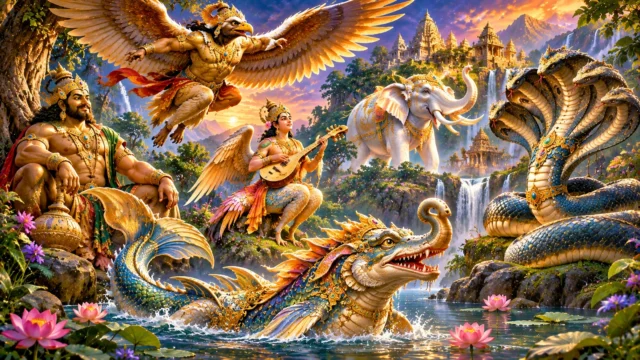
The ocean-churning narrative is a striking exception to the idea that Devas and Asuras only fight. In versions including Bhagavata Purana 8.7, the two groups cooperate to obtain amrita, the nectar associated with immortality. Mount Mandara serves as the churning rod and the serpent Vasuki as a rope. Vishnu, in a tortoise-associated form, supports the mountain. The participants disagree over positions and shares, but their labor is temporarily shared.
Before the desired nectar arrives, a terrible poison called Halahala appears. Shiva intervenes to contain the threat, producing the well-known Neelkanth or blue-throated story. Later episodes concern treasures, Dhanvantari, Mohini and rivalry over the nectar. The precise sequence differs across texts; a responsible article does not pretend every Purana has the same inventory of fourteen treasures. Cooperation, risk and competition sit side by side.
The key lesson is not that one side simply became good for a day. It is that rivals can recognize a common objective while remaining rivals, and that the pursuit of a prize can create dangerous consequences before bringing benefits. This is why Samudra Manthan deserves its own place in a Deva–Asura comparison, rather than being treated as just another battlefield scene.
The Generous Asura King Bali and Vamana
Bali, also known as Mahabali, is an important counterexample to the assertion that all Asuras are evil. Traditions describe him as powerful, generous and capable of deep devotion. In the Vamana narrative, Vishnu approaches him as a small Brahmin visitor and requests land measured in three steps. The divine visitor then assumes a cosmic form, known as Trivikrama, and measures the worlds. Interpretations differ on whether the story stresses Bali’s pride, faithfulness to his promise, cosmic sovereignty or several of these themes at once.
Bali’s dignity remains significant even when the narrative involves his loss of dominion. In Kerala’s Onam traditions, Mahabali is remembered with affection, though local versions and the precise relationship between festival history and particular texts vary. Readers should not turn a beautiful cultural association into a claim that every source has identical details. The story is about generosity tested by a demand, not only an easy victory over a villain.
This example shows why moral analysis cannot be based on supernatural labels alone. A person identified as an Asura can become a model for keeping one’s word. The text invites reflection on humility and obligations under pressure, and it complicates the picture of a universe divided neatly into faultless defenders and irredeemable enemies.
Are Devas Always Good and Asuras Always Evil?
No. The broad story pattern often aligns Devas with cosmic order and Asuras with the challenge to their authority, but many individual narratives complicate that contrast. The Devas can act fearfully or pursue their advantage. Prahlada is an exemplary devotee despite his Asura lineage; Bali is praised for generosity. Conversely, cruel conduct is criticized even when committed by an influential character. Birth category alone does not settle a moral question.
Modern readers sometimes compare the Deva–Asura conflict with superhero films or video games. Such analogies can help visualize a rivalry, but they often erase the religious ideas at stake. Dharma concerns a complex moral and cosmic order; it is not simply a team uniform. Different texts debate competing duties, and the same event may be explained differently in Vaishnava, Shakta, Shaiva or regional devotional settings.
There is also no good historical basis for assigning the labels Deva and Asura to modern nationalities, races or communities. Claims that an excavated sword or mysterious crater proves one of these divine battles require independent evidence; sacred stories alone cannot establish such findings. Respectful writing distinguishes religious truth claims, literary symbolism, archaeological research and popular fiction.
A Timeline of the Major Stories—Without Inventing Dates
These tales do not come with a shared modern calendar. Rigvedic hymns, epic material and Puranic narratives emerged and were transmitted over long historical periods. The stories also describe mythic eras, not events with independently certified year-by-year battle logs. Avoid online lists that give a precise date, body count or geographic coordinate for every Deva–Asura war without evidence.
A better learning sequence is thematic. Begin with Indra and Vritra to understand a Vedic hymn about the release of waters. Continue with the genealogies that connect Devas, Daityas and Danavas. Read the Narasimha–Prahlada tale for the opposition between coercion and devotion, and the Durga–Mahishasura story to see how Shakta traditions place the Goddess at the center. Explore Vamana and Bali for the complications of power and generosity. Finish with Samudra Manthan, where the antagonists cooperate but do not resolve their rivalry permanently.
This order is a reader’s learning path, not a claim that the stories occurred in that sequence. Always name the text, translation or regional tradition being used. Multiple narrations can coexist without requiring a modern writer to invent a single definitive script.
Devas, Asuras, Rakshasas and Nagas: Not the Same Labels
Several Sanskrit terms become blurred in English-language articles. Deva generally refers to a celestial or divine being. Asura often denotes a rival power in later narratives, but its history is more complex. Daitya and Danava refer to lineages connected with Diti and Danu in widely known genealogies. Rakshasa is another category, frequently associated with the Ramayana, although its characters also vary enormously in conduct and role. Nagas are serpent-associated beings whose stories have their own religious and regional contexts.
For example, Ravana is commonly called a rakshasa king, but that does not make every rakshasa a Daitya or prove that all Asuras have ten heads. The serpent Vasuki plays a central role in the ocean-churning episode, yet a naga is not merely a type of Asura soldier. The character labels are meaningful within their literary worlds, and an accurate mythology guide should not collapse them into the vague phrase “evil monsters.”
This distinction also helps parents and teachers introduce Indian mythology without promoting prejudice. One can discuss frightening behavior, the abuse of authority and the need to resist injustice without assuming any entire inherited group is permanently bad. Complexity is not a flaw in these epics; it is one reason readers return to them.
What the Stories Can Teach Today
The most useful contemporary reading asks not “Which team had the most destructive weapons?” but “What does power do to the person who holds it?” Vritra’s defeat is linked with the release of waters; the Narasimha story asks how a ruler should treat conscience; Durga’s victory places transformative protection at the center; Bali’s generosity shows the importance of honoring a promise; Samudra Manthan illustrates both common effort and unintended danger.
These are possible interpretations rather than universal rules accepted by every Hindu school. They should not be used as instructions to fight people who disagree or as justification for mistreating a community. Religious stories describe extraordinary conflicts; ordinary ethical life still calls for evidence, restraint and responsibility. The best image poster or educational article illustrates the narrative while clearly labeling it mythology and tradition, not archaeology or medical science.
Readers who want to go deeper can compare a translation of Rigveda 1.32 with Bhagavata Purana books seven and eight, then examine a reliable translation or art-historical explanation of the Devi Mahatmya. Notice which characters are praised, which actions are criticized, and where different sources disagree. That method is more revealing than memorizing a ranking of imaginary power levels.
Frequently Asked Questions
What is the main difference between Devas and Asuras?
In many later Hindu narratives, Devas are celestial guardians of order and Asuras are powerful rivals. Earlier uses of asura and individual characters make the distinction more complex.
Are Asuras always evil?
No. Prahlada is celebrated as a devotee, and King Bali is admired for generosity in important traditions.
Who is the king of the Devas?
Indra is commonly called the king of the Devas in Vedic and later mythology. This title does not erase the distinct theological status of Vishnu, Shiva or Devi in devotional schools.
Who are Daityas and Danavas?
They are lineages associated with Diti and Danu in commonly cited Puranic genealogies and are often included among Asura groups.
What is the most famous Deva–Asura battle?
There is no single official ranking. Widely known stories include Indra versus Vritra and Durga versus Mahishasura.
Why did Devas and Asuras churn the ocean together?
They temporarily cooperated in pursuit of amrita, the nectar of immortality, in the Samudra Manthan narrative.
Were Devas and Asuras real historical armies?
Their battles belong to religious mythology; specific claims about literal armies or ancient weapons require separate verifiable historical evidence.
Are Asuras and Rakshasas the same?
No. They are different categories in many texts, though popular adaptations sometimes mix the terms.
Conclusion: Beyond a Good-versus-Evil Shortcut
Devas and Asuras form one of the great recurring rivalries of Hindu mythology, yet their stories are much more than a cosmic scoreboard. Early language, family origins, revered Asura-born devotees, the power of the Goddess and even episodes of cooperation all complicate the usual “gods versus demons” summary. The best way to understand them is to start with the named text, distinguish its characters carefully and ask what it says about power and dharma. These narratives can be meaningful without being presented as photographs of literal ancient wars.
Related Reading
Sources and Further Reading
- Rigveda 1.32: Indra and Vritra
- Bhagavata Purana 8.7: Ocean churning and Halahala
- Bhagavata Purana 7.5: Prahlada
- Indira Gandhi National Centre for the Arts: Mahishasuramardini
- Kurma Purana summary of Narasimha and Prahlada
Editorial note: These are religious and mythological traditions. Symbolic artwork and devotional interpretations do not independently establish supernatural events as historical facts.


Share Your Opinion
Comments are closed on this post.