 Vista
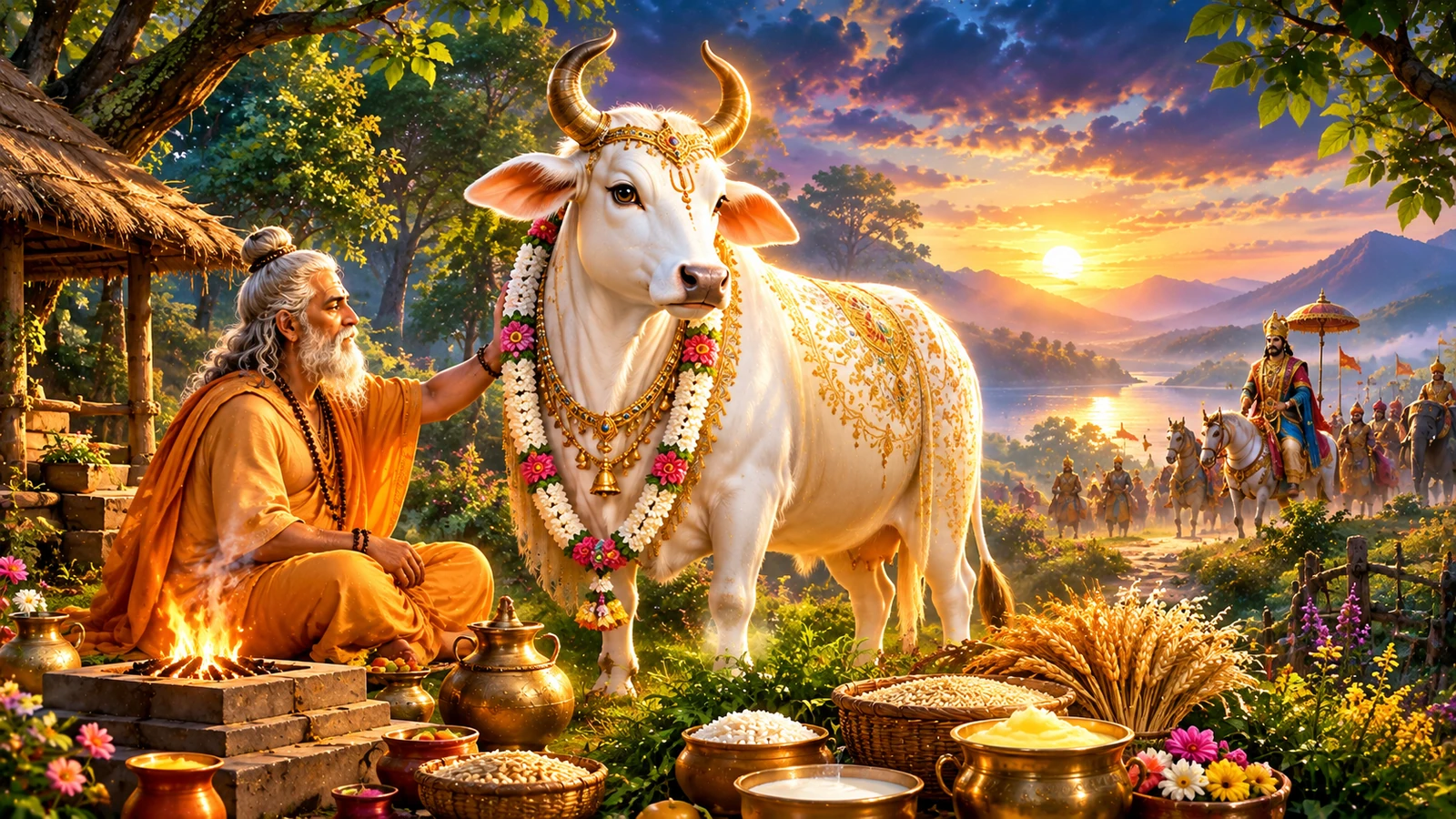
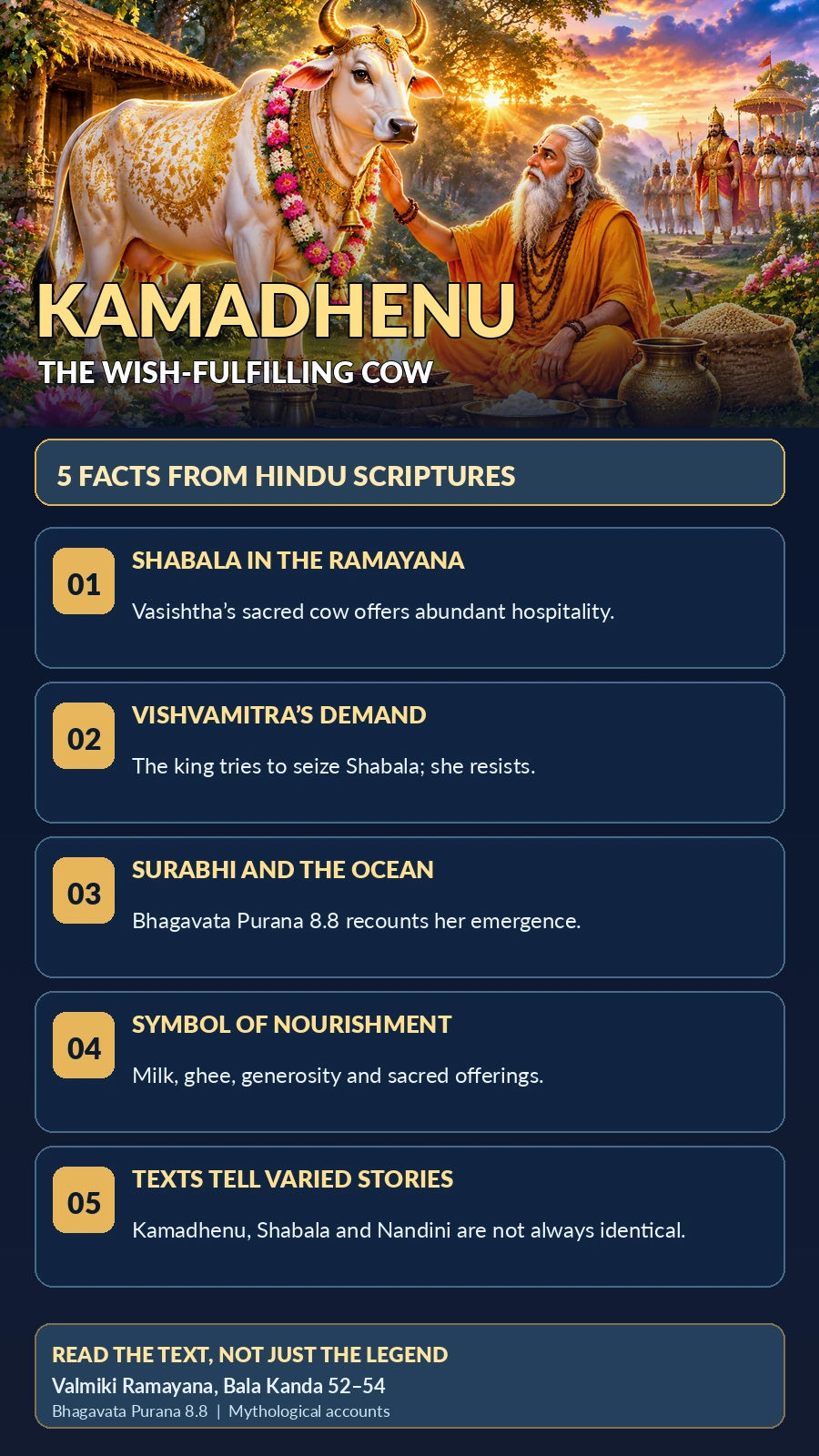
Quick answer: Kamadhenu is the legendary wish-fulfilling cow of Hindu religious literature, celebrated as a source of abundance, nourishment and sacred generosity. The name can describe a divine cow able to provide what is needed, rather than one single character whose story is identical in every Hindu text. One famous form is Shabala, the extraordinary cow belonging to the sage Vasishtha in the Bala Kanda of the Valmiki Ramayana. Shabala supplies hospitality for King Vishvamitra and his large retinue; when the king tries to take her away, a dramatic conflict reveals that spiritual authority cannot simply be bought or seized. Another important account in the Bhagavata Purana describes a Surabhi cow appearing during the churning of the Ocean of Milk, associated with the milk and ghee needed for ritual offerings. Kamadhenu also appears in later devotional art with a luminous white body, elaborate ornaments and sacred imagery. These are mythological and religious representations, not records of a scientifically verified animal. The most useful way to understand Kamadhenu is to follow the stories separately, notice their differences and ask why a source of nourishment became a symbol of an inexhaustible gift.
What Does the Name Kamadhenu Mean?
Kamadhenu combines the Sanskrit idea of kama, meaning a wish or desire in this context, with dhenu, meaning a milk-giving cow. The expression is commonly rendered “wish-fulfilling cow.” That translation does not imply that ordinary cattle can materialize money, cure illness or grant every request made to them. It identifies an extraordinary being in the world of sacred narrative. In some literary settings, a phrase like kamadhenu can work descriptively: a cow that yields what is sought. Consequently, the names Kamadhenu, Surabhi, Shabala and Nandini deserve careful handling. They are connected in many explanations, but writers should not assume that every scripture calls the same individual by all four names in the same way. The Valmiki Ramayana names Vasishtha’s cow Shabala in the story of Vishvamitra. Other materials give prominence to Surabhi as an archetypal divine cow or ancestor of cattle. Nandini is familiar in later traditions as a wish-giving cow, sometimes described as a daughter of Surabhi or linked to Vasishtha. These relationships are tradition-dependent. For a beginner, the safest summary is that Kamadhenu is a broad sacred-cow motif, with memorable named manifestations in several texts.
Vasishtha and Shabala: How the Story Begins
The best-known story begins when the powerful king Vishvamitra visits the forest hermitage of the sage Vasishtha. The contrast is striking: the king arrives with soldiers and the resources of worldly authority, while the sage lives in a seemingly modest setting dedicated to study and spiritual discipline. Vasishtha warmly welcomes his guest and offers to feed the royal party. Vishvamitra initially doubts that a hermitage can provide such extensive hospitality. Yet the sage calls his extraordinary cow, Shabala, who produces plentiful foods and drinks appropriate for a grand feast. In the Bala Kanda, the scene illustrates the unexpected abundance available through the sacred cow, but it also introduces the idea that hospitality is an ethical obligation. Vasishtha does not use the abundance merely to advertise luxury. He first uses it to care for a guest. A modern reader can appreciate the tale as a moral contrast between giving and possessing. It would be an error, however, to retell the episode as archaeologically established evidence of an ancient food-producing device. The narrative functions in a world where sages, vows and divine forces have extraordinary powers. Its significance arises from that religious and literary framework.
Why Did Vishvamitra Try to Take the Sacred Cow?
After seeing Shabala’s capacity to provide unlimited hospitality, King Vishvamitra wants her for himself. He offers valuable compensation, and in different tellings the proposed exchange and the king’s arguments receive varying emphasis. Vasishtha refuses. For the sage, Shabala is not an ordinary possession that can be separated from his spiritual life in return for wealth. She supports the rituals, hospitality and responsibilities of the hermitage. The refusal frustrates a monarch accustomed to obtaining what he desires through power and payment. The narrative becomes especially sharp when the king uses force. Shabala suffers at being taken away and calls out to Vasishtha. Her response matters: the cow is represented as an active participant in the story rather than a silent object over which two men bargain. The struggle then grows far beyond a dispute over a valuable animal. It poses an ethical question about the limits of political authority: does the ability to take something make taking it right? The Ramayana answers through a mythic confrontation. Readers should follow the particular text instead of turning this into a universal rule for all disputes between kings and sages in Hindu literature.
How Shabala Resisted the King and Protected the Hermitage
The Bala Kanda continues with Shabala asking Vasishtha why she is being taken and expressing her distress. The sage explains his situation and eventually calls upon her extraordinary power. In the epic narrative she generates defenders capable of confronting the royal forces. Accounts of the groups produced, their names and their organization differ in translation, making an unqualified modern map of those troops misleading. The central movement is clear: a king assumes that a physically powerful army is sufficient to command the sage’s resources, but the extraordinary cow overturns his expectations. The episode helps launch Vishvamitra’s larger spiritual journey. He comes to understand that ascetic power cannot be replaced by royal prestige alone, and later narratives describe his difficult pursuit of the status of a Brahmarishi. Shabala’s role therefore goes beyond producing food. She exposes an imbalance between force and wisdom and refuses to be treated as mere wealth. A responsible account also remembers the story’s dramatic violence rather than presenting it as a cute animal fairy tale. Its ethical force depends on understanding why the conflict began and who tried to control whom.
Surabhi and Samudra Manthan: A Different Origin Story
A separate and much-loved account appears in the Bhagavata Purana, Canto 8, Chapter 8. After Shiva consumes the dangerous poison that appeared during the churning of the Ocean of Milk, gods and asuras resume their work. A Surabhi cow appears from the churning. The following verse explains why sages take charge of her: the cow supplies milk products, especially ghee, used for sacrificial offerings. This is an explicit textual link between the sacred cow and ritual nourishment. Many modern lists place “Kamadhenu” among the treasures of Samudra Manthan, but a careful writer should identify the text and the name it actually uses. The Bhagavata’s account names Surabhi. The Ramayana’s Shabala episode has a different setting and narrative function. Neither must be dismissed; they belong to a plural tradition in which images, names and motifs travel between texts. Nor should one force them into a single modern chronological biography without acknowledging the difficulty. The two stories answer different questions: the Ramayana asks what happens when a king covets sacred abundance; the Bhagavata explains why a heavenly cow is associated with offerings and prosperity.
Kamadhenu, Surabhi, Shabala and Nandini: What Is the Difference?
Online articles often produce a tidy family tree: Surabhi is the mother, Nandini is her daughter, Shabala is another name, and Kamadhenu is the universal label. That scheme can be useful as a summary of particular later traditions, but it should not be presented as an unchanged statement in every early source. Names and relationships differ depending on whether a reader consults the Ramayana, the Mahabharata, Puranic literature, devotional poetry or regional storytelling. In the Shabala episode the sacred cow directly supports Vasishtha. In other tellings the name Nandini becomes strongly linked with his hermitage. Surabhi may be a primordial or celestial cow associated with the wider lineage of cattle, while Kamadhenu describes the extraordinary power to grant a desired resource. This flexibility is not necessarily a contradiction that needs to be erased. Mythological traditions often preserve overlapping identities because a symbol is more important than an ordinary biographical record. When comparing two websites, check the scripture actually cited, the translation and the name in the passage. If a source does not specify whether Surabhi and Nandini are identical, do not invent certainty for the sake of a faster answer.
Why Is Kamadhenu Shown with Deities, Wings or Sacred Symbols?
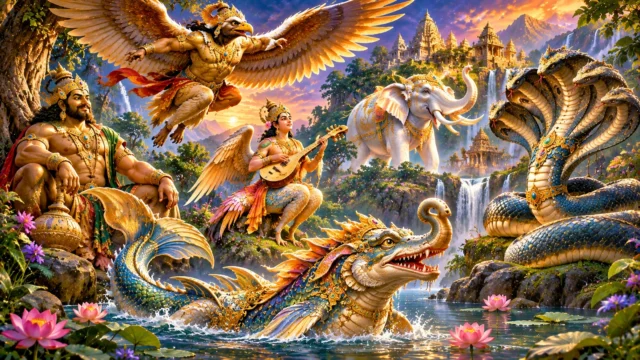
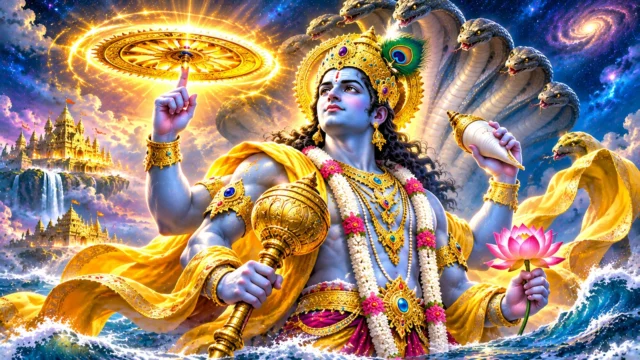
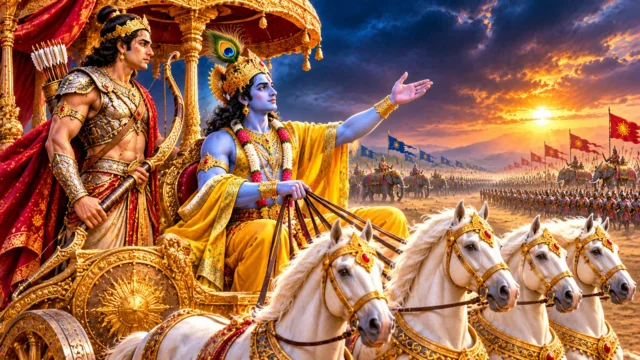
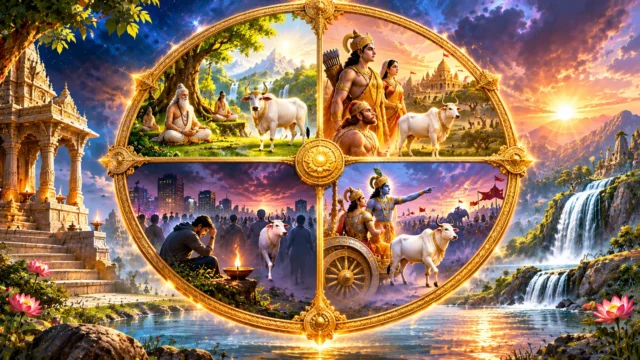
In devotional paintings Kamadhenu is commonly depicted as a radiant cow decorated with flowers, jewelry, a halo or divine figures. Some elaborate iconographic forms place several deities or sacred symbols on parts of the cow’s body; these are visual expressions of religious reverence. Such images communicate that the cow represents life-sustaining generosity and the presence of sacred qualities. They are not anatomical diagrams and should not be introduced as proof that a physical cow contains miniature gods. Artistic conventions also vary: not every region paints Kamadhenu with the same colors, headgear, wings or human features. A simple white cow beside a sage may fit the Shabala narrative more closely than an elaborate cosmic collage. The important distinction is between artwork inspired by a text and the exact language of the text itself. A digital image of Shabala providing food to Vasishtha is a modern illustration, however beautiful it may be. Label it as an imaginative depiction. That honesty protects both the dignity of the tradition and the reader from an inaccurate claim that the image reconstructs a documented historical event.
What Does the Wish-Fulfilling Cow Symbolize?
Kamadhenu’s most enduring symbolism is the idea that nourishment is more than an item of private wealth. Milk and ghee appear in these stories not only as valuable products but also as resources that sustain hospitality, ritual and community. The cow in Vasishtha’s hermitage produces food to welcome guests; Surabhi’s abundance supplies offerings in a cosmic narrative. The stories invite several interpretations. A gift becomes meaningful when shared. Authority should not turn generosity into something to be seized. A fragile setting may possess more moral strength than an apparently powerful state. Reverence for cows in Hindu communities has many historical, regional and theological dimensions, and Kamadhenu should not be treated as the single origin of every contemporary practice. Nor does a mythological ideal justify neglecting real animal welfare. A contemporary reader who values the symbol can express that respect through humane treatment, clean water, appropriate food, veterinary care and a refusal to mistreat cattle. Those practical duties can be discussed without promising supernatural rewards for a specific ritual or purchase. Mythology offers a language of values, not evidence of guaranteed miracles.
Connection to Parashurama and Kartavirya Arjuna
Many readers connect the divine cow with a later story about the sage Jamadagni, his family, King Kartavirya Arjuna and Parashurama. Those narratives often involve a miraculous cow being taken or coveted, bringing a violent clash between a ruling power and a family of sages. The parallels with Vasishtha and Vishvamitra are striking, but they should not be confused into a single episode. Jamadagni and Parashurama belong to a different story cycle; Vishvamitra’s journey toward becoming a sage is another. The name and identity of the cow, the sequence of attacks and the role assigned to Kartavirya Arjuna vary across tellings. The safe approach is to say that the wish-giving cow motif appears in more than one epic and Puranic context. Its recurrence emphasizes the vulnerability of sacred hospitality when it encounters greed and force. The stories also raise difficult questions about retaliation and the consequences of pride. They are mythic narratives, not sufficient historical evidence for every modern claim about an ancient political dynasty. For a connected reading, compare a dedicated account of Parashurama with the opening chapters of the Ramayana’s Vishvamitra episode, keeping the casts separate.
Is Kamadhenu Real? Faith, History and Animal Welfare
Kamadhenu belongs to mythological and devotional literature. There is no reliable scientific evidence for a cow that creates unlimited food, materializes objects or fulfills spoken wishes. That is not a reason to mock a religious belief; it simply separates the kinds of claims that sacred stories make from the kinds of claims that zoology can investigate. The real history of cattle, pastoral societies and dairy practices is a legitimate field of research, but it cannot by itself verify the supernatural events described in the Ramayana. Readers should also be wary of sensational posts using computer-generated pictures as “photographs of Kamadhenu.” They are illustrations. The symbolism of nurturing abundance may inspire present-day kindness, but no cow should be subjected to harmful rituals, denial of veterinary treatment or pressure to produce beyond its welfare. If a devotional story encourages generosity, its most defensible everyday application is to care for beings that depend on us. The difference between tradition and evidence does not diminish literature’s capacity to guide ethical reflection. It gives the reader a clearer understanding of what the account actually is.
How to Read the Story in Primary Sources
For the Vasishtha–Vishvamitra story, begin with the Valmiki Ramayana, Bala Kanda, especially Sargas 52–54. The hospitality and Shabala’s powers are introduced in the first portion; the dispute, attempted seizure and defense follow. For the Surabhi story, read Bhagavata Purana 8.8.1–2, where the cow emerges during ocean churning and sages seek her milk products for offerings. These two references provide a stronger foundation than an unsourced list of “14 treasures” copied between websites. Translations may use Vasishtha/Vashishta, Vishvamitra/Vishwamitra and Shabala/Sabala; spelling variations do not automatically indicate different people. Narrative traditions may use Kamadhenu and Nandini with differing degrees of precision. Before quoting any verse, check whether the number and wording match the edition used. It is also helpful to read later retellings as retellings, not as if they were all identical to the earliest surviving version. This reading method preserves curiosity while guarding against invented quotations, false chronology and exaggerated scientific claims.
Conclusion: Why the Story Still Matters
Kamadhenu remains memorable because she combines an extraordinary supernatural gift with an ordinary human concern: how will people be fed and treated with dignity? In one account, Shabala enables generous hospitality and resists a king’s attempt to seize her; in another, Surabhi brings ritual nourishment from the cosmic ocean. The sacred cow is not simply a magical vending machine, nor do all Hindu sources tell one fixed origin story. Reading the different traditions side by side reveals why a figure of abundance can also become a figure of freedom, responsibility and restraint. The best takeaway is not a promise that every wish will materialize, but a lasting image of the power of nourishment when it is shared rather than hoarded.
Frequently Asked Questions
Who is Kamadhenu in Hindu mythology?
Kamadhenu is the sacred wish-fulfilling cow associated with abundance and nourishment. Different texts emphasize names and forms including Shabala and Surabhi.
Are Kamadhenu and Surabhi the same?
They are closely associated in many traditions, but specific scriptures do not always use the names interchangeably. Bhagavata Purana 8.8 explicitly names Surabhi.
Who owned Kamadhenu in the Ramayana?
In the Bala Kanda story, the sage Vasishtha is associated with Shabala, the miraculous cow that enables extraordinary hospitality.
Why did Vishvamitra want Kamadhenu?
After seeing the cow provide enough food for a royal company, the king wanted to possess her; Vasishtha refused and conflict followed.
Where did Surabhi come from?
Bhagavata Purana 8.8.1 describes a Surabhi cow emerging during the churning of the Ocean of Milk.
Is Nandini the daughter of Kamadhenu?
Some later traditions connect Nandini and Surabhi through family relationships, but sources vary. A specific version should be identified rather than assumed universal.
Can Kamadhenu really grant wishes?
Wish fulfillment is a supernatural feature of sacred narrative. No scientific evidence establishes that real cattle can materialize requested objects.
What is the main lesson of Kamadhenu’s story?
Her stories highlight generosity, hospitality, nourishment and the danger of treating sacred resources as possessions to be seized.
Related Reading
- Parashurama: duty, justice and the danger of power
- Samudra Manthan and Shiva’s Neelkanth story
- The ten avatars of Lord Vishnu explained
Sources and Textual Context
The passages below should be read in their source setting; versions and later retellings differ in names, details and chronology.
- Valmiki Ramayana, Bala Kanda, Sarga 52 – hospitality and Shabala
- Valmiki Ramayana, Bala Kanda, Sarga 54 – attempted seizure and Shabala
- Bhagavata Purana 8.8.1 – Surabhi appears from ocean churning
- Bhagavata Purana 8.8 – churning sequence and Surabhi milk products
Editorial note: Religious and literary narrative, not verified zoological or historical fact. Updated 13 November 2026.













Share Your Opinion
Comments are closed on this post.