 Vista

Were there flying machines in ancient India? Hindu epics certainly describe remarkable airborne conveyances, especially the Pushpaka Vimana in the Ramayana. But a description in a sacred story is not the same as evidence that an aircraft was engineered, built and flown in the historical world. The Sanskrit word vimana does not always mean an airplane. Depending on the period and passage, it can refer to a palace, elevated structure, a celestial vehicle, a particular heavenly residence or a part of a temple. That distinction is the key to understanding the subject without either ridiculing the tradition or exaggerating what archaeology can establish.
The most famous example is Pushpaka: a magnificent flying palace associated with Kubera, Ravana and finally Rama. In the Yuddha Kanda of the Valmiki Ramayana, it carries Rama, Sita and their companions on a journey toward Ayodhya. The text gives a vivid picture of an extraordinary conveyance, not a reproducible set of engineering specifications. Later interpretations, artworks and viral videos often convert its ornamental features into modern aircraft parts. Our guide separates the original narrative, its symbolism, the meaning of the word and modern claims about aviation. The result is a more interesting mystery than either an uncritical “proof of ancient jets” or a careless dismissal of Indian literature.
What Does the Sanskrit Word Vimana Actually Mean?
In modern Indian languages, vimana often simply means an airplane. Translating that modern sense backward into every Sanskrit occurrence causes problems. Sanskrit terms developed a range of meanings over centuries. In epic literature, vimana may refer to a splendid measured building, a palace of the gods, a celestial conveyance or even a residence associated with heaven. Architectural usage developed a separate technical meaning, particularly for the structure above the sanctum of a South Indian temple. The precise English translation depends on the context, not on a modern dictionary’s most familiar entry.
A scholarly discussion by Sanskrit researcher Danielle Feller examines these different senses in the Ramayana and Mahabharata. Her study describes how an expression connected with measurement and built space could be used for palace-like constructions, then for flying palaces and celestial residences. That semantic history is important because a sentence mentioning a vimana may be describing a magnificent heavenly mansion rather than a machine powered by fuel or engines. A translator who chooses “aircraft” for every occurrence can accidentally insert a twentieth-century image into an older story.
The safest reading habit is simple: identify the exact book and passage, read what surrounds the term, and note whether the object is a building, celestial throne, flying palace or something else. Some retellings explicitly present an airborne vehicle; other usages have nothing to do with travel. The distinction helps readers ask better questions and keeps a genuinely fascinating tradition from being buried under viral misunderstandings.
The Pushpaka Vimana Story in the Ramayana
Pushpaka is the best-known vimana in the Sanskrit epics. Its narrative involves changing possession, royal prestige and the completion of Rama’s long exile. According to the Valmiki Ramayana tradition, the marvelous conveyance is connected first with Kubera, the deity of wealth. Ravana, ruler of Lanka and Kubera’s relative, takes it from him. After Rama defeats Ravana, Vibhishana, the new ruler of Lanka, offers Pushpaka to Rama so that he can return promptly to Ayodhya. Different versions of the broader epic may tell individual details somewhat differently, which is why an article should name the source being used rather than announcing one version as every Hindu tradition’s single account.
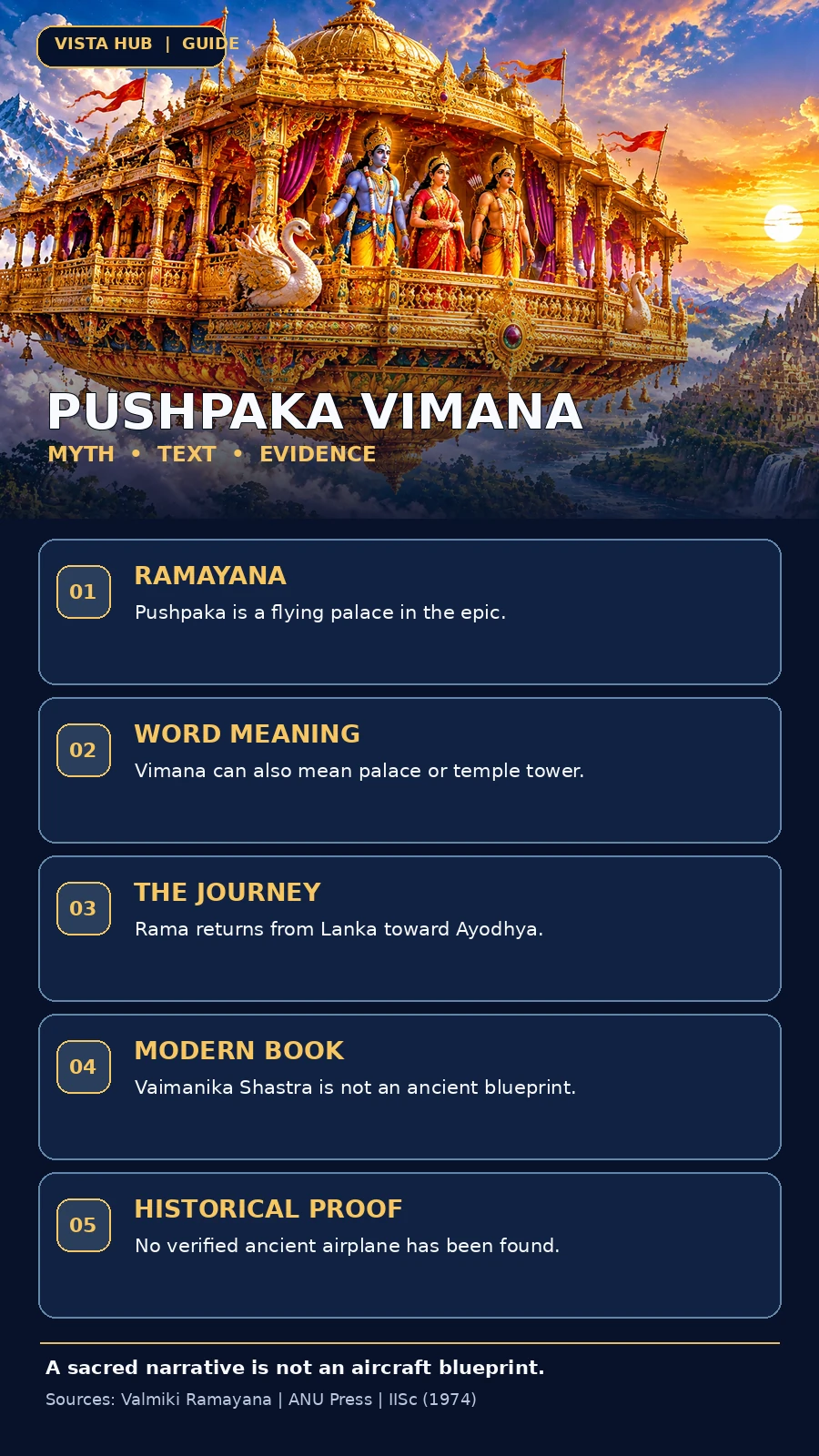
The Yuddha Kanda describes Pushpaka in royal and architectural language: a large and splendid vehicle with gold, precious stones, decorated spaces, banners and seats. It is compared with a mountain or palace, an image quite different from a compact metal airplane. Verse references in editions vary in their presentation, but Yuddha Kanda 124 is a useful place to read the conveyance being made available, while chapter 123 recounts the airborne journey and places Rama points out to Sita. Ramayana 6.124.9–10 describes the vehicle as divine and capable of moving according to the rider’s wish. We are looking at the language of wonder and mythic agency.
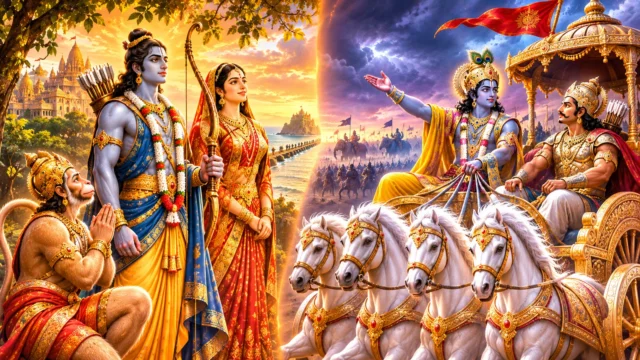
The return journey has narrative purpose. Rama recounts landscapes and scenes linked with the events of his exile and battle, and the movement through the sky brings the sprawling story toward homecoming. In many visual retellings, Rama, Sita and Lakshmana stand on an open terrace as the golden palace flies above rivers and forests. Such imagery is useful as illustration, but an artist’s particular wings, rotors or windows should never be claimed as a precise diagram preserved by the epic.
How Did Pushpaka Fly: Technology or Divine Power?
This is the question that draws most online searches, and the honest answer begins with what the text actually supplies. The flying palace is portrayed as an extraordinary, sometimes self-moving, celestial object. It can be described as moving according to the will of an occupant and as possessing speed beyond ordinary means of travel. Its splendid decoration receives more attention than anything resembling a fuel system, wing geometry, propulsion controls, airframe stresses or experimentally verifiable design. Saying that a passage speaks of motion is correct; saying the passage therefore documents a working jet engine is not.
Some writers interpret phrases such as “moving at will” as references to automatic navigation or voice control. That is an imaginative comparison to modern technology, not a conclusion established by the text. A story can depict a self-directed flying object without providing instructions for building it, just as a modern fantasy novel can depict a portal without explaining actual physics. The interesting literary feature is agency: Pushpaka almost functions as a character, conveying status and responding to the demands of the narrative.
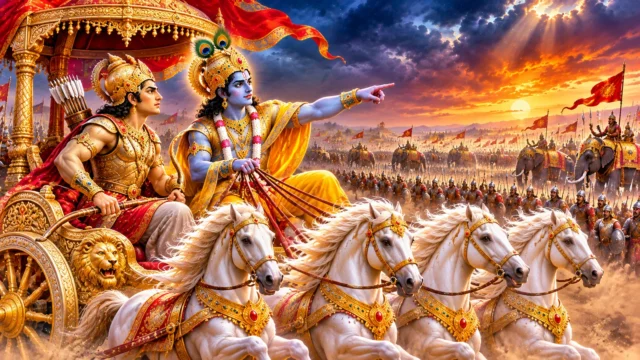
Later painters often give it bird shapes, swan ornamentation, temple roofs, sails or wings. These do not constitute a sequence of historical aircraft prototypes. Designs differ because artists transform verbal poetry into visual forms using the artistic vocabulary of their own time. If you want to study how Pushpaka was imagined, compare illustrated Ramayanas from different periods. If you want to investigate ancient aviation, seek material evidence and technical records rather than treating every painted wing as a surviving mechanical blueprint.
Vimanas Beyond Pushpaka: The Mahabharata and Celestial Worlds
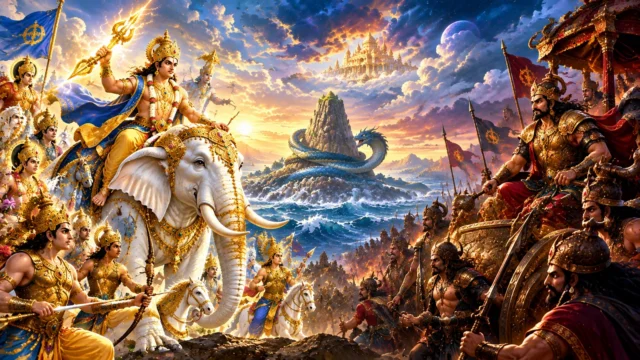
Pushpaka is memorable because it has a name, associated owners and a journey that drives the Ramayana plot forward. Yet the concept of heavenly conveyances appears more widely in Indian religious literature. In the Mahabharata, gods and extraordinary beings can travel or appear in celestial spaces, and different passages describe heavenly dwellings and radiant vehicles. The same word vimana may refer to a flying palace, a splendid residence or a form of heavenly reward. An article promising “the exact 40 Vedic aircraft models” without naming a passage is therefore taking a very large leap.
The epics are also not the only Indian texts that use imaginative descriptions of cosmic mobility. Religious poems, Puranic stories and later literature have their own celestial imagery. Specific theological meanings depend on the tradition. Some images celebrate divine freedom from ordinary limitations, others mark royal splendor or the passage between human and celestial realms. A vehicle from a narrative should not automatically be merged with every other airborne image into one supposed aviation manual. In particular, a divine chariot pulled by celestial beings is not the same kind of object as a palace said to move by itself.
This distinction helps preserve literary variety. We can compare the motifs of a flying residence, a heavenly chariot and a god’s mount without insisting that all three share a single engine or inventor. Readers who want an exact claim should ask: Is this passage in the Valmiki Ramayana, the Mahabharata, a Purana, a later commentary or a modern popular book? Does it use the Sanskrit word vimana? Does it describe flight, or only a heavenly palace? These questions are more productive than repeating lists with no verifiable chapter references.
Why Vimana Also Appears in Hindu Temple Architecture
A major source of confusion is the use of vimana in temple architecture. In the vocabulary of South Indian or Dravida-style temple design, the term often refers to the towering, carefully constructed superstructure over the garbhagriha, the inner sanctum. This is a real architectural usage with physical monuments that can be studied, photographed and measured. It does not mean that every temple tower was designed to detach and fly. The architectural term belongs to a different context from the celestial palace in the Ramayana.
You can see why the names might be connected through imagery: a richly ornamented sanctuary rises above the central sacred space, while an epic’s flying palace is also portrayed as magnificent architecture. But similarity in language and form is not proof of a shared mechanical function. Many visitors mistake a high temple gateway for the vimana; depending on the regional architectural vocabulary, the towering gateway is often called a gopuram, while the vimana belongs above the shrine itself. Exact usage can vary, so an image caption should identify the particular monument.
For a school assignment, this makes an excellent two-column comparison: “vimana in architecture” versus “vimana in epic narrative.” One concerns a historical building tradition; the other concerns a literary or religious portrayal of celestial movement. Both deserve accurate presentation, and neither must be reduced to the other.
What Is the Vaimanika Shastra, and How Old Is It?
The Vaimanika Shastra, also spelled Vymanika Shastra or Vaimānika Śāstra, is frequently promoted online as an ancient Sanskrit aviation engineering textbook. Its historical documentation tells a different story. The text is associated with Pandit Subbaraya Shastry, whose verses were reported as being dictated in the early twentieth century and written down by G. Venkatachala Sharma. Manuscript history includes early twentieth-century records, and editions appeared in the middle and later twentieth century. It has often been attributed to the ancient sage Bharadvaja, but that authorship and an ancient date are not established by reliable historical evidence.
In 1974, H. S. Mukunda and colleagues at the Indian Institute of Science evaluated the book in a study titled “A Critical Study of the Work ‘Vymanika Shastra’.” They examined both its proposed history and the feasibility of aircraft designs described in it. Their conclusion was that the text could not be shown to predate the early twentieth century and that its described aircraft were technically infeasible. This does not mean that every ancient Indian account of flight has been “disproved.” It means that one specifically cited document fails as evidence for a workable prehistoric aviation technology.
A crucial timeline distinction is easily missed: Valmiki’s Ramayana and its Pushpaka story belong to a much older literary tradition, whereas the modern Vaimanika Shastra has its own recent documented history. They are not interchangeable sources. The Ramayana is evidence that stories of celestial flight existed; the modern book does not retroactively supply tested engines or aerodynamic specifications to the ancient narrative. When websites combine an image of Rama’s flying palace with a diagram from the Vaimanika Shastra and call the combination “archaeological proof,” the reader is seeing an unsupported collage of separate materials.
Were Aircraft Actually Built in Ancient India? What Evidence Is Needed?
The responsible answer is that mythological descriptions alone do not establish that aircraft were manufactured and flown in ancient India. Archaeologists and historians would need securely dated physical remains, documented manufacturing practices, identifiable mechanisms, contemporary records that can be critically evaluated, and a coherent explanation of how the craft operated. An exceptional technological claim requires evidence that matches its specificity. A poetic description of a “sun-like flying palace” is valuable evidence for imagination, ritual culture and literary history, but it is not a recovered engine.
People sometimes argue that absence of surviving aircraft proves nothing because metal could have been recycled or structures lost. It is true that historical evidence can disappear. However, a possibility that traces were lost is not itself positive proof that a particular machine existed. Equally, insisting that ancient people lacked imagination or technical skill would be unfair. South Asia has an impressive documented history of mathematics, metallurgy, architecture, navigation and craftsmanship. Acknowledging those real achievements does not require inventing working jet aircraft for the Ramayana age.
Science and devotional reading answer different questions. A devotee may understand Pushpaka as part of sacred history or divine reality. A textual scholar may examine how its descriptions vary between passages. An engineer evaluates whether a machine design could fly; an archaeologist examines dated material evidence. These methods need not insult one another, but they should not be confused. Our illustration is deliberately labeled as an artistic interpretation, never as a photograph or technical reconstruction of an excavated object.
Five Common Claims: Myth, Text and Evidence
Claim one: “Vimana always means airplane.” That is inaccurate. Sanskrit usage also includes palace, elevated architectural structure and celestial residence. Check the passage before translating.
Claim two: “Pushpaka has an engine and pilots’ cabin described in the Ramayana.” The familiar epic story describes an extraordinary flying palace and its journey. It does not provide a verified engineering manual with the specifications of modern aviation.
Claim three: “The Vaimanika Shastra is a 5,000-year-old aircraft textbook.” The available historical record does not support that dating; researchers at the Indian Institute of Science identified serious problems with its age and proposed designs.
Claim four: “Every golden flying-palace image proves ancient aircraft.” Most circulating images are modern paintings, television-inspired art or AI-generated fantasy. A picture’s ability to look convincing does not authenticate a mechanical device.
Claim five: “Because old aviation is unproven, the texts are meaningless.” That is another mistake. The narratives remain important for understanding epic storytelling, religious imagination, ideas of kingship, celestial geography and Indian artistic history. We can take the literature seriously without turning it into a physics laboratory.
How to Explore Vimana Stories Without Falling for Viral Claims
Start with a primary passage, not a cropped social-media image. For Pushpaka’s return journey, look at Valmiki Ramayana, Yuddha Kanda chapters 123 and 124 in a reliable translation; verse and chapter numbering sometimes differs between editions. Read neighboring verses to see whether the speaker is describing a vehicle, a palace, a personified wonder or a symbolic location. Next, consult a scholarly study of the word vimana, such as Danielle Feller’s work on Sanskrit epics. Only then approach videos that claim to reveal a secret engine or advanced material.
Ask four practical questions. What is the exact source and date? What does the original language say? Is the explanation a devotional interpretation, a literary analysis or an engineering assertion? What evidence supports a claim that an actual object existed? You do not have to abandon curiosity when an answer is uncertain. Instead, you can appreciate why a splendid self-moving palace fascinated generations of storytellers, sculptors and painters.
For children, the easiest introduction is to draw two labeled pictures: the mythic Pushpaka Vimana and a modern aircraft. Explain that one comes from an epic narrative and the other from documented aviation engineering. For adults, the richer comparison includes temple architecture, historical lexicography and debates over the modern Vaimanika Shastra. What makes the subject worth studying is not an imaginary secret patent; it is the meeting point of language, faith, literature, art and evidence.
Frequently Asked Questions
What is Pushpaka Vimana in the Ramayana?
It is a divine, palace-like flying conveyance associated with Kubera, Ravana and Rama. In the Yuddha Kanda it carries Rama and his companions toward Ayodhya after the war in Lanka.
Did ancient Hindus really invent airplanes?
Hindu epics depict celestial flight, but those depictions are not verified evidence of engineered, working ancient airplanes. A historical technology claim needs independently assessable material and technical evidence.
Does the word vimana always mean an aircraft?
No. Its meanings include a palace, celestial car, heavenly residence and a temple architectural structure, depending on the source and context.
Who owned the Pushpaka Vimana?
In the Ramayana tradition it is associated with Kubera, seized by Ravana and later used by Rama after Ravana’s defeat.
How did Pushpaka Vimana fly?
The epic portrays divine or wish-directed movement. It does not supply a tested engine design or modern aeronautical calculations.
Is Vaimanika Shastra an ancient engineering manual?
Its documented textual history is modern. A 1974 IISc technical study found its claimed ancient dating unsupported and its designs infeasible.
What does vimana mean in a South Indian temple?
It often refers to the superstructure above the inner sanctum, an architectural feature rather than a flying machine.
Can artistic images of vimanas be used in school projects?
Yes, if clearly labeled as mythological or artistic interpretations rather than historical photographs or recovered technology.
Conclusion: A Better Way to Understand Ancient Vimanas
Vimanas are genuinely compelling because they unite a memorable flying-palace story with layers of language, theology and art. The Ramayana’s Pushpaka is a vivid literary object; the broader term vimana has multiple meanings; and the modern Vaimanika Shastra is not reliable proof of ancient flight engineering. The evidence-based approach does not diminish the wonder of the narrative. It gives readers a clear answer to the question they came with, while allowing religious tradition and historical inquiry to retain their own integrity. Read the source, check the date, enjoy the imagery and distinguish what a story describes from what the material record proves.
Related Reading
- Ramayana vs Mahabharata: key differences
- Why Rama sent Sita to the forest
- Hindu cosmology: creation and cosmic cycles
Sources and Editorial Note
- Valmiki Ramayana, Yuddha Kanda 6.123 — airborne return journey
- Valmiki Ramayana, Yuddha Kanda 6.124 — Pushpaka and its description
- Danielle Feller, ANU Press — flying palace Pushpaka and Sanskrit word meanings
- H. S. Mukunda et al., Indian Institute of Science (1974) — Critical Study of Vymanika Shastra
Updated November 13, 2026. Mythological imagery is illustrative; historical aviation claims are assessed separately using documentary and technical evidence.





















Share Your Opinion
Comments are closed on this post.