Legal disclaimer
This article provides general legal information about India, reviewed on 9 October 2026. Ask an advocate to assess the land category, possession history, special laws and limitation calculation. It is not advice to occupy somebody else’s land or manufacture a claim against its owner.
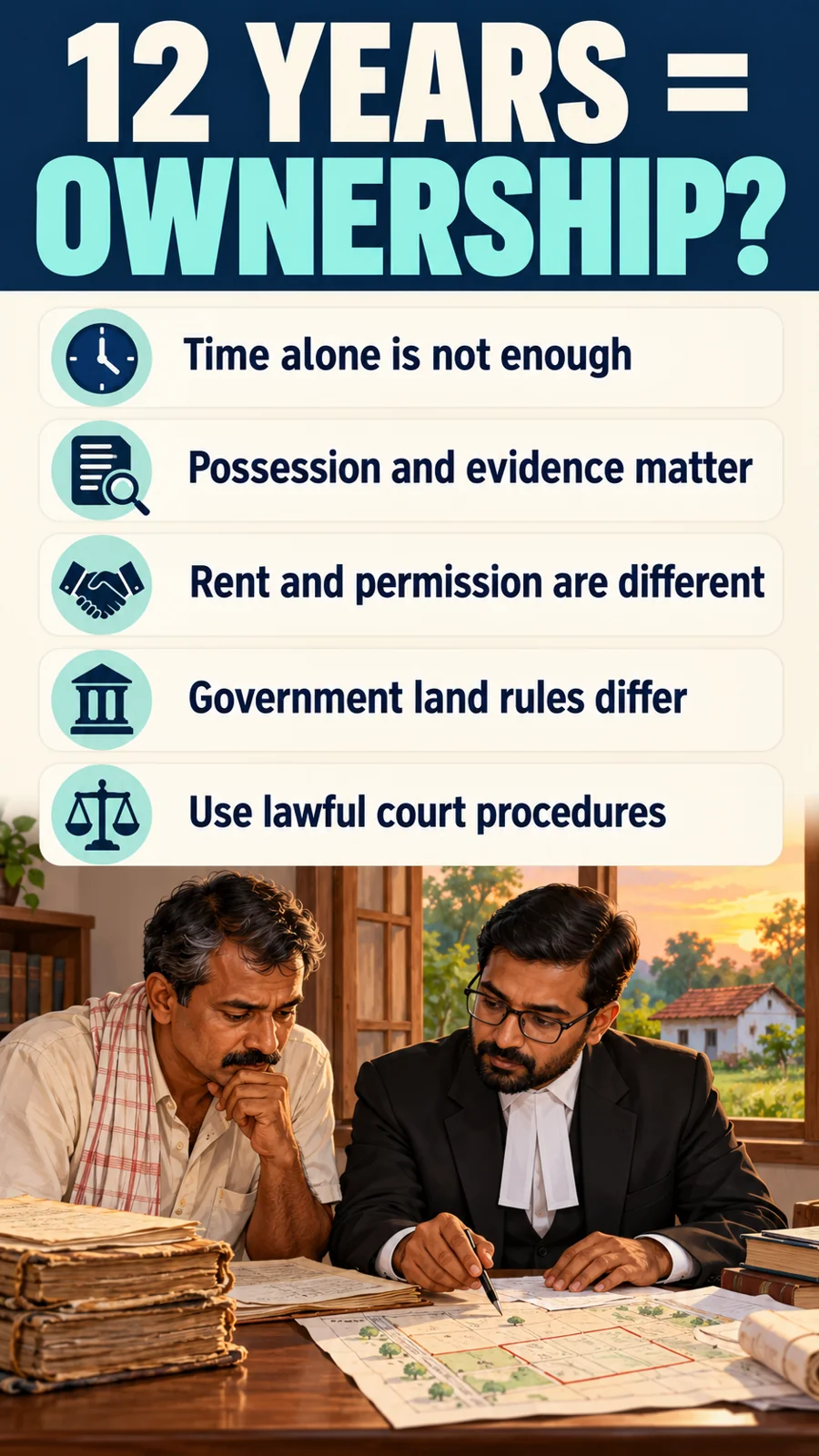
Twelve years alone does not establish ownership
Living in a house or using land for twelve years does not automatically make you its owner. An adverse-possession claim depends on the character of possession, the applicable period and reliable evidence. A tenant, a permitted relative, a caretaker and someone asserting genuinely adverse possession do not begin from the same legal position.
An electricity bill, water connection or property-tax receipt may be relevant evidence of use or possession. None is a universal substitute for title or proof of every adverse-possession requirement. The claim that changing the utility account will produce ownership after twelve years is misleading. It can lead people into serious property disputes.
Start with the actual history: when possession began, why the person entered, whose rights were involved and how occupation continued. Identify the precise property and its ownership chain. A long-standing address tells only part of that story. A lawful assessment requires the facts that help the claim and those that weaken it.
Where the twelve-year rule comes from
Article 65 of the Limitation Act, 1963 provides the ordinary twelve-year period for a suit for possession of immovable property or an interest in it based on title. Its starting point is when the defendant’s possession becomes adverse to the plaintiff. This is not necessarily the date the occupier first entered the premises. [1]
Article 64 concerns a different situation: recovery based on previous possession rather than title after dispossession. Its ordinary twelve-year period runs from dispossession. Mixing Articles 64 and 65 can produce the wrong deadline and the wrong legal argument. An advocate should identify the actual basis of the suit before calculating limitation. [1]
Section 27 addresses the effect on the property right when the relevant limitation period for a possession suit expires in the required circumstances. That presupposes a correct legal calculation and the necessary facts. Where title is disputed, adjudication may be needed. The passage of a calendar date does not issue a fresh registered title document.
FACT: Long occupation under a tenancy or the owner’s permission is generally different from adverse possession. Twelve years of utility bills do not, by themselves, establish ownership.
The possession must have the necessary character
The claimant must establish actual, open and sufficiently continuous possession adverse to the relevant owner’s rights for the required period. Occasional use, hidden occupation or use dependent on permission is not the same. The necessary exclusivity and the extent of possession must be assessed against the property and interest being claimed.
Hostile possession is a legal description of possession in opposition to the owner’s title. It does not mean violence, personal hostility or threatening behaviour. Knowledge, or knowledge properly attributable to the owner from the circumstances, matters. Threatening an owner is neither proof of the legal requirements nor an acceptable way to satisfy them.
The commencement date and nature of the claim need a clear factual foundation. A permission granted years ago cannot be turned into an earlier adverse occupation by a new assertion today. Previous letters, admissions, proceedings and rent payments can affect the case. Give the adviser the whole history rather than a selectively favourable version.
Tenants, relatives and co-owners
A tenant ordinarily enters through a tenancy. Stopping rent payments, expiry of an agreement or the landlord living elsewhere does not automatically create adverse title. Occupation acknowledging the landlord’s rights and occupation allegedly denying those rights require different analysis. Any claimed change must be legally assessed and proved on the actual evidence.
A relative allowed to stay, a caretaker or a person permitted to cultivate land generally raises the question of permissive possession. Time, repairs or cultivation alone do not retrospectively convert that permission into an adverse claim. If the legal character is alleged to have changed, the claimant must establish when and how the change occurred.
One co-owner using the entire property is not automatically possessing it adversely against all other co-owners. Clear ouster and the relevant knowledge may need proof. A sister’s absence from the village does not itself extinguish her share. Examine the family relationship, documents and conduct before making any statement about exclusive ownership.
What the Supreme Court actually clarified
In Ravinder Kaur Grewal v. Manjit Kaur, (2019) 8 SCC 729, the Supreme Court clarified that a person who has perfected title through adverse possession can, in appropriate circumstances, bring proceedings for declaration, protection or restoration. The established right is not confined to being used only as a defence. [2]
The ruling does not declare every long-term occupier an owner. The required facts and period still need proof. The official order dated 8 August 2019 in Krishnamurthy S. Setlur and connected matters reproduces relevant passages from Grewal, including the distinction between long trespass and adverse possession. That distinction is central to understanding the result. [2]
The quoted reasoning also makes clear that joint possession is not presumed adverse and casual use is insufficient. Adding a landmark case name to an application does not repair missing facts. The court assesses whether the legal requirements are met in the particular dispute, not whether the claimant has spent many years at an address.
Build the evidence from genuine records
Identify the property through deeds, survey numbers, boundaries and maps. Relevant evidence may include older correspondence, genuine photographs, tax records, earlier proceedings and independent witnesses. Its weight and admissibility depend on the facts. A present-day photograph cannot establish every year of the required historical possession.
Prepare an honest chronological record. Include permission to enter, rent payments, objections, acknowledgments of ownership and earlier disputes. Show both favourable and unfavourable documents to the advocate. A contradiction that appears only after filing can damage the case and make the initial advice unreliable. Accuracy matters more than making a neat story.
Do not create backdated bills, false letters, fabricated affidavits or coached witness accounts. These practices can undermine the claim and expose the people involved to separate proceedings. If genuine evidence is insufficient, say so. There is no lawful shortcut that turns manufactured documents into a valid history of adverse possession.
Government land and special categories
Article 112 generally provides a thirty-year period for relevant suits by the Central or State Government, subject to its scope and other applicable rules. Not every public body or local authority automatically falls within that provision. A private-land twelve-year explanation should not be applied to government property without checking the correct framework. [1]
Forest land, public paths, water bodies, religious property, agricultural tenancies and other special categories may be governed by separate restrictions or statutes. A regularisation scheme also operates under its own eligibility conditions. Possession, eligibility for regularisation and title are separate questions. An application under a scheme is not proof that ownership has already been acquired.
Buyers should be particularly careful. A seller’s possession story does not replace an independent title investigation, relevant decisions and proof of transferable rights. Litigation, land classification and special-law problems can survive a long occupation. A low purchase price is not a reason to skip verification of the ownership chain.
Use the correct proceedings
An advocate should assess limitation, the character of possession and the appropriate court or forum. Depending on the actual dispute, declaration, injunction, recovery of possession or another remedy may be appropriate. Identify the correct parties and property clearly. A revenue mutation request does not conclusively resolve a complicated disputed title.
If you are the owner, respond promptly to interference or unauthorised occupation. Do not assume that sending a legal notice automatically stops every limitation period. Seek advice about the necessary proceedings and any interim protection. Do not recover possession through violence or forced entry simply because you believe your title is stronger.
Frequently asked questions
Does a tenant become the owner after twelve years?
Not merely because of the duration. Tenancy and adverse possession are different, and the necessary legal facts must be proved.
Are an electricity bill and Aadhaar address enough?
No. They may support an address or use, but do not alone prove title and every adverse-possession requirement.
Does the twelve-year rule apply to all government land?
No. Article 112 and applicable special laws need separate assessment.
Is sending a legal notice sufficient for the owner?
Not in every case. Correct proceedings and limitation calculations matter; a notice does not automatically suspend every deadline.
Does Grewal guarantee mutation without a case?
No. Disputed title, evidence and the appropriate legal procedure may require separate adjudication.
Advice
Do not sell land or plan an occupation on the assumption that time alone creates ownership. Take the genuine timeline, permission or rent history and property records to an advocate. Owners and occupiers should follow lawful procedures. Where a legitimate purchase or settlement can clarify title, obtain a separate assessment of that option.
Related reading: How to exclude daughter from father property: Will, gift deeds, and Hindu Succession Act realities · Tenant not vacating house legal action: Step-by-step legal eviction procedure without police overreach
Official sources and judgments
[1] India Code — Limitation Act, 1963, Section 27 and Schedule Articles 64, 65 and 112: https://www.indiacode.nic.in/indiacode/handle/123456789/1565?view_type=browse
[2] Supreme Court — order dated 8 August 2019 in Krishnamurthy S. Setlur and connected matters, quoting Ravinder Kaur Grewal v. Manjit Kaur: https://api.sci.gov.in/supremecourt/2008/2540/2540_2008_4_1501_15807_Judgement_08-Aug-2019.pdf
[3] India Code — Specific Relief Act, 1963, provisions concerning possession and declaratory relief: https://www.indiacode.nic.in/bitstream/123456789/1583/7/A1963-47.pdf
Detailed legal disclaimer
This article does not endorse encroachment, concealed facts, fabricated records or forcible possession. Adverse-possession claims require assessment of both facts and law. No ownership, mutation, litigation result or platform-policy approval is guaranteed. This disclaimer does not remove legal duties or the rights of another person.