What to Do If Someone Swallows Poison: Get Help Immediately
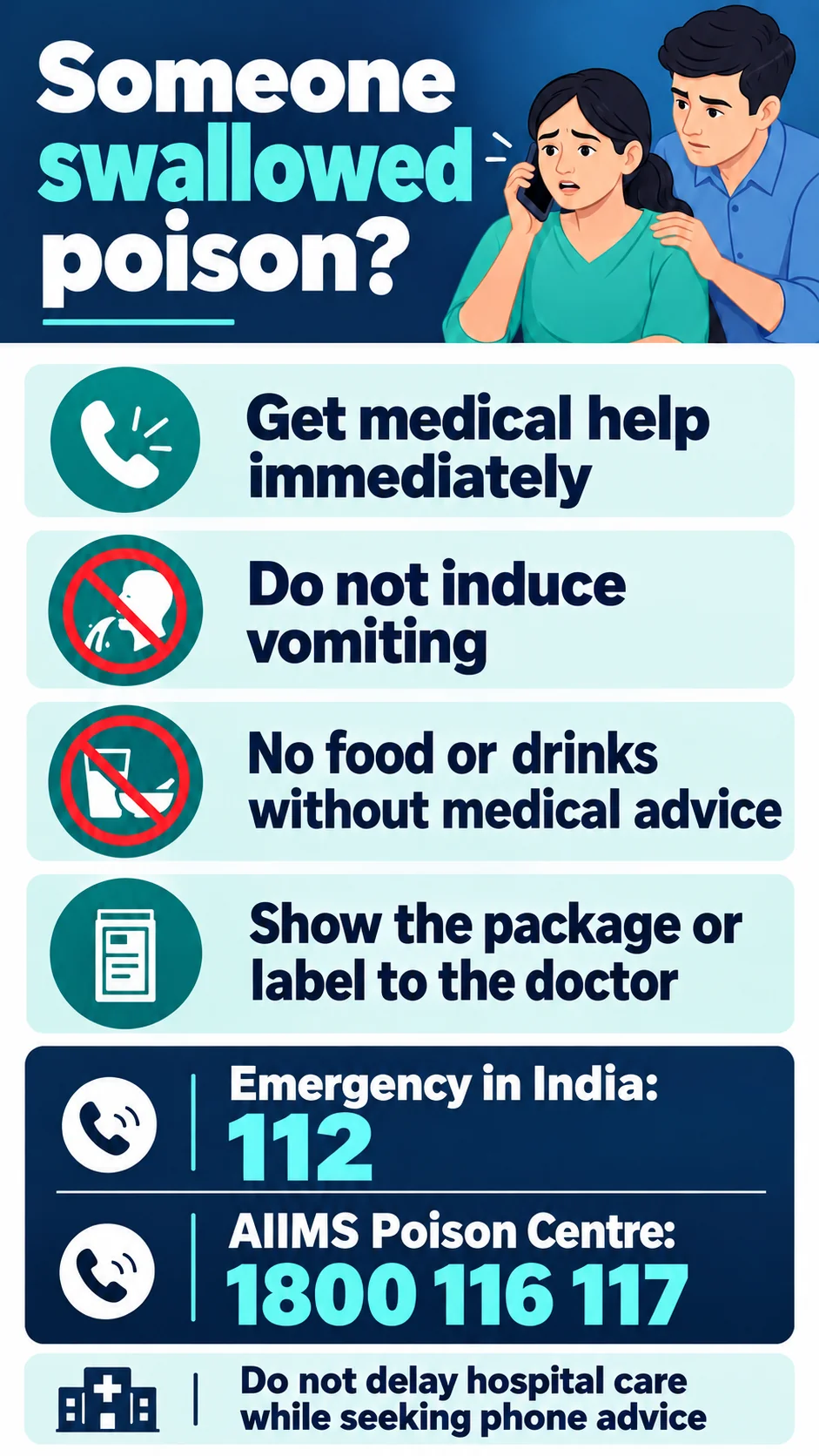
If this is happening now, stop reading and seek urgent medical help. In India, call 112 for emergency assistance. AIIMS National Poisons Information Centre: 1800 116 117. Do not wait for symptoms. Do not make the person vomit or give food, drinks or home remedies without instructions from a healthcare professional.
When a possible poisoning happens at home, people may rush to find a remedy before calling for help. A clearer first step is to contact medical professionals, describe what happened and follow their instructions. This guide explains how to seek help, what information to provide and which common mistakes to avoid. It is an India-focused awareness guide, not a plan for treating poisoning at home.
What should you do first?
Check whether the person responds when you speak to them and whether they are breathing normally. Collapse, unconsciousness, seizures or severe breathing difficulty require immediate emergency assistance. Call 112 and describe those signs clearly. Ask someone nearby to help so that one person can make the call while another stays with the patient.
If the person is awake, stay with them and calmly ask what happened. Keep watching their condition while help is arranged. Do not let an affected person drive themselves to hospital. Follow the emergency operator's advice about immediate assistance and transport.
The AIIMS poison information centre is a useful contact for poisoning guidance. It does not replace an ambulance or emergency department. If the person is seriously unwell, do not delay an emergency call while trying to reach a poison specialist. Another helper can make the additional call when available.
Why should you avoid vomiting and home remedies?
Do not try to force vomiting with fingers, salt water or another substance. Vomiting can allow harmful material to enter the airway, and some substances can cause further injury when they come back up. Trying to remove a poison at home can create an additional problem instead of solving the original one.
Milk, lemon juice, oil, food or large amounts of water are not universal treatments. Different exposures need different advice. Do not give anything to eat or drink unless a doctor or poison specialist instructs you to do so for that particular situation.
Never give anything by mouth to a person who is unconscious or cannot swallow properly. Do not administer medicines, charcoal or a supposed antidote on your own. Products used in hospital are chosen after an assessment and should not be copied from an online description.
What if the person is unconscious?
Unconscious but breathing normally: place the person on their side in the recovery position and keep checking breathing. If an injury is suspected or you are unsure how to position them, ask the emergency operator for guidance. Do not put food, drinks or medicines into their mouth.
Unresponsive and not breathing normally, or only gasping: call 112, use speakerphone and begin CPR according to the operator's instructions. If trained, follow your training. Tell the operator whether the patient is an adult or a child because resuscitation instructions differ.
If poisonous material is on the person's mouth, avoid direct mouth-to-mouth contact with it. Tell the operator about the contamination and ask for safe resuscitation instructions. Do not expose yourself by tasting or deliberately smelling an unidentified substance.
What information should you give the doctor?
Write down what is known: the person's age, the suspected substance, the approximate time of the incident, the amount if genuinely known and any symptoms. Mention regular medicines and anything given after the incident. A short note can help when different relatives speak to the medical team.
If safely available, bring the medicine strip, product label or closed container. A clear label photograph may be useful when carrying the item is impractical. Do not handle a leaking container or loose chemical simply to collect evidence.
Do not leave the patient alone or delay transport to search for packaging. “I don't know the amount” is a valid answer. Accurate information is more useful than a confident estimate that may be wrong. Avoid hiding details because of embarrassment or fear of being blamed.
Why do you need advice when there are no symptoms?
Looking well does not establish that a suspected exposure is harmless. Some effects can appear later. Seek medical advice promptly instead of deciding independently to wait at home. The medical team determines whether observation, tests or treatment are needed.
Vomiting, unusual drowsiness, confusion, breathing difficulty or loss of consciousness can occur, but symptoms do not reliably identify the substance. Update the emergency operator if the condition changes. Do not make a prognosis based on an internet checklist.
FACT BOX: Vomiting does not prove that all the substance has left the body. The absence of symptoms is not a guarantee of safety. A professional assessment is needed to decide the next step.
Poisoning from a swallowed chemical or medicine is different from ordinary food poisoning caused by contaminated food. Advice for routine diarrhoea should not be transferred to a suspected chemical exposure. If the distinction is unclear, explain the suspected product and circumstances to a clinician.
How can you support someone after deliberate ingestion? Advice
If the substance was swallowed deliberately, immediate medical assistance remains the priority. Stay with the person. Avoid blame, threats, lectures or filming the incident. A calm statement such as “I am staying with you; we are getting help” keeps attention on the next useful action.
If it is safe, reduce access to nearby harmful items. Do not put yourself in danger or start a physical struggle. Do not promise to hide the incident from the medical team. They need an honest account to provide appropriate care.
After the physical emergency is addressed, ask the hospital team about a mental health assessment and follow-up support. Understand the discharge instructions and arrange practical support at home. A conversation about recovery belongs after urgent care, not in place of it.
FAQ: Someone swallowed poison—what should you do?
Should you make them vomit?
No. Do not force vomiting. Contact emergency services or a poison specialist for instructions.
Should you give milk or water?
Do not give food or drinks without professional advice. Never give anything by mouth to an unconscious person.
Can you stay home if they seem fine?
Do not decide this independently. Seek prompt medical advice after a suspected poisoning.
What if the substance is unknown?
Call for help anyway. Provide a label, packaging or photograph if safely available, without delaying assistance.
Which numbers apply in India?
Call 112 for emergency assistance. AIIMS National Poisons Information Centre: 1800 116 117. Serious symptoms need urgent medical care without delay.
Health disclaimer: This article provides general awareness, not diagnosis or treatment. In an actual poisoning, seek immediate help from emergency services, a doctor or a poison specialist. This article has not received an individual medical review.
Official information and sources: AIIMS NPIC · India 112 · NHS · MedlinePlus · Red Cross · healthdirect
Sources checked: 12 October 2026.