 Vista
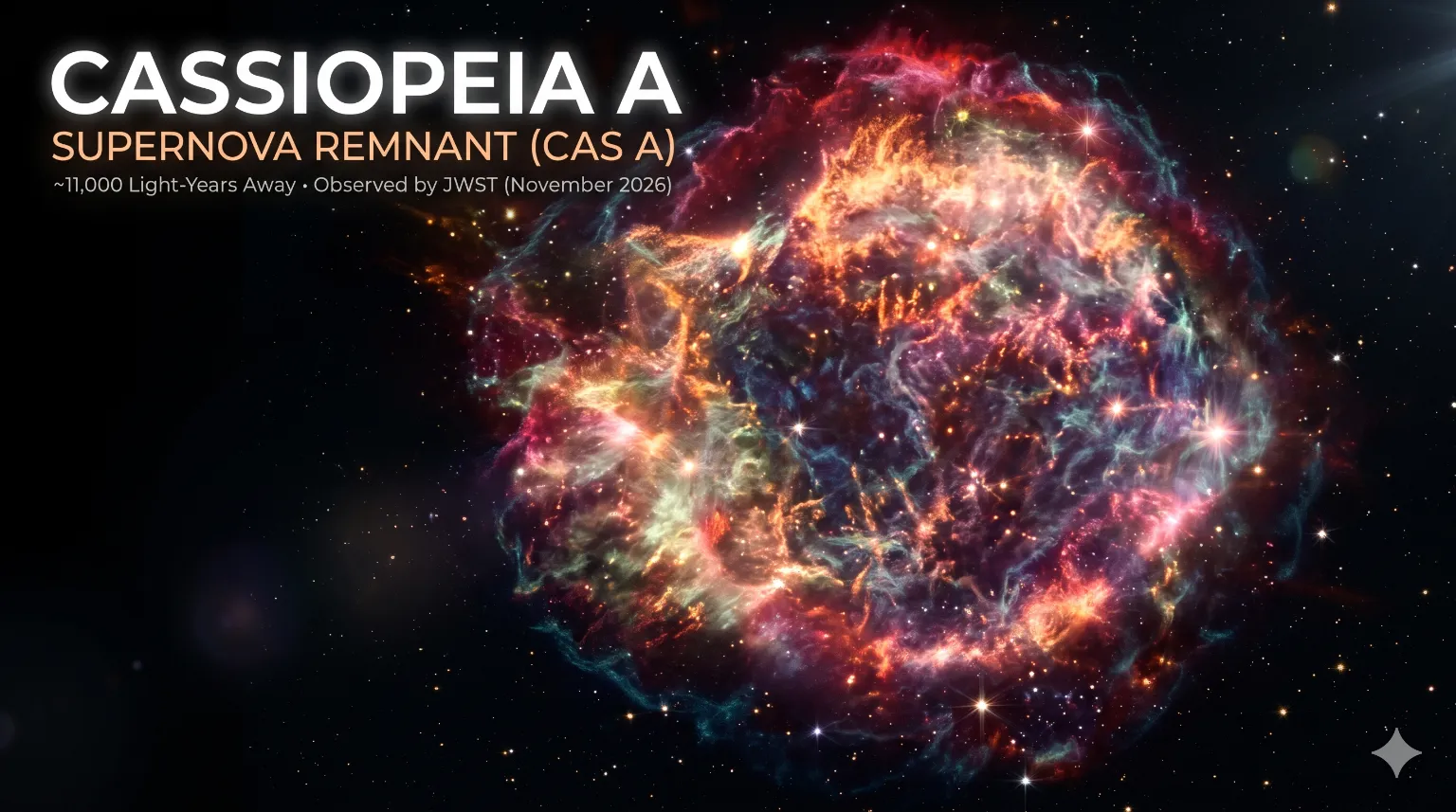
25 November 2026: New James Webb Space Telescope observations of Cassiopeia A (Cas A) suggest that internal layers of the massive star that created this supernova remnant may have mixed shortly before its explosion. NASA announced the findings on 23 November. The researchers examined the chemical composition of dust in the remnant, not a live recording of the original star’s final hours. The observations offer a new way to reconstruct stellar evolution from material scattered into space centuries ago.
Featured visual: conceptual illustration. Official NASA MIRI observation images are linked in the sources.
Cassiopeia A discovery: what Webb found
| Property | Details |
|---|---|
| Object | Cassiopeia A, also called Cas A |
| Object type | Supernova remnant |
| Instrument | James Webb Space Telescope, mid-infrared observations |
| Research release | 23 November 2026 |
| Interpretation | Evidence consistent with mixing of burning shells shortly before core collapse |
| Publication | The Astrophysical Journal Letters |
What is Cassiopeia A?
Cas A is the expanding debris from a massive star that exploded in the past. It lies in the direction of the constellation Cassiopeia, roughly 11,000 light-years away. The light from the explosion reached Earth’s neighborhood centuries ago. A supernova remnant contains material from the exploded star as well as surrounding material disturbed by the expanding shock waves. This mixture can preserve evidence of what the star was like before the explosion.
Different telescopes reveal different aspects of the same object. X-ray instruments can observe extremely hot gas, infrared instruments can detect emission from dust and other material, and radio observations reveal additional physical processes. A colorful infrared composite is therefore not necessarily how the remnant would look to the human eye. Assigned colors help make different wavelength bands and structures easier to distinguish.
How massive stars form layers of elements
Stars produce energy by nuclear fusion during much of their lives. For a Sun-like star, hydrogen fusion is the dominant process for billions of years. More massive stars consume their fuel more rapidly and can progress through additional stages of fusion after hydrogen and helium burning. Under suitable conditions, burning of carbon, neon, oxygen and silicon contributes to increasingly heavy nuclei.
Late in a massive star’s evolution, different fusion reactions may occur in regions surrounding its center. Textbooks often draw this as an onion with concentric layers, but real stars are dynamic objects. Material moves, turbulence develops and boundaries between regions need not remain perfectly sharp. Nuclear reactions alter composition, while convection transports heat and matter. Understanding these movements is important for modeling the final stages of a star’s life.
What is a stellar shell merger?
A shell merger can occur when adjacent burning regions interact and their material mixes. In the scenario examined by the new study, mixing involving carbon-burning and oxygen-burning material can change the chemical structure of the star before core collapse. When the star explodes, some of this material is ejected and can later contribute to dust grains. Scientists can compare the composition of those grains with expectations from different stellar evolution models.
The evidence supports a possible merger shortly before the explosion; it is not direct footage of an event that happened a few hours before the November announcement. Timing is inferred using models and measurements. Neither the precise three-dimensional structure nor every detail of the original star’s final hours is known. Scientific papers use such evidence to evaluate competing explanations rather than promise a complete reconstruction from one picture.
What the MIRI dust observations revealed
Earlier Spitzer observations helped researchers select regions for closer investigation. Webb’s Mid-Infrared Instrument (MIRI) can distinguish smaller structures and their spectral properties. The team investigated ejecta regions with different dust compositions, including regions dominated by silica and carbon-bearing dust. It also studied the Green Monster, a structure rich in magnesium silicates associated with material lost by the star before the explosion. Distinguishing this circumstellar material from supernova ejecta is important because the two originated at different stages.
Combined with complementary X-ray evidence from other observatories, the distribution of dust strengthens the case for mixing within the progenitor. Dust is more than a beautiful feature in a telescope picture: its chemical makeup can preserve clues about nuclear reactions and the conditions in which grains formed. Researchers must nevertheless account for heating, shock processing and the possibility that some grains have been destroyed or altered.
Why supernova dust matters for planets and life
Massive stars enrich their surroundings with elements produced during their evolution and explosions. Future stars and planets can form from interstellar gas and dust containing material from many earlier stellar generations. This does not mean that every element on Earth came from one supernova. Different processes, including other kinds of stellar explosions and neutron-star mergers, contribute to the cosmic inventory.
Models of chemical evolution need estimates of how much of each element stars release. If internal mixing changes that yield, it can affect predictions about how galaxies acquire their chemical composition. The Cas A observations provide a case study for improving such models. They also illustrate how scientists can infer events long before any human-made telescope existed.
Frequently asked questions
Did Webb watch a star explode in real time?
No. Webb studied the existing Cas A remnant and inferred earlier processes.
Is Cassiopeia A dangerous to Earth?
The study concerns a distant historical explosion and does not identify a new threat to Earth.
What is MIRI?
Webb’s Mid-Infrared Instrument, used for imaging and spectroscopy in mid-infrared wavelengths.
Are the colors in the image real?
They represent measured infrared data mapped into visible colors, rather than an ordinary human-eye photograph.
Did the study prove the exact timing of a shell merger?
No. The evidence supports a scenario of late-stage mixing, possibly hours before collapse.
Conclusion
Webb’s Cas A dust map provides a new method for investigating the hidden interior of a massive star after it has exploded. Its value is the chemical evidence, the comparison with other telescopes and the questions it raises about stellar evolution.
Sources and official images: NASA Science, 23 November 2026; ESA/Webb research release; NASA MIRI image and credits; Spitzer–Webb comparison. The research was published in The Astrophysical Journal Letters.
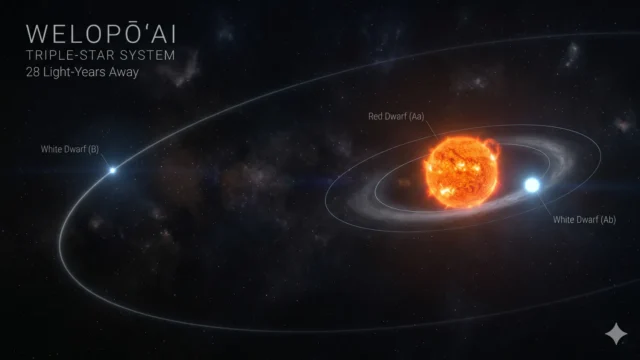
Related reading: Welopōʻai Triple Star System: Two White Dwarfs Just 28 Light-Years From Earth





















Share Your Opinion
Comments are closed on this post.