 Vista
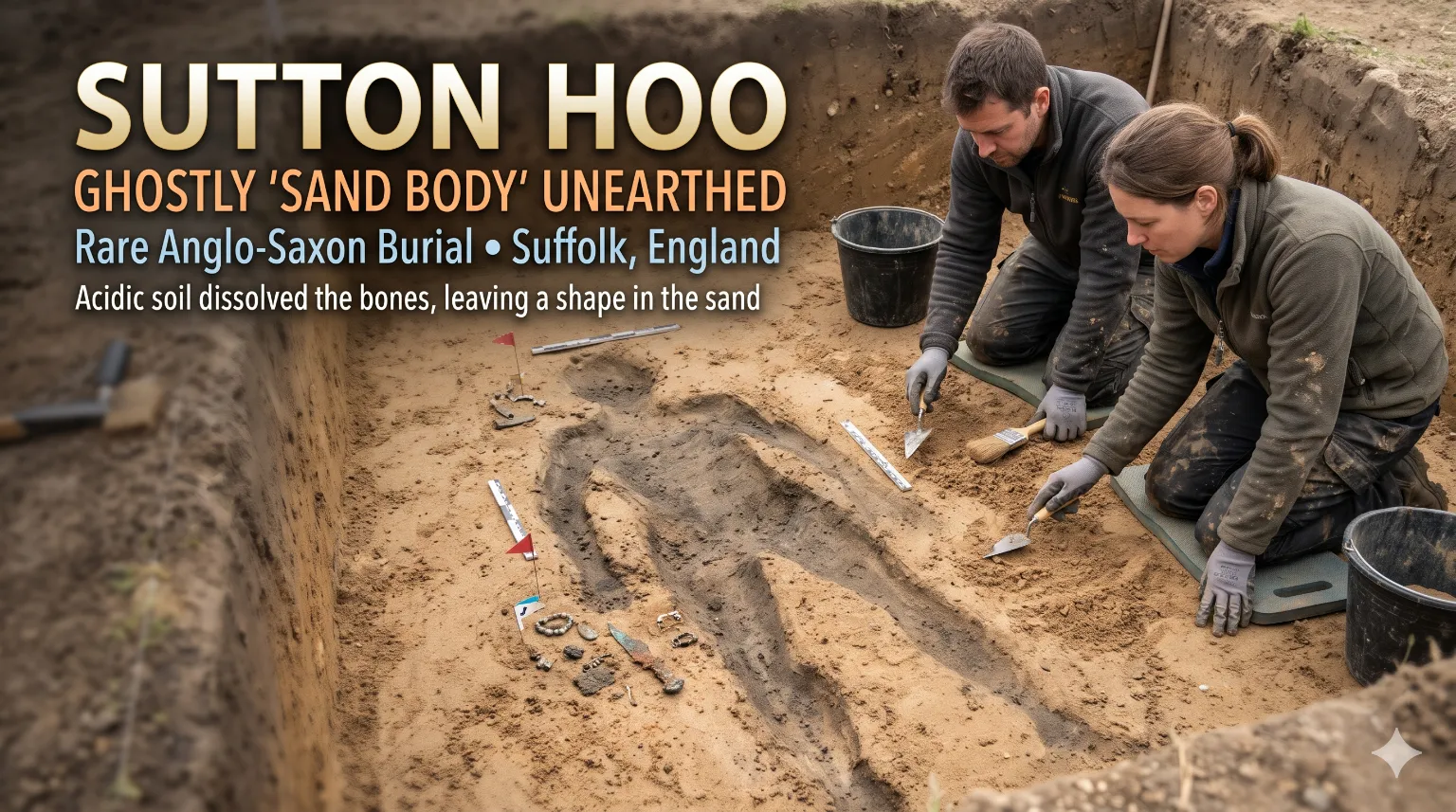
Updated 25 November 2026: A grave excavated at Sutton Hoo in Suffolk, England, has attracted renewed attention this November because of an unusual preservation process. The body has decomposed, but its outline survived in the soil. Archaeologists call this a sand body. The excavation occurred in 2025 in Garden Field, and its results are being presented in a new Time Team documentary series in November 2026. Evidence beneath the grave raises the possibility of another burial, but the relationship between the two has not been established.
Featured visual: an illustrative reconstruction, not an authentic photograph of the Sutton Hoo excavation.
What was discovered at Garden Field?
| Question | Answer |
|---|---|
| Location | Garden Field, Sutton Hoo, Suffolk |
| Excavation | 2025, final week of a month-long project |
| New coverage | November 2026 |
| Find | Sand-preserved human outline and grave goods |
| Possible second burial | Requires further investigation |
The National Trust describes objects associated with the grave, including beads, tweezers, a knife and a brooch. Such finds can help archaeologists explore burial customs, craft and material culture. Their presence does not immediately reveal the deceased person’s name or social position. Objects can be placed in a grave for many reasons, and their significance depends on context.
What is a sand body and how does it form?
Human remains usually change after burial as biological and chemical processes break down tissues. Soil chemistry, water movement, temperature and microorganisms affect what survives. In acidic soil, the mineral component of bones can dissolve over time. At certain sites, altered sand and soil retain a trace of the shape once occupied by a body. Archaeologists can identify contrasts in the sediment even when intact bones are absent.
The appearance can resemble a silhouette rather than a conventional skeleton. It is not a ghost, nor does the term mean a naturally mummified person has been found. Excavation requires great care because the physical evidence consists of subtle changes in the deposits. Removing a layer without recording its relationship to other features can destroy information that cannot be recovered later. Archaeologists document the position of each feature with photographs, drawings and measurements.
Why Sutton Hoo matters in British history
Sutton Hoo lies in the landscape of early medieval East Anglia near Woodbridge. It is famous for the extraordinary ship burial investigated in 1939. The burial’s objects demonstrate the craftsmanship, travel connections and social complexity of early medieval England. A ship laid beneath a mound represents a substantial investment of labor and material, but the famous burial is only one part of the wider landscape.
Popular descriptions sometimes identify the royal burial with King Rædwald of East Anglia. That is a historical interpretation rather than a name confirmed by an inscription on the body. Garden Field is a separate cemetery from the well-known royal mounds. Its study gives researchers a chance to examine people and burial traditions that might illuminate the development of the site beyond elite history.
Is this a double burial?
The excavators observed evidence of a possible additional burial beneath the sand body. Several explanations are conceivable: two people could have been placed in a grave at different times, a later grave could intersect an older feature, or the deposits could represent a more complex burial sequence. The available announcement does not resolve the alternatives. A claim that the two people were relatives, spouses or victims of a ritual would go beyond the evidence.
To investigate, archaeologists compare the edges and layers of grave cuts. A feature cutting another deposit is ordinarily later than the deposit it intersects. Dating suitable preserved material and examining the positions of associated objects can narrow the sequence. When bones are absent, some usual forms of biological analysis may not be possible. The absence of data is not a license to invent a biography.
The Bromeswell Bucket and other Garden Field finds
The project returned to Garden Field after an earlier investigation in 2024. One important object from that season was the base of the Bromeswell Bucket, a decorated vessel of Byzantine origin that had been used in a cremation burial. The vessel’s manufacture and its use in a grave need not have occurred at the same time. Imported objects can travel through trade, gifts or other exchanges before becoming part of a burial.
Cremation and burial of an unburned body are different funerary treatments. Their presence in one landscape can raise questions about chronology, cultural practice and the decisions made by different communities. It would be premature to conclude that every person buried in Garden Field belonged to the same generation or shared the same beliefs.
How to see the Sutton Hoo discovery
Time Team’s second Sutton Hoo series began on November 14, 2026. The National Trust and Time Team pages provide details of the research and documentary. Distinguish the original fieldwork date from the broadcast date when sharing the discovery. Official photographs have captions and credit information; a dramatic reconstruction is not a photograph of the actual excavation.
FAQs
Was a skeleton found?
The notable evidence is an outline preserved in sand after decomposition, rather than an intact skeleton.
Was the grave found in November 2026?
No. The excavation took place in 2025; the new coverage is from November 2026.
Is the person’s identity known?
The announcement does not establish an individual identity.
Is the second burial confirmed?
The evidence suggests a possibility, not a definitive conclusion about the second person.
Is Garden Field the famous ship burial?
No. It is a separate cemetery in the wider Sutton Hoo landscape.
How archaeological dating works when bones are missing
Researchers may compare pottery, metalwork and other associated objects with independently dated examples. Suitable organic samples may permit radiocarbon analysis if their relationship to the burial is understood. An object could be older than the grave itself, however. Combining several independent forms of evidence is therefore preferable to relying on an object’s appearance alone.
Conclusion
The sand body is remarkable because soil can preserve information even after ordinary human remains disappear. The discovery is an example of how archaeological context, not merely spectacular objects, helps reconstruct the past.
Sources: National Trust: Time Team at Sutton Hoo; Time Team documentary announcement; ITV report, November 2026.
Related reading: More history, science and practical guides

























Share Your Opinion
Comments are closed on this post.