 Vista
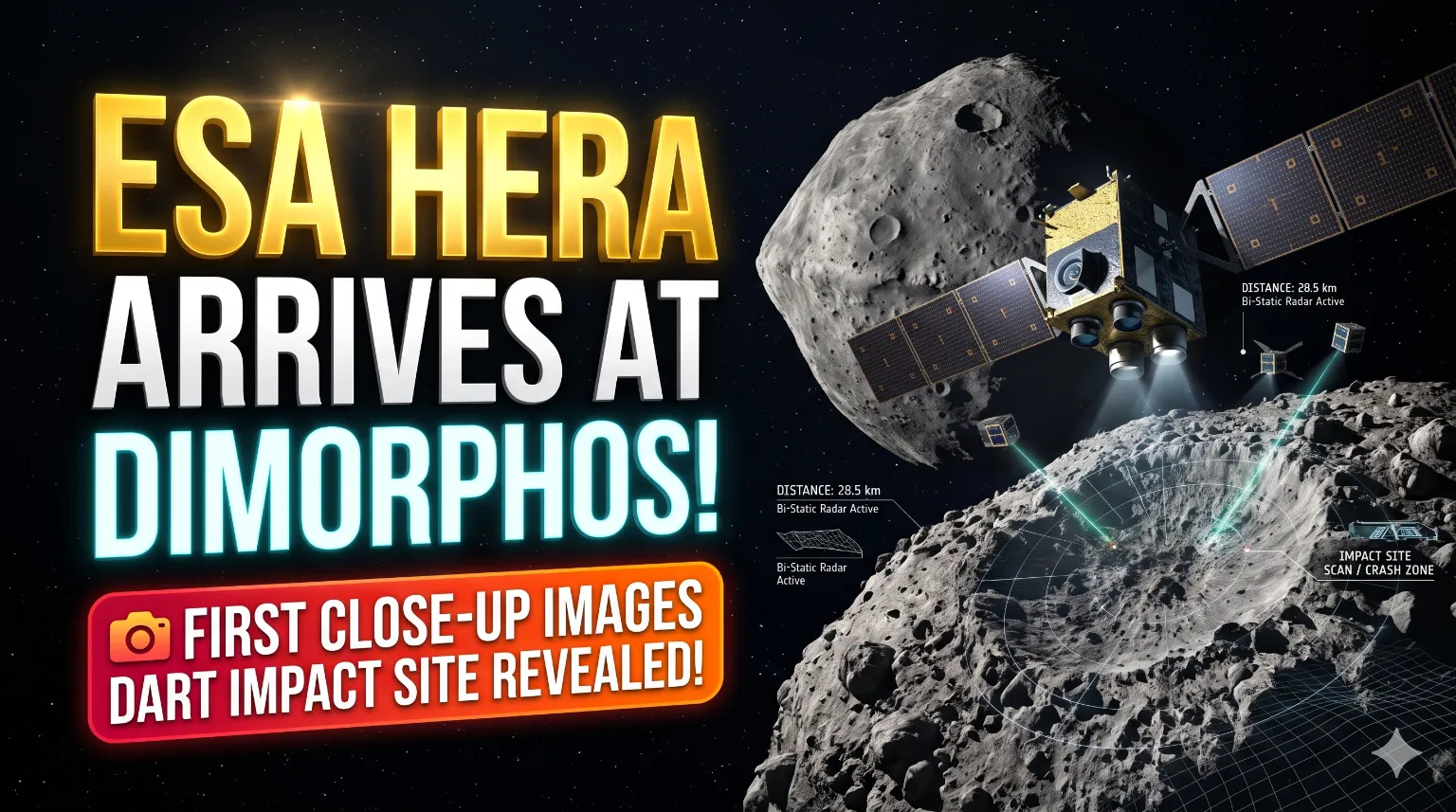
Updated November 25, 2026, before the image unveiling: ESA’s Hera spacecraft has reached the Didymos binary asteroid system to investigate the effects of NASA’s 2022 DART test. ESA scheduled its first close-up image presentation of the altered Dimorphos moonlet for 19:45 CET on November 25, equivalent to 18:45 UTC and 12:15 a.m. IST on November 26. Until those images are released and examined, the detailed shape and impact aftermath should not be presented as confirmed new findings.
Featured visual: conceptual mission artwork, not a newly released ESA close-up or a verified crater/radar measurement.
Hera mission facts and timeline
| Item | Details |
|---|---|
| DART impact | 26 September 2022 |
| Hera launch | 7 October 2024 |
| Target | Didymos and Dimorphos |
| Approximate diameters | 730 m and 151 m respectively, per ESA’s event notice |
| First image event | 25 November 2026, 18:45 UTC |
| Main goal | Measure the outcome of a kinetic impact test |
Why NASA deliberately hit an asteroid
DART stands for Double Asteroid Redirect Test. It was a controlled experiment in planetary defense, not a response to a known threat from Didymos. Scientists selected a binary system because the small object’s orbit around the larger asteroid could be measured through changes in reflected brightness. A change in that orbital period gives a measurable result without requiring a large change in the pair’s path around the Sun.
When the spacecraft transferred momentum to Dimorphos, additional material was expelled from the surface. That debris can carry momentum in the opposite direction and increase the overall deflection. Observations from Earth established that the orbital period shortened by approximately 33 minutes. Measuring this period is only part of the story; researchers still need the body’s mass and physical properties to determine how efficiently the impact worked.
What will Hera’s first Dimorphos images show?
ESA’s presentation is intended to give the public a closer view of the modified asteroid. Scientists will use images to examine its surface, shape, boulders and possible impact-related features. A close-up photograph alone will not establish the complete internal structure, nor should a crater be assumed to exist in a particular form before the results are presented. Some models allow substantial reshaping when a weakly bound object is struck.
Hera had already obtained approach observations of the binary system, including views of the larger asteroid. An earlier pair of images taken on November 6 was used to make a stereoscopic view of Didymos. Those are genuine mission observations, but they should not be mislabeled as the newly scheduled close-ups of Dimorphos. Readers can use the official ESA broadcast linked below to distinguish the new release from earlier pictures.
How two spacecraft missions work together
DART was the experimental impactor. Hera is the follow-up investigator. An analogy is a laboratory experiment in which the initial treatment produces a measurable change, followed by measurements of the material and its response. The missions complement each other rather than duplicate the same task.
One crucial parameter is mass. The momentum delivered by a spacecraft of known mass and speed can be estimated, but the change in a target’s velocity also depends on how massive it is. Without a good mass estimate, researchers have more uncertainty about the effectiveness of the experiment. Surface composition, porosity and the distribution of rocks can also affect how debris is produced.
Milani and Juventas: smaller spacecraft with a purpose
Hera carries two small CubeSats intended to complement its observations. Milani is designed to investigate mineral and dust-related characteristics, while Juventas is intended to explore the asteroid’s interior using radar and other measurements. ESA plans to deploy them during the later investigation rather than assuming their results are already available. CubeSats can help gather observations in different locations and provide a demonstration of operating small spacecraft near low-gravity bodies.
What the mission means for protecting Earth
Planetary defense begins with identifying and tracking potentially hazardous objects, estimating their orbits and assessing the uncertainty in a predicted encounter. Deflection would depend on the available warning time, target size, composition and orbit. A technique that worked for one small moonlet cannot automatically be scaled to every asteroid.
Small changes can become significant over long periods because the target continues to travel through space. This is why early detection matters. Hera’s purpose is to reduce scientific uncertainty so that future decisions can be based on better evidence. The asteroid system in this experiment was not selected because it was about to collide with Earth.
Where to watch the Hera first images event
ESA announced a public livestream beginning at 19:45 Central European Time on November 25. View the ESA broadcast and follow the agency’s mission page for the released imagery and captions. The equivalent time in India is shortly after midnight on November 26. After the event, check the replay and dated release rather than assuming that every circulating asteroid picture is new.
FAQs
Is Hera going to hit Dimorphos?
No. Hera is the survey mission investigating the effects of the earlier DART impact.
Did DART succeed?
It demonstrably shortened Dimorphos’s orbital period around Didymos by about 33 minutes.
Are Didymos and Dimorphos threatening Earth?
The mission is a controlled planetary defense test, not an emergency response to these objects.
Have the first close-ups been released?
The official presentation is scheduled for November 25 UTC; this draft is based on the pre-event announcement.
Why measure the interior?
Internal structure helps determine how an asteroid responds to an applied force.
How to read the new asteroid photographs
Check the image scale, acquisition date and which asteroid is pictured. A bright patch can be caused by illumination rather than a different mineral. Comparing images taken at different viewing angles helps researchers separate surface shape from shadows. Repeated measurements over months are more informative than one dramatic picture. The ESA image archive will provide captions that explain the observation geometry.
Conclusion
Hera turns a successful demonstration into a more detailed scientific experiment. Its images and subsequent measurements will help assess how an asteroid can be deflected and what uncertainties remain.
Sources: ESA official event and mission update; ESA early stereo images; official ESA image unveiling broadcast; NASA DART mission.
Related reading: Muhammad Zeeshan Ali: Pakistan's First Astronaut, Shenzhou-24 and Tiangong Space Station Mission























Share Your Opinion
Comments are closed on this post.