 Vista
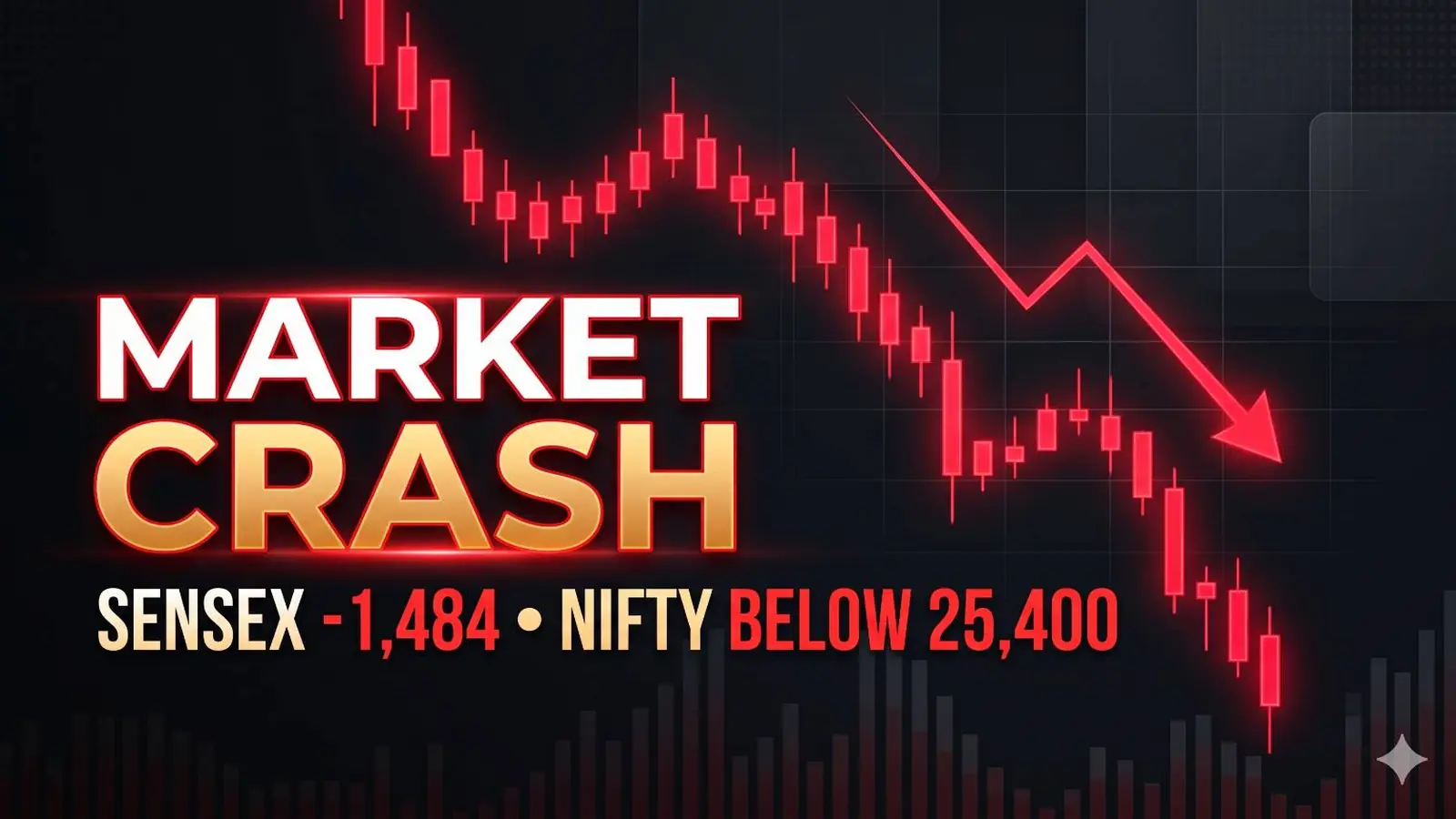
Updated: 23 November 2026. Indian stock markets fell sharply on Monday, 23 November 2026: the BSE Sensex declined 1,483.72 points, or 1.77%, to close at 82,435.99, and the Nifty 50 lost 450.95 points, or 1.75%, to finish at 25,349.65. Banking, financial and metal shares contributed to the weakness, and the session followed a period of strong market gains. For an investor searching “Why is Sensex down today?” the useful answer is a combination of sector pressure, profit-taking and broader market risk appetite rather than a single dramatic event. Below are five factors, the numbers that matter and a practical framework for deciding what to do next without predicting tomorrow’s price.
What happened to Sensex and Nifty today?
The Nifty’s close at 25,349.65 placed it below the widely watched 25,400 level, while the Sensex ended at 82,435.99 after a fall of almost 1,484 points. These are closing data, not intraday lows or estimates from an early market update. The benchmark move was approximately 1.7–1.8% in one session, which is large enough to move the value of a diversified equity portfolio significantly but not sufficient on its own to declare a prolonged bear market. Bank, financial-services and metal stocks were notably weak. Investors should distinguish headline point movements from percentage changes: the Sensex uses a larger index level, so a four-digit point fall does not mean that all stocks lost the same amount.
Reason 1: profit-booking after a market rally
Markets can reverse sharply when investors take profits after a sustained advance. Recent gains in the broader Indian market meant some investors had unrealised profits and chose to reduce exposure as volatility increased. Profit-booking is not the same as discovering that all listed businesses have suddenly become less valuable. It is a trading response to changes in price, positioning and short-term expectations. A correction after a rally can become self-reinforcing when multiple investors move to protect gains or rebalance portfolios. However, describing every sell order as profit-taking would oversimplify the day: some trades reflect hedging, reallocation and revised risk tolerance. Examine the previous weeks’ market performance when interpreting a one-day drop.
Reason 2: weakness in banking and financial shares
Banks and financial companies have substantial weight in major Indian benchmarks, so declines among important constituents can pull Sensex and Nifty down even when several unrelated stocks rise. Banking shares were among the key areas of pressure on 23 November, according to closing-market reports. The sector is sensitive to funding costs, interest-rate expectations, credit quality and investor positioning. That does not prove a banking-system problem or indicate that every lender is facing the same business conditions. Index investors should look at sector contributions and the breadth of losses rather than judging the entire economy from one session. The useful follow-up search is “which Nifty Bank stocks fell most,” supported by verified exchange closing data.
Reason 3: selling in metal stocks
Metal companies also saw pressure during the session, reinforcing the negative tone in benchmark and broader-market trading. This sector can react to global commodity prices, growth expectations, currency moves and company-specific developments. One company announcement can amplify the move in a sector without explaining every other stock’s decline. For long-term investors, a red trading screen should prompt a check of corporate disclosures and earnings sensitivity, not an automatic conclusion that underlying demand has collapsed. Short-term commodity-cycle concerns can move valuations faster than reported quarterly performance. Investors holding concentrated metal-sector funds should understand that such products may be more volatile than diversified equity indices and can experience much steeper losses than the headline Nifty move.
Reason 4: global risk sentiment and overseas markets
International market direction can influence Indian opening prices and intraday trading through institutional portfolio flows, currency expectations and the global appetite for risk assets. Reports on 23 November also noted weakness in parts of the global market backdrop. Yet an overseas red session does not mechanically cause the same percentage decline in Indian shares; local valuations, sector composition and domestic flows matter. In fact, strong foreign inflows reported over parts of November show why “foreign investors sold everything” would be an unsafe blanket claim without checking the actual daily flow data. Separate confirmed net flow figures from market commentary about sentiment. A sharp Indian market decline can occur even during a month that has attracted substantial international investment.
Reason 5: derivatives, positioning and volatility
Price moves can be intensified by short-term traders unwinding leveraged positions, derivatives expiry-related behaviour and stop-loss orders. When market participants react to the same price levels, the move can accelerate for reasons beyond fresh fundamental news. These mechanisms may explain intraday volatility but should not be presented as proven causes unless backed by exchange positioning data. A sudden drop can also trigger fear-driven selling among retail investors, amplifying sentiment. Someone investing through SIPs should not confuse speculative intraday leverage with a long-term fund allocation. Check whether a position is funded with borrowed money, whether it has a defined risk limit and whether you can afford further price swings without forced liquidation.
A calmer checklist for retail investors
First, verify the official closing figures and avoid confusing intraday headlines with final prices. Second, check whether your holdings are diversified or concentrated in sectors that fell most. Third, confirm that debt, emergency cash and essential expenses are not exposed to short-term stock-market swings. Fourth, decide whether anything important changed in the investment thesis rather than reacting solely to red numbers. Finally, ignore guaranteed-recovery claims and unverified trade tips spreading in messaging groups. Frequent buying and selling adds costs and can magnify mistakes in volatile conditions. Readers who want to understand the next session should follow market breadth, sector leadership, verified institutional flows and company disclosures, without turning those observations into certainty about prices.
Frequently Asked Questions
How many points did Sensex fall on 23 November 2026?
The Sensex closed 1,483.72 points lower at 82,435.99, a fall of about 1.77%.
Where did Nifty close after the fall?
The Nifty 50 ended at 25,349.65, down 450.95 points, or about 1.75%.
Was this fall caused only by banking stocks?
No. Banking and financial stocks were important contributors, but metals, profit-taking and broader sentiment also mattered.
Should investors stop their SIP after a crash?
Not automatically. Consider your time horizon, goals, fund suitability and ability to take risk; a fall alone is not a complete investment strategy.
Will the market recover tomorrow?
No one can confirm the next trading day’s direction. Avoid guaranteed predictions and leverage based on one session’s movement.
Sources and disclaimer
Closing figures and sector commentary: Business Today closing report, Moneycontrol, and Reuters on market positioning. Updated 23 November 2026; general education, not personalized investment advice.






















Share Your Opinion
Comments are closed on this post.