 Vista
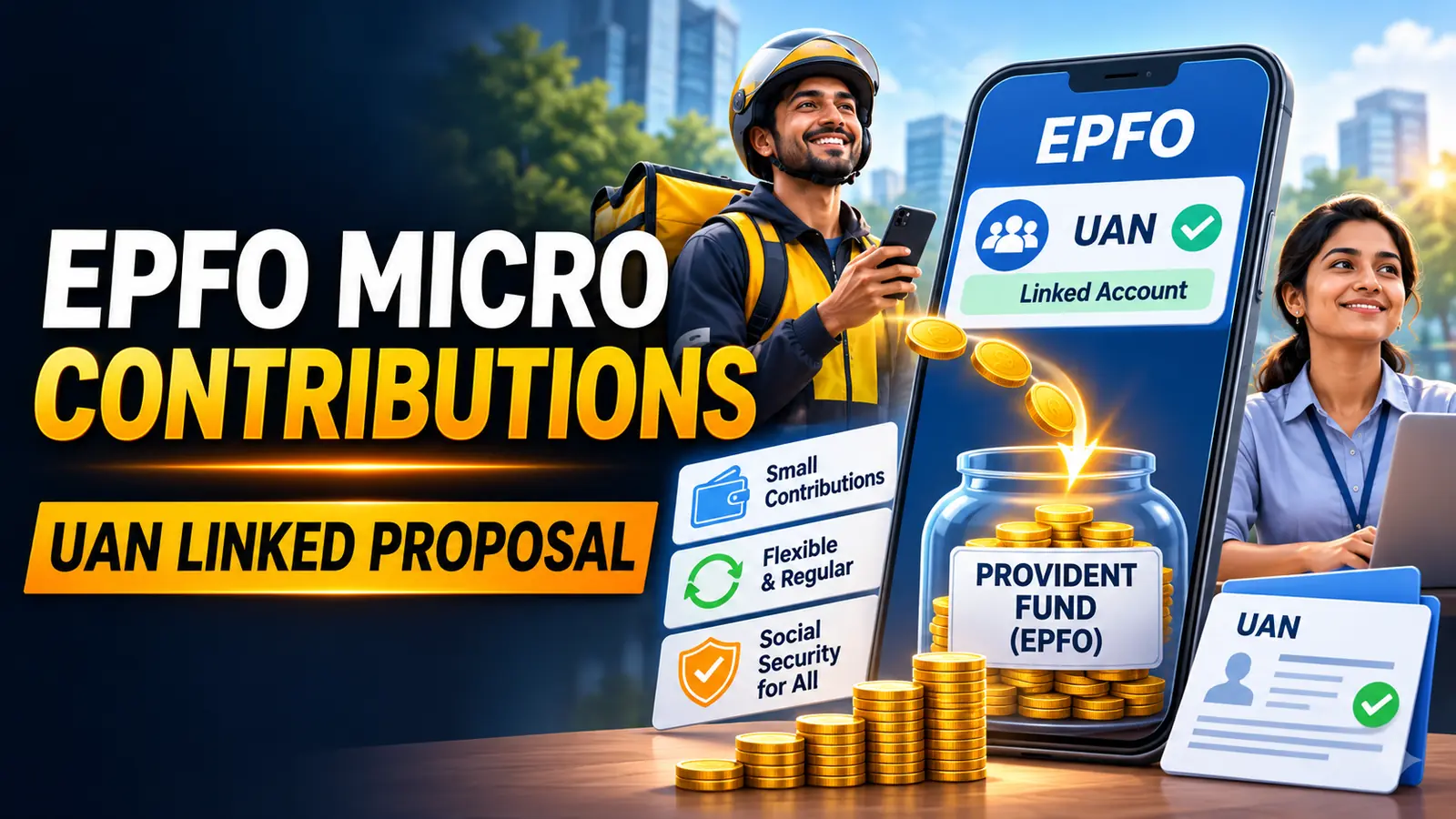
Updated: 23 November 2026. The Employees’ Provident Fund Organisation (EPFO) has outlined a proposal for UAN-linked voluntary and third-party micro-contributions that could extend retirement-saving access beyond conventional payroll deductions. The idea would allow small contributions, including potential customer tips, to flow into a worker-linked provident-fund arrangement without requiring a traditional employer payroll entry for each payment. This is important for delivery partners, platform workers, freelancers and other people with irregular earnings. But the distinction matters: a proposal discussed or approved in principle by the EPFO board is not the same as a universally available new payment feature. As of 23 November 2026, individuals should not treat this concept as an active app-based deposit service.
What EPFO announced in November 2026
A Press Information Bureau release published in November describes proposals intended to support flexible social-security arrangements, including direct voluntary contributions linked to a Universal Account Number and micro-contributions from third parties. The policy direction aims to reduce dependence on a conventional employer payroll and help people whose incomes arrive in small, uneven amounts. The same board discussion included a Systematic Withdrawal Plan for retiring EPF members. These are two different ideas: one addresses how money could enter a retirement account, while the other addresses how accumulated savings might be paid out over time. Readers should evaluate each in its own context instead of assuming the details and final rollout date are already settled.
What exactly is a UAN-linked micro-contribution?
A UAN, or Universal Account Number, connects a person’s employment-linked provident fund records across eligible establishments. Under the proposed framework, a worker might eventually receive small voluntary deposits or approved third-party payments into a retirement-savings structure using the UAN as a link. Think of a delivery partner earning varying amounts during a week: rather than waiting for a fixed salary deduction, a permissible contribution mechanism could accommodate smaller deposits. Customer tips are cited as a possible example, not a promise that every tip will automatically enter the EPF account. Product design, accounting treatment, permitted contributors, payment limits and how refunds or errors are handled still require detailed rules.
Why gig workers and platform earners could benefit
Traditional EPF coverage often assumes an employer-employee relationship, regular wages and defined payroll contributions. App-based delivery, ride-hailing and project work can involve several income sources, shorter engagements and gaps between paid assignments. A more flexible contribution route may make it easier to save when funds are available and pause when earnings are low, while retaining a link to a longer-term retirement goal. Yet access cannot be assumed solely because someone has an app account: regulators would need to define eligibility, onboarding and the relationship with existing EPF and social-security provisions. A platform worker without a UAN should not invent one or rely on an unofficial agent to create a supposedly special account.
Can customers, platforms or other parties deposit money?
The PIB description explicitly mentions third-party micro-contributions, such as customer tips, as a policy possibility. That does not establish a payment gateway, guarantee that all platforms must participate or mean that a customer can already transfer money to anyone’s EPF account using a UAN alone. Future rules would need to protect financial privacy and prevent misuse, accidental payments and transaction fraud. They could also need mechanisms for consent, attribution, transaction records and grievance handling. Workers should distinguish between a regular tip received in a bank or wallet and money recognized as a regulated provident-fund contribution. Until operating instructions and supported channels are formally released, do not share your UAN, bank details or OTP with someone claiming to offer “instant EPFO tip deposits.”
How the proposed Systematic Withdrawal Plan differs
The same EPFO board communication discusses a Systematic Withdrawal Plan, or SWP, for retiring members. Instead of taking the entire eligible accumulated balance at once, a member could potentially receive regular instalments designed to support recurring retirement income. The release says the approach could help lower reinvestment risk and maintain an income stream; it does not mean every retiree must choose instalments. Exact eligibility, payout frequency, minimum balances, tax implications, nomination rules and the ability to change the arrangement require implementation instructions. A withdrawal mechanism for mature savings is not the same as a contribution channel for a young gig worker. Readers comparing EPF withdrawal versus SWP should wait for the final official scheme document before moving money or making a retirement plan.
What is confirmed, and what remains undecided?
Confirmed at the policy-announcement level is that the EPFO board discussed or approved proposals for SWP and more flexible UAN-linked contribution approaches, as reflected in the government press release. Not yet established by that statement alone are a public launch date, deposit button, contribution ceiling, interest treatment for new payment types, KYC flow or coverage for every informal worker. It is particularly important not to confuse the word ‘approved proposal’ with ‘facility operational nationwide.’ Detailed regulations, technical integration and consumer safeguards may be needed before an individual worker can use a new service. For now, existing EPF account holders should continue following their current applicable contribution and withdrawal rules.
Practical saving steps while the proposal develops
Irregular earners can start with a basic separation of emergency cash and long-term retirement saving, even before any future micro-contribution system arrives. An emergency reserve is important because a retirement account may restrict withdrawals or be subject to eligibility conditions. Compare permitted regulated saving products based on liquidity, costs, risk and tax treatment, and avoid assuming EPF-like returns apply to a platform company’s wallet. Keep records of earnings and voluntary savings so you can evaluate affordability across low-income months. When EPFO publishes its final contribution mechanism, read who can join, what documents are needed, how funds are credited, whether deposits are reversible and how account statements display them. This article will not describe an application procedure that the authorities have not yet activated.
Frequently Asked Questions
Is EPFO micro-contribution through UAN available today?
The November announcement describes a proposal, not a confirmed nationwide public payment facility. Check EPFO instructions for an actual launch.
Can a customer tip be directly added to my PF balance now?
Do not assume so. Customer tips are an example in the policy proposal; supported channels and rules still require official implementation.
Does a gig worker need an employer to save under the plan?
The proposal aims to allow certain contributions independently of traditional employer payroll, but final eligibility and onboarding rules are not yet specified.
Is the EPFO SWP the same as micro-contributions?
No. SWP concerns periodic withdrawals from savings at retirement; micro-contributions concern adding small amounts to an account.
Where can I verify future changes?
Read official EPFO and Ministry of Labour/PIB releases. Ignore requests for OTPs or fees from unofficial facilitators.
Official sources
Official government communication: PIB EPFO board press release. Official service information: EPFO website. Updated 23 November 2026; regulatory implementation and launch details may change. This is a policy explainer, not an announcement that deposits are already enabled.




















Share Your Opinion
Comments are closed on this post.