 Vista
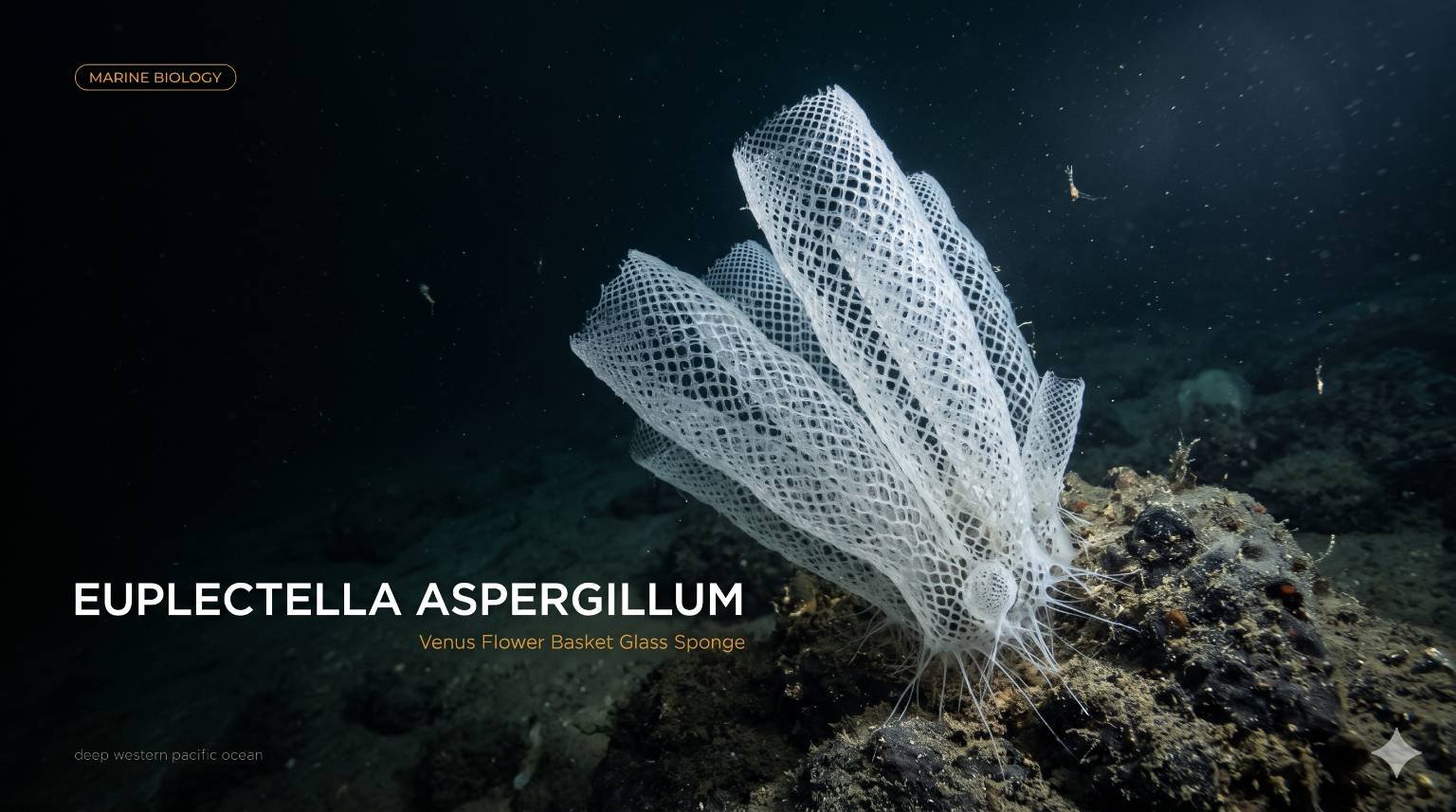
Euplectella aspergillum, also called the Venus flower basket, is a deep-sea glass sponge with an astonishing woven-looking silica skeleton. It is an animal, not a plant or an object made by a glassmaker. Its lattice structure, relationship with shrimp and lessons for structural engineering make it one of the ocean’s most visually remarkable organisms. Explore pictures, anatomy and verified science below.
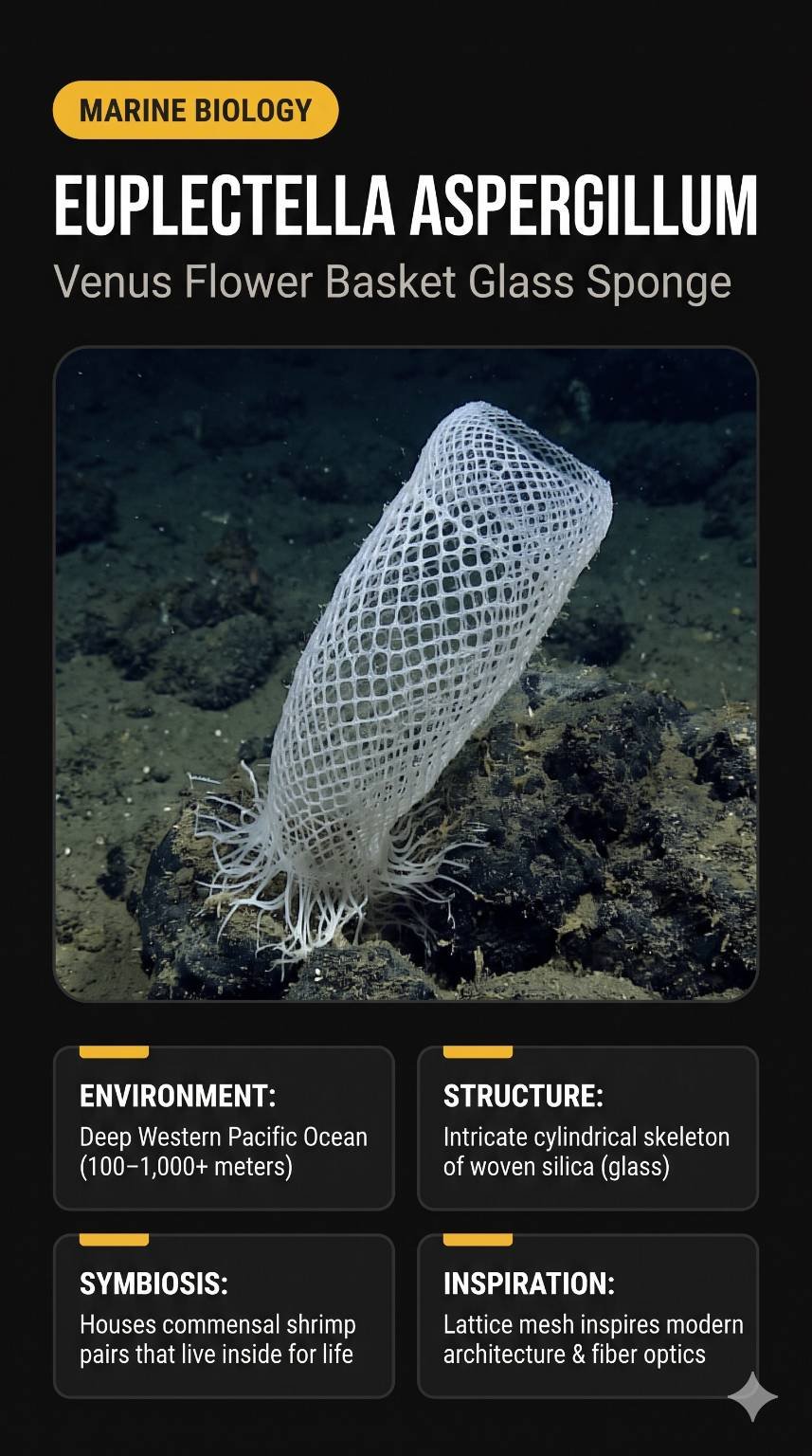
What is Euplectella aspergillum, the Venus flower basket?
Euplectella aspergillum is a deep-sea glass sponge famous for its delicate, cylindrical, basket-shaped skeleton. It belongs to the animal phylum Porifera and the class Hexactinellida, a group whose skeletal elements are made from silica. The common name Venus flower basket refers to the remarkable woven appearance of this species. A mature specimen may resemble a finely made vase or lacework tube rising from the seafloor, yet the shape is produced by a living marine animal, not by human glass blowing. The living sponge filters suspended particles and microorganisms from seawater, using currents that flow through its porous body. Its lacy skeleton provides both structural support and shelter for other small animals. People searching for Euplectella aspergillum pictures are often surprised that this apparently fragile structure can withstand deep-water conditions. Its beauty is only half the story: scientists study the arrangement of its silica fibres because the design combines lightness, geometric order and mechanical stability in ways that interest engineers.
Why is the skeleton described as glass?
Glass sponges do not manufacture window glass or spin threads exactly like a textile factory. They extract dissolved silica-related materials from seawater and form skeletal units called spicules. These spicules can be rod-like, needle-like or branching structures, and in some species they fuse into a more rigid lattice. The material is silica, chemically related to the main component of glass, which explains the common name. The Smithsonian’s specimen description explains that many spicules have four or six rays arranged roughly at right angles, giving the skeletal framework a regular geometric quality. In the Venus flower basket, the structure becomes a tube with patterned openings, reinforced by fibres crossing in different directions. An empty dried skeleton can remain visible after the sponge’s living tissues are gone, which is why museum specimens often look like white, transparent lace. The hard lattice is not a separate man-made container housing an animal; it is the support architecture produced during the sponge’s growth.
Where does the Venus flower basket live?
Euplectella aspergillum is associated with deep marine environments, and museum specimens and records of the wider glass-sponge group occur in different parts of the world’s oceans. The western Pacific is often mentioned in explanations of the Venus flower basket, but a search result describing a glass sponge from another region should not automatically be dismissed as impossible. NOAA has published an image identifying Euplectella aspergillum in the northwestern Gulf of America and explains the deep-water lifestyle of glass sponges. Environmental records depend on the exact species, specimen and locality, so avoid describing a single fixed depth as if every animal lived there. Many glass sponges inhabit cold deep seafloor habitats, sometimes anchored to sediment by long tufts of spicules. This arrangement allows a sponge to remain upright while water moves around and through its porous body. The deep sea is a range of environments rather than one uniform habitat, and some glass sponge species form reefs while others occur as individual vase-shaped animals.
How is the intricate lattice built?
The Euplectella skeleton contains a regular network of vertical and horizontal silica elements, crossed by diagonal and helical reinforcements. This geometric organisation may look like an architect’s structural drawing, yet it develops as the sponge grows. Its hierarchy is important: the smallest spicules and their layered construction contribute to fibres, which in turn form bundles and larger crossing members. The large-scale lattice distributes stresses, while reinforcing diagonal elements can help resist deformation. Recent biomaterials research has examined how this arrangement behaves under loading and how comparable principles could inform structural design. That does not mean the animal was designed for architecture or that every modern building copied it. It means researchers can study natural forms for useful mechanical ideas. A good diagram shows the cylindrical body, square lattice, diagonals and basal anchoring fibres separately. A photograph may be breathtaking but often cannot reveal the detailed relationships among these layers without annotations or magnification.
Why does the lattice resist breaking?
One of the surprising lessons from Venus flower basket studies is that delicate-looking materials may be mechanically effective because of how they are arranged. A single thin fibre can break under force, but a network can redirect loads through many connected elements. Cross-bracing helps restrict large deformations and may improve stability against particular stresses. Some glass sponge spicules also have concentric layers of silica separated by small organic regions, which researchers have investigated for their potential role in damage resistance. Mechanical performance depends on scale, fibre geometry and the surrounding seawater environment. It would be misleading to claim that every Euplectella skeleton is indestructible, bulletproof or stronger than all industrial materials. Laboratory comparisons usually test specific specimens or simplified models under selected conditions. The scientific significance is the combination of hierarchy, reinforcement and efficient material use. Those concepts are valuable in engineering education because they explain why geometry can matter as much as the raw material itself.
Why do shrimp live inside Venus flower baskets?
The sponge’s open framework allows tiny marine organisms to enter while they are small. NOAA describes a particularly memorable relationship involving two shrimp-like crustaceans of the Stenopodidea group that may live as a male and female pair inside the basket. As they grow, the animals become too large to pass back through the lattice openings and remain sheltered within the sponge. The relationship is often called symbiotic and is associated with protection and access to food. The crustaceans can contribute to cleaning the interior, while the sponge’s filter-feeding activity helps create a sheltered microhabitat. Young offspring can leave through the openings while small and seek other baskets. However, not every glass sponge necessarily contains exactly two shrimp, and biological relationships can vary by host and locality. It is therefore more accurate to say that the Venus flower basket is famous for this shrimp association rather than declare an unvarying rule for every specimen. The story illustrates how a single marine animal can provide habitat for others.
What is the relationship between sponges and water flow?
Glass sponges are filter feeders. Seawater enters through small openings, and cells within the living tissue help capture bacteria and tiny suspended food particles. Water movement also carries oxygen and helps remove waste. The shape of the skeleton can influence how current passes through and around the animal, which makes Euplectella interesting to researchers modelling fluid flow. Some studies explore whether the basket-like form interacts with vortices in ways that improve feeding conditions or mechanical stability. These are scientific questions investigated through observations and simulations; not every attractive computer flow graphic demonstrates the complete living process. The skeleton alone does not capture food—the living sponge performs that biological function. An educational chart should therefore show water movement, the living filtering surface and the surrounding skeletal lattice as related but distinct components. A dried museum skeleton can be visually spectacular yet has lost the tissues responsible for feeding and growth.
Does Venus flower basket inspire architecture and optical technology?
Scientists study Euplectella’s silica structure for lessons in architecture, lightweight frameworks, fibre design and biomimicry. Biomimicry is the practice of learning functional principles from organisms and adapting them to human challenges. The sponge’s layered fibres and crossing lattice are especially relevant to questions about stiffness, resistance to cracking and efficient bracing. Researchers also investigate optical properties of certain glass-sponge spicules, because some silica fibres can transmit or guide light under particular circumstances. This does not prove that today’s commercial fibre-optic internet was invented by copying Euplectella, and the popular “nature created broadband cables” headline is an overstatement. The useful comparison is between natural silica structures and engineered systems, not a direct claim that one is a finished blueprint for the other. Engineers must still account for manufacturing, material purity, safety and loads in their own designs. A truthful article highlights the inspiration while acknowledging those practical and scientific differences.
Euplectella aspergillum pictures: how to identify the structure
The most useful picture shows a tall, narrow, tubular, white lattice that resembles a woven basket or a hollow vase. Near the bottom, long hair-like fibres may anchor it into the sediment, while the upper opening is part of its water circulation anatomy. The characteristic repeated lattice pattern is clearer in a high-resolution side view than in a distant seafloor photograph. A close-up of the skeletal fibres helps show that each strand is not simply a piece of textile. In image-search results, some objects labelled “Venus flower basket” are dried skeletons displayed in museums; others show living specimens with tissue still present in their deep-sea habitat. A poster can combine these views as an educational overview, but readers should not assume every elegant basket-shaped sponge in a picture is scientifically verified as E. aspergillum. The taxonomic name, locality, museum caption and specimen data are needed for a confident identification. Good ALT text describes the structure being illustrated, not an unverified claim about depth or location.
What does modern research still seek to understand?
Despite decades of study, several questions remain open about how the Venus flower basket develops its structure and how different parts contribute to performance. Research published in 2025 examined its microstructural hierarchy and possible biomimetic applications, while a 2026 study explored functional reasons behind the sequence in which its larger skeleton forms. Biologists and engineers want to understand how growth, mechanical forces and water flow interact throughout the sponge’s life. Such studies are more specific than the vague claim that scientists have discovered an unbreakable natural glass. The species also invites ecological questions: how populations are distributed, what organisms use the interior as shelter and how deep-sea environmental change affects filter feeders. Because many habitats are difficult to observe directly, museum records and carefully documented remotely operated vehicle images remain valuable. A useful picture-led article connects the organism’s beauty to these real questions while treating ongoing hypotheses as research, not already-settled fact.
Euplectella aspergillum FAQ
Is Venus flower basket actually a plant?
No. Euplectella aspergillum is a marine sponge, an animal in the phylum Porifera.
What is its skeleton made of?
Silica spicules organised into a delicate, reinforced lattice.
Where is the Venus flower basket found?
It is associated with deep-water ocean habitats; location claims should be tied to verified specimens and scientific records.
Do shrimp always live inside the sponge?
The species is famous for hosting small shrimp-like crustaceans, sometimes a pair, but not every specimen has identical occupants.
Why do engineers study it?
Its hierarchical silica fibres and crossing lattice offer lessons in mechanical stability and material-efficient design.
Did the sponge invent modern internet fibre optics?
No. Optical properties of some silica spicules are studied, but a direct invention claim would be misleading.
Conclusion and verified research sources
The Venus flower basket proves that a seemingly fragile skeleton can embody sophisticated natural architecture. The most reliable explanations connect its visible silica lattice to biological growth, filter feeding and ecological partnerships without overselling engineering claims. Updated: 23 November 2026.
References: NOAA Ocean Service — What is a glass sponge?; Smithsonian — Venus Flower Basket (Euplectella aspergillum); Microstructural hierarchy and biomimetic applications study; 2026 study of developmental sequence of the macrostructure.
Related science reading
- Indian Bramble Shark (Echinorhinus roinee): New Kerala Deep-Sea Species, Photos & Facts
- India Deep Ocean Mission Discoveries 2026: New Sharks, MATSYA-6000 & 2028 Dive Target
















Share Your Opinion
Comments are closed on this post.